
Why Most Hypertrophy Programs Fail After 6 Weeks
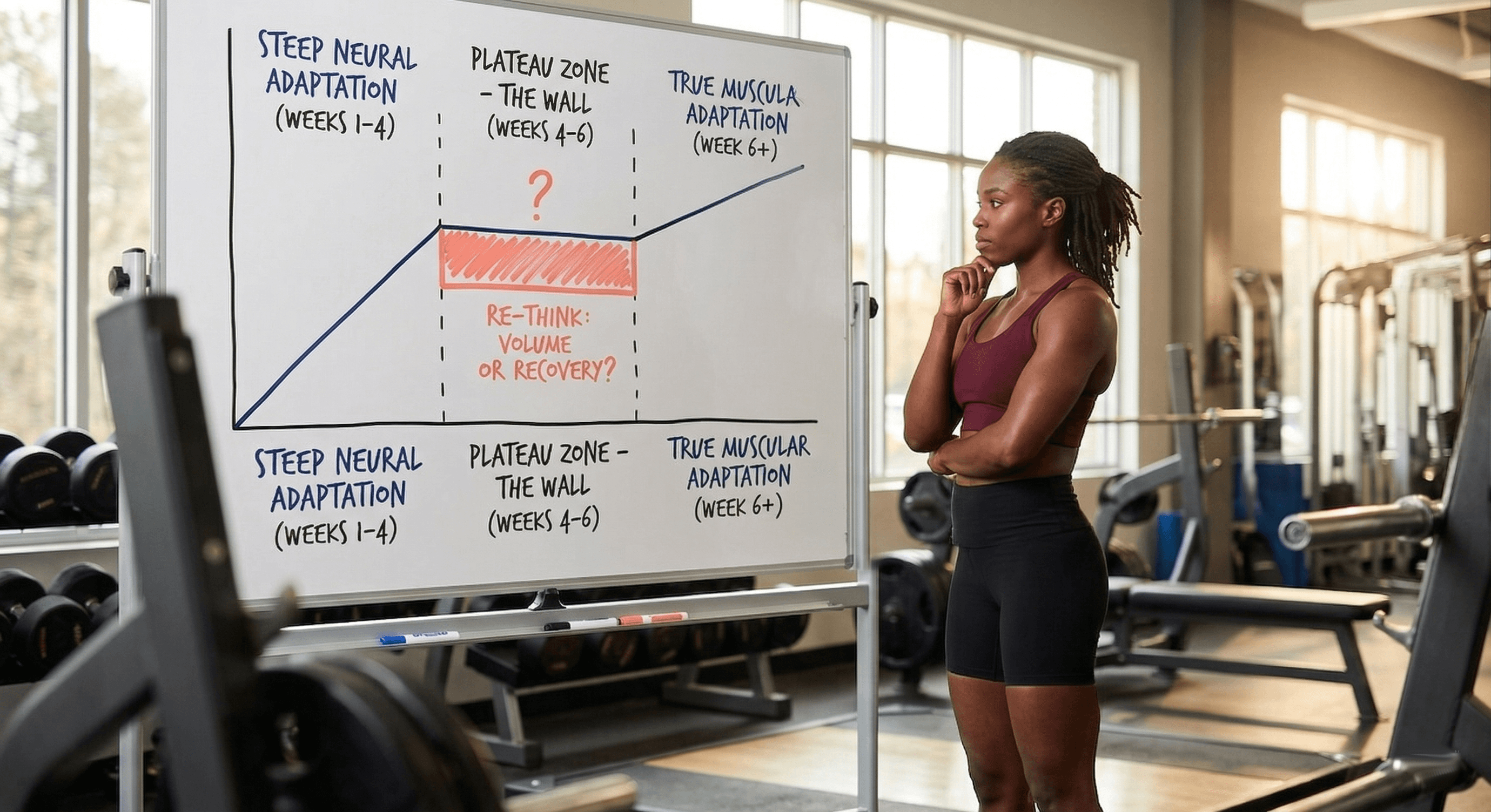
The first four weeks felt like everything was working. Weights went up every session. Muscles felt fuller, harder, more responsive to training. Your clients were texting you after sessions, thanking you for "finally finding the right program." Or maybe you were the one training, watching the bar get heavier week after week, convinced you had cracked the code.
Then week six hit, and everything stopped.
The weights that moved last Tuesday would not budge. The pump that used to last an hour faded by the time you left the gym. Progress photos looked identical to the ones from two weeks ago. And the question started forming — the same question that derails more hypertrophy clients than bad nutrition or missed sessions combined: Is this program still working?
This is not random. It is not bad luck. And it is not because the exercises were wrong. Why hypertrophy programs fail at the 6-week mark has a specific, research-backed biological explanation — and understanding it changes how you design, coach, and evaluate every muscle-building program you write.
According to the Les Mills 2026 Global Fitness Report, 30% of gym-goers have already hit training plateaus, while 58% report feeling confused by conflicting advice about what to do next. The ACSM 2026 Resistance Training Position Stand — the first comprehensive update in 17 years, drawing from 137 systematic reviews and over 30,000 participants — confirms that total weekly training volume is the primary driver of muscle growth. But understanding that volume matters is not the same as understanding why the volume that worked in week three stops producing results by week six.
Your hypertrophy program did not fail because of bad exercises or weak discipline. It failed because of a predictable biological transition that most programs — and most trainers — do not account for.
If you manage 20 or more clients, you have seen this pattern in nearly all of them. The enthusiasm of weeks one through four. The stall at week five or six. The request to "switch things up." If you have lived through the 6-week wall yourself, you know the frustration of watching progress evaporate despite doing everything right.
We previously argued that the program is not the problem — the system is. That remains true at the macro level. But hypertrophy has a specific failure mode that even the best system cannot override without understanding the biology. This article is about that biology.
Audit Your Hypertrophy Program Before Week 6 Hits. Get the Free Checklist.
The 6-Week Wall Is Not a Plateau — It Is a Transition
The 6-week wall is the convergence point where neural adaptation gains have peaked and muscular hypertrophy has not yet produced visible or measurable results. It is not a plateau in the traditional sense — progress has not stopped. The mechanism of progress has shifted, and the program has not shifted with it.
Here is what actually happens inside the body during the first six weeks of a hypertrophy program.
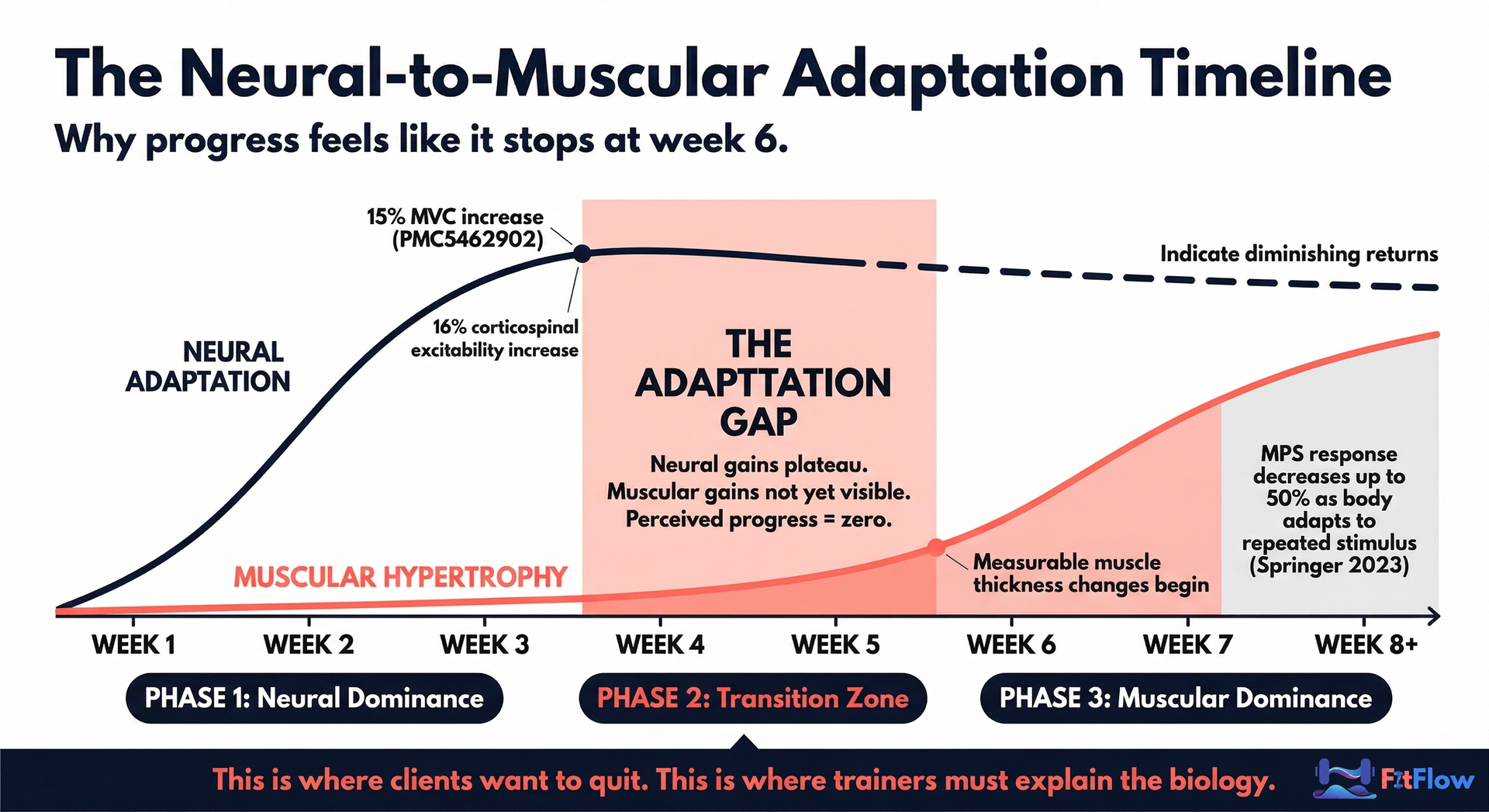
For the first four weeks, the majority of performance gains come from neural adaptations — your nervous system learning to recruit more motor units, synchronize muscle fiber firing, and reduce co-contraction of opposing muscle groups. Research published in the European Journal of Applied Physiology (PMC5462902) found that after four weeks of resistance training, subjects demonstrated a 15% boost in maximal voluntary contraction and a 16% increase in corticospinal excitability. These are significant, measurable improvements. They are also almost entirely neurological.
The critical finding: measurable changes in muscle thickness and pennation angle — the structural adaptations that constitute actual hypertrophy — did not appear until after six weeks of consistent training.
This creates what we call the adaptation gap: a window between the neural ceiling (when nervous system improvements plateau) and the visible muscular response (when structural changes become measurable). During this gap, the client's perception is that progress has stopped. In reality, the mechanism of progress is transitioning from one system to another. The nervous system has done its part. The muscular system has not yet caught up.
The ACSM 2026 guidelines support this framework. By confirming that a minimum of 10 or more sets per muscle group per week drives hypertrophy across a broad loading spectrum, the guidelines implicitly acknowledge that the stimulus must evolve as the body's adaptation mechanism shifts. What drove progress in weeks one through four — neural efficiency gains that made the same weight feel lighter — is no longer the active growth driver by week six.
What the Research Actually Shows
The timeline of adaptation follows a predictable sequence:
Weeks 1-4 (Neural Dominance): Performance improves rapidly. Weights increase session to session. The lifter or client feels noticeably stronger. This is primarily the nervous system becoming more efficient at producing force — not the muscles getting bigger.
Weeks 4-6 (Transition Zone): Neural adaptations approach their ceiling. Performance gains slow or flatten. The client perceives stagnation. Meanwhile, muscle protein synthesis is actively occurring, but the structural changes have not yet reached the threshold of visible or measurable difference.
Weeks 6+ (Muscular Adaptation Dominance): If the program has been appropriately designed with progressive volume and adequate recovery, structural hypertrophy begins to become measurable. Muscle cross-sectional area increases. Pennation angles change. This is when "real" hypertrophy — the kind you can see and measure — starts to accumulate.
A 2025 meta-analysis published in Nature examining neuromuscular adaptations in both elite and recreational athletes confirmed this phased response, noting that the neural-to-muscular transition timeline varies by training status but consistently manifests within the four-to-eight-week window. The Springer 2023 review on plateau mechanisms in muscle growth added a critical detail: muscle protein synthesis response to a given stimulus can decrease by up to 50% as the body adapts to a repeated stimulus — meaning the exact training protocol that drove growth in weeks two and three produces a measurably diminished response by weeks five and six.
The 6-week wall is not a sign that the program failed. It is a sign that the body's adaptation machinery is switching gears. And most programs — whether written by trainers, downloaded from the internet, or generated by AI — do not account for this transition.
Three Reasons Your Hypertrophy Program Breaks at the 6-Week Mark
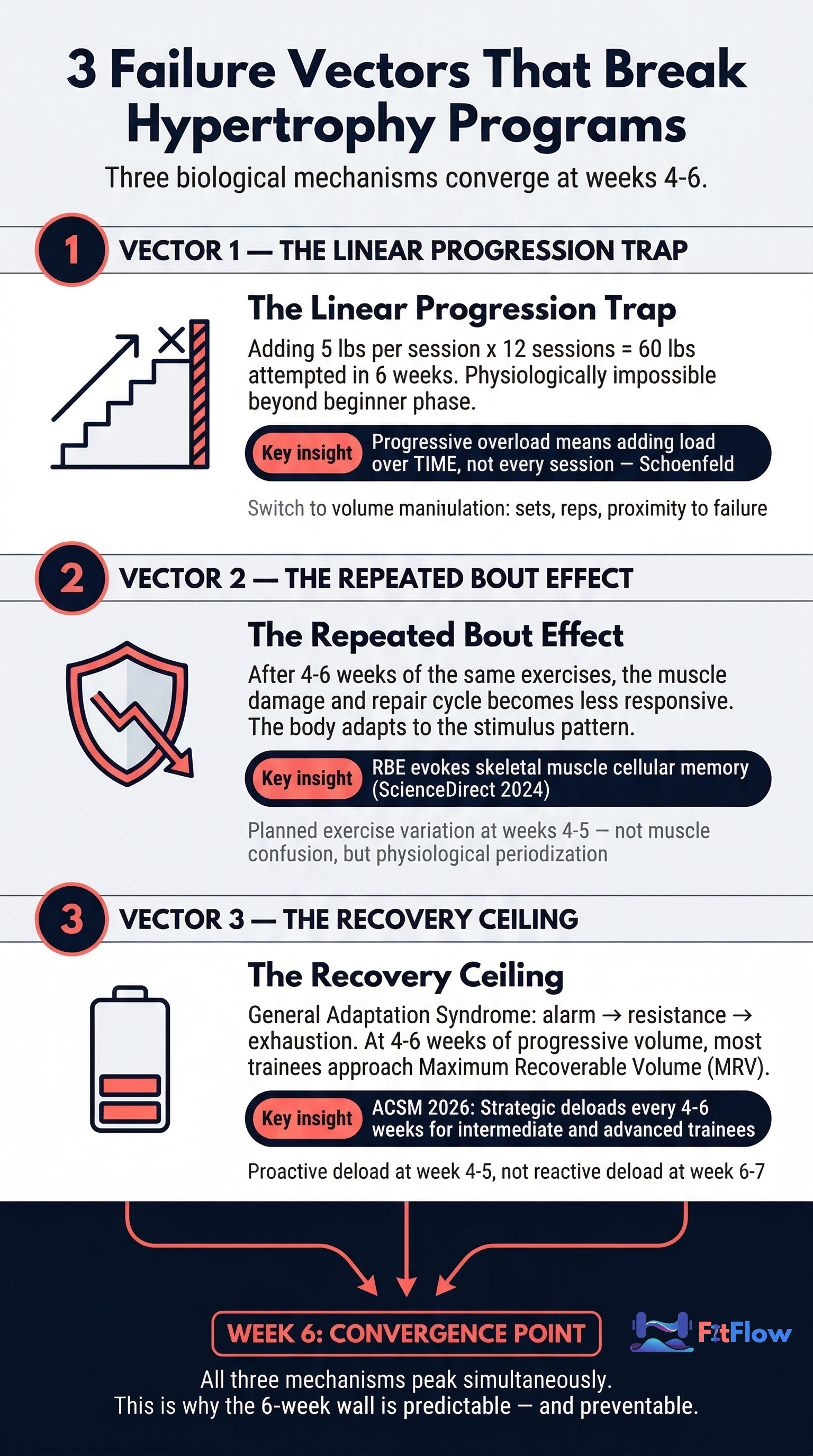
The 6-week failure is not caused by a single mistake. It is the convergence of three distinct physiological mechanisms — failure vectors — that independently approach their breaking points within the same four-to-six-week window. Understanding each one is the difference between diagnosing the problem and guessing at it.
Failure Vector 1: The Linear Progression Trap
Most hypertrophy programs are built on a simple premise: add weight to the bar every session. This is progressive overload in its most basic form, and it works — for a while.
Here is the math. If a client trains twice per week and adds 5 pounds per session, they have attempted to add 60 pounds to their working weight over 12 sessions (six weeks). For a compound lift like the bench press or squat, this is physiologically achievable during the beginner phase, when neural adaptations are driving rapid strength gains. For intermediate and advanced lifters — which most hypertrophy-focused clients become within their first training year — adding 60 pounds in six weeks to any movement is a biological impossibility.
The progression model breaks before the program does.
This is not a controversial observation. NASM's progressive overload guidelines explicitly state that "progressive overload does not mean adding load to the bar every session." Brad Schoenfeld, one of the most cited hypertrophy researchers working today, has stated on X/Twitter that "progressive overload means adding load over time, not every session." Yet the majority of programs distributed through apps, social media, and even personal training certifications default to session-to-session load progression as the primary — sometimes only — overload mechanism.
When load progression stalls, the overload strategy must shift. Volume manipulation — adjusting sets, reps, or proximity to failure — takes over as the primary growth driver. But this switch requires deliberate programming. It requires understanding that the client is no longer in the neural-dominant phase where adding weight was easy. Most programs do not make this switch because they were not designed for the transition. They were designed for the start.
For trainers managing multiple clients on hypertrophy blocks, this failure vector multiplies. If 15 of your 30 hypertrophy clients started their programs within the same two-week window, all 15 will hit the linear progression ceiling in the same month. Without proactive volume manipulation strategies, you are troubleshooting 15 identical problems reactively rather than programming around them proactively.
Failure Vector 2: The Repeated Bout Effect
The Repeated Bout Effect is the body's protective mechanism that reduces the damage response to familiar stimuli. After four to six weeks of performing the same exercises, the muscle damage and repair cycle — one of the drivers of hypertrophy — becomes progressively less responsive to the same movement patterns.
A 2024 study published in ScienceDirect demonstrated that the repeated bout effect evokes a form of skeletal muscle cellular memory, effectively "teaching" the muscle to resist the same stimulus more efficiently over time. From a survival perspective, this is elegant. From a hypertrophy perspective, it means the exercises that produced meaningful mechanical tension and metabolic stress in week two are producing a measurably diminished adaptive response by week six.
This does not mean you need to change exercises every week. The "muscle confusion" approach — randomly rotating exercises to keep the body guessing — has been thoroughly debunked as a training philosophy. Consistency in movement patterns matters for skill acquisition, motor learning, and progressive loading.
What it does mean is that stimulus variation within a consistent framework is physiologically necessary at the four-to-six-week mark. Rotating exercise variants (incline to flat, barbell to dumbbell), shifting rep ranges (from the 8-12 range to 6-8 or 12-15), or modifying tempo and range of motion can reintroduce a novel stimulus without abandoning the program's architecture.
For a complete framework on how periodized exercise rotation fits within evidence-based programming, see our evidence-based program design guide, which covers the full periodization taxonomy. The point here is narrower: the Repeated Bout Effect is a specific mechanism that converges at the same four-to-six-week window as the neural adaptation plateau, compounding the perception that the program has stopped working.
Failure Vector 3: The Recovery Ceiling
General Adaptation Syndrome (GAS), first described by Hans Selye and later adapted for exercise science, describes the body's three-phase response to training stress: the alarm phase (initial stress response), the resistance phase (adaptation to the stimulus), and the exhaustion phase (accumulated fatigue exceeding recovery capacity).
At four to six weeks of progressively increasing training volume, most intermediate and advanced trainees approach or exceed their Maximum Recoverable Volume — the upper limit of training stress from which the body can recover within a given timeframe. This is not a discipline failure. It is a predictable physiological response to cumulative training stress.
The signs are consistent: sleep quality declines despite no lifestyle changes. Resting heart rate elevates slightly. Motivation drops. Joints ache in ways that were not present at week two. Performance does not just plateau — it begins to regress. The client who was adding reps at week three is now losing them at week six.
The ACSM 2026 guidelines recommend planned deload periods for intermediate and advanced trainees, aligning with the RP Strength volume landmark framework that recommends starting mesocycles at Minimum Effective Volume, ramping through Maximum Adaptive Volume over four to five weeks, approaching Maximum Recoverable Volume at weeks five to six, and then resetting with a deload at maintenance volume.
The exhaustion phase is not optional. It is programmed into human physiology. The only variable is whether the deload happens proactively — before performance declines — or reactively, after the client has already lost one to two weeks of productive training to accumulated fatigue.
This failure vector is especially relevant given the rise of wearable fitness technology. According to industry data, wearable integration now exceeds 55% in fitness studios, giving both trainers and clients access to recovery markers like HRV, resting heart rate, and sleep quality scores. The data is available. The question is whether the program was designed to respond to it.
How Many of Those Failure Vectors Apply to Your Program? Score It Now. Download the Audit Checklist.
The Program Hopping Trap — Why Week 6 Is When Clients Want to Quit
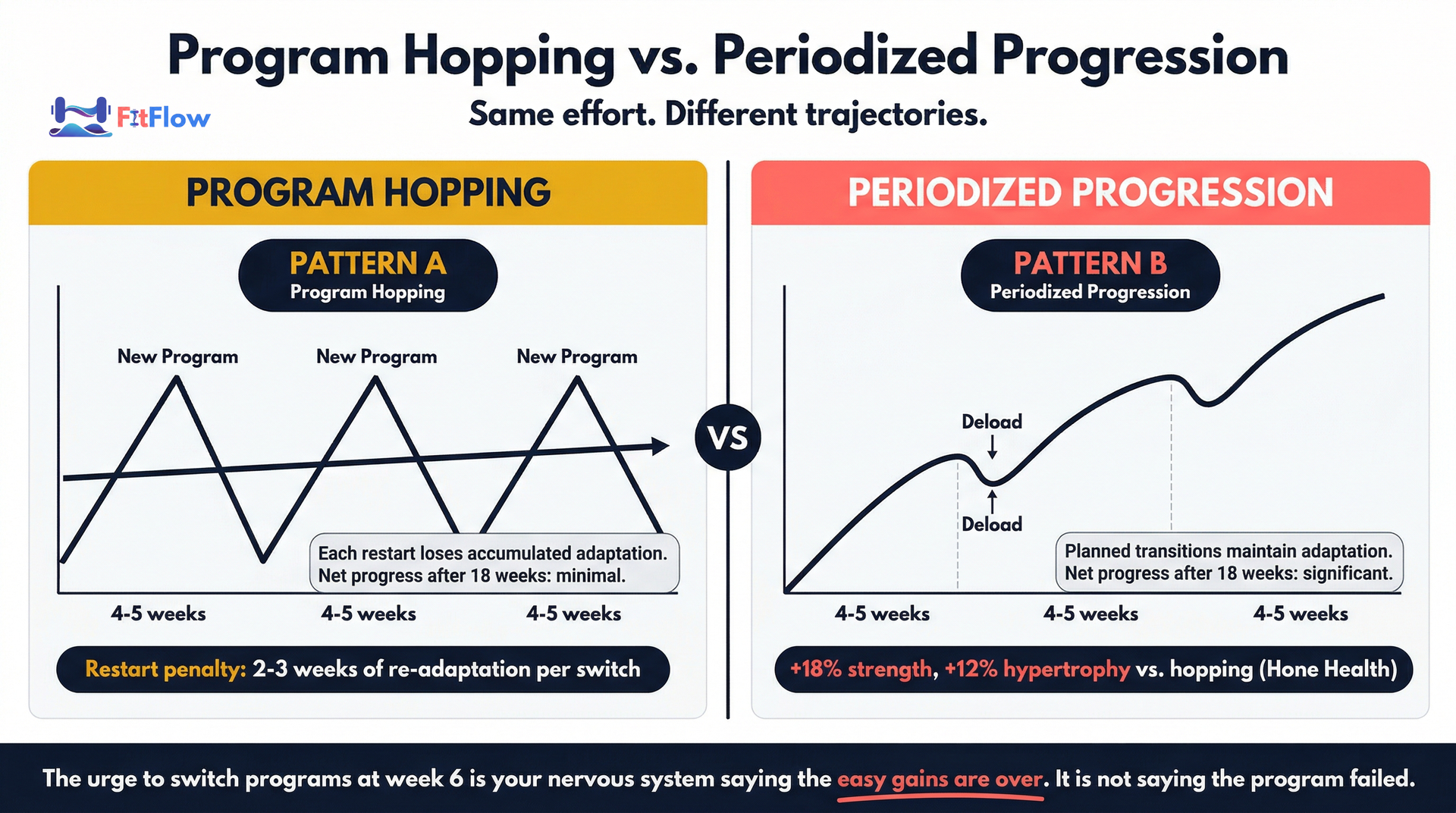
The three failure vectors above converge at the same point: weeks four through six. Load progression stalls. The repeated bout effect diminishes the stimulus response. Recovery debt accumulates. And the client — who felt like a different person at week three — now feels like they are spinning their wheels.
This is the exact moment when clients ask to "switch things up."
Program hopping — abandoning a training block in favor of something new — is one of the most discussed problems in the training industry. ACE Fitness has identified it as among the most common training mistakes. But the conventional framing treats program hopping as a discipline problem: clients lack patience, they chase novelty, they need to be coached on commitment.
That framing is incomplete. Program hopping at the 6-week mark is a rational response to a perceptual gap. The client is not being impatient — they are responding to real signals: performance has stalled, the exercises feel stale, recovery is compromised. They just do not have the physiological framework to understand that these signals indicate a transition, not a failure.
The data supports the case for staying the course — with modifications. Research compiled by Hone Health found that trainees who maintained single-program consistency demonstrated 18% greater strength gains and 12% more hypertrophy compared to those who switched programs every three to four weeks. But the solution is not "just be more disciplined." The solution is understanding the biology and programming around it.
For trainers: your clients are not lazy or impatient. They are experiencing a predictable biological event. Your job is to explain it and program around it. When a client says "this isn't working anymore" at week five, the correct response is not "trust the process" — it is "here is exactly what is happening in your body right now, and here is how the program adjusts for it."
For self-directed lifters: the urge to switch programs at week six is your nervous system telling you the easy gains are over. It is not telling you the program failed. The neural adaptations that made everything feel effortless for four weeks have peaked. The slower, harder muscular adaptations are just beginning. Abandoning the program now means restarting the neural adaptation phase with a new program — and hitting the same wall six weeks later.
What Evidence-Based Trainers Do Differently
Understanding why hypertrophy programs break at the 6-week mark is the diagnosis. What follows is the treatment. These are not generic tips. They are specific responses to the three failure vectors described above.
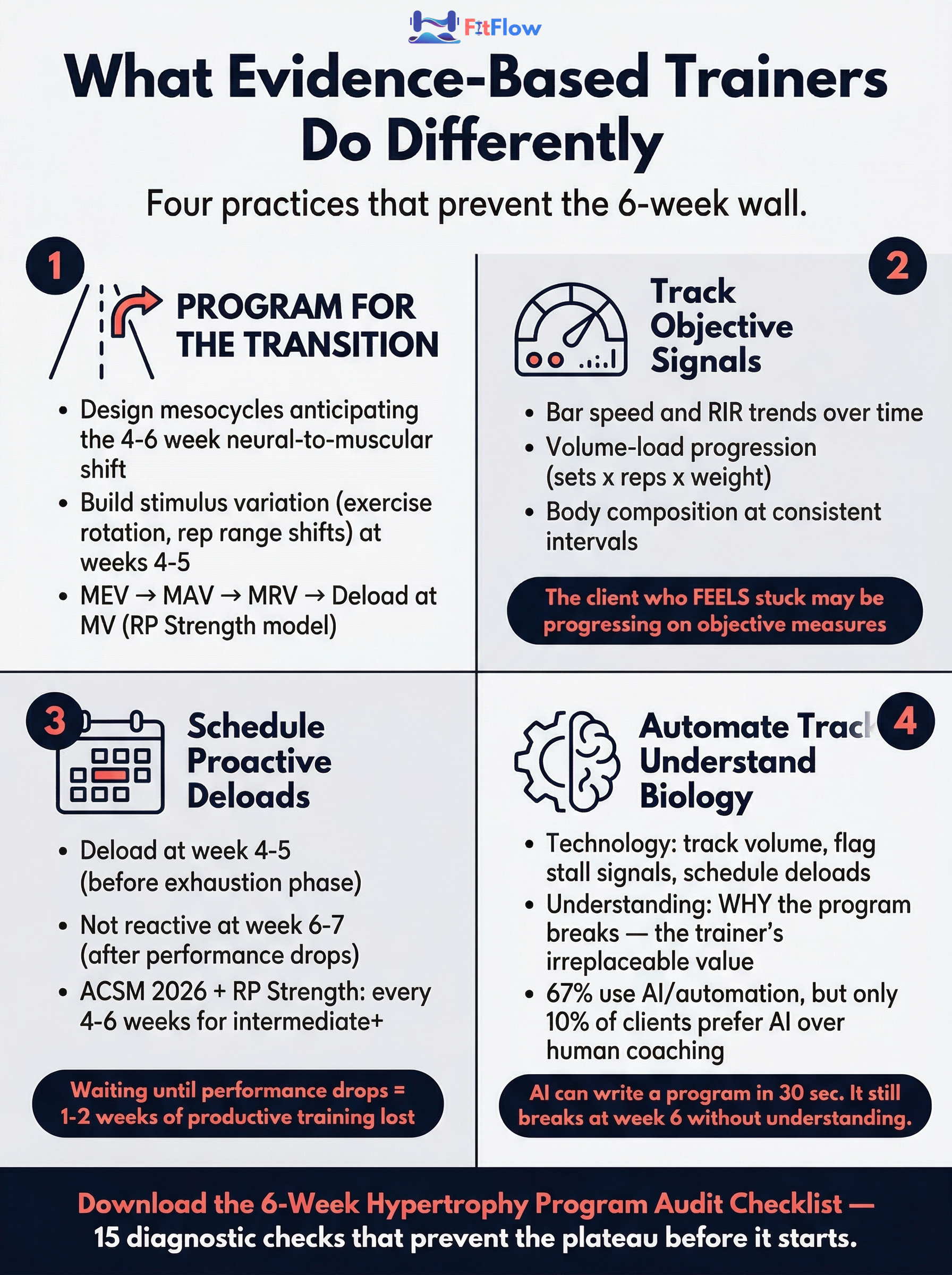
Program for the Transition, Not Just the Start
The most common programming mistake is designing mesocycles that optimize for the first three weeks and ignore the transition that follows.
Evidence-based trainers design for the neural-to-muscular shift from the outset. They build in planned stimulus variation at weeks four to five — not because the program "needs a change," but because the physiological response to the original stimulus has measurably diminished. Exercise variants rotate on a predetermined schedule. Rep range shifts are programmed, not improvised. The mesocycle architecture follows a structured progression: start at Minimum Effective Volume, ramp through Maximum Adaptive Volume over four to five weeks, approach Maximum Recoverable Volume at weeks five to six, and reset with a planned deload.
This is not complicated programming. It is anticipatory programming. The transition is predictable. The program should be designed for it.
Use Objective Adaptation Signals, Not Subjective Feel
The adaptation gap creates a perception problem: the client feels stuck, but may be progressing on objective measures. Conversely, a client whose objective measures have genuinely flatlined needs a different intervention than one who is merely perceiving a plateau.
Track bar speed and rate of perceived exertion trends across sessions. Track volume-load progression — total sets multiplied by reps multiplied by weight — across weeks, not just sessions. Take body composition measurements at consistent intervals with standardized conditions. Log reps in reserve consistently to detect shifts in effort-to-output ratio.
The client who "feels" stuck but whose volume-load has increased 8% over four weeks needs reassurance and education, not a program rewrite. The client whose volume-load has been flat for three consecutive weeks despite increasing effort needs a genuine programming adjustment.
For a structured approach to monitoring these signals across multiple clients, see our guide on building a client progress tracker dashboard. The point is not which tool you use. The point is that subjective feel during the adaptation gap is an unreliable indicator of actual progress.
Schedule the Deload Before Your Client Needs It
If you wait until performance drops to schedule a deload, you have already lost one to two weeks of productive training to accumulated fatigue.
Proactive deloading — scheduling a reduced-volume week at weeks four to five before the exhaustion phase manifests — is fundamentally different from reactive deloading at weeks six to seven after performance has already declined. Both the ACSM 2026 guidelines and the RP Strength mesocycle framework recommend deload frequency of every four to six weeks for intermediate and advanced trainees.
The proactive deload is not a break. It is a programmed reset that allows the resistance phase of General Adaptation Syndrome to restart at a higher baseline. The client who deloads at week five comes back at week six with restored recovery capacity and a fresh stimulus response. The client who pushes through fatigue at week five arrives at week seven overtrained, demotivated, and asking to switch programs.
For trainers managing 20 or more hypertrophy clients, proactive deloading is also a scheduling and communication challenge. The deload needs to be explained in advance — "this is part of the design, not a step backward" — and ideally tracked through your coaching system so it is not missed during a busy week.
Automate What You Can, Understand What You Cannot
Technology can track volume across sessions, flag adaptation stall signals when volume-load progression flattens, remind trainers to schedule deloads, and deliver check-in communications that keep clients engaged during the adaptation gap. According to the Trainerize 2026 State of Personal Training report, 67% of trainers now report using AI or automation as part of their coaching workflow.
Technology cannot replace the understanding of why the program breaks. It cannot explain to a frustrated client that their body is transitioning from one adaptation mechanism to another. It cannot make the judgment call about whether a particular client needs a stimulus variation, a deload, or simply reassurance backed by objective data. That is the trainer's irreplaceable value.
The Les Mills 2026 report found that only 10% of clients prefer AI-driven coaching over human trainers. The other 90% want a person who understands both the science and them. For a deeper look at which tools support this kind of coaching, see our fitness tech stack guide.
Here is the uncomfortable truth about AI-generated programming: AI can write a periodized hypertrophy program in 30 seconds. The program still breaks at week six if neither the AI nor the trainer understands the neural-to-muscular transition. The technology is a tool. The understanding is the skill.
The 6-Week Wall Is Biology. Your Response Is Programming. Get the Free Audit Checklist.
The Bottom Line
The 6-week hypertrophy plateau is not a programming failure. It is a biological transition — the predictable convergence of three mechanisms: the linear progression trap (load-based overload hitting its mathematical ceiling), the repeated bout effect (diminished stimulus response from exercise familiarity), and the recovery ceiling (cumulative fatigue exceeding recovery capacity).
Each mechanism has a specific response. Load progression stalls require a shift to volume-based overload strategies. The repeated bout effect requires planned stimulus variation within a consistent program framework. Recovery debt requires proactive deloading before the exhaustion phase manifests.
Together, these three vectors create the adaptation gap — the window where the nervous system has finished its work and the muscular system has not yet shown its. This is the window where clients want to quit, trainers want to rewrite, and programs get blamed for a problem that was never about the program.
For trainers managing hypertrophy clients: understanding the biology of the 6-week wall is not optional knowledge. It is the difference between a client who stays because you explained what was happening and programmed around it, and a client who program-hops to another trainer because nobody told them the stall was temporary.
For self-directed lifters: the next time your program feels like it stopped working at week six, remember — you are not failing. Your body is transitioning. The question is whether your program transitions with it.
For the complete program design framework that builds these principles into a scalable system, see our evidence-based program design guide. For the systems-level perspective on why great programming still fails without the right infrastructure around it, see why the program is not the problem — the system is.