
Your Training Program Is Not the Problem. Your System Is.
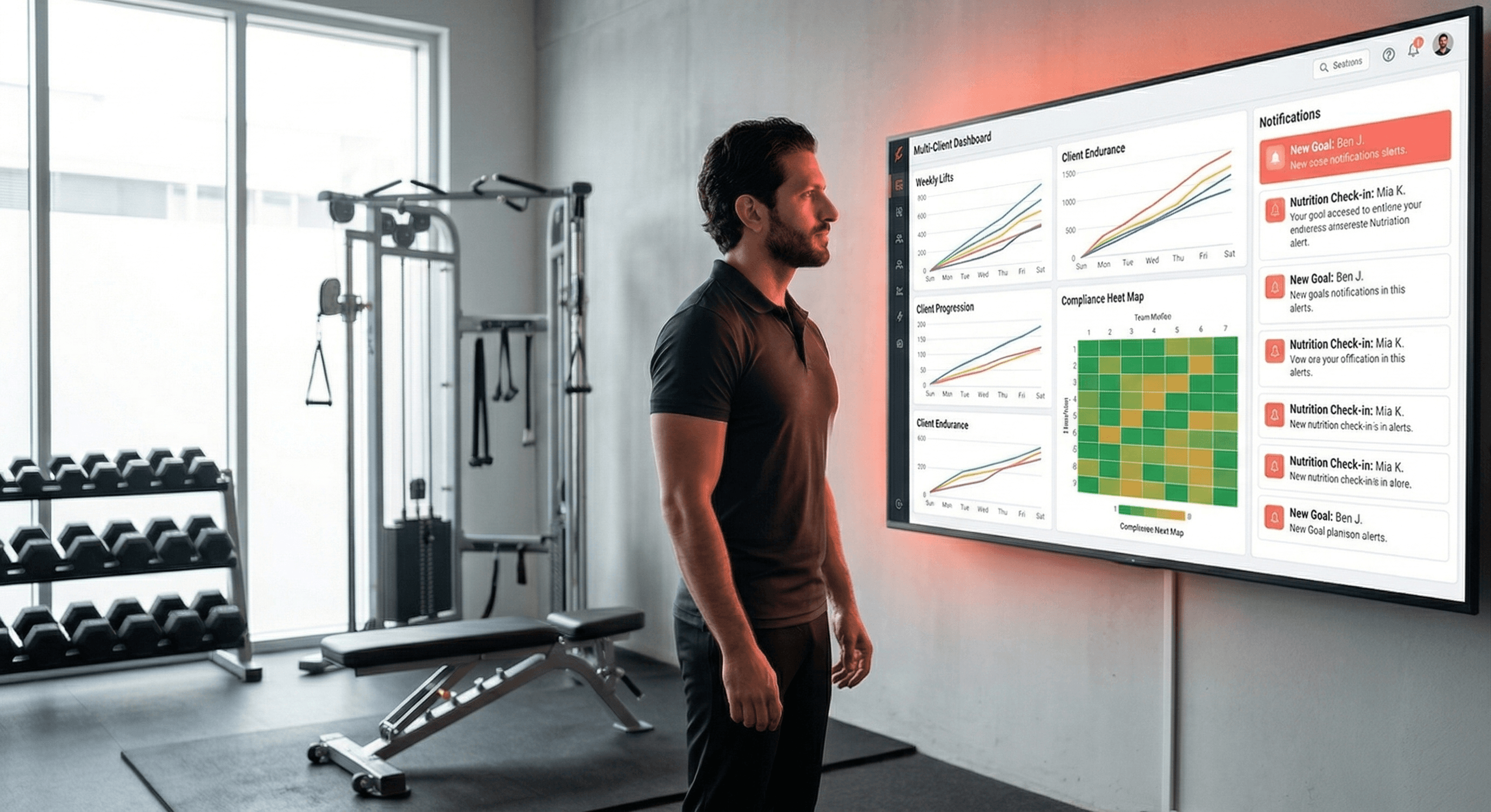
Is Your System the Bottleneck? Find Out in 5 Minutes. Get the Free Checklist.
You spent four hours last Sunday building a program. Proper periodization. Progressive overload baked into every block. Undulating rep schemes, intelligently sequenced accessories, a deload programmed at week seven. By any reasonable standard, it was a good program.
Three weeks later, your client has logged 60% of the prescribed sessions. She skipped the deload because she "felt fine." She's asking about a program she saw on Instagram. And you're sitting at your desk wondering if you need to rewrite the whole thing.
You don't.
The program was never the problem. Your personal training system was.
Here's what most coaches get wrong: they treat stalled clients as a programming failure. The reflex is to redesign -- swap exercises, change rep ranges, bolt on a new periodization model. But the evidence points somewhere else entirely. The average personal trainer retains only 70-75% of clients monthly, and the primary reason clients leave is "not seeing results fast enough" -- accounting for roughly 30% of all departures (Arvo, 2026). These clients aren't leaving because of bad programming. They're leaving because no personal training system existed to make the program visible, trackable, and adjustable in real time.
This article introduces a diagnostic framework -- the 6-Layer System Stack -- that separates the program (what to do) from the system (how it gets executed, tracked, adjusted, and communicated). If you manage 20 or more clients, at least three of the failures described here will sound familiar. That's not an insult. It's a diagnosis.
The "Program Hopping" Epidemic Is a Personal Training System Failure
Program hopping -- clients abandoning a training block every two to four weeks in favor of something newer, shinier, or more Instagram-friendly -- ranks among the most common frustrations in coaching. The conventional wisdom from organizations like ACE Fitness and the NSCA is straightforward: clients need a minimum of 12 weeks of consistent stimulus for meaningful physiological adaptation. The SAID principle demands sustained, specific stress over six to twelve weeks for measurable results.
That advice is correct. It's also incomplete.
Program hopping is not a discipline problem. It's a visibility problem. Clients switch programs when they have no evidence that the current one is working. Think about it from their perspective: they show up, they lift, they leave. Nobody shows them that their squat volume increased 14% over the last four weeks. Nobody flags that their bench press is three reps away from a progression threshold. Nobody sends them a weekly check-in that says "here's what the data shows -- you're on track."
Without a tracking system, the client is training blind. Without a communication cadence, they have no accountability structure. Without progression data, the trainer has no evidence to say "trust the process -- and here's proof."
Research backs this up: clients who systematically track their progress maintain better consistency and reach their goals faster, a finding supported by data from multiple coaching platforms including Trainerize's analysis of platform-wide behavior patterns. Software-enabled personalization alone increases session adherence by 38% (Trainerize, 2026).
If you've ever told a client "just trust the process" without showing them data, you don't have a discipline problem. You have a personal training system problem.
Program hopping is a symptom. The disease is an invisible program running inside no system.
What a "Personal Training System" Actually Means
Most trainers have a program. Almost none have a system.
A program tells the client what to do. A personal training system ensures they do it, tracks whether they did, and adjusts when they don't.
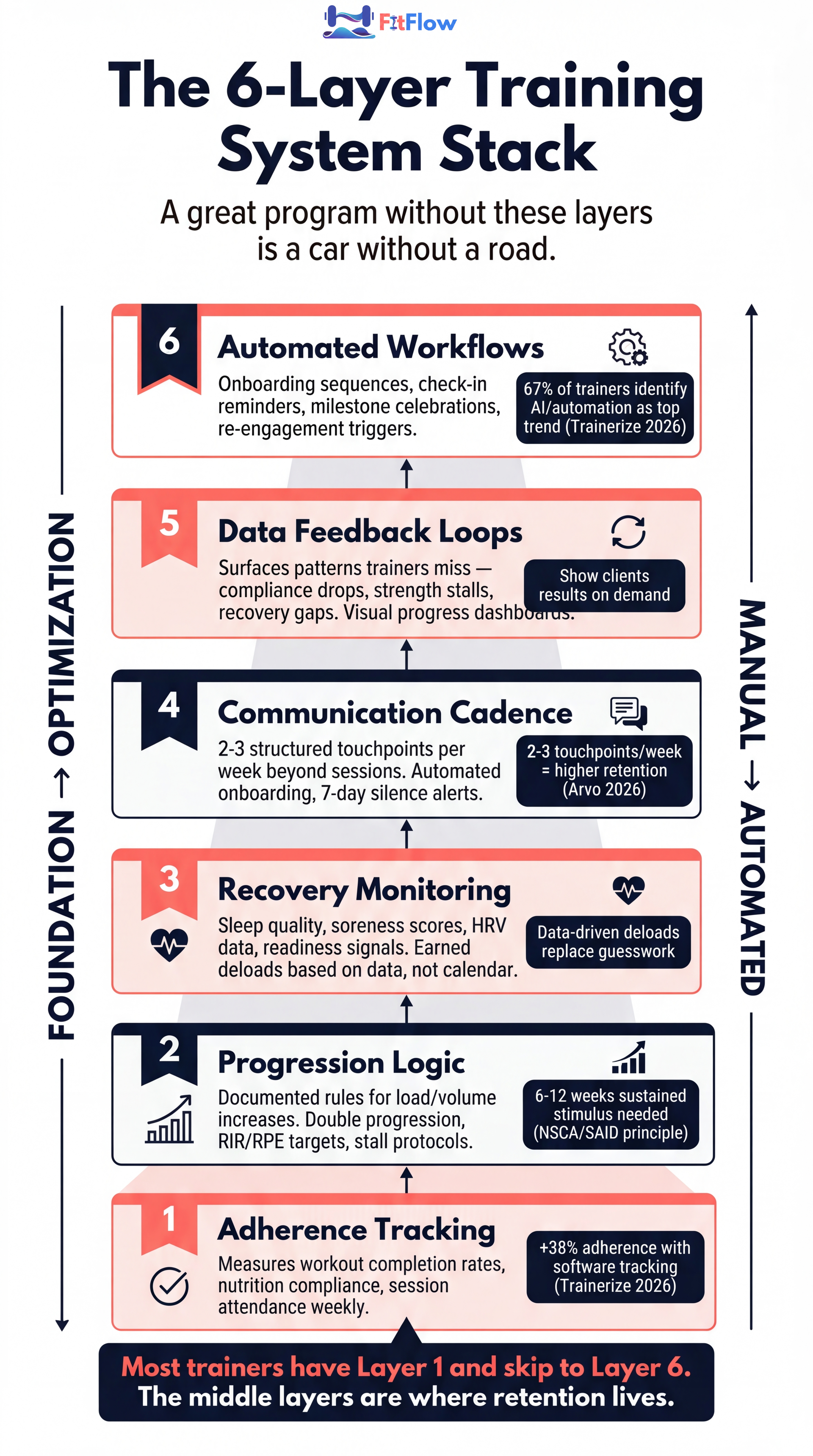
That distinction separates coaches who retain clients from coaches who constantly replace them. A complete coaching system operates across six layers -- what we call the 6-Layer System Stack:
1. Adherence Tracking
Are clients actually completing prescribed workouts? At what compliance rate? What about nutrition adherence -- not just macros prescribed, but macros followed?
You can't fix what you can't measure. And the data is clear: software-enabled personalization increases session adherence by 38% and reduces churn by 21% (Trainerize, 2026). Adherence tracking is the foundation layer. Everything else depends on it.
2. Progression Logic
Documented, repeatable rules for when to increase load, volume, or complexity. Double progression thresholds. RIR and RPE targets. Decision trees for stalls.
Without formalized progression logic, advancement is based on "feel" -- and feel is unreliable at scale. When you manage 30 clients, you cannot remember that Client #17 hit all her top sets at RPE 7 last week and is due for a load increase. A system remembers. You coach.
3. Recovery Monitoring
Sleep quality, soreness patterns, HRV data (when available), readiness signals. The difference between a scheduled deload ("every four weeks") and an earned deload ("this client's readiness score dropped 20% over three sessions") is a system function.
Data-driven deload triggers protect clients from both under-recovery and unnecessary deloading -- and they give the trainer a defensible rationale beyond gut instinct.
4. Communication Cadence
Structured check-in frequency: two to three touchpoints per week beyond scheduled sessions, per Arvo's retention data. Not ad-hoc WhatsApp messages. Not "let me know if you need anything."
Trainers maintaining structured weekly touchpoints beyond sessions see measurably better retention rates. Communication cadence is the connective tissue between program and result -- it's where coaching actually happens outside the gym.
5. Data Feedback Loops
Your personal training system should surface patterns the trainer would otherwise miss: this client's bench press has stalled for three weeks. This client's compliance dropped below 50% last week. This client hasn't logged recovery data in ten days.
Without feedback loops, you're coaching blind -- reacting to problems that have already compounded instead of intercepting them early. A system with functional feedback loops turns reactive coaching into proactive coaching.
6. Automated Workflows
Onboarding sequences, check-in reminders, milestone celebrations, re-engagement triggers for dropped-off clients. Operational infrastructure that runs whether or not the trainer remembers to do it manually.
This layer matters more than most coaches realize: 67% of trainers now identify AI and automation as the top industry trend (Trainerize 2026 State of Industry Report). That number isn't about replacing trainers. It's about giving trainers a system.
The key message: a program is a document. A personal training system is an operating environment. The program lives inside the system. When the system is broken, even the best program produces mediocre results.
5 Signs Your System Is Broken (Even If Your Programming Is Great)
Apply this diagnostic to your own practice. If three or more apply, the bottleneck is your personal training system -- not your program.
1. High Client Churn Despite Good Programming
You write solid programs. Clients like you. But they quietly disappear after three to four months.
System diagnosis: No retention feedback loop. No automated re-engagement. No visibility into declining adherence before the client ghosts. By the time you notice, the relationship is already over. A functioning system flags a client whose compliance drops below 70% and triggers a check-in within 48 hours -- not after they've already found another trainer.
2. Clients Aren't Logging Workouts
You prescribe, they execute (maybe), but you have no data on compliance, loads used, or RPE.
System diagnosis: No adherence tracking infrastructure. The program exists in a vacuum. You're delivering a training plan but collecting zero signal on whether it's being followed. Think of it as prescribing medication with no follow-up appointment.
3. No Progression Data
You can't answer "how much has this client's squat gone up in the last eight weeks?" for 80% or more of your roster.
System diagnosis: No progression tracking protocol. Decisions based on memory, not data. When a client asks "is this working?" and your best answer is "I think so" -- that's not a coaching answer. That's a guess.
4. You Spend More Time Writing Programs Than Reviewing Client Data
Program design consumes more hours than actual coaching. You're building new programs instead of optimizing existing ones based on feedback.
System diagnosis: No template system. No batch review workflow. Manual chaos has you trapped in the creation cycle instead of the coaching cycle. Here's the irony: the hours spent writing the "perfect" program would produce better results spent reviewing client data and adjusting the existing program.
5. Clients Ask "Is This Working?" and You Can't Show Them
You believe the program is working. But you have no dashboard, no metrics, no visual proof.
System diagnosis: No data feedback loop. No client-facing progress visibility. The client's perception of results matters as much as the actual results -- and perception requires evidence. Clients who can visually track their own progress stay more engaged and are more likely to renew.
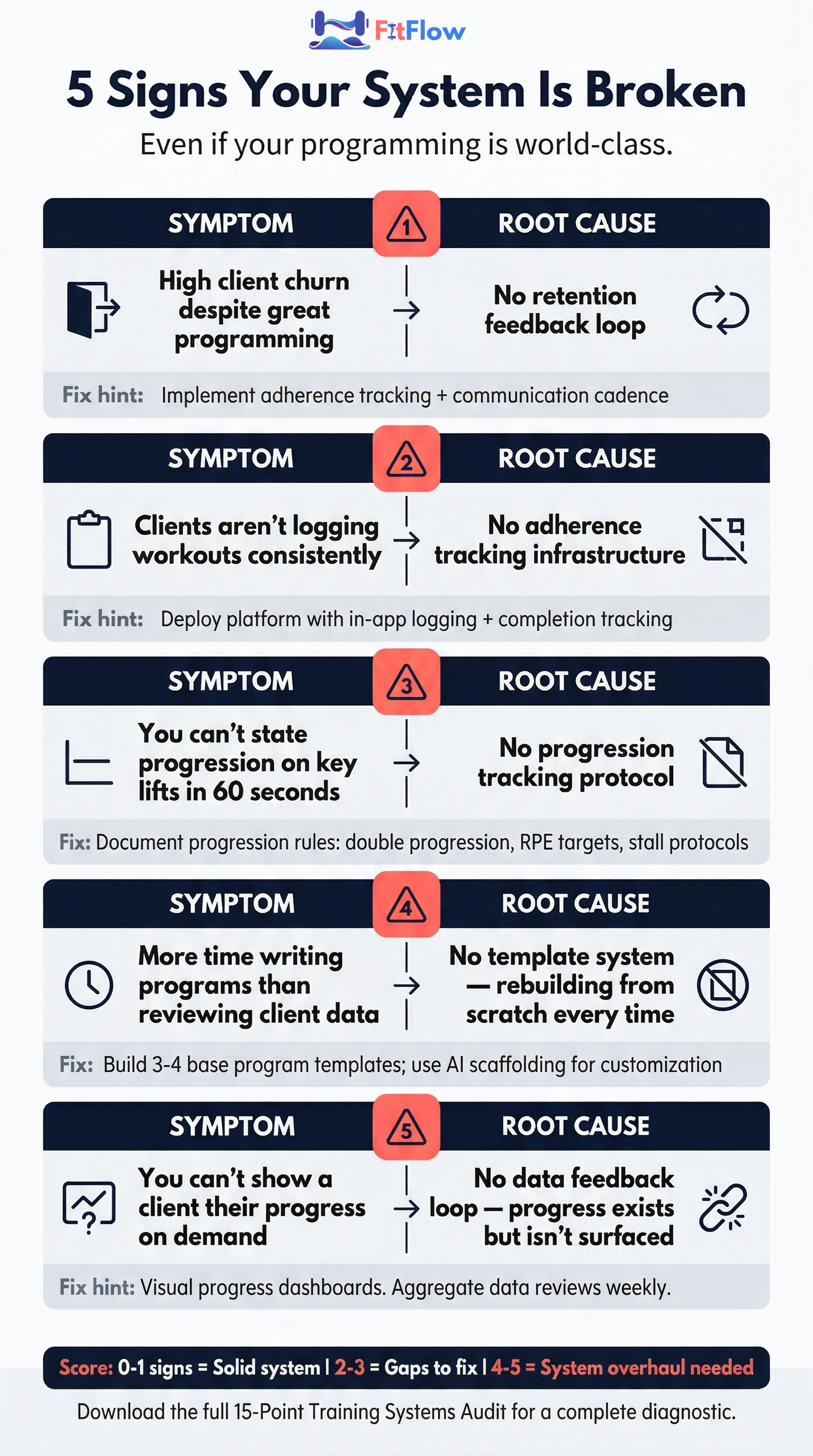
If three or more of these apply, your personal training system is the bottleneck -- not your program. The 15-Point Training Systems Audit will give you a complete diagnosis with a scored assessment.
How Many of Those Signs Apply to You? Score Your System Now. Download the Systems Audit.
Same Program, Two Systems: A Case Framework
Abstract arguments only go so far. Here is what happens when identical programming runs inside two different systems.
The Program (held constant): A 12-week hypertrophy block. Four days per week, upper-lower split. Undulating periodization. Properly selected compound and isolation movements. Deload at week seven. Progressive overload via double progression.
Well-designed. Evidence-based. It would earn a passing grade from any credentialed exercise science professional.
System A: "The Spreadsheet"
Program delivered via PDF or spreadsheet
Client logs workouts in a notes app (sometimes)
Check-ins: ad-hoc, when the client texts
Progression: trainer remembers to ask about loads at the next session
Recovery: "How do you feel?" at the start of each session
Data: none beyond bodyweight (if the client weighs in)
Illustrative result at Week 12: Client completed approximately 60% of prescribed sessions. No evidence that progressive overload occurred. Can't prove results. Client says, "I think I should try something different." Trainer rewrites the program.
System B: "The Full Stack"
Program delivered through a coaching platform with real-time tracking
Client logs every set, RPE, and completion status
Check-ins: automated weekly review plus trainer follow-up on flagged items
Progression: system alerts when a client hits double-progression thresholds
Recovery: weekly readiness score from sleep, soreness, and mood data
Data: compliance rate, volume trends, estimated 1RM tracking, body composition timeline
Illustrative result at Week 12: Client completed 88% of prescribed sessions. Bench press 1RM estimate increased 12%. Squat training volume increased 23%. Client sees the graph. Client renews.
Note: These figures represent a composite framework based on patterns observed across coaching platforms, not a single controlled study. Individual outcomes will vary based on client adherence, programming, and other factors.
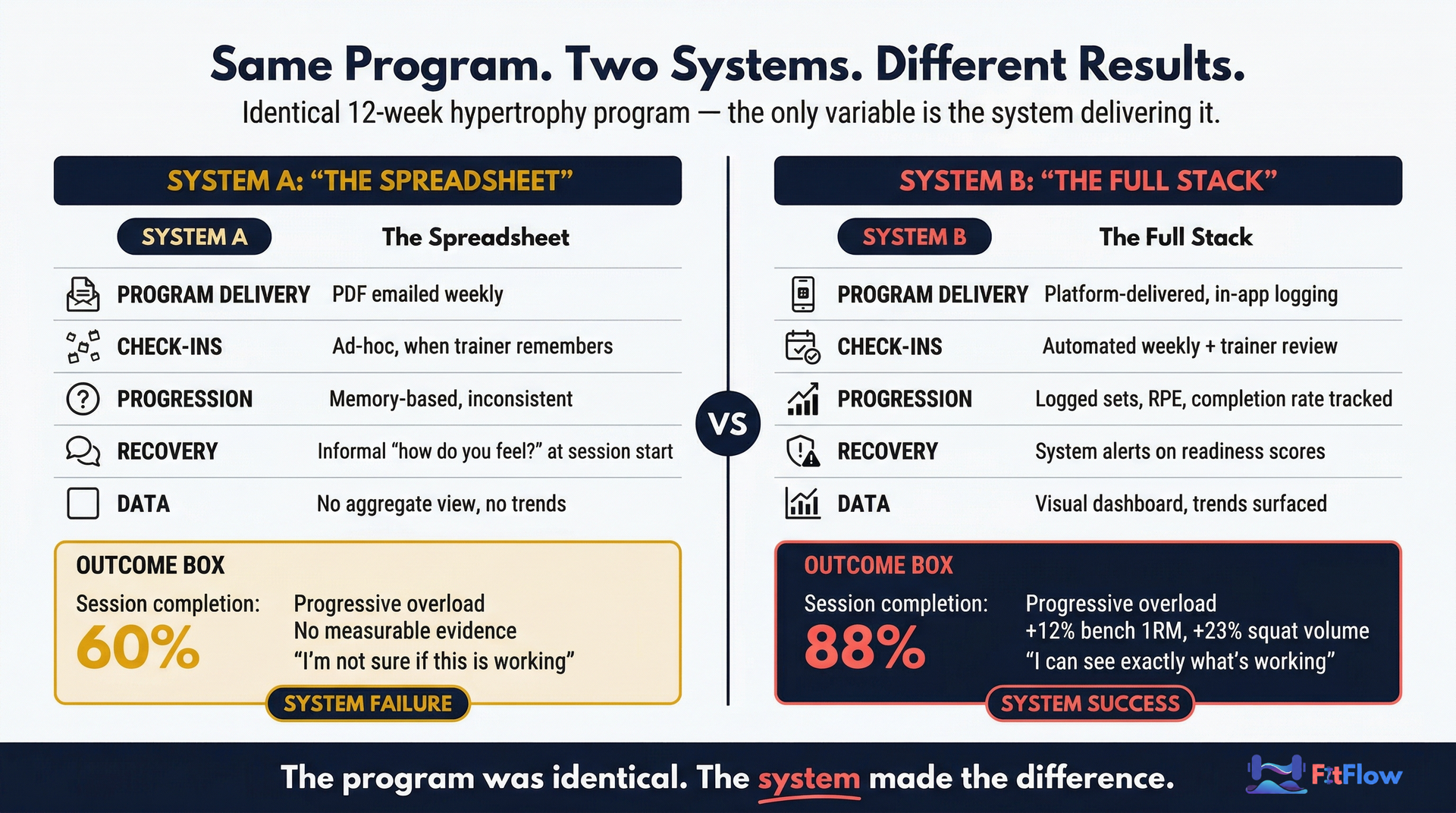
The program was identical. The outcomes were not. The variable was the system.
This is the core argument: a mediocre program inside a great personal training system will outperform a perfect program inside no system. The system is the multiplier. The program is the input.
The System Stack: How Technology Replaces Manual Chaos
Every component of the 6-Layer System Stack can be done manually. Spreadsheets for tracking. Text messages for check-ins. Paper logs for progression. Memory for recovery.
The problem is that manual systems don't scale. They work for ten to fifteen clients. They break at twenty. They collapse at thirty-plus.
Trainers report recovering eight to twelve hours per week when manual processes are replaced with system infrastructure (PT Distinction, Feed.fm, 2026). That's not a convenience metric -- it's a capacity metric. Those recovered hours represent five to eight additional clients a trainer could serve, or the coaching attention that keeps the next client from churning.
The hybrid model -- combining in-person and online coaching -- has reached approximately 50% adoption among personal trainers (Trainerize 2026). Running hybrid without a personal training system is operationally impossible. You cannot manually track session compliance, send structured check-ins, monitor progression, and manage recovery signals across 30 clients split between two delivery modalities.
Here is what a modern coaching platform provides at each system layer:
Adherence: Automated compliance scoring and alerts when clients fall below thresholds
Progression: Built-in tracking with threshold notifications and trend visualization
Recovery: Integrated readiness questionnaires and wearable data integration
Communication: Scheduled check-ins with templated triggers and escalation protocols
Feedback loops: Dashboards showing trends, flags, and prioritized action items
Automation: Onboarding flows, milestone messages, and re-engagement sequences
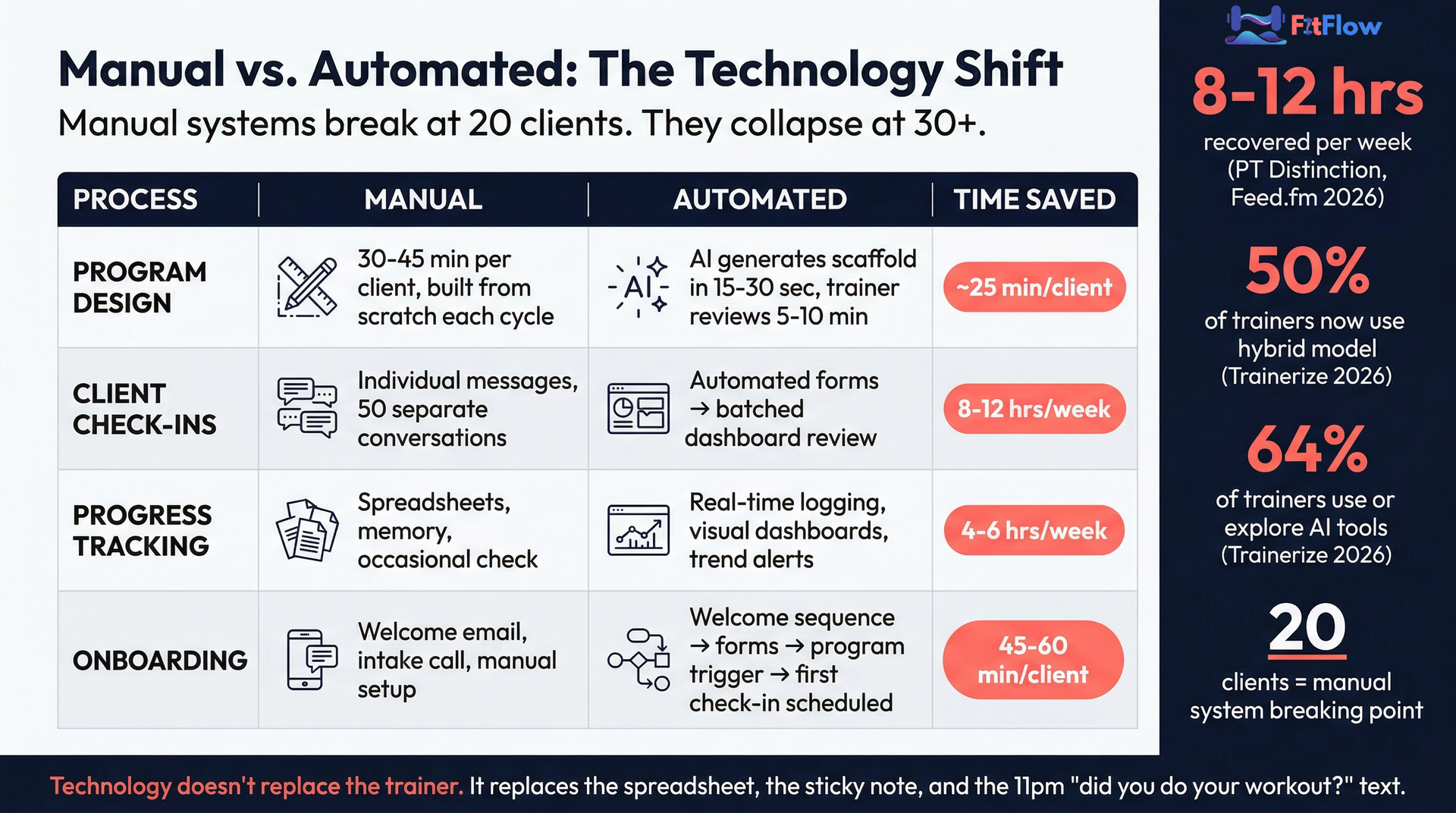
64% of trainers now actively use or explore AI tools for programming and communication (Trainerize, 2026). But only 10% of gym-goers prefer AI coaching over human coaching (Les Mills 2026 Global Fitness Report). The implication is clear: clients want human coaches supported by automated systems -- not AI replacing the coach, but AI powering the system that makes the coach more effective.
Technology doesn't replace the trainer. It gives the trainer a personal training system so they can focus on what humans do best -- coaching, empathy, judgment calls -- while the system handles what technology does best: tracking, alerting, automating, visualizing.
Platforms like FitFlow's program builder and client tracking tools represent this system layer: infrastructure that transforms a static program into a managed coaching environment.
Building Your Personal Training System: Where to Start
You don't need to build the full 6-Layer System Stack overnight. Start with the layer that produces the most immediate impact.
Start with adherence tracking. You can't fix what you can't measure.
Here is a four-step implementation sequence:
Step 1: Audit your current system. Use the 15-Point Training Systems Audit (linked below) to score yourself across all six layers. Most trainers score between 3 and 6 out of 15 -- firmly in the "partial system" category. Knowing your score gives you a starting point, not just a vague sense that "something isn't working."
Step 2: Implement compliance tracking this week. Even a simple "did you complete today's workout?" prompt sent to every client changes the dynamic. You move from hoping clients follow the program to knowing whether they do. This single layer often increases adherence by double digits.
Step 3: Build one feedback loop. Show clients their progression data monthly. A simple chart -- squat volume over eight weeks, estimated 1RM trend, compliance percentage -- transforms "I think this is working" into "here's proof it is." Refer to the 5 metrics that actually predict client results for guidance on which data points matter most.
Step 4: Automate one check-in cadence. A weekly "how are you recovering?" message -- sent automatically, reviewed by the trainer -- establishes the communication rhythm that retention depends on.
Once these foundation layers are in place, you can add recovery monitoring, automated workflows, and full-stack integration. The point is not perfection on day one. The point is recognizing that your personal training system -- not the program -- is where the leverage lives.
Disclaimer: This article provides general guidance on coaching business operations. It does not constitute medical advice. Consult a qualified healthcare professional before recommending any new exercise or nutrition program to clients. Individual results will vary based on client-specific factors including adherence, prior training history, and health status.
Key Takeaways
Your program is rarely the bottleneck. Most client failures -- stalls, disengagement, churn -- are system failures, not programming failures.
Program hopping is a system symptom. Clients switch programs when they have no visibility into whether the current one is working. Fix the personal training system, and the hopping stops.
A complete coaching system has six layers: adherence tracking, progression logic, recovery monitoring, communication cadence, data feedback loops, and automated workflows. Most trainers have one or two at best.
Same program, different system, different results. The case framework demonstrates that the system is the multiplier. A well-designed program inside no system produces mediocre outcomes.
Manual systems don't scale past 15-20 clients. Technology is not a luxury -- it's the infrastructure that unlocks capacity and prevents burnout.
Start with adherence tracking. It's the foundation layer. You can't manage progression, recovery, or communication without first knowing whether clients are following the program.
Audit before you rebuild. The 15-Point Training Systems Audit identifies exactly where your personal training system breaks down -- so you fix the right layer first.
Stop Rewriting Programs. Start Building a System. Get Your Free Audit Checklist.
Frequently Asked Questions
Comments