Why Fitness Apps Fail And What Trainers Should Build Instead
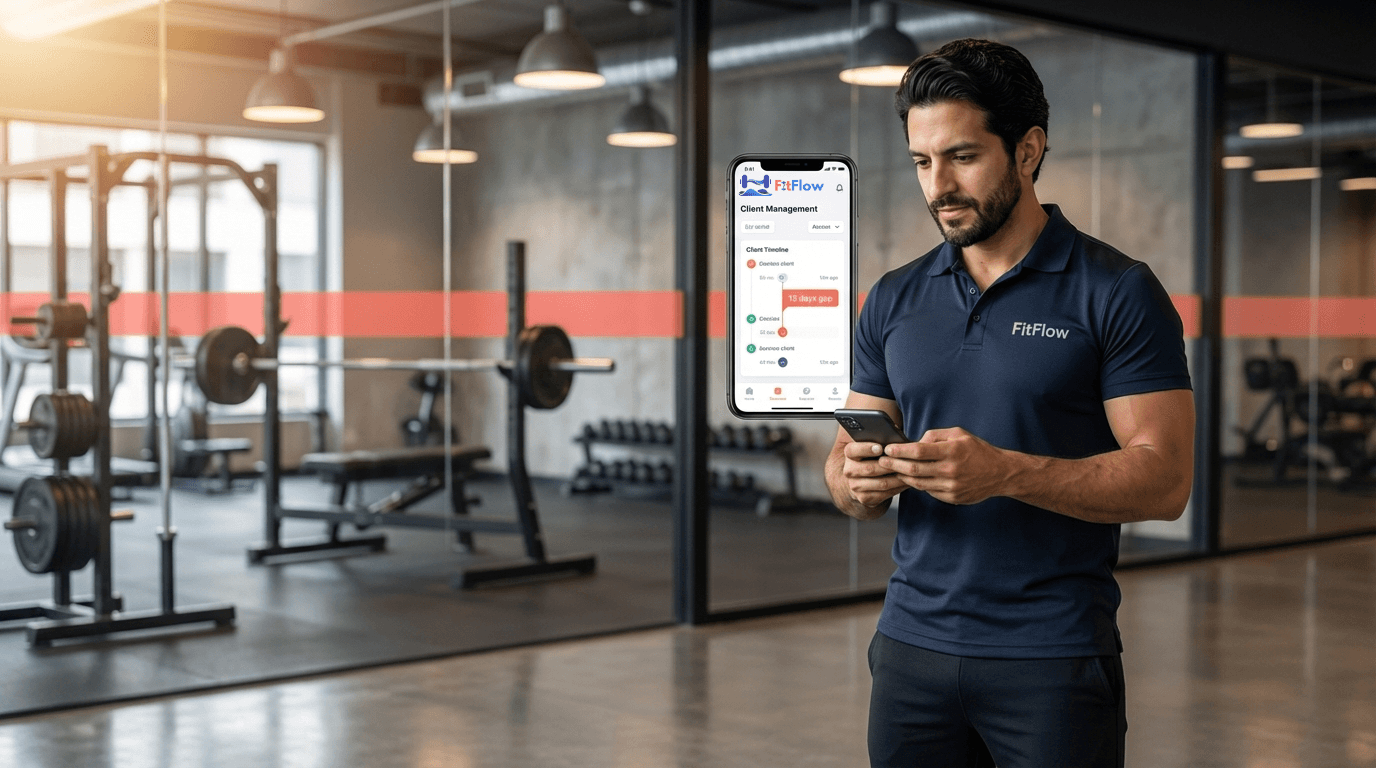
YYou have had this conversation. A client you spent 45 minutes programming for sends a message three weeks later: "Hey, I stopped using the app. It just wasn't for me."
The client is not lying. The app genuinely was not for them. But the reason has nothing to do with willpower, motivation, or your programming. It has everything to do with architecture — with what the app was designed to do and what it was never designed to do. This is not a user behavior problem. It is a structural design problem.
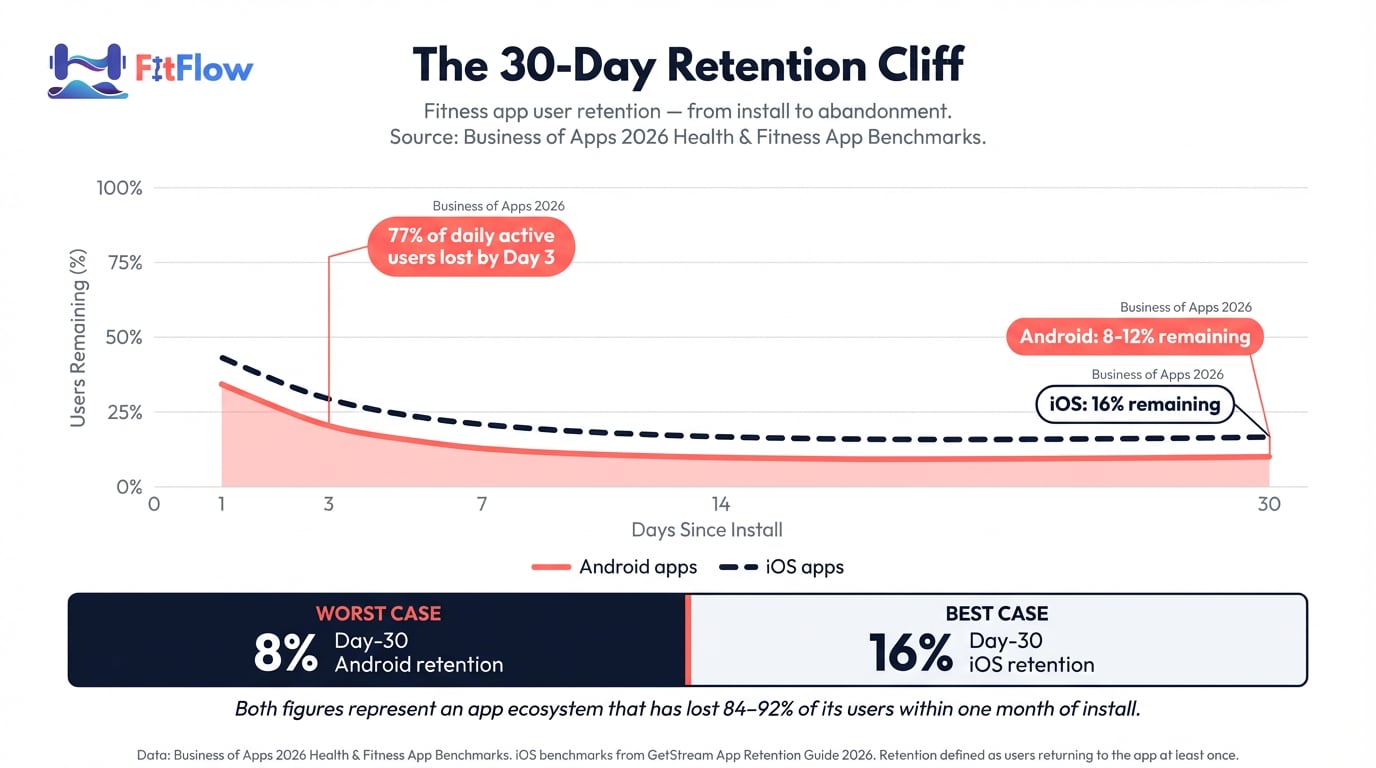
Here is how structural: 9 out of 10 people who download a fitness app have quit using it within 30 days. Business of Apps 2026 benchmarks report Day-30 retention for fitness apps averages 8-12% on Android and 16% on iOS. For every 100 people who download the app you recommended, somewhere between 84 and 92 will be gone before the month ends.
Fitness apps fail not because the technology is bad but because they automate the wrong thing: content delivery instead of coaching relationships. The app delivers workouts. Nobody delivers accountability. The client drifts.
This post lays out the 7 structural failure patterns that explain why fitness apps fail — backed by peer-reviewed research, platform earnings data, and industry benchmarks from 2025-2026. More importantly, it lays out what trainers should build instead. If you have abandoned three fitness apps and assumed it was your fault — it was not. The apps were designed with the wrong system at their core.
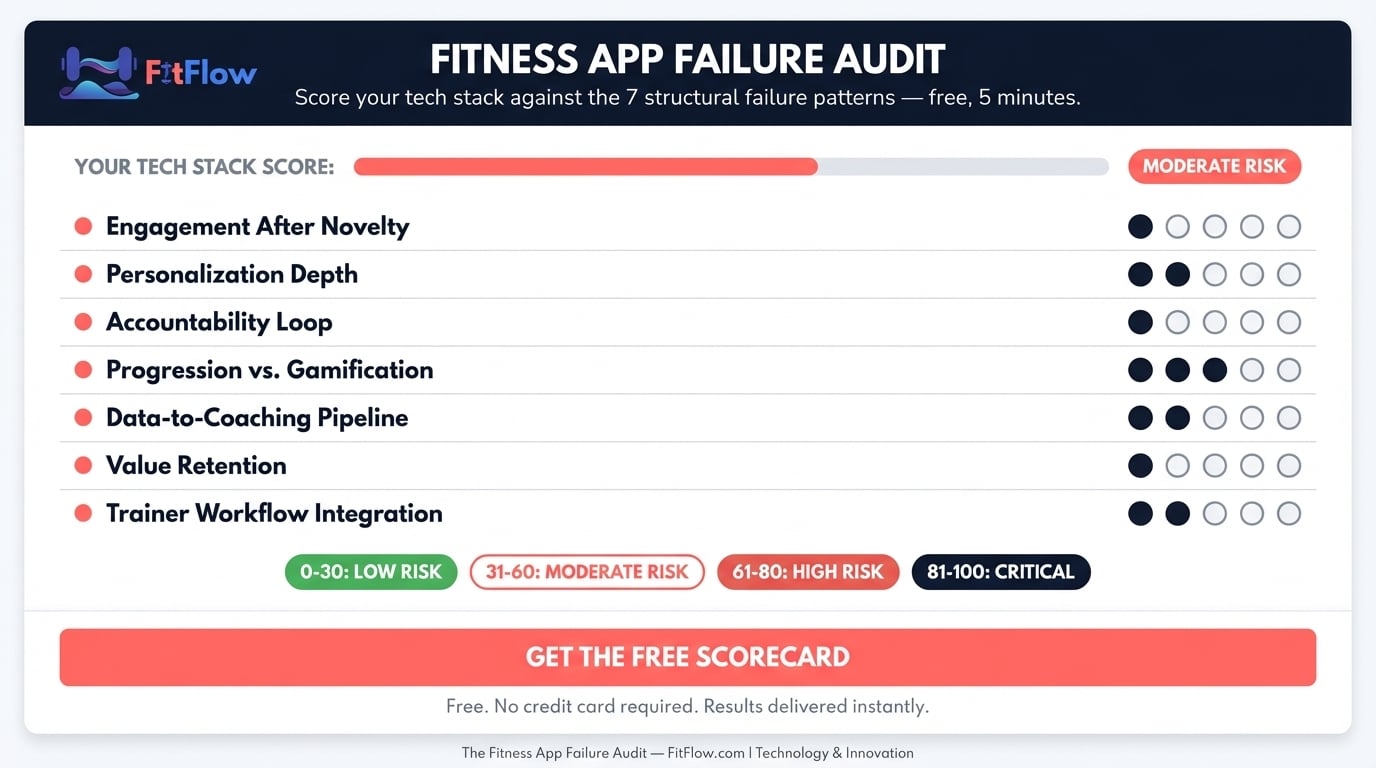
The 7 failure patterns in this post are also available as a free scorecard. Score your current tech stack in 5 minutes. Get the Fitness App Failure Audit.
The Numbers No App Developer Wants You to See
Before we get into the failure patterns, consider the data environment. These are not edge cases or cherry-picked anecdotes. These are industry-wide structural metrics.
Retention cliff: Fitness apps lose 77% of daily active users within three days of install. By Day 30, retention sits at 8-12% on Android and 16% on iOS (Business of Apps 2026).
Psychological harm: A UCL and Loughborough University study published in the British Journal of Health Psychology (October 2025) analyzed 58,881 social media posts about the five most profitable fitness apps. The findings were stark: users experienced shame, guilt, and streak anxiety that led to complete disengagement. The apps designed to motivate people were actively demotivating them.
Human preference: The Les Mills 2026 Global Fitness Report — 10,000+ respondents across five continents — found only 10% prefer an AI-generated workout over a human-led experience. Even Gen Z (11%) and Millennials (9%) show the lowest preference for AI coaching.
Platform-level churn: Peloton reported a decrease of 164,000 paid connected fitness subscribers year-over-year in Q1 FY2026. Digital subscribers have dropped 46.74% from the June 2022 peak (Backlinko). Noom has completed its third round of layoffs in two years (MobiHealthNews).
These are not isolated product failures. They are symptoms of a structural architecture problem. For the full technology landscape, see our complete guide to fitness technology for professionals.
The 7 Structural Reasons Fitness Apps Fail
Fitness apps fail for seven structural reasons that have nothing to do with technology quality and everything to do with what technology is being asked to do. The seven failure patterns are: (1) engagement cliff after novelty, (2) one-size-fits-all programming, (3) no human accountability loop, (4) gamification without progression, (5) data collection without actionable insight, (6) subscription fatigue and value-to-cost misalignment, and (7) failure to integrate with trainer workflows.
Each pattern follows the same structure: what the failure looks like, what assumption drives it, what the data shows, and what the trainer-first alternative looks like in practice.
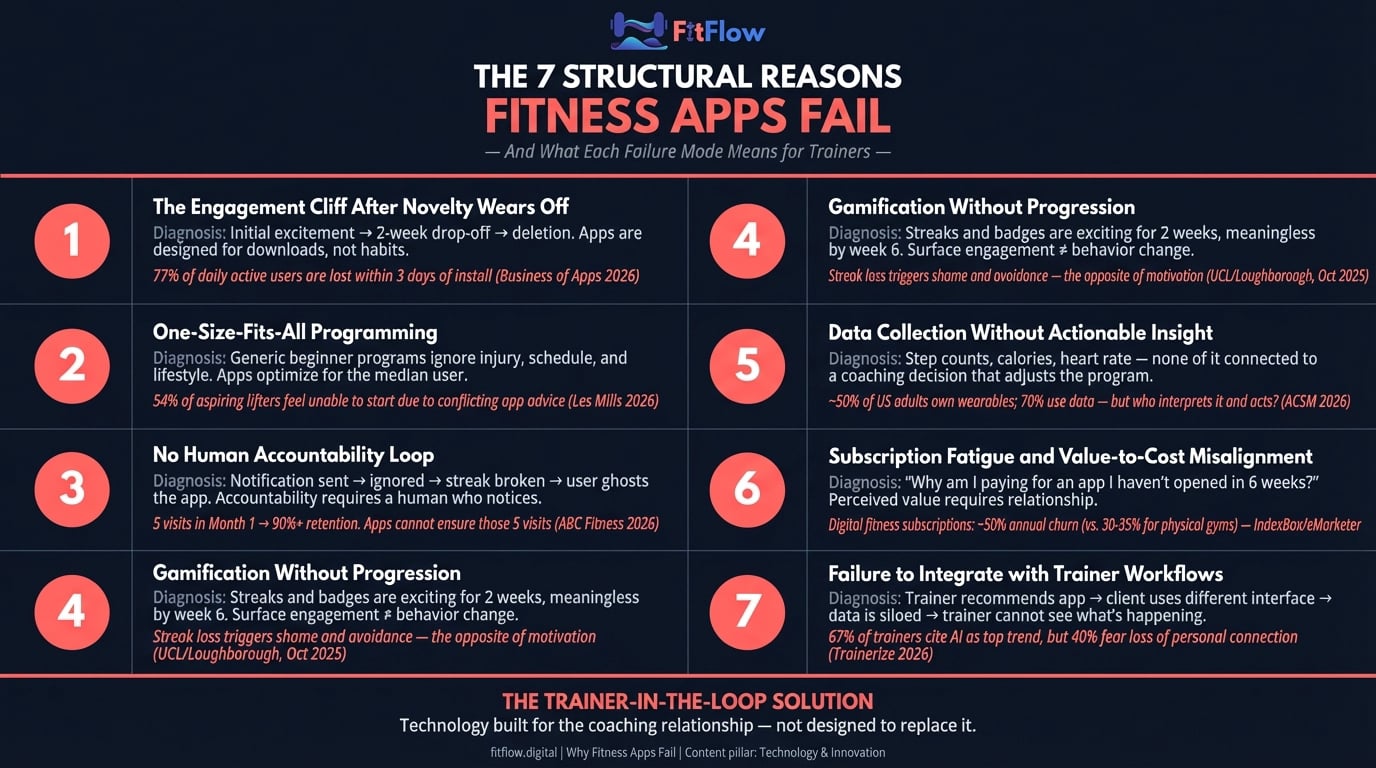
1. The Engagement Cliff After Novelty Wears Off
What it looks like: Your client downloads the app on Monday. By Wednesday, they have logged two workouts. By the following Wednesday, the app is a silent notification on their lock screen.
The wrong assumption: That downloading an app equals forming a habit. Day-1 novelty is not Day-90 behavior change.
What the data shows: Fitness apps lose 77% of daily active users within three days of install (Business of Apps 2026). Day-1 retention averages 30-35% — meaning one in three people who open the app on Day 1 never open it on Day 2. These apps are engineered for acquisition, not for what happens on Day 14 when the novelty has worn off and the client needs a reason to keep showing up.
The trainer difference: A coach who notices the drop-off and reaches out on Day 5 does something no algorithm can replicate. A human noticing is different from an algorithm triggering a push notification. The client knows the difference.
Diagnostic question: Does your technology alert you when a client's engagement drops, or does it only measure what happens after they have already disappeared?
2. One-Size-Fits-All Programming
What it looks like: A client with a rotator cuff history, a toddler at home, and 35 minutes between meetings three days a week opens the app and sees "Beginner Strength Program — Week 1." The first exercise is an overhead press.
The wrong assumption: That segmenting users into "beginner," "intermediate," and "advanced" constitutes personalization. Real personalization accounts for injury history, schedule constraints, lifestyle context, equipment access, recovery capacity, and training preferences — none of which a three-question onboarding quiz captures.
What the data shows: The Les Mills 2026 report found that 54% of aspiring lifters feel unable to start strength training because of conflicting or generic advice. A 65,000-user comparative analysis published by FitTrackAI — a platform with a commercial interest in hybrid models — reported that hybrid AI-human coaching delivers 74% better outcomes than AI-only programming. Independent confirmation of the exact figure is limited, but the directional finding aligns with broader research on coached versus self-directed interventions. The difference is not the algorithm. It is the human who interprets context the algorithm cannot see.
The trainer difference: A real assessment. A program that accounts for the rotator cuff, the toddler schedule, and the 35-minute window. A plan that adapts when the client's life changes — because someone is watching and adjusting, not just serving the next workout in a queue.
Diagnostic question: Does your current technology let you adapt a client's program based on life context — or does it only serve pre-built templates with cosmetic variations?
3. No Human Accountability Loop
What it looks like: The app sends a push notification. The client ignores it. The streak breaks. The client feels guilt (the UCL study confirms this pattern). The client ghosts the app.
The wrong assumption: That notifications equal accountability. A push notification is a reminder. A text from a trainer saying "Hey, I noticed you missed Tuesday — everything OK?" is accountability. The difference is a human who notices absence, cares about it, and acts on it.
What the data shows: The ABC Fitness 2026 Wellness Watch Report — based on 600 million check-ins across 30,000 facilities and 40 million members — found that members who hit 5 visits in their first month achieve 90%+ retention rates. The technology question is not "does the app remind clients to show up?" but "does the technology surface disengaged clients to the trainer before the 5-visit window closes?"
The ACSM 2026 Worldwide Fitness Trends survey reports wearable technology has been the number-one fitness trend for 20 consecutive years. Nearly 50% of US adults own a fitness tracker. But wearing a device is not the same as being accountable to a person who reviews your data.
The trainer difference: "I see you logged two sessions instead of your usual four — is something going on?" No notification badge delivers that. And if your technology does not surface that information automatically, your system is the problem, not the tool.
Diagnostic question: Does your technology tell you which clients are disengaging before they tell you?
4. Gamification Without Progression
What it looks like: Streaks, badges, points, leaderboards. The client earns a "7-Day Warrior" badge in week one. They earn a "30-Day Champion" badge in month one. By month two, they have run out of badges to earn and the streaks feel like obligations rather than achievements.
The wrong assumption: That gamification produces motivation. It does not — at least not the lasting kind. Gamification addresses surface engagement: the dopamine hit of earning a reward. It does not address the deeper question that keeps a client coming back after the novelty fades: "Am I actually making progress toward something that matters to me?"
What the data shows: A Cornell University study published December 2025 found that rigid app goals undermine intrinsic motivation for users who were already internally motivated to exercise. The apps designed to motivate were actually eroding the motivation that already existed.
The UCL/Loughborough study confirms the mechanism from the other direction: losing a streak triggers shame and avoidance behavior. The user who misses one day does not come back motivated to rebuild. They come back ashamed — and then they stop coming back at all. The gamification that was supposed to increase engagement becomes the trigger for quitting.
The trainer difference: Progression means something when someone is watching and coaching it. "You squatted 135 pounds for the first time today" lands differently than a badge notification. The trainer provides context for what the number means. The app provides the number and nothing else.
Diagnostic question: Does your technology show clients meaningful progression (strength gains, body composition changes, consistency trends) — or does it only show gamification metrics (streaks, badges, points)?
5. Data Collection Without Actionable Insight
What it looks like: Step counts, calories burned, heart rate zones, sleep scores, HRV, weekly movement minutes. The client has a dashboard full of numbers. None of those numbers connect to a coaching decision.
The wrong assumption: That collecting data is the same as using it. Data without interpretation is noise. Interpretation requires someone who understands both the data and the client — a coach who says "your HRV has been trending down for two weeks, let's pull back on volume" instead of displaying another chart.
What the data shows: The ACSM 2026 report confirms nearly 50% of US adults own a fitness tracker, and 70% of wearable users report using data to inform exercise decisions. Yet fitness app Day-30 retention is still 8-12%. People collect data. They do not change behavior based on it. The data-to-insight gap is the failure mode.
Consider MyFitnessPal: the most downloaded fitness app in history locked its barcode scanner behind a premium paywall in October 2025. A custom macro goal bug reported July 2025 remained unfixed through March 2026. ChoosingTherapy noted that "the backlash was immediate and intense."
The trainer difference: A 5-metric client progress dashboard is more useful than 50 app-generated charts that nobody interprets. Not more data — data connected to coaching decisions.
Diagnostic question: Can you act on your clients' data within your current technology — or is it trapped in an app you cannot see?
6. Subscription Fatigue and Value-to-Cost Misalignment
What it looks like: "Why am I paying $15 a month for an app I have not opened in six weeks?" Industry estimates suggest the average smartphone user carries multiple abandoned fitness app subscriptions — a pattern consistent with the single-digit Day-30 retention rates reported across the sector.
The wrong assumption: That subscription models work for fitness apps the way they work for entertainment. They do not. Entertainment subscriptions deliver passive value — you can watch a show without doing anything. Fitness subscriptions require active behavior change. When the behavior stops, the perceived value drops to zero overnight.
What the data shows: Digital fitness subscriptions carry annual churn near 50% — compared to 30-35% for physical gym memberships (IndexBox/eMarketer). Peloton raised prices on October 1, 2025 and saw accelerated cancellations in Q1 FY2026. Noom's app-only model proved financially unsustainable — three rounds of layoffs, then a pivot to GLP-1 products.
The economics tell the story: industry benchmarks for mobile fitness app user acquisition typically range from $50 to over $100 per install (Liftoff 2024 Mobile App Trends), with some estimates running higher depending on channel and geography. Meanwhile, the ongoing cost of retaining a client through trainer-led technology — communication tools, programming delivery, progress tracking — sits in the range of $5-15 per month per client. The app model spends heavily to acquire users it cannot retain.
The trainer difference: Relationship value compounds over time. App value depreciates. A client who has worked with a trainer for six months perceives higher value in month six than month one — because the trainer knows their history, their patterns, their goals. A client who has used a fitness app for six months perceives lower value because the novelty is gone and nothing replaced it.
Diagnostic question: Is your technology's value tied to a subscription the client can cancel — or to a relationship they do not want to lose?
7. Failure to Integrate with Trainer Workflows
What it looks like: You recommend an app to a client. Now the client logs workouts in one interface while you program in another. Their data lives in a system you cannot access. You have zero visibility into whether the client is following the program you wrote.
The wrong assumption: That a consumer fitness app can serve a coaching relationship. Consumer apps are built for end users operating independently, not for the bidirectional trainer-client relationship. Every consumer app a trainer recommends creates a data silo and a visibility gap.
What the data shows: The Trainerize 2026 State of the Personal Training Industry Report found that 67% of trainers identify AI and automation as the top industry trend. But 40% report their primary concern is "loss of personal connection." Trainers adopting technology are simultaneously worried that same technology is eroding what makes their service valuable.
Apps that ignore the trainer workflow break the accountability loop at its source. If the trainer cannot see the client's data, the trainer cannot act on it. No action means no accountability. No accountability means the client is using a solo consumer app — with all the retention numbers that implies.
The trainer difference: Technology built for the coaching relationship integrates with the trainer's workflow. The trainer sees the client's data. The client knows the trainer sees it. That visibility alone is accountability. For a guide to evaluating tools that fit your workflow, see how to build your trainer tech stack.
Diagnostic question: Does your technology serve the coaching relationship — or does it work around it?
The Case Studies That Prove It
These are not hypothetical failure scenarios. They are real companies, with real subscriber data, demonstrating the structural failure patterns in action.
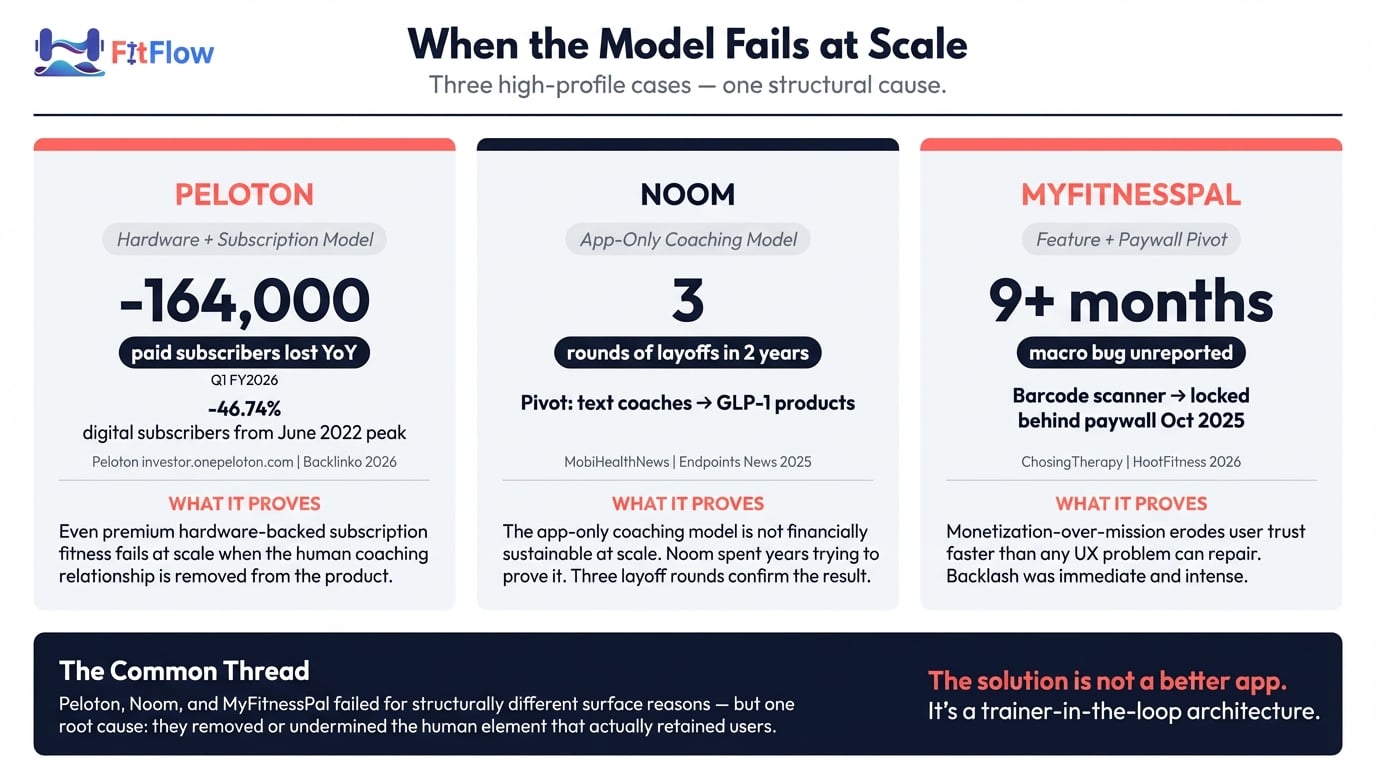
Peloton: When Hardware-First Subscription Fitness Fails
Peloton lost 164,000 paid connected fitness subscribers year-over-year in Q1 FY2026, ending at 2.732 million (Peloton Q1 FY2026 Earnings). Digital subscribers have declined 46.74% from the June 2022 peak. After raising subscription prices on October 1, 2025, cancellations accelerated.
What Peloton built was a media company wearing the uniform of a fitness company. Their instructors on screen are engaging — but they do not know your name, your knee injury, or that you skipped Tuesday. The content is excellent. The accountability is zero. Premium hardware plus streaming content minus human coaching equals churn.
Noom: When App-Only Coaching Reaches Its Ceiling
Noom promised behavior change through in-app text-based coaching. Then the unit economics caught up: three rounds of layoffs between 2022 and 2025 — 495 coaching staff initially, then 500 more, then another round. The company pivoted to video coaching and GLP-1 medication products (MobiHealthNews).
What Noom proved is that app-only coaching is not financially sustainable at scale. The coaches were the value, but scaling human coaching through a text interface created costs the subscription model could not support. The lesson: if you strip out the human, you strip out the retention.
MyFitnessPal: When Features Replace Mission
The most downloaded fitness app in history locked its barcode scanner behind a premium paywall in October 2025. A custom macro goal bug reported July 2025 remained unfixed through March 2026. Premium subscribers paid for broken functionality while free users lost the feature that made the app worth opening.
The lesson: monetization-over-mission erodes user trust faster than any UX improvement can repair it. When a company treats its most-used feature as a revenue lever instead of a retention tool, users leave.
Is Your Tech Stack Built to Fail?
Score your current fitness technology against the 7 structural failure patterns. The Fitness App Failure Audit takes 5 minutes and tells you exactly where your setup is vulnerable — with specific action items for every score tier. Get the Free Scorecard.
What Trainers Should Build Instead
This post is not anti-technology. Some fitness apps succeed — and the ones that do share a common characteristic: they are built for the coaching relationship, not as a replacement for it.
The structural answer is not "use fewer apps." It is "build a different architecture" — one where the trainer stays in the loop and technology extends the relationship rather than replacing it.
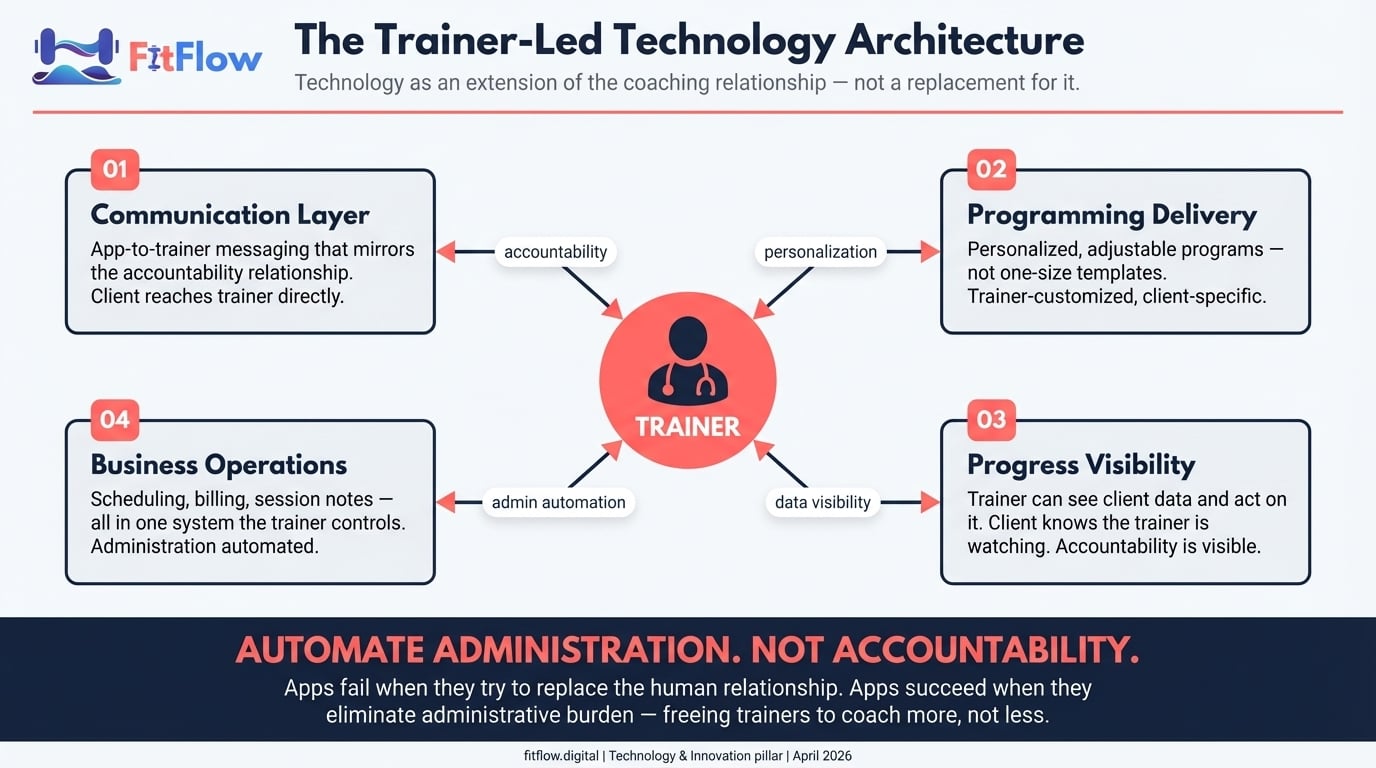
The 4 Components of a Trainer-Led Technology System
A technology system that retains clients has four layers, each supporting the trainer-client relationship:
1. Communication layer — Direct messaging between trainer and client. Not algorithmic push notifications. Actual communication where the client knows a human is on the other end. This is what makes the 5-visit-in-30-days threshold (90%+ retention per ABC Fitness) achievable beyond the four walls of a gym.
What this looks like in practice: A client misses Tuesday. By Wednesday morning, the trainer sends a direct message — "Everything OK? Want to shift Thursday's session?" The client responds. The relationship survives. Compare this to a push notification that says "You missed your workout!" — which the UCL study shows triggers shame, not re-engagement.
2. Programming delivery — Personalized, adjustable programs the trainer controls. Not templates with beginner/intermediate/advanced labels. Programs that account for the rotator cuff, the toddler schedule, and the 35-minute window — programs the trainer modifies when life changes.
What this looks like in practice: A client reports shoulder pain on Monday. By Tuesday, the trainer has swapped overhead presses for landmine presses and added extra thoracic mobility work — all visible in the client's program before their next session. An app serves the same program it served last week. A trainer-controlled system adapts in real time.
3. Progress visibility — A shared view where the trainer sees client data and the client knows it. When clients know their trainer reviews their check-ins, they check in. When clients suspect their data goes into a void, they stop logging. Visibility is itself accountability.
What this looks like in practice: The trainer opens their dashboard and sees that a client's training frequency dropped from four sessions to two over the past two weeks, and sleep scores have trended down. That is not just data — it is a coaching conversation waiting to happen. The trainer reaches out before the client drops off entirely.
4. Business operations — Scheduling, billing, notes, and client management in one system. Not four separate apps with zero data connection between them. The administrative infrastructure that lets the trainer spend time coaching instead of managing tools.
What this looks like in practice: Session notes, billing, scheduling, and client communication live in one platform. The trainer is not copying workout data from one app, checking payment status in another, and scheduling through a third. Every hour saved on administration is an hour available for the coaching that actually retains clients.
Together, these components create a trainer-in-the-loop architecture. For implementation specifics, see how to scale your PT business to 50+ clients and why personal training business systems — not more clients — are the real growth lever.
The Key Principle: Automate Administration, Not Accountability

Every failed fitness app in this post made the same mistake: they automated the human relationship. Accountability became push notifications. Personalization became algorithms. Motivation became gamification.
The apps that work do the opposite. They automate the administrative burden — scheduling, billing, program delivery, data collection — and free the trainer to be more present, not less. The technology handles logistics. The trainer handles the human.
That is the difference between an app that fails at 90% churn in 90 days and a coaching system that retains clients for years.
The fitness app industry will spend the next decade learning what trainers already know: people do not change behavior alone. They change it in relationships.
The 7 failure patterns in this post are not bugs to patch. They are the predictable outcome of building technology that automates the wrong thing. No amount of UX polish, gamification, or AI-generated programming fixes an architecture that was never designed for the coaching relationship.
The trainers who win the next decade will not be anti-technology. They will be the ones who understand which parts of coaching can be systematized — scheduling, billing, program delivery, data collection — and which parts require a human who notices, interprets, and acts. That distinction is the entire difference between 8% retention and a client who stays for years.
Before you recommend another app to a client, score your current technology against these 7 failure patterns. If your tech stack fails on three or more, your clients are not the problem. Your architecture is.
Disclaimer: This article provides general information about fitness technology trends and business strategy. It does not constitute medical advice. Consult a healthcare professional before starting any new exercise or nutrition program. All statistics cited are sourced from publicly available reports and earnings data; links and data were verified as of April 2026.
Score your tech stack — free audit. Score your current fitness technology against the 7 structural failure patterns. See How FitFlow Is Built for Trainers.
Frequently Asked Questions
Comments