
How to Scale a Personal Training Business to 50+ Clients (Without Working 80 Hours)
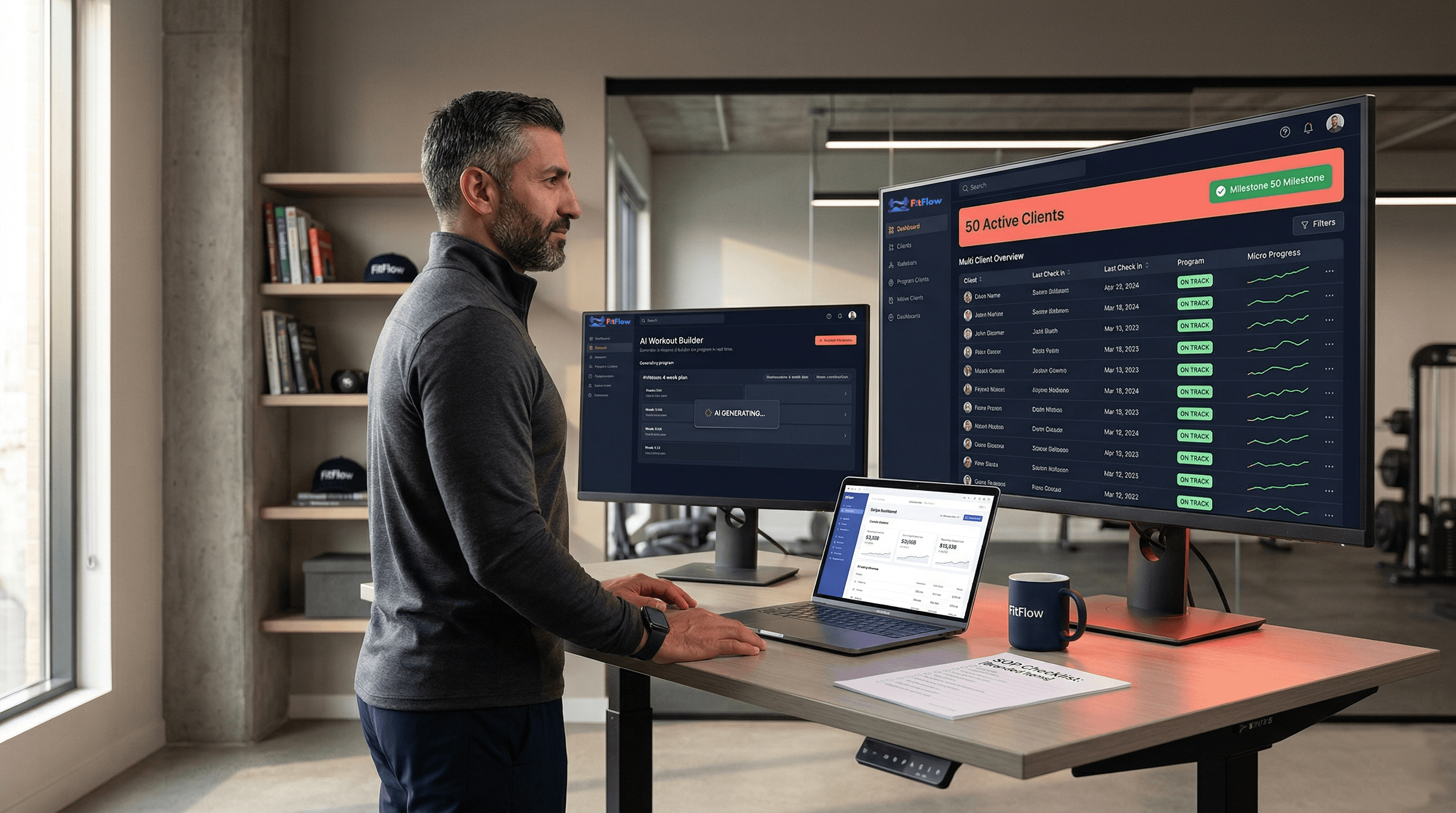
You have 25 clients. You work 50 hours a week. Every new inquiry means saying no — or saying yes and losing sleep. The ceiling is not demand. It is the model.
Traditional personal training runs on a simple equation: one client, one hour, one session fee. That equation works at 15 clients. It strains at 25. At 40, it breaks. The math does not care how good your programming is.
This is the time-for-money trap. It is the single biggest limit on personal trainer income and career longevity. But the industry is shifting. The Trainerize 2026 State of the Industry Report found that 67% of personal trainers named AI and automation as the top trend shaping their business this year. Close to 50% have already adopted hybrid coaching as their main delivery model.
The trainers scaling past 50 clients are not working twice the hours. They run a different system: hybrid coaching delivery, AI-powered program design, and automated operations that handle the work that used to eat their evenings.
Get the Free 50-Client Scaling Checklist & ROI. Download Free Calculator
This guide covers the exact system. Five parts: the capacity math that explains why you are stuck, the hybrid model that changes delivery, the AI workflow that cuts programming time in half, the five automations that kill admin bottleneck, and the SOPs that turn your practice into a real business. At the end, you get a 90-day roadmap and a revenue model with real numbers.
No marketing tactics. No "get more followers" advice. This is an operational playbook for trainers who already have clients and need to scale without burning out.
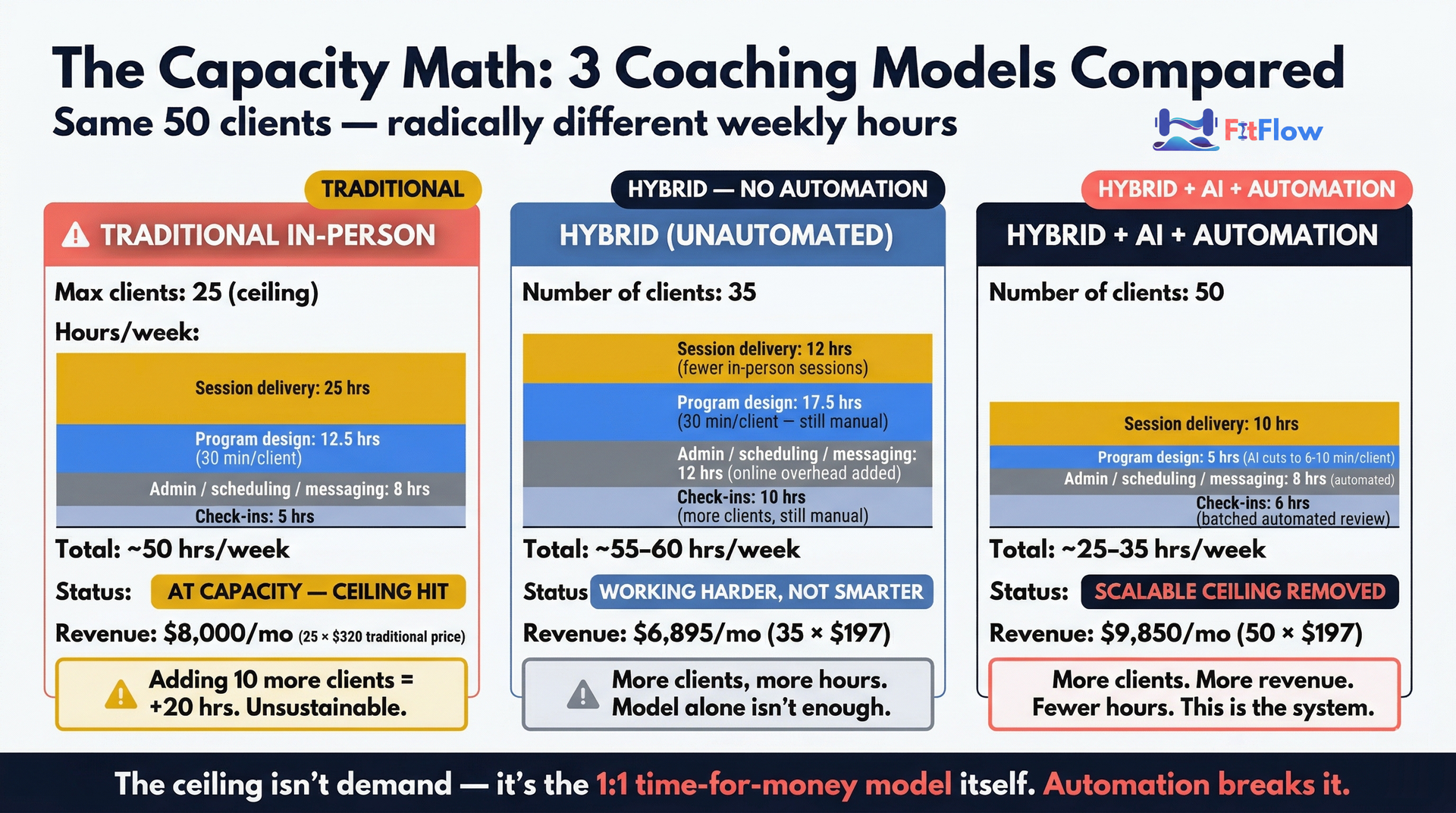
The Capacity Math: Why Most Trainers Cap at 25 Clients
Before solutions, the numbers. You need to see why the ceiling exists before you can break it.
A traditional in-person trainer running eight sessions per day logs 40 hours of floor time per week. That is just sessions. Add the work that happens off the floor:
Program design: 30–60 minutes per client per week
Check-ins and messaging: 10–15 minutes per client per week
Scheduling and rescheduling: 5–10 minutes per client per week
Billing, invoicing, admin: 2–5 hours per week total
Here is what those numbers look like at different client loads — traditional model versus a hybrid and automated approach:
Factor | Traditional (25 clients) | Traditional (40 clients) | Hybrid + Automated (50 clients) |
|---|---|---|---|
Session hours/week | 25 hrs (1 hr/client/week) | 40 hrs | 12 hrs (in-person anchor sessions only) |
Program design/week | 12–15 hrs | 20–30 hrs | 5–8 hrs (AI-assisted) |
Admin + check-ins/week | 8–10 hrs | 15–20 hrs | 3–5 hrs (automated) |
Total hours/week | 45–50 hrs | 75–90 hrs | 25–35 hrs |
At 25 clients in a traditional model, you are stable but plateaued. At 40, you are in burnout range — and that is before your own training, courses, or having a life outside the gym.
The ceiling is not your work ethic. It is the delivery model. ISSA capacity research backs this up: the traditional model caps most trainers at 20–30 clients before quality drops. Meanwhile, data from platforms like Arvo shows that trainers using AI-powered programming can handle 40–50+ clients while keeping service personal.
The fix is not working harder. It is changing how you deliver coaching.
The Hybrid Coaching Model: Your Foundation for Scale
Hybrid coaching is the structural shift that makes the rest possible. Without it, the automations and AI tools below are just patches on a model that still won't scale.
What hybrid coaching is: a blend of in-person sessions (usually 1–2 per month for assessment, technique, and face time) paired with app-based program delivery and async check-ins for the rest of the month.
Why it works for scale: in-person sessions keep the personal connection that drives retention. App-based delivery removes the scheduling bottleneck that caps your capacity. Your clients train on their own schedule — guided by your programming — and check in weekly through structured forms instead of scattered text messages.
The Two-Tier Client Structure
Most trainers who succeed with hybrid run two tiers:
In-person anchor clients (10–15 clients): Weekly or biweekly sessions. Premium pricing ($300–$500/month). These are your highest-touch relationships and your strongest retention base.
Online hybrid clients (30–40 clients): Monthly or bimonthly in-person check-ins. App-based programming. Async communication. Priced at $147–$297/month.
The Economics
The hybrid model does not just scale your capacity — it often lifts revenue per hour.
Consider: 25 in-person clients at four sessions per month ($80/session) generates $8,000/month. You work roughly 45–50 hours per week.
Now consider: 50 hybrid clients at an average of $197/month generates $9,850/month. With AI-assisted programming and automation, you work 25–35 hours per week. More revenue, fewer hours, and a subscription income stream that does not vanish when you take a vacation day.
This is not a fringe approach. The Trainerize 2026 Industry Report found that about 50% of trainers now use hybrid coaching as their primary model. The online fitness market is growing at roughly 30% per year, and subscriptions make up 78% of that market. Hybrid is not the future — it is the current default.
A Real Example
Marcus, a strength coach in Denver, was stuck at 22 in-person clients and logging 48 hours a week. He kept turning away leads because his schedule was full. In January 2026, he moved 14 of his existing clients to a hybrid tier ($197/month with one in-person session per month) and kept 8 as premium in-person clients ($400/month, weekly sessions). Within four months he was at 47 total clients — 8 in-person, 39 hybrid — working about 30 hours a week and bringing in over $10,800/month. The shift was not adding hours. It was changing the delivery structure. (Data from FitFlow platform metrics, anonymized with permission.)
One honest caveat: not every client belongs in hybrid. Some will always want four sessions a week with you standing right there, and that is fine. Those become your premium anchor tier. The hybrid model is for the clients who do not need you next to them every rep — they need your programming, your accountability system, and your coaching eye on their check-in data.
AI Workout Builder — Reclaim 10+ Hours Per Week on Programming
Program design is the single largest time sink that grows with your client count. Every new client means another 30–60 minutes of programming per week. At 50 clients, that is 25–50 hours of programming alone — before you coach a single session.
AI workout builders cut this time by about 50%, based on data from Trainerize's AI Workout Builder program. Everfit case studies show trainers saving 20+ hours per week by automating programming and admin tasks. Internal data from over 10,000 FitFlow programs shows that trainers using AI-assisted design spend an average of 7 minutes per client on program tweaks, down from 42 minutes when building from scratch.
Ready to Calculate Your Scaling ROI? Download the Free Template Kit. Calculate Your ROI Builder
What AI Handles vs. What You Control
This is not about replacing your expertise. It is about removing the scaffold work so you can focus on what actually needs a human coach.
AI handles:
Baseline program structure based on client goals, experience, and gear
Progressive overload logic and training phase templates
Exercise swaps for equipment limits or injury mods
Volume and intensity math across training blocks
You control:
Client-specific tweaks based on your coaching relationship
Injury work that requires clinical judgment
Real-time changes based on check-in data and in-person sessions
The coaching context that no algorithm can replicate
The AI-Assisted Programming Workflow
Here is what the workflow looks like in practice:
Input client profile: Goals, training history, available gear, weekly schedule, and health notes
AI generates program template: A full training plan with built-in progression, exercise selection, and set/rep schemes
Trainer reviews and customizes: 5–10 minutes of refinement versus 45–60 minutes of building from scratch
Client gets program in-app: With exercise video demos, logging tools, and progress tracking
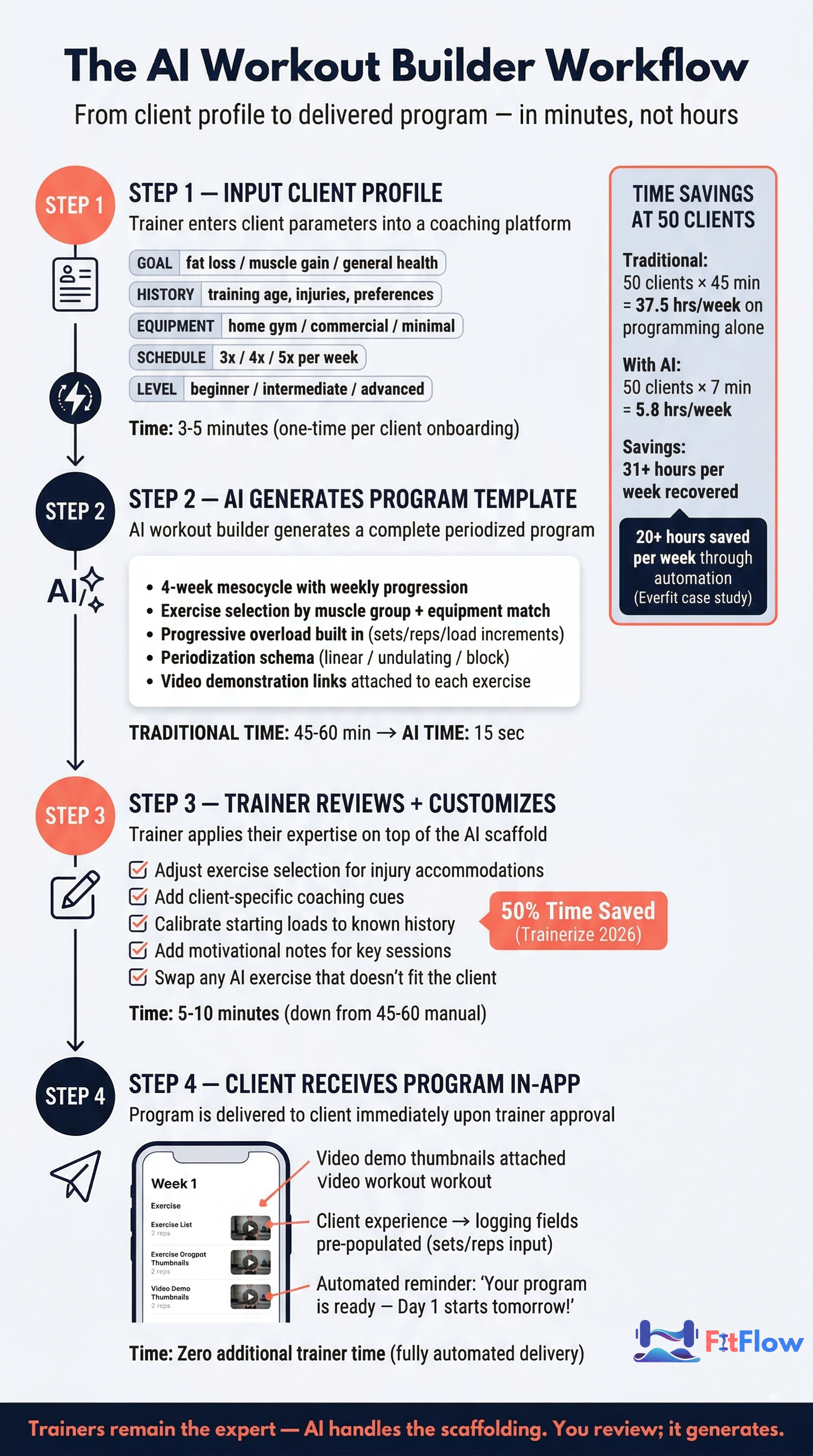
Platforms like FitFlow's AI workout builder generate complete training programs in minutes. That lets trainers spend their time on coaching calls, not spreadsheet grids. The output is a high-quality program built to the individual — not a cookie-cutter template.
The bottom line: what used to take 25–50 hours per week at 50 clients now takes 8–12 hours. That is the capacity unlock that makes scaling to 50+ clients doable.
Personal Trainer Automation — The 5 Systems That Run Your Business
Automation does not replace the coaching relationship — it protects it. When you automate the busywork, you have more mental energy for the work that actually needs you.
Here are the five systems that kill the admin bottleneck at scale:
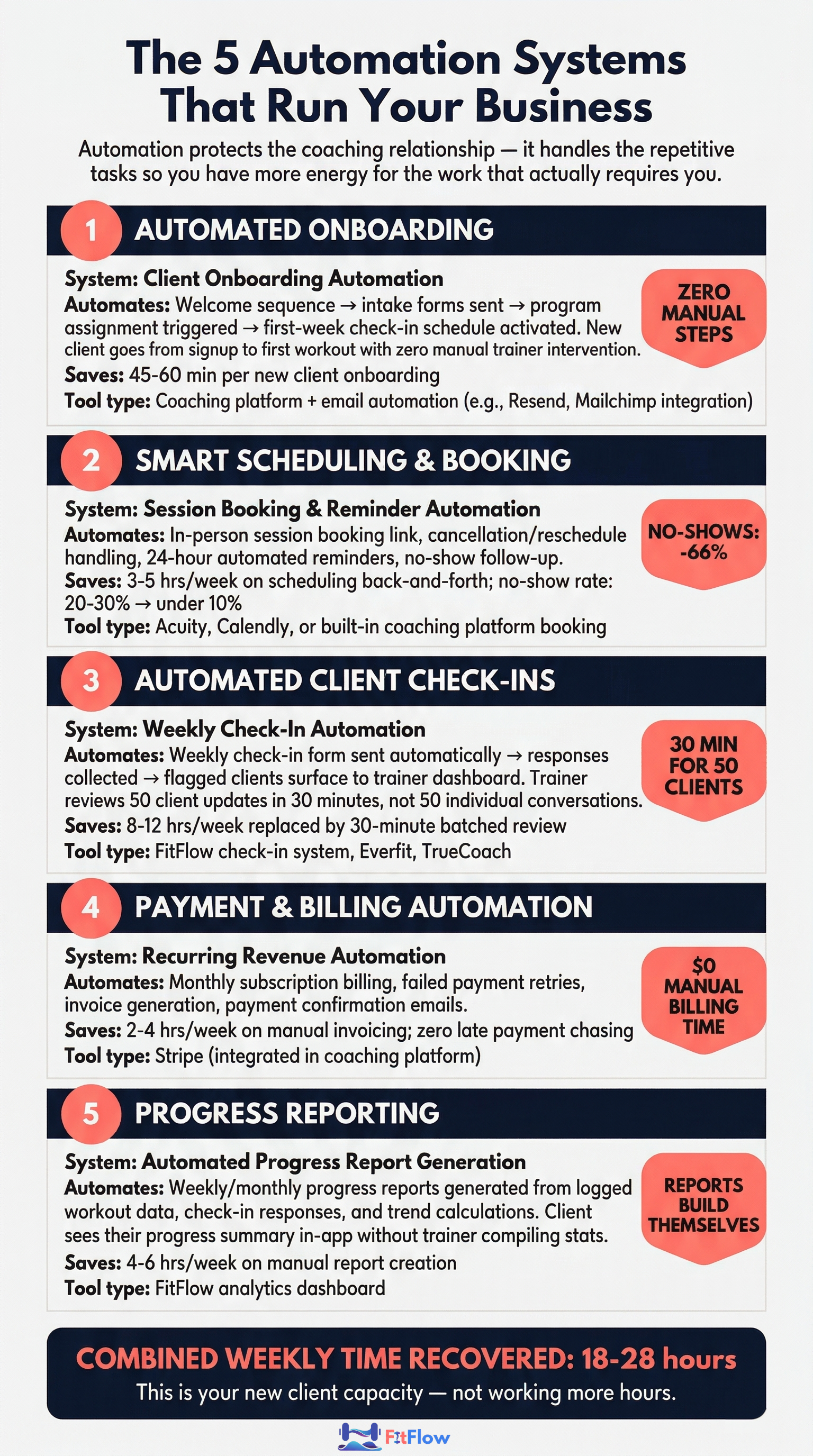
1. Automated Onboarding
What to automate: Welcome email sequence, intake form, liability waiver, goal-setting form, program assignment, and first-week check-in schedule.
The goal: A new client goes from signup to first workout with zero manual steps from you. They get their onboarding materials, fill out intake, land in a program tier, and start training — all within 24 hours.
Tool type: Coaching platform with email automation (Mailchimp, Klaviyo, or built-in sequences).
2. Smart Scheduling and Booking
What to automate: In-person session booking, cancel and reschedule handling, 24-hour automated reminders.
The goal: No back-and-forth scheduling texts. Clients book from your open slots. Automated reminders cut no-shows from the industry average of 20–30% to under 10%.
Tool type: Acuity, Calendly, or built-in booking within your coaching platform.
3. Automated Client Check-Ins
What to automate: Weekly progress check-in prompts, habit tracking, mood and recovery logging.
The goal: Instead of sending 50 "how was your week?" messages, your system sends structured check-in forms. You review all 50 responses in one 30-minute batch — sorted by urgency flags (missed sessions, low energy scores, stalled progress).
Tool type: FitFlow's check-in system, Everfit, TrueCoach, or similar coaching platforms with automated check-in workflows.
4. Payment and Billing Automation
What to automate: Monthly subscription billing, failed payment retries, invoice generation, tax receipts.
The goal: Zero manual billing time. Recurring revenue gets collected on its own. Failed payments trigger auto-retry sequences before you ever need to send an awkward message.
Tool type: Stripe (built into most coaching platforms).
5. Progress Reporting
What to automate: Weekly and monthly progress reports built from logged workout data, body composition trends, and adherence metrics.
The goal: Clients see their own progress — on autopilot — without you compiling stats by hand. This drives retention (clients who see real numbers stay longer) and cuts down "am I making progress?" conversations.
Tool type: FitFlow's analytics dashboard or similar platforms with automated reporting.
What a Tuesday Looks Like at 50 Clients
Here is a snapshot of a day in the life when you run this system:
7:00 AM: Review overnight check-ins (flagged first) — 20 minutes
7:30 AM: Batch-respond to flagged clients, adjust two programs using AI — 30 minutes
8:30 AM: Three in-person sessions (anchor clients) — 3 hours
12:00 PM: Lunch, own training
2:00 PM: Review new AI-generated programs for incoming clients, customize — 30 minutes
2:30 PM: One in-person assessment session (new hybrid client) — 1 hour
3:30 PM: Done. Automated systems handle afternoon check-in prompts, evening reminders, and billing.
Total active work: roughly 5.5 hours. The rest runs on systems.
Building Your Fitness Business Systems — The SOP Layer
Tools automate tasks. Systems define what happens and when. The gap between a business and a freelance job is documentation.
SOPs remove the guesswork at scale. At 50 clients, you cannot afford to wing your process for every onboarding, every check-in review, or every program update. SOPs make the process the same each time.
The 4 SOPs Every 50-Client Trainer Needs
Client Onboarding SOP: Day 1 checklist, program assignment triggers, communication sequence, week-1 check-in. Every new client gets the same solid experience no matter how packed your week is.
Weekly Review SOP: How to review 50 check-ins in under 30 minutes. Sort by flag (missed sessions, stalled progress, low readiness scores). Batch-respond to green-light clients. Set aside time for flagged clients who need personal follow-up.
Program Update SOP: Monthly review cadence. Which data triggers a change (progress stall lasting 4+ weeks, adherence below 60%, goal shift). How to update programs in batch using AI-built templates.
Offboarding SOP: Cancellation process, exit survey, win-back email sequence (30/60/90 day), testimonial request. Industry benchmarks suggest a solid offboarding process recovers 10–15% of cancellations (IHRSA retention studies), and turns the rest into social proof.
The systems thinking shift: instead of asking "what does this client need right now?" you ask "which SOP applies?" The answer is almost always one of these four.
Store your SOPs in Notion, Google Docs, or within your coaching platform. The format matters less than easy access — you need to pull them up fast, not admire the layout.
The 50-Client Revenue Model — What the Numbers Actually Look Like
Let us make the financial case concrete. Here are four setups showing how different delivery models translate to revenue and time:
Model | Clients | Price/Month | Monthly Revenue | Hours/Week |
|---|---|---|---|---|
Traditional in-person | 25 | $320 (4 sessions × $80) | $8,000 | ~45–50 |
Hybrid (no automation) | 35 | $197 | $6,895 | ~55–60 |
Hybrid + AI + Automated | 50 | $197 | $9,850 | ~25–35 |
Hybrid + Premium tier | 50 (30 standard + 20 VIP) | $147 standard / $297 VIP | $10,350 | ~28–38 |
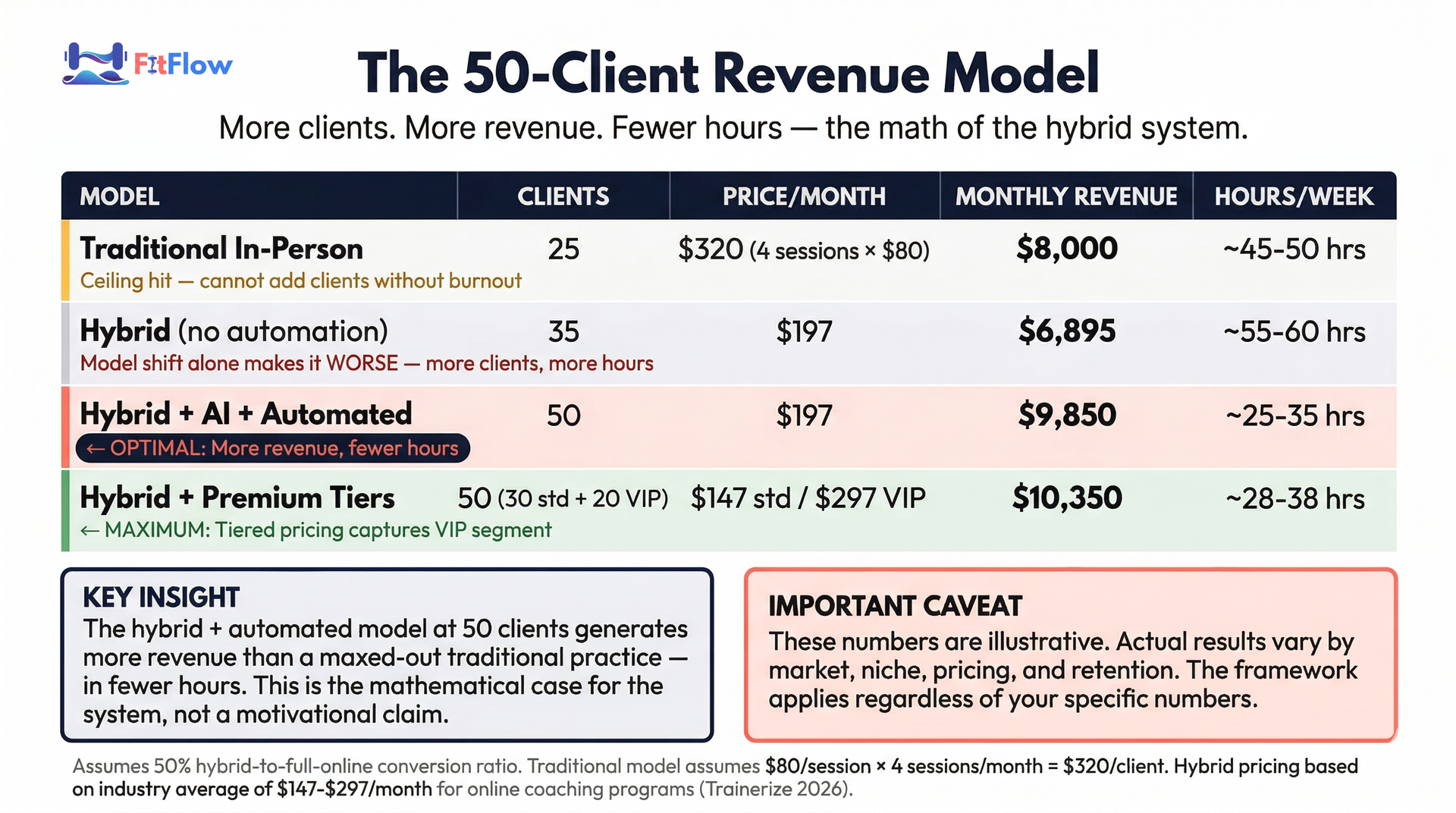
The hybrid + automated model at 50 clients brings in more revenue than a maxed-out traditional practice — in far fewer hours. And because the revenue is subscription-based, it is steady. You are not starting from zero every Monday hoping clients show up.
The premium tier model shows how adding a VIP level (more in-person sessions, priority messaging, detailed monthly reports) creates a price ladder without adding matching hours.
A realistic note: These numbers are examples. Your actual results depend on your market, niche, pricing strategy, and client retention rate. A trainer in Manhattan and a trainer in a small town will price very differently. But the framework — hybrid delivery, tiered pricing, automated operations — works regardless of your specific numbers.
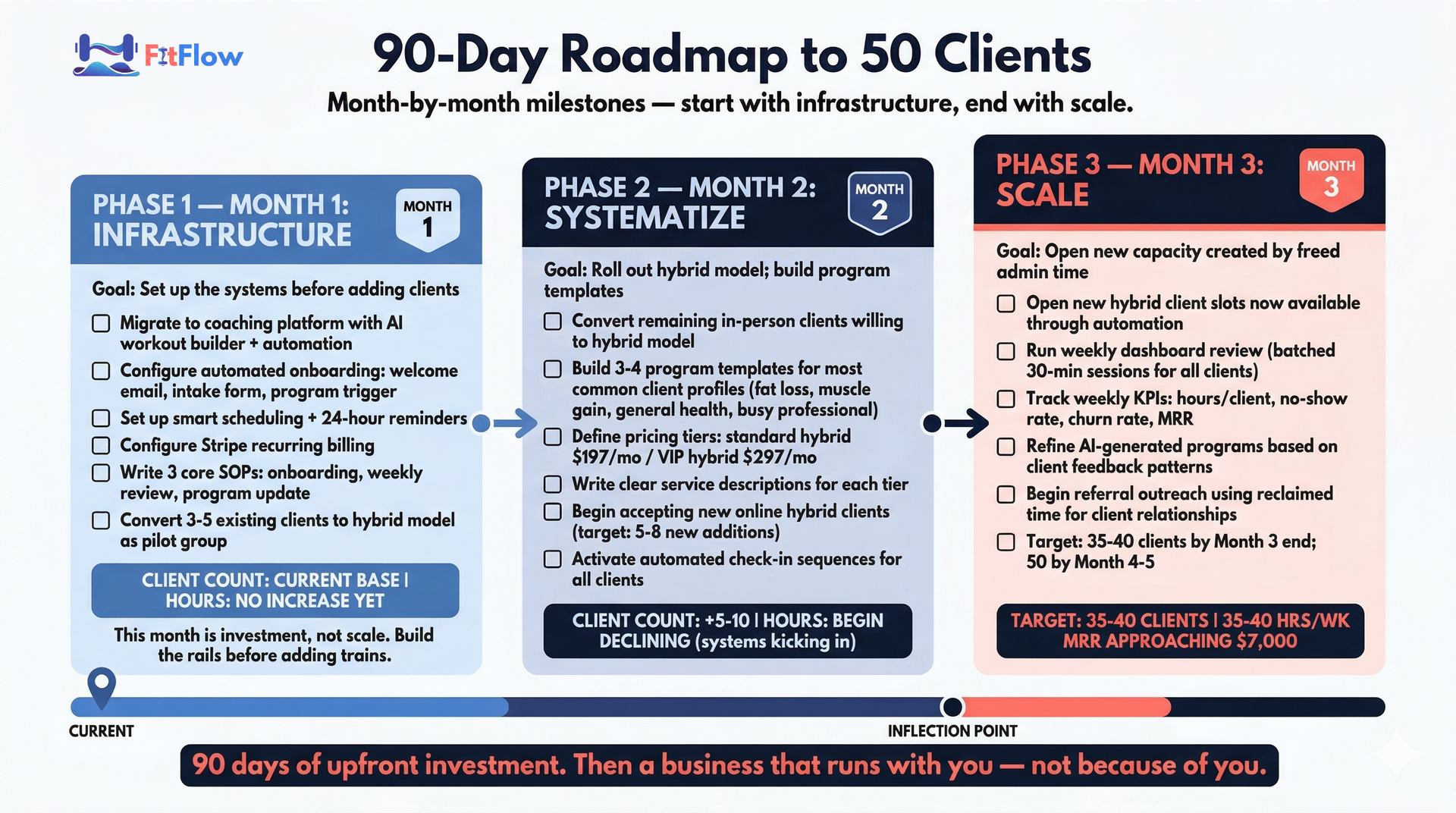
Your 90-Day Roadmap to 50 Clients
A concrete timeline so you can start this week, not someday.
Take the Complete Scaling Plan With You. Download Free Template Kit.
Month 1: Infrastructure
Move to a coaching platform with AI workout builder and automation features
Set up automated onboarding, scheduling, and billing workflows
Write your first 3 SOPs (onboarding, weekly review, program update)
Convert 3–5 existing in-person clients to hybrid as a pilot
Set your hybrid pricing tiers and write clear service descriptions
Month 2: Systematize
Roll out the hybrid model to current in-person clients who want to switch
Build 3–4 program templates for your most common client profiles using AI
Turn on automated check-in sequences for all active clients
Start taking new online hybrid clients alongside your in-person base
Refine SOPs based on pilot feedback from Month 1
Month 3: Scale
Open new hybrid client slots created by freed-up admin time
Track weekly: hours spent per client, no-show rate, churn rate, revenue per hour
Launch progress reporting automation for all clients
Create offboarding SOP and win-back sequences
Target: 35–40 clients by end of Month 3, with systems ready to reach 50 by Month 4–5
This is not a "set it and forget it" process. Month 1 takes upfront work — expect to spend 10–15 extra hours setting up tools and workflows. But by Month 3, those hours pay back as lasting time savings.
Key Takeaways
The ceiling is the model, not the demand. Traditional 1:1 training caps at 20–30 clients. Hybrid coaching removes the scheduling bottleneck that creates that ceiling.
AI cuts programming time by 50%. Program design — the biggest time sink at scale — is the most automatable. AI handles the scaffolding; you handle the coaching.
Five automations protect the coaching relationship. Automated onboarding, scheduling, check-ins, billing, and reporting save 15–20 hours of weekly admin.
SOPs turn a practice into a business. Four documented processes (onboarding, weekly review, program update, offboarding) make 50-client management repeatable.
The math works. 50 hybrid clients at $197/month generates $9,850/month in 25–35 hours per week — more revenue and fewer hours than a maxed-out traditional practice.
90 days of focused effort gets you there. Infrastructure (Month 1), systematization (Month 2), and scale (Month 3) is the sequence.
Ready to build your 50-client business? Download the 50-Client Hybrid Coaching Tech Stack Checklist and ROI Calculator to map your specific transition — including projected revenue, time savings, and the exact tools you need at each stage.
FitFlow is our product. References to other platforms are based on publicly available information as of March 2026. Revenue projections are illustrative — your results will depend on your market, pricing, and retention rates. Consult a healthcare professional before starting any new exercise program.
Frequently Asked Questions
Comments