
You Don't Need More Clients. You Need Better Systems.

You have 28 clients. You work 55 hours a week. Your mornings are coaching. Your afternoons are writing programs. Your evenings are answering texts, chasing invoices, and wondering why your best client of eight months just ghosted.
Find Out Which Systems Are Costing You Clients and Revenue. Get Your Free Systems Audit.
Your instinct? "I need to post more on Instagram. I need more clients."
That instinct is wrong.
The fitness industry has one default answer to every business problem: get more clients. Revenue down? More clients. Can't pay rent? More clients. Best client left? Replace them with two new ones.
But here is what nobody in your certification program told you: if your personal training business systems cannot retain the clients you already have, more clients just means more chaos at a higher volume. You are pouring water into a bucket with five holes in the bottom and wondering why it never fills up.
You don't need more clients. You need better systems.
This article is about business systems — the operational infrastructure that manages the client lifecycle from first contact to long-term retention: scheduling, onboarding, billing, retention workflows, and admin automation. This is not about coaching methodology. We previously explored how coaching systems determine client results. This article tackles the other half: the business systems that determine whether your business survives.
The economics are unambiguous. It costs 6-7x more to acquire a new client than to retain an existing one (Harvard Business School via Arvo, 2026). A 5% increase in client retention can boost profits by 25-95% (TrueCoach, 2026). Yet most trainers spend 80% of their business energy on acquisition and 20% on retention.
That ratio is backwards. Here are the 5 personal training business systems that separate trainers who plateau at $6K/month from trainers who scale past it — without a single new Instagram post.
The Real Reason Your Business Is Stuck (It's Not Marketing)
You have heard the advice cycle. Struggling? Post more on social media. Need more revenue? Run Facebook ads. Lost a client? Replace them.
Here is the math that breaks that logic.
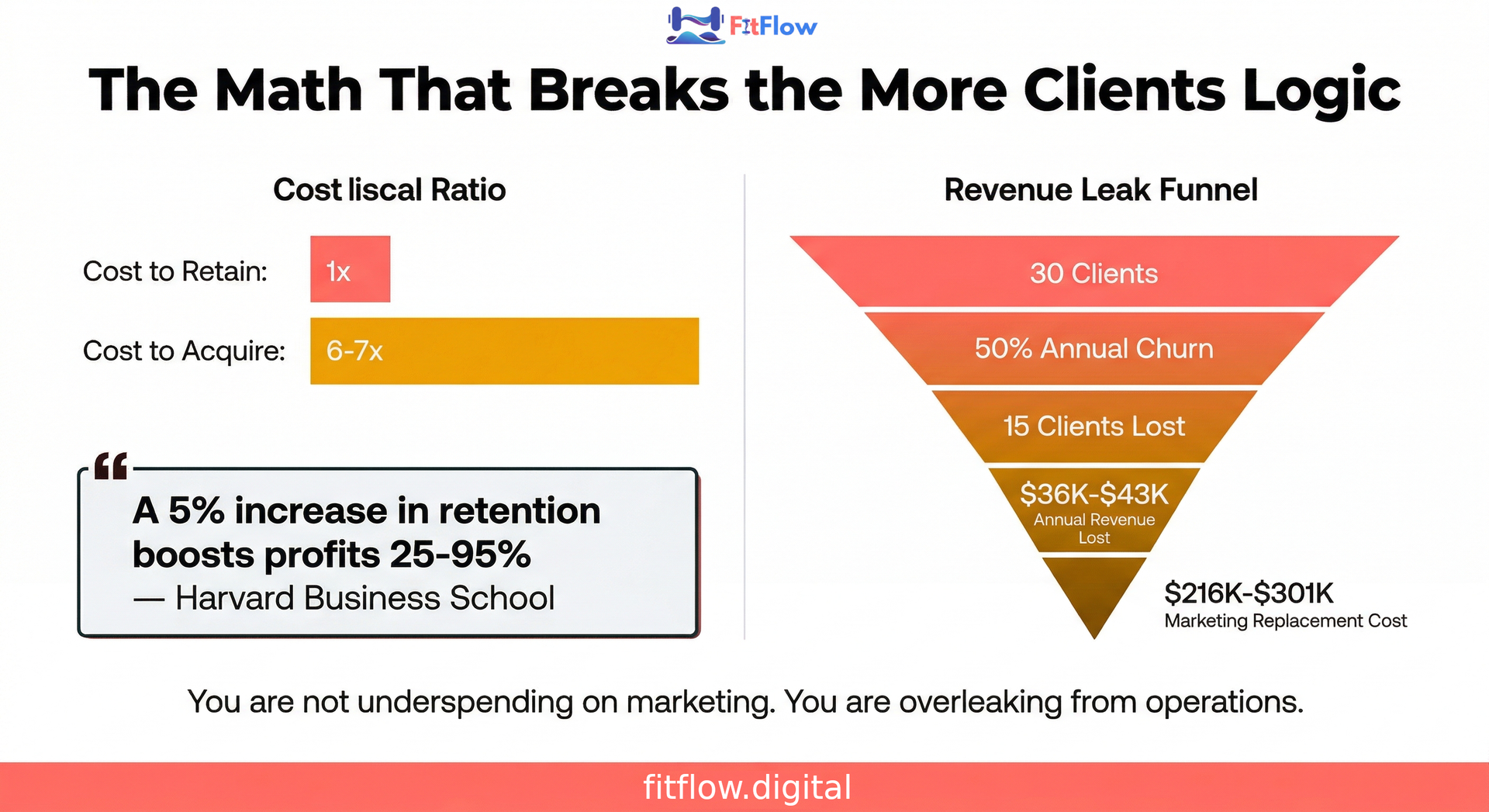
The average client retention rate for personal trainers is 50-60% annually (Trainero, 2026; FITSW). That means if you have 30 clients at an average of $200/month, you lose 15-18 of them every year. That is $36,000-$43,200 in annual revenue walking out the door.
Now consider what it costs to replace them. At 6-7x the retention cost, filling those 15 empty slots requires the marketing-equivalent investment of $216,000-$302,400. No Instagram strategy on earth covers that gap.
And the acquisition channel itself is drying up. Four in five trainers report that finding new clients is harder or has plateaued compared to previous years (Trainerize 2026 State of the Industry Report). The pipeline that used to refill your roster is narrowing while your churn rate stays the same.
This is why 80% of personal trainers quit within their first two years (FitBudd; BrainzMagazine; Striive). Not because they are bad coaches. Because the business operations required to sustain a practice — scheduling, billing, client communication, retention monitoring — were never taught in any certification program.
The diagnosis is straightforward: most trainers are running a coaching practice, not a business. A business has systems. A practice has a person doing everything manually until they burn out.
If acquisition is harder and retention is cheaper, the highest-ROI investment is not a new marketing channel. It is operational infrastructure.
Here are the 5 systems that matter.
The 5 Personal Training Business Systems That Drive Growth
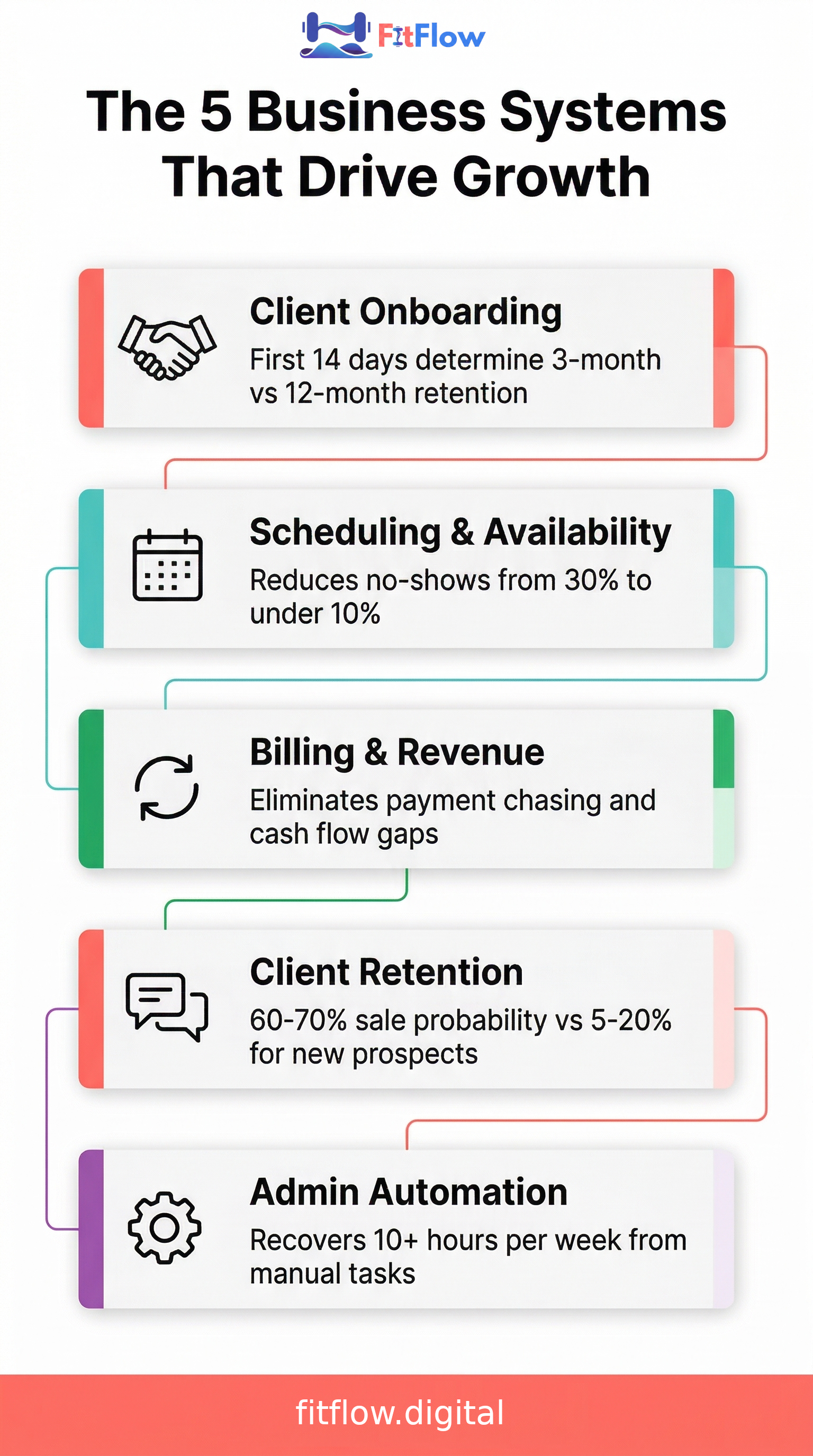
Most trainers have a coaching skillset. Almost none have a business system. A coaching skillset tells clients what to do. A business system ensures the business runs — clients are onboarded smoothly, sessions happen on time, payments collect automatically, retention is actively managed, and admin does not consume your week.
These are the 5 operational systems that separate plateaued trainers from scaling ones.
1. Client Onboarding System
The first 14 days of a client relationship determine whether they stay for 3 months or 12 months. A structured onboarding sequence — welcome email, intake forms, goal-setting call, first-week check-in schedule, program assignment — creates the "this is professional" impression that sets the retention trajectory for everything that follows.
Without it, new clients drift. They are unsure how scheduling works, when check-ins happen, or what the next step is. Confusion in the first two weeks is the leading predictor of early churn.
The data: 60% of clients who achieved their fitness goals still left their trainer — because no follow-up plan or transition was offered (PTDC). The relationship is lost at transitions, and onboarding is the first critical one.
The system: Automated welcome sequences, digital intake forms, scheduled first-week touchpoints, and templated program assignment — all triggered the moment a client signs up.
2. Scheduling and Availability System
Back-and-forth scheduling via text message is the signature of an unsystematized business. Every manual scheduling interaction costs 5-10 minutes and creates friction that erodes the client experience. Multiply that across 30 clients rescheduling once a month, and you have burned 2.5-5 hours on a task that software handles in zero.
The data: Automated reminders reduce no-shows from 20-30% to under 10% (Mindbody). For a trainer averaging $75/session, reducing no-shows by just 2-3 per month saves $150-$225/month — that is $1,800-$2,700 per year in recovered revenue.
The system: Online self-service booking, automated confirmations and reminders (24-hour and 1-hour), and cancellation/reschedule policies enforced by software rather than awkward conversations.
3. Billing and Revenue System
Manual invoicing — Venmo requests, end-of-month emails, "hey, you owe me for last week" texts — is the most common revenue leak in personal training. It delays cash flow, creates awkward money conversations that damage the coaching relationship, and signals to clients that you are running a side project, not a business.
The probability of selling to an existing client is 60-70%, compared to 5-20% for a new prospect (TrueCoach, 2026). Every dollar you fail to collect from a current client is harder to replace than it looks.
The system: Automated recurring billing (Stripe, Square, or built into your coaching platform), failed payment auto-retry sequences, subscription-based pricing models, and a payment tracking dashboard so you never have to ask "who owes me this month?"
4. Client Retention and Communication System
The gap between sessions is where client motivation either dies or grows. Trainers who maintain 2-3 structured touchpoints per week beyond sessions see measurably better retention rates than those who only communicate face-to-face (Arvo, 2026).
Yet most trainers treat between-session communication as "I'll check in when I remember." That is not a system. That is hoping your memory holds across 30 different client relationships.
The data: The average client relationship in personal training lasts 3-6 months (Trainero, 2026). The trainers who push that to 9-12 months are not necessarily better coaches — they have a retention system that catches declining engagement before it becomes a cancellation email.
The system: Automated weekly check-in prompts, progress milestone triggers, re-engagement sequences for clients who go quiet for 7+ days, and a structured communication cadence that runs whether you remember or not. FitFlow's retention automation, for example, flags at-risk clients automatically — but any structured cadence beats none.
Recognize 3 or More of Those Signs? Score Yourself Across All 5 Systems. Get Your Full Diagnosis.
5. Admin Automation System
Trainers spend up to 30% of their working week on administrative tasks (Fitness Gear & Training; Trainerize, 2026). For a trainer working 50 hours/week, that is 15 hours of scheduling texts, program writing from scratch, invoice chasing, and client data management.
At a coaching rate of $50-$100/hour, those 15 hours represent $750-$1,500/week in forfeited coaching revenue — roughly $39,000-$78,000 per year spent on tasks that generate no direct revenue.
The data: 67% of trainers identify AI and automation as the number one industry trend, and 64% are already using AI tools regularly for admin, marketing, and programming tasks (Trainerize 2026 Report). This is not a future trend. This is current practice for the majority of the industry.
The system: AI-assisted program generation from templates (not writing every program from scratch), automated progress reports pulled from logged data, batch client review workflows, and template libraries for common client profiles. The goal is to cut admin from 15 hours/week to 5 or fewer.
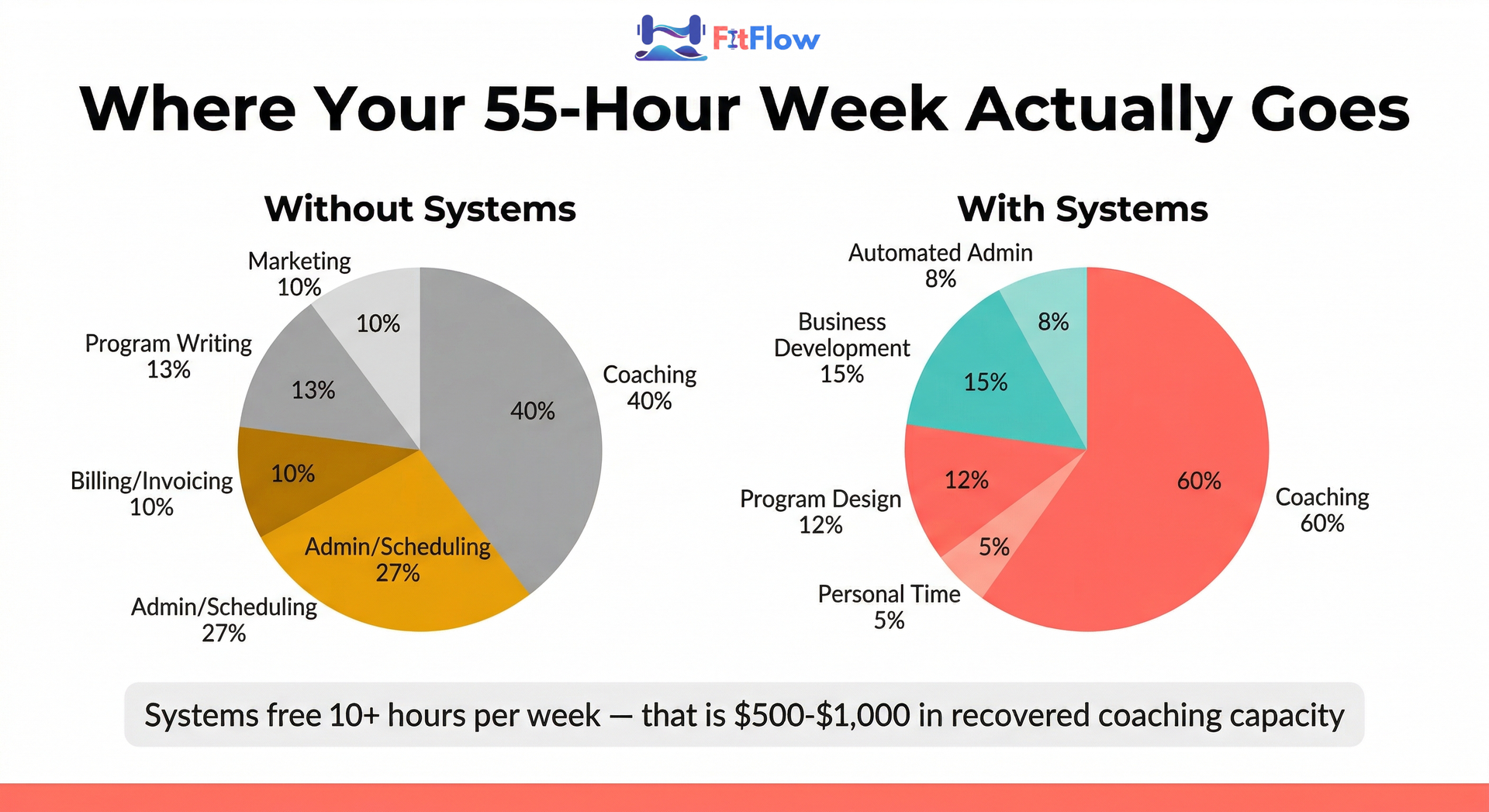
The key message across all 5 systems: You do not need to be a better marketer. You need to be a better operator. Each of these systems compounds — better onboarding improves retention, better retention stabilizes revenue, stable revenue frees time from acquisition hustling, and freed time goes into coaching (or into your life outside of work).
The Operations Audit: 5 Signs Your Systems Are Broken
Read these five signs. If three or more describe your business, your operations are the bottleneck — not your client count.
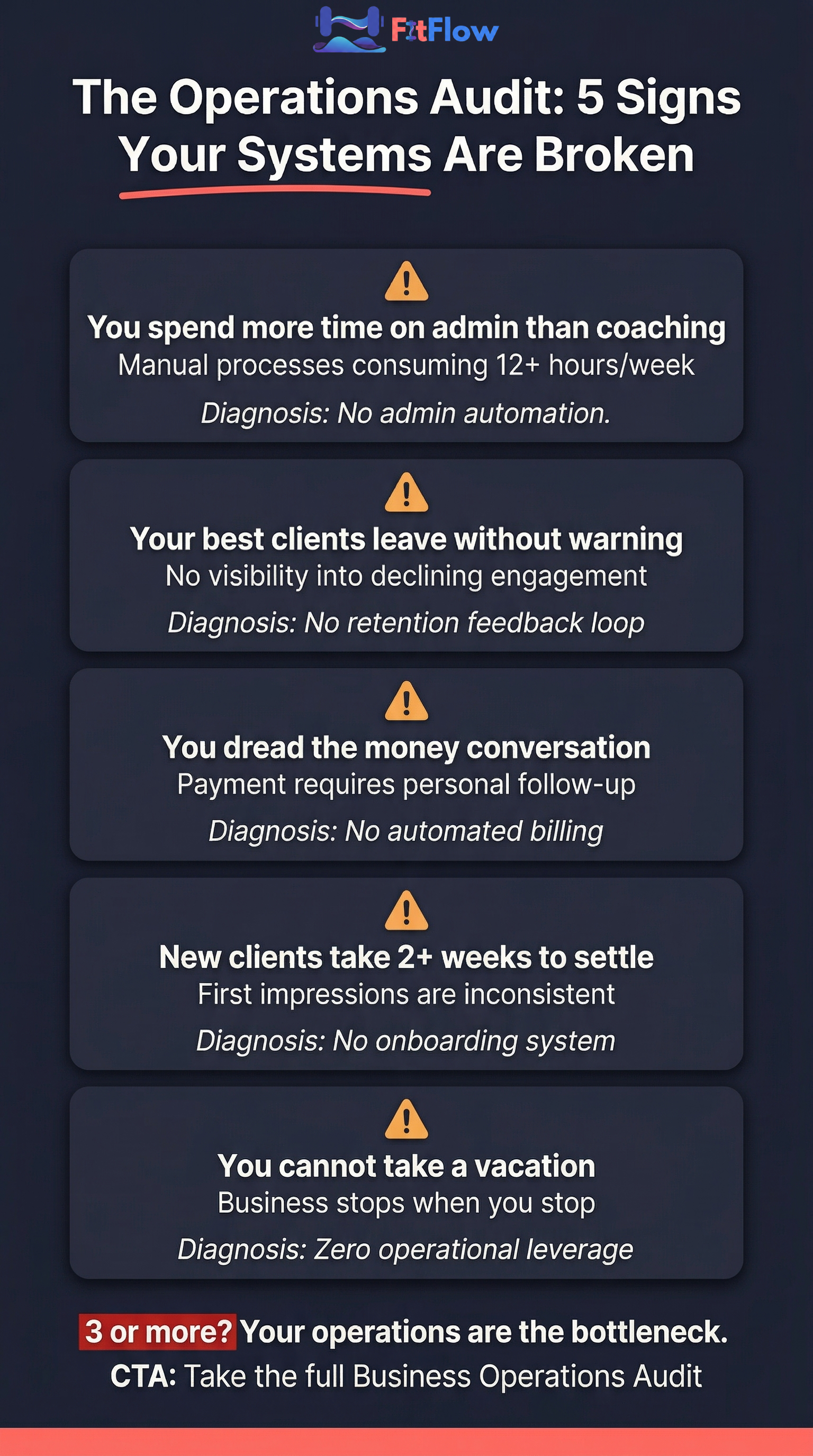
1. You spend more time on admin than coaching.
Your weekly calendar has more hours dedicated to scheduling, billing, program writing, and text messaging than actual coaching sessions. You started this career to coach. You spend most of it being your own secretary.
System diagnosis: No admin automation layer. Manual processes are consuming 12+ hours/week.
2. Your best clients leave without warning.
You thought everything was fine. Then a six-month client cancels with "I just need a break." You had no visibility into their declining engagement — missed check-ins, shorter sessions, fewer messages — because you have no retention monitoring system.
System diagnosis: No retention feedback loop. No automated re-engagement triggers. No visibility into adherence trends. For context, the 5 metrics that predict client results can provide the tracking infrastructure your retention system needs.
3. You dread "that conversation" about money.
Collecting payment requires a personal text, a reminder email, or an awkward face-to-face ask. One client owes you for three weeks and you have not brought it up because it feels uncomfortable. Your revenue is unpredictable because it depends on manual follow-up.
System diagnosis: No automated billing. Cash flow depends entirely on your willingness to have uncomfortable conversations.
4. New clients take 2+ weeks to feel settled.
They signed up excited. Two weeks later, they are still confused about scheduling, have not received their full program, and are not sure how check-ins work. That initial enthusiasm is fading into frustration.
System diagnosis: No onboarding system. First impressions are inconsistent. Early churn risk is high.
5. You cannot take a vacation without your business stopping.
If your entire operation depends on you being personally available seven days a week, you do not have a business. You have a job that happens to pay per client — and it has no sick days, no PTO, and no off switch.
System diagnosis: No automated workflows. No systems running independent of the owner. Zero operational leverage.
If three or more of these apply, the fix is not a better Instagram strategy. The fix is operational infrastructure.
Free: Business Systems Audit. Get the Audit.
Same Business, Two Systems: A Case Framework
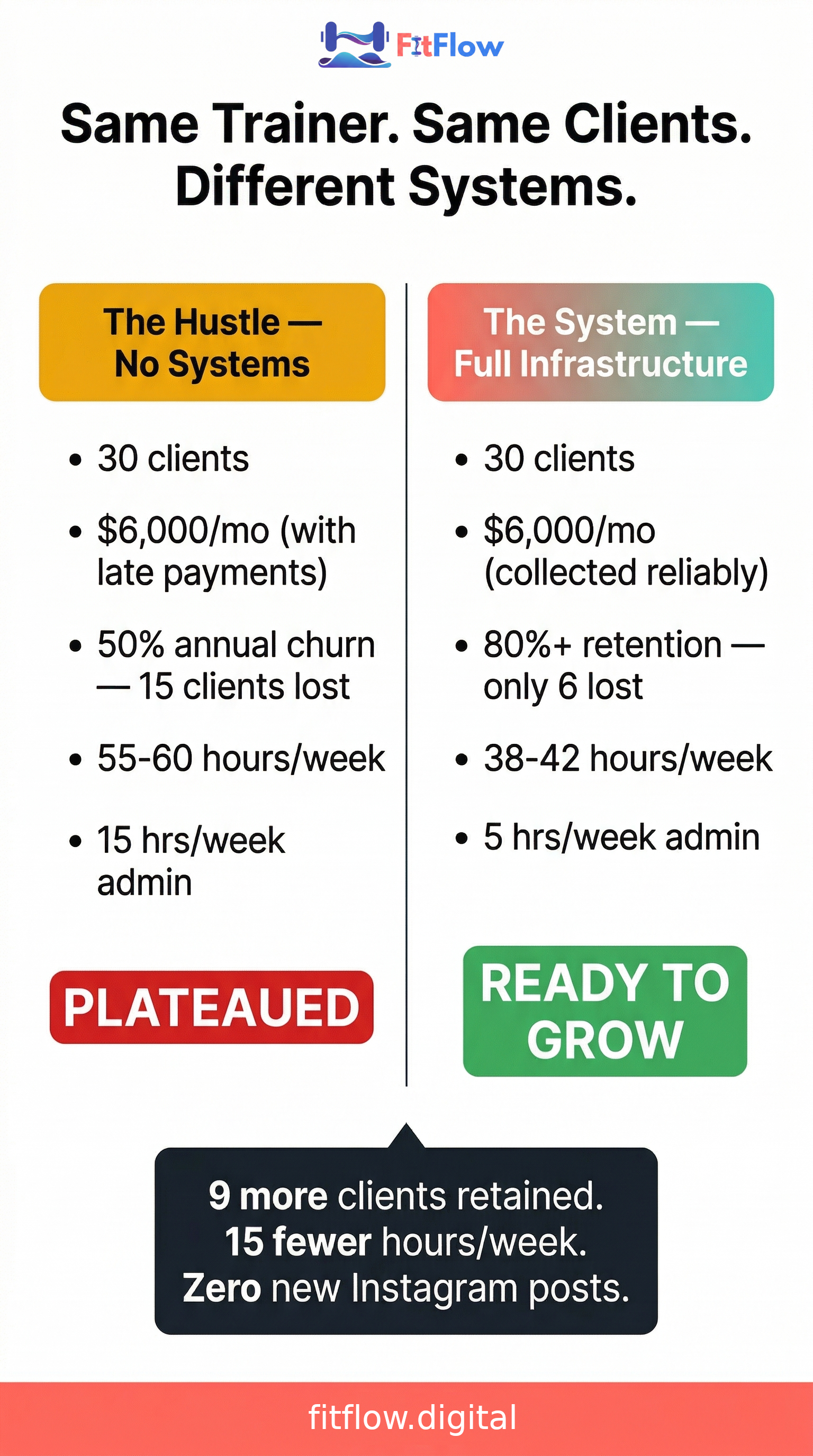
Abstract concepts become real through comparison. Here is the same trainer — same credentials, same clients, same coaching ability — running two different operations.
The Trainer (held constant): Certified for 4 years. Specializes in strength and fat loss. Has 30 clients. Charges $200/month average. Works 55 hours/week.
Operations A: "The Hustle" (No Systems)
Area | How It Works | Result |
|---|---|---|
Scheduling | Clients text to book; trainer manages calendar manually | 3-4 no-shows per week |
Onboarding | PDF welcome packet emailed; trainer follows up "sometime this week" | New clients confused for 2+ weeks |
Billing | Venmo requests at end of month; 2-3 clients consistently late; one owes 6 weeks | Unpredictable cash flow |
Retention | Trainer notices client stopped responding after 4 months; no protocol | Clients ghost without warning |
Admin | 15 hours/week on scheduling texts, programs from scratch, invoice chasing | Time swallowed by non-coaching tasks |
Year 1 Result: 30 clients. $6,000/month average (with late payments dragging it down). 50% annual churn — 15 clients lost. 55-60 hours/week. Income plateaued. Trainer considering quitting.
Operations B: "The System" (Full Infrastructure)
Area | How It Works | Result |
|---|---|---|
Scheduling | Online self-service booking with automated reminders | No-shows drop to 1/week |
Onboarding | Automated 14-day sequence: welcome email, intake form, program assignment, first-week check-in | New client settled within 5 days |
Billing | Recurring subscription billing via Stripe; failed payments auto-retry 3x | Zero awkward conversations; reliable cash flow |
Retention | Automated weekly check-ins; system flags declining engagement; re-engagement fires at 7 days inactive | At-risk clients caught early |
Admin | 5 hours/week — AI-assisted programs, auto-generated progress reports, batch review workflows | Time returned to coaching (or life) |
Year 1 Result: 30 clients. $6,000/month collected reliably. 80%+ annual retention — only 6 clients lost instead of 15. 38-42 hours/week. Capacity freed for 8-10 more clients without adding hours.
Same trainer. Same skills. Same client count. Different operations.
The trainer in System B retained 9 more clients, worked 15 fewer hours per week, and freed capacity to grow — all without a single new Instagram post. Over a full year, those 9 retained clients represent $21,600 in preserved revenue that System A lost to churn.
If you want to understand how this systems-first approach scales to 50+ clients, see the complete scaling playbook for personal trainers. And for a comprehensive view of how these operational systems fit into building a thriving PT business, the business growth guide covers the full picture.
Where to Start: The First System to Build This Week
You do not need to build all five systems overnight. That is the same "do everything at once" trap that got you here. Trying to overhaul your entire operation in a weekend leads to half-built systems that create more confusion than the manual processes they replaced.
Start with the highest-impact, lowest-effort system: automated billing.
Here is why billing comes first:
It is the simplest to implement (Stripe subscriptions, Square recurring, or built into any coaching platform)
It eliminates the most emotionally draining task (chasing payments)
It immediately stabilizes cash flow, which reduces financial stress and frees mental bandwidth for everything else
It signals to clients that this is a professional operation
Your implementation roadmap:
This week: Audit your current systems using the Business Operations Audit (below). Score yourself across all 5 areas. Know where you stand.
Week 1: Move all clients to automated recurring billing. Even if it is just Stripe subscriptions without a full platform — automate the money first.
Week 2: Set up automated scheduling with reminders. Calendly, Acuity, or your coaching platform. Eliminate the scheduling text chain.
Within 30 days: Implement a basic onboarding sequence for new clients — even a simple 3-email automation beats a manual "I'll follow up when I remember" approach.
Each system you build frees time and reduces chaos, making the next system easier to implement. This is not a linear process — it compounds.
For trainers who want to see how all five systems connect into a complete fitness tech stack for personal trainers, the technology selection guide covers the tool landscape in depth.
And for trainers ready to systematize everything at once, FitFlow's platform handles scheduling, onboarding, billing, retention automation, and AI-assisted programming in one integrated stack. But the principle holds regardless of what tools you use: systems first, scale second.
Key Takeaways
The "more clients" instinct is a misdiagnosis. If your retention rate is 50-60% (industry average), you lose half your roster every year. More clients at that churn rate means more chaos, not more growth.
80% of personal trainers quit within 2 years — not from bad coaching, but from briken operations. Personal training business systems — not better programming — are what most trainers are missing.
The 5 business systems that drive growth: Client Onboarding, Scheduling and Availability, Billing and Revenue, Client Retention and Communication, and Admin Automation.
Same skills, different systems = different outcomes. A systematized trainer retains 9 more clients per year, works 15 fewer hours per week, and frees capacity to grow.
Start with automated billing. It is the fastest to implement, eliminates the most painful task, and immediately stabilizes cash flow.
Retention is 6-7x cheaper than acquisition. Every dollar spent on keeping a client delivers more ROI than any dollar spent finding a new one.
You do not need to build everything at once. One system per week for 30 days will transform your operations without overwhelming your bandwidth.
You don't need more clients. You need the infrastructure to serve the ones you already have. Build the systems. The growth follows.
You've Seen the 5 Systems. Now Score Yours. Download the Free Audit.
Frequently Asked Questions
Comments