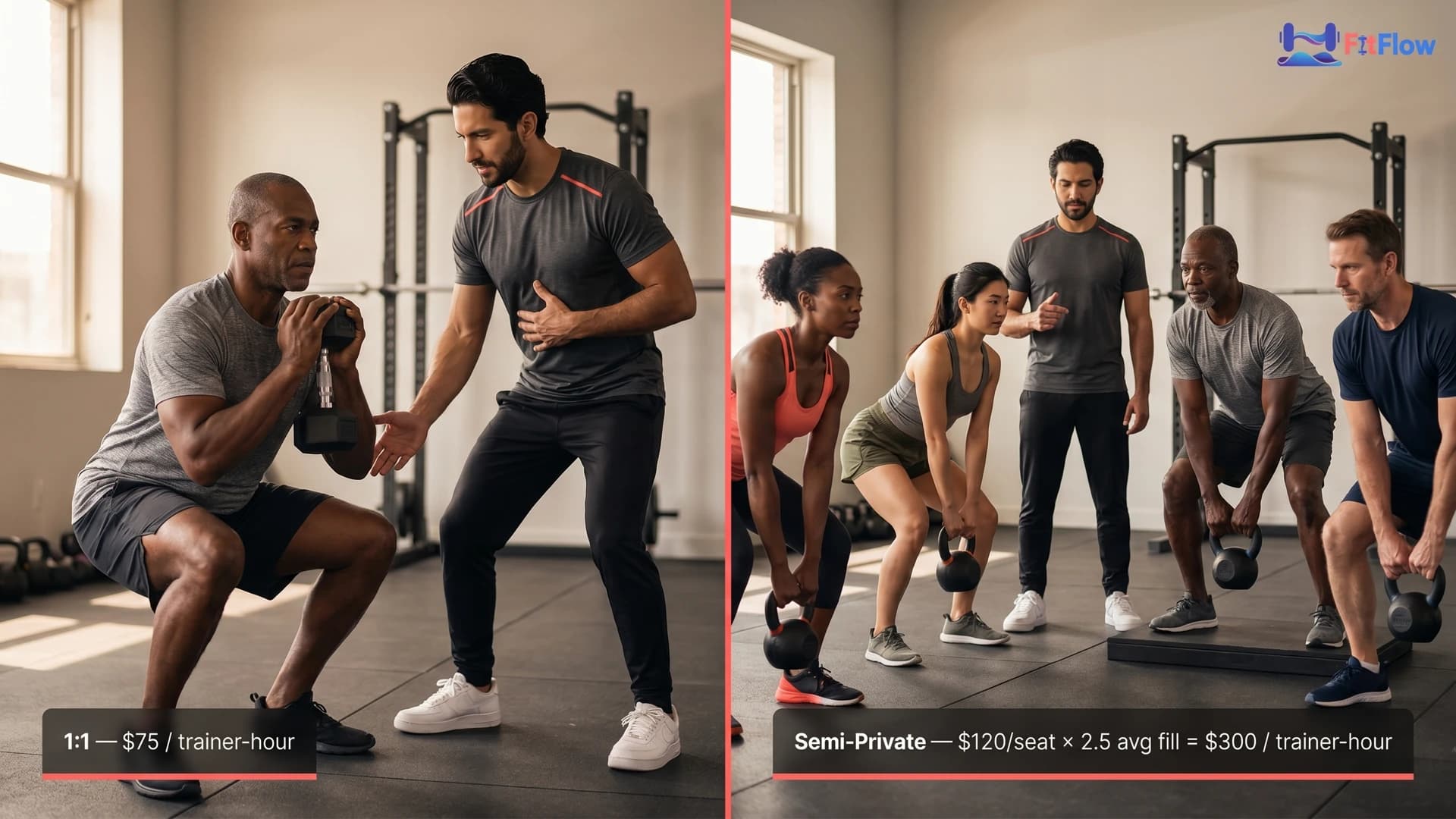
Referrals Don't Feel Sleazy Because You're Pushy. They Feel Sleazy Because You Have No System.

The statistical paradox nobody talks about
Your client just hit a personal best. They racked the bar, turned to you, and said the words you've heard a hundred times: "I haven't felt this strong in years." You smiled. You wrote it in their log. You let the moment pass.
That moment was a referral trigger. You didn't use it because you didn't have a system to use it with. Somewhere in the back of your head, the same thought flickered: I should ask, but I don't want to be that trainer.
Here is the paradox. Per Fitness Mentors' 2026 survey of roughly 500 personal trainers, more than 50% of trainers cite word-of-mouth as their primary acquisition channel. The Nielsen 2021 Trust in Advertising study explains why: 88% of consumers trust personal recommendations more than any other form of advertising. A widely cited Dale Carnegie study makes the gap painful: 91% of customers say they'd give referrals if asked, yet only 11% of salespeople ask. In a market of 370,100 fitness trainers and instructors employed in the US in 2024 (per the Bureau of Labor Statistics Occupational Outlook), that ask gap translates directly into unbilled revenue.
The most trusted acquisition channel in the industry is also the least systematized. That gap is the gap.
Referrals don't fail because trainers feel awkward asking. They fail because there's no designed moment, no specific ask, and no fulfillment loop. Discomfort is a symptom of missing architecture, not a personality flaw.
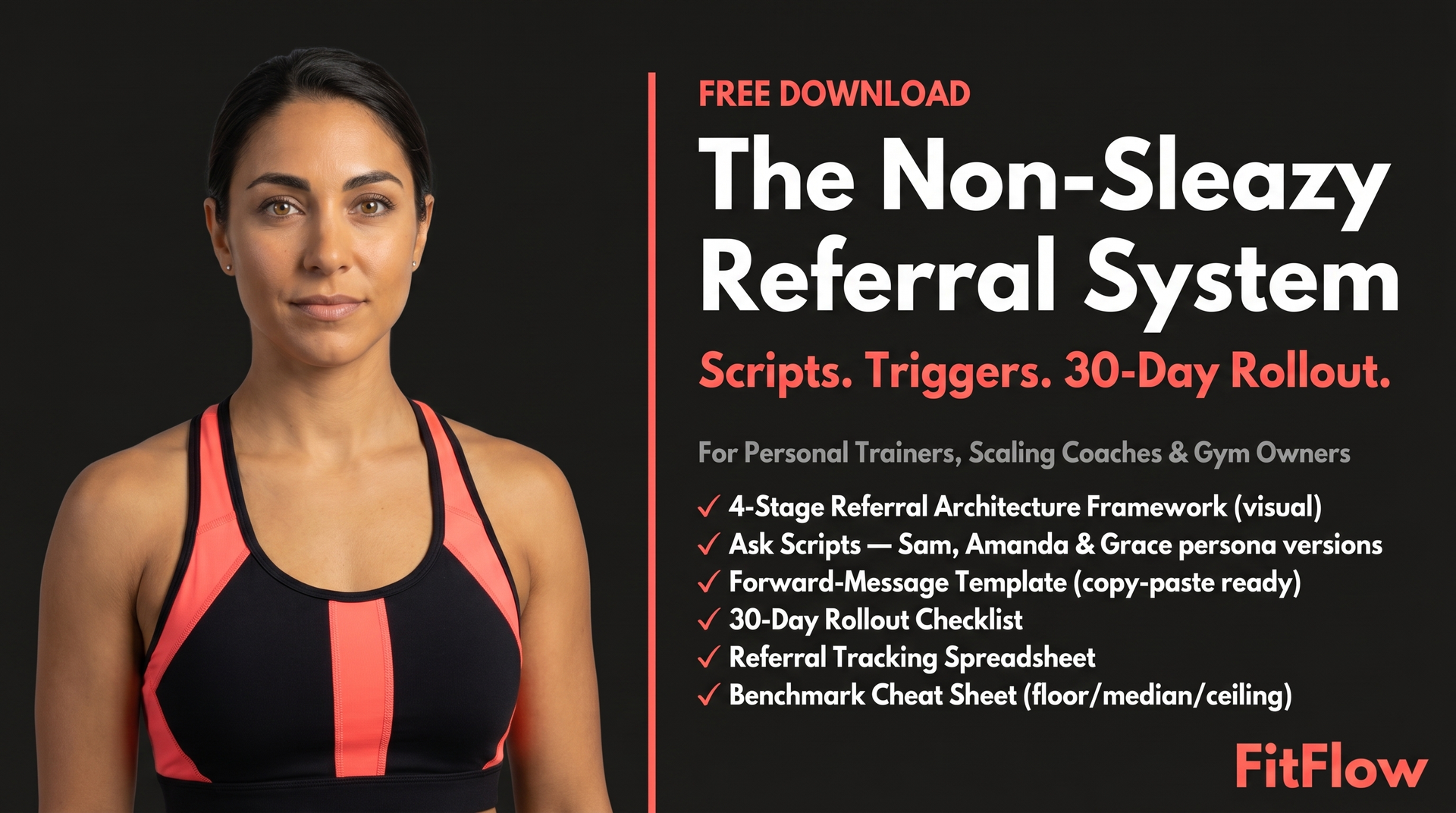
Most trainers know referrals should work. Most have nothing built. Get the 9 fillable ask scripts (one per persona, per trigger moment), a 7-moment trigger map, forward-message templates, and the day-by-day 30-day rollout that turns this framework into a working system. Free. Get the 9 scripts + 30-day rollout.
This is also the most common reason trainers stall at $5K/month. They can deliver the service, but the highest-leverage acquisition channel is dark, unmeasured, and improvised.
"Feeling sleazy" is a misdiagnosis
The standard advice in the trainer literature is some version of "just ask, it's easier than you think." That advice fails for a reason. If you ask without a trigger, without a script, and without a closed loop, the discomfort returns at the next ask, and the one after that. You're not building a muscle. You're improvising in front of someone whose social capital you're about to spend.
The problem isn't your personality. The problem is you're improvising every time.
A surgeon doesn't invent a new incision technique every operation. A pilot doesn't draft a new pre-flight checklist before takeoff. Referrals work the same way: a repeatable interaction with a protocol, not a courage gauntlet.
Bill Cates of Referral Coach International, author of Get More Referrals Now and Beyond Referrals, argues that referral advocates must be primed, not surprised. The ask doesn't begin with the ask. It begins weeks earlier with positioning and value delivery. The Two-Brain Business "Tactical Referrals" data backs this up: when their member gyms use directed, named referral invitations ("this card is for your friend Phil, not your neighbor"), the close rate runs roughly 40%. Undirected, ambient asks convert at a fraction of that.
So this isn't a personality issue. It's a design issue. One note before we go deeper: positioning clarity that makes referrals feel natural to give sits upstream of any referral system. If your client can't articulate what you do and who you do it for, no script will save the ask.
The three failure modes
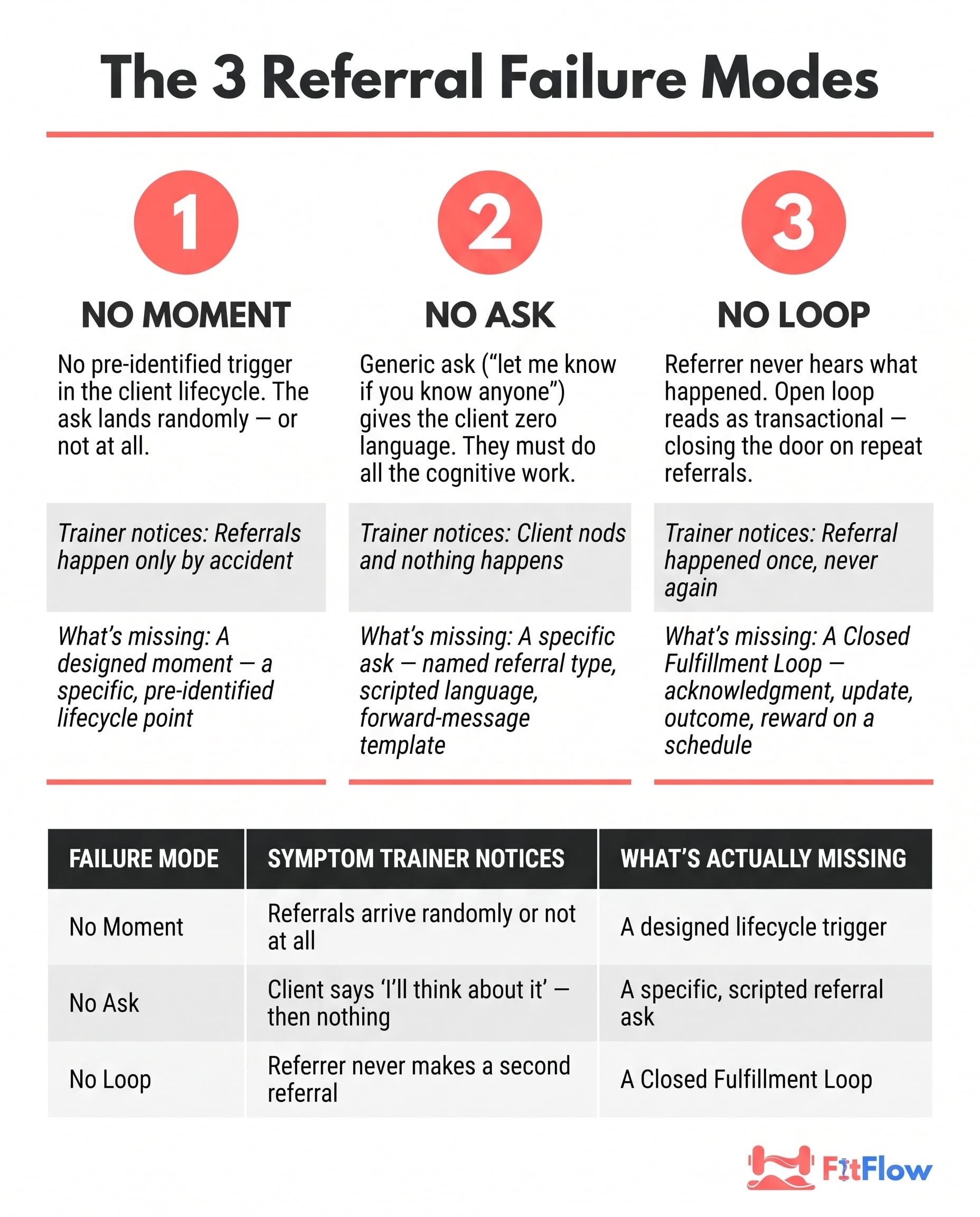
Every broken referral system fails in one of three places. Whichever one breaks first is where you start.
Failure mode 1: no moment
Referrals happen at random, or not at all, because no identified trigger exists in your client lifecycle when the ask is structurally appropriate.
In practice: you ask at intake because you read you should "set the expectation early." Or you ask at random, which means rarely. Or you never ask because no moment ever feels right. The cost: 30 happy clients, zero referrals last quarter. You are not bad at training. You are running a system that has no trigger event. This is the most common breakdown inside a client acquisition architecture that otherwise looks healthy.
Failure mode 2: no ask
The generic ask, "let me know if you know anyone," is mechanically broken. It hands the client three jobs at once: identify someone, frame the pitch, make the intro. None of those are their job.
In practice: you say the line at the end of a session. Your client nods. They mean well. They forget within 20 minutes, because you gave them a homework assignment instead of a referral. The cost: a 100% well-meaning client base converts at near-zero.
Failure mode 3: no loop
Most referral programs have no closed feedback loop. The client makes an intro. The trainer may or may not follow up. The client never hears what happened. If the lead didn't convert, the referrer often reads silence as "my referral wasn't good enough."
That open loop is the actual source of the sleazy feeling. It feels transactional precisely because nothing confirms the referral was handled with care. The cost: one-and-done referrals.
Failure mode | Symptom you notice | What's actually missing |
|---|---|---|
No moment | "I keep forgetting to ask" or "It never feels like the right time" | A pre-identified trigger event in the client lifecycle |
No ask | "I ask, but nothing happens" | A specific, scripted ask with a named referral type |
No loop | "Clients refer once and never again" | A closed feedback and reward sequence after every intro |
All three are structural. None of them are about your personality.
The referral architecture framework
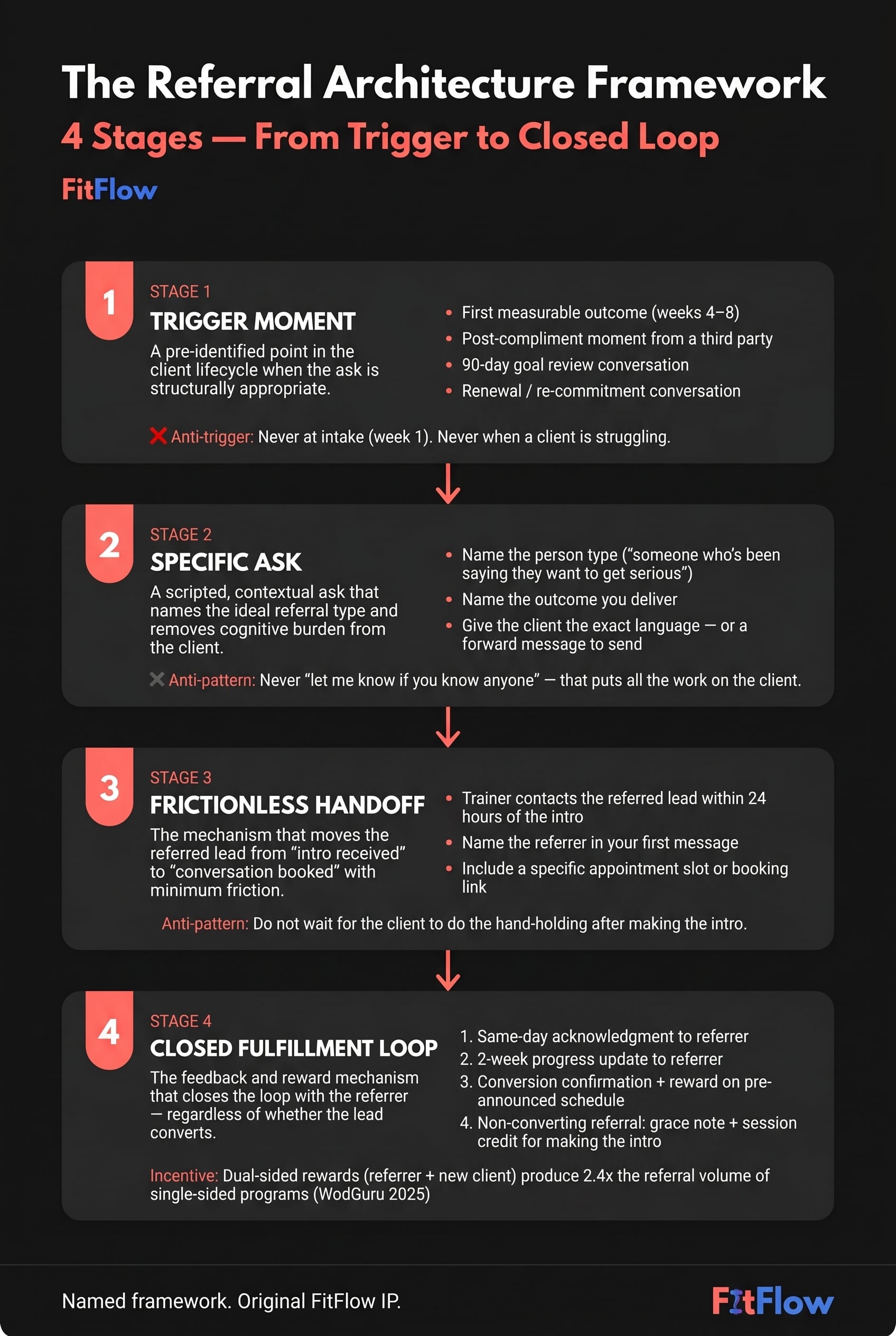
Four stages. Each one fixes part of the three failure modes above.
Stage 1: trigger moment
A pre-identified point in the client lifecycle when the ask is structurally appropriate. The defining property: the client has tangible evidence of your value before you ask them to stake their social credibility on it.
Use these four triggers:
First measurable outcome. Typically weeks 4 to 8. Strength PR, scale change, measurable mobility win.
Post-compliment moment. When the client mentions a partner or coworker noticed a change. Highest-conviction trigger, because social proof has already landed externally.
90-day goal review. The most reliable trigger per Two-Brain Business' referral culture methodology, because it happens whether or not a star moment has hit.
Renewal conversation. The highest-satisfaction point in the relationship.
Anti-pattern: asking at intake. Don't. Your client has zero evidence yet. The discomfort they feel is accurate.
The 4-to-8-week window aligns with how ISSA's Business of Personal Training curriculum frames the client lifecycle. Referral generation is taught as a milestone-triggered competency, downstream of a documented first result. Treat 4 to 8 weeks as a planning floor, not a guarantee. The actual window depends on goal type, adherence, and starting condition.
Stage 2: specific ask
A scripted, contextual request that names the ideal referral profile and removes cognitive burden from the client. Generic says "if you know anyone." Specific says "if you know someone who's been saying they want to get serious about strength training, I have two intake spots opening next month."
Three elements:
Name the person type. Be concrete. "Someone who's been saying they want to get serious" beats "anyone interested in fitness."
Name the outcome you deliver. Short, real, plausible. Not "transformation." The specific outcome your existing clients are getting.
Provide the mechanism. A forward-message your client can copy-paste, or a card with the exact words.
Trainerize's 2026 State of Personal Training Industry Report notes referred leads convert at a 40% higher rate than other acquisition methods, and produce roughly 30% higher lifetime value. The forward-message feature in modern coaching platforms reflects this: when the client just hits "forward," friction drops near zero.
Voice rule: frame the ask as a favor to the potential referral, not to you. "You'd be doing your colleague a real favor" lands. "I could really use a new client" repels.
Stage 3: frictionless handoff
The mechanism that moves a referred lead from "intro received" to "conversation booked" with minimum friction and maximum speed.
The trainer initiates the next step. Do not rely on the lead to chase you.
A direct, personal message from you to the referred lead, naming the referrer, within 24 hours.
A specific appointment slot offered, not "let me know what works."
Two-Brain Business reports that when member gyms text the referred lead within 24 hours using the referrer's name and a specific time, conversion to a booked consultation runs about 40%. Every additional day reduces conversion.
Stage 4: closed fulfillment loop
The feedback and reward mechanism that closes the loop with the referrer, regardless of whether the lead converts. This is the stage that separates a referral system from a referral event.
Four components:
Same-day acknowledgment to the referrer. ("Thanks. I'll reach out to Jamie today.")
Two-week update to the referrer. ("Had a great first call with Jamie. Intake scheduled.")
Outcome message at conversion or non-conversion, with reward on a pre-announced schedule.
Graceful non-conversion. The referrer still gets acknowledged. ("It didn't work out this time, but I appreciate you thinking of me. Your next session is on me.")
Incentive: dual-sided programs (rewards for both the referrer and the new client) generate roughly 2.4x the referral volume of single-sided programs per WodGuru's 2025 referral analysis. Free sessions outperform cash equivalents because they reinforce the service relationship rather than commoditizing it.
FTC disclosure: if a client receives any material benefit (free session, discount, gift card, cash) for recommending your services, FTC endorsement guidelines (16 CFR Part 255) require disclosure on social posts and reviews. Standard language: "I received a complimentary session for this recommendation." You are responsible for informing referrers, ideally in writing.
IRS 1099 note: under the One Big Beautiful Bill Act, the 2026 IRS reporting threshold for Form 1099-MISC rose from $600 to $2,000 for prizes, awards, and miscellaneous income. Cash or gift card payments to a single referrer totaling $2,000 or more per calendar year generally require 1099-MISC filing. Service-only incentives (free sessions) typically don't trigger 1099 reporting, though imputed value rules may still apply. Thresholds adjust for inflation starting 2027. Verify the current applicable threshold and form type via the IRS and your CPA before launching a cash-incentive program.
This is where the fulfillment loop becomes an automation candidate. Once you've run the manual loop for 30 to 60 days, the acknowledgments, updates, and reward delivery can be templated and triggered from your CRM.
The framework above is the map. The download is the kit. You now have the 4-stage architecture. The kit gives you the specific scripts for each stage, the forward-message templates, the 30-day rollout, and the fulfillment-loop tracker — ready to use this week. Free, no credit card. Get the kit (free).
How Sam, Amanda, and Grace build the system differently
The framework is the same. The implementation isn't.
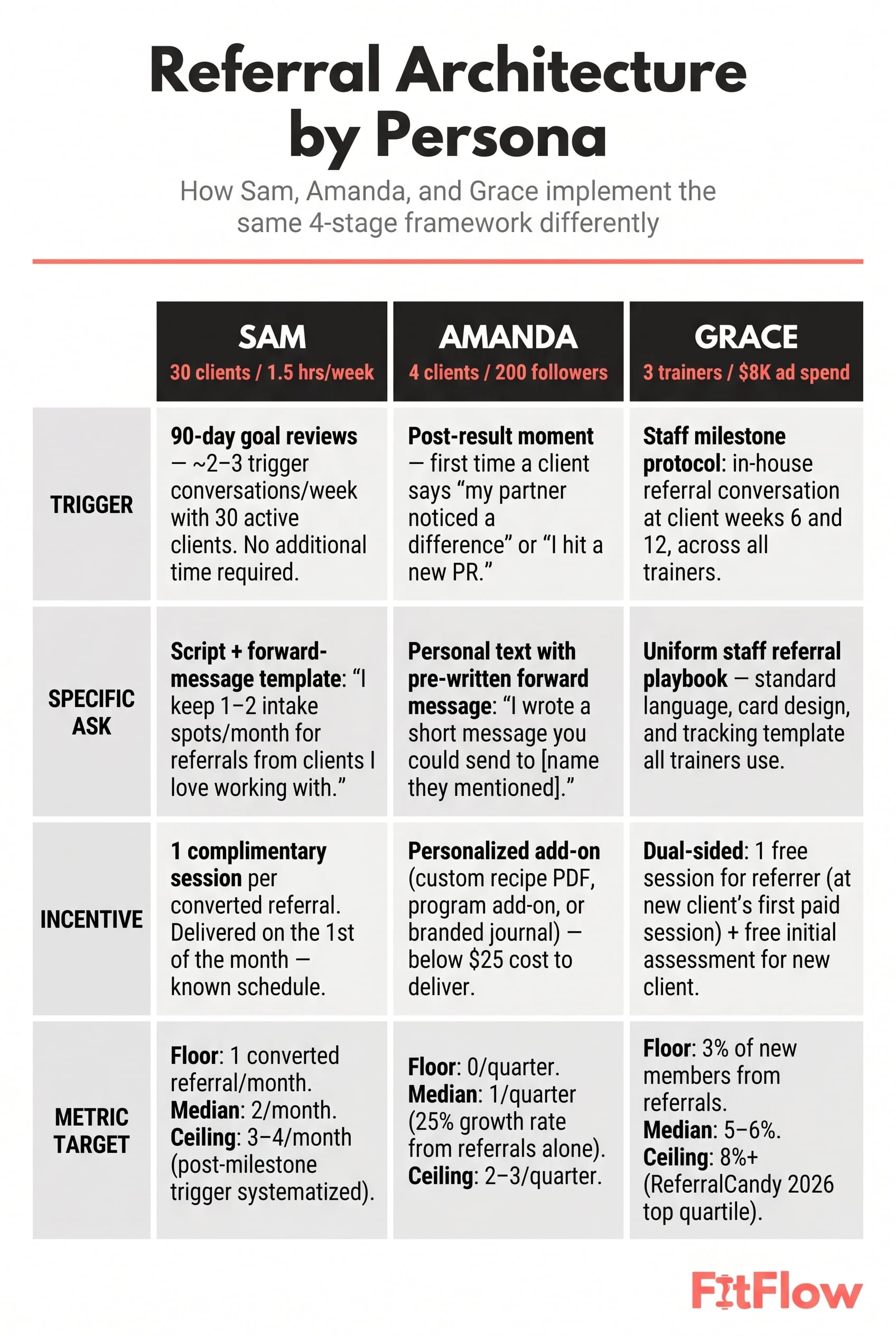
Amanda: solo trainer, 4 clients, 200 followers, sub-$3K/month
Amanda has 4 clients, about 200 Instagram followers, and revenue under $3K/month. She can't afford to wait for word-of-mouth to compound at her client count. She also can't afford to use free sessions as the incentive (they're her primary revenue).
Trigger: post-result moment. With 4 clients she can manually watch for the first time each one says "my partner noticed" or "I hit a PR."
Ask: same-day forward-message template. "I wrote a short note you could send to [the person they mentioned]. You just forward it." Cognitive load near zero.
Handoff: Amanda texts the lead directly within 24 hours, names her client, offers two specific time slots.
Loop: thank-you text same day. Calendar note for 2-week follow-up. Handwritten card if the lead converts.
Incentive: non-session. A custom meal-prep PDF, branded training journal, or personalized program add-on. Cost-to-deliver under $25.
Benchmark: 1 converted referral per quarter is a 25% client growth rate at her base. Floor: 0/quarter. Median: 1. Ceiling: 2 to 3 with all 4 clients triggered on discipline.
Sam: scaling trainer, 30 clients, 1.5 hours/week on acquisition, $4 to $8K/month
Sam has 30 clients, generates $4 to $8K/month, and spends roughly 1.5 hours per week on acquisition (most of it on Instagram DMs). He has enough happy clients to generate 3 to 5 referrals per month if he designed the system. He hasn't.
Trigger: quarterly 90-day goal reviews. With 30 clients on rolling cadence, that's 2 to 3 trigger conversations per week. Zero additional time.
Ask: "I keep one or two intake spots per month for referrals from clients I love working with. If you know someone who's been saying they want to get serious about [their specific goal], I can offer them a complimentary initial call. You send me their name, I'll reach out."
Handoff: Sam texts the lead within 24 hours, names the referring client, offers two specific times that week.
Loop: simple spreadsheet (referrer, lead, date, status, incentive delivered, delivery date). Free session credits delivered on the 1st of the month following conversion. A known schedule removes awkwardness.
Incentive: one complimentary session per converted referral. No cash. Service-only sidesteps the 1099 question at his volume.
Benchmark: target 1 to 2 converted referrals per month from 30 active clients, a 3 to 7% monthly conversion. Floor: 1/month. Median: 2. Ceiling: 3 to 4 if Sam also systematizes the post-milestone trigger. At 2/month, the system covers Sam's full monthly churn replacement, which is the lever that lifts him through the acquisition failure that keeps most trainers under $5K.
Grace: gym owner, 3+ trainers, $8K/month ad spend
Grace runs a gym with 3+ trainers and spends $8K/month on paid acquisition. Her clients churn faster than referred members would, and her trainers improvise or don't ask at all.
Trigger: built into the gym's milestone protocol. Outcome measurements at weeks 6 and 12, already part of the client experience, become the referral trigger for every trainer.
Ask: staff referral playbook. Standard language, card design, incentive structure, tracking template. Referred leads get a consistent experience regardless of which trainer they meet first.
Handoff: every referred lead is texted by the head trainer (not the referring trainer) within 24 hours. Centralizes handoff quality.
Loop: tracked in the gym's coaching management software. Referral tags applied to client profiles. Monthly referral report reviewed in staff meeting.
Incentive: dual-sided. One free session for the referrer when the new client completes their first paid session. The new client receives a free initial assessment, not a free regular session (protects margins). Dual-sided runs ~2.4x single-sided volume per WodGuru 2025.
FTC note: when members post about the gym on social media in exchange for free sessions, the gym is the business entity with the disclosure obligation. Grace builds disclosure language into the written program terms that referring members sign.
Benchmark: target 5 to 8% of new member sign-ups from referrals within 60 days of launching the staff protocol. Floor: 3%. Median: 5 to 6%. Ceiling: 8%+, which is top-quartile per ReferralCandy's 2026 Health & Wellness program data.
The benchmarks: what good actually looks like
Every benchmark below is Tier-1 sourced and framed as floor / median / ceiling. A single number, without distribution context, is how trainers end up either disappointed at median or overconfident at floor. Results may vary based on client mix, market, and consistency of execution.
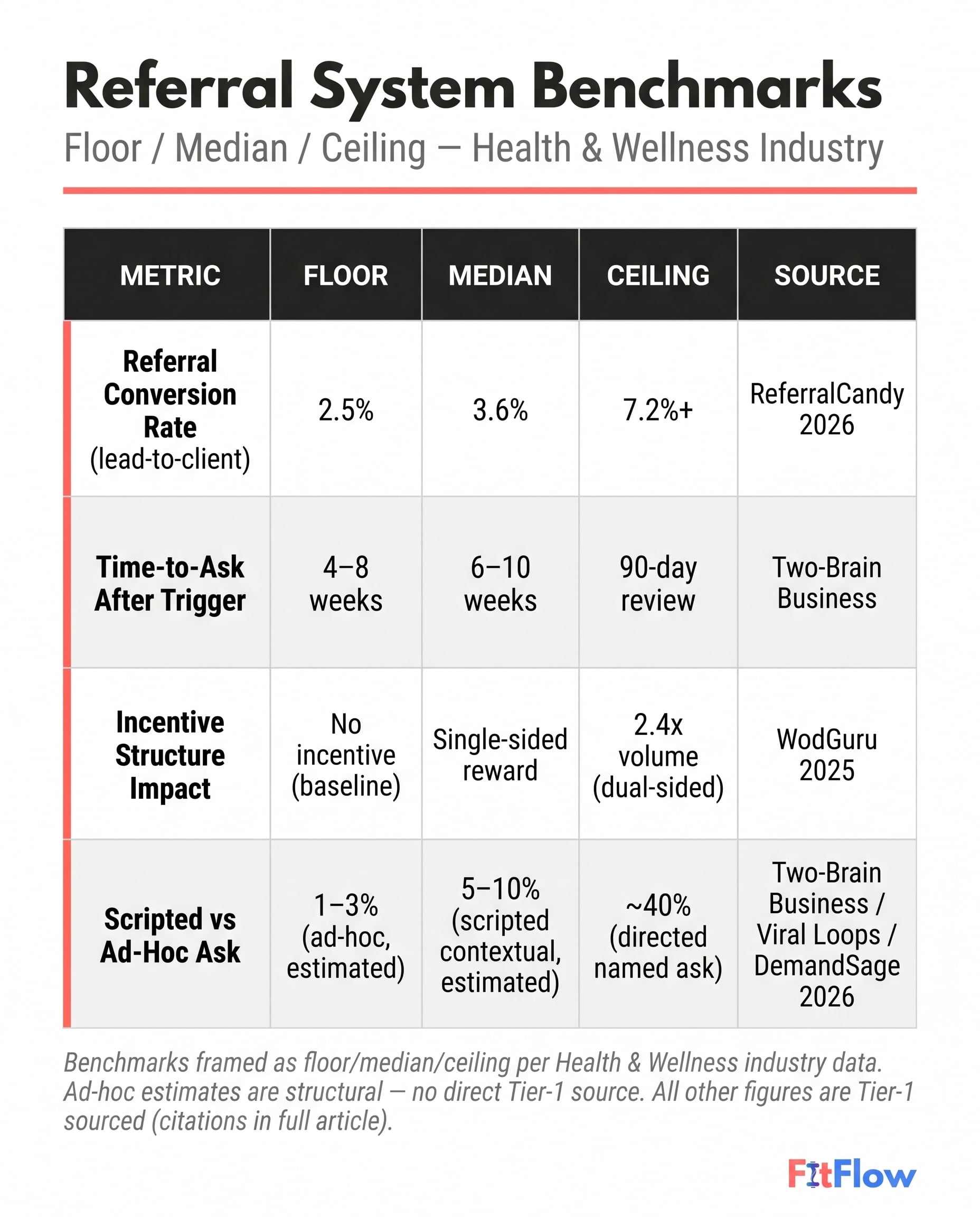
Referral conversion rate (lead to client)
Floor: 2.5%. Undirected, unincentivized programs across consumer service categories.
Median: 3.6%. Health & Wellness industry median per ReferralCandy 2026.
Ceiling: 7.2%+. Top-quartile Health & Wellness performers. Achievable with designed trigger + specific ask + dual-sided reward.
Time-to-ask after trigger
Floor: 4 to 8 weeks from client start (first measurable outcome window).
Median: 6 to 10 weeks for fat loss, strength, mobility goals.
Ceiling: 90-day review conversation. Guaranteed quarterly trigger regardless of star moments.
Incentive architecture
Floor: unincentivized. Inconsistent, no repeatability.
Median: single-sided incentive (referrer only). Improves volume modestly.
Ceiling: dual-sided incentive. About 2.4x the volume of single-sided per WodGuru 2025.
Scripted vs. ad-hoc ask
Floor: ad-hoc ask. The generic "let me know if you know anyone." Industry-wide cold-channel conversion ranges 1 to 3% per Viral Loops Insider, which is the floor that undirected fitness asks land at.
Median: scripted, contextual ask with specific person type and outcome. Estimated 5 to 10% conversion, consistent with DemandSage 2026 referral marketing benchmarks of 10 to 15% for healthy referral programs.
Ceiling: fully directed referral with named contact and forward-message. Around 40% per Two-Brain Business.
Referred client quality (vs. other acquisition)
Floor: 18% greater loyalty for referred customers per DemandSage 2026.
Median: 30% higher lifetime value for referred personal training clients per Trainerize 2026.
Ceiling: 37% lower 12-month churn for referred gym members vs. digitally acquired per Glofox 2025.
Paid acquisition cost (context for Grace)
Floor: about $29.70 CPL on Facebook Ads in fitness, 2025, per SuperAds.ai Facebook Ads benchmarks.
Median: about $45 CPL blended across paid channels.
Ceiling: about $61.56 CPL on Google Ads in fitness, 2025, per Financial Models Lab 2026 gym KPIs.
Referral incentive cost per referred lead: about $35 to $50 at $20 to $40 per side. Even at ceiling, referrals beat paid acquisition on cost. They dramatically beat them on conversion quality and lifetime value.
The three anti-patterns (and why they backfire)
Anti-pattern 1: asking at intake
The move: "I'd love it if you'd tell your friends about me as we work together."
Why it backfires: your client has zero evidence of your value at intake. You're asking them to stake their social credibility on an unproven service. The discomfort is accurate. It would be weird for them to recommend you yet.
The fix: hold the ask until the first real result arrives. Patience here is protocol, not passivity. NASM CPT business module curriculum frames referral marketing as a milestone-triggered competency, not a day-one ask.
Anti-pattern 2: the broadcast ask
The move: posting "if you know anyone who wants a trainer, send them my way!" on Instagram, in a group, or in a mass text.
Why it backfires: it hands every recipient four jobs at once (identify, qualify, introduce, sell) when you needed one. Response rate approaches zero, and in social contexts it reads as desperation, eroding the positioning equity you've built.
The fix: the problem isn't your audience. It's the cognitive load you're handing them. Replace the broadcast with a targeted, one-to-one ask that has a named referral type and a forward-message they can send with one tap. This is also the structural argument for systems thinking over client hustle. Broadcast asks feel like activity but produce no measurable input.
(Consumer gym referral codes, like the Planet Fitness-type structural programs, work differently. The platform infrastructure handles identification, qualification, and tracking. As a solo or small-team trainer, you don't have that infrastructure, which is why the personal, specific ask is non-negotiable.)
Anti-pattern 3: the open loop
The move: saying thank you when a client makes a referral, then going silent while you pursue the lead.
Why it backfires: the referrer feels used, not appreciated. Silence after a non-conversion reads as "my referral wasn't good enough." After a conversion, the referrer often doesn't learn what happened until much later, when the moment to thank them has landed flat. Either way, the likelihood of a second referral collapses.
The fix: close the loop at every stage. Same-day acknowledgment. Two-week update. Outcome message and reward at conversion or non-conversion. Every referral your client makes is them staking their reputation. Leaving them in the dark is how you spend that capital without repaying it.
The 30-day implementation rollout
Week by week. Action items. Success metrics. Don't skip: Stage 3 fulfillment loops fail when Week 1 trigger inventory is incomplete.
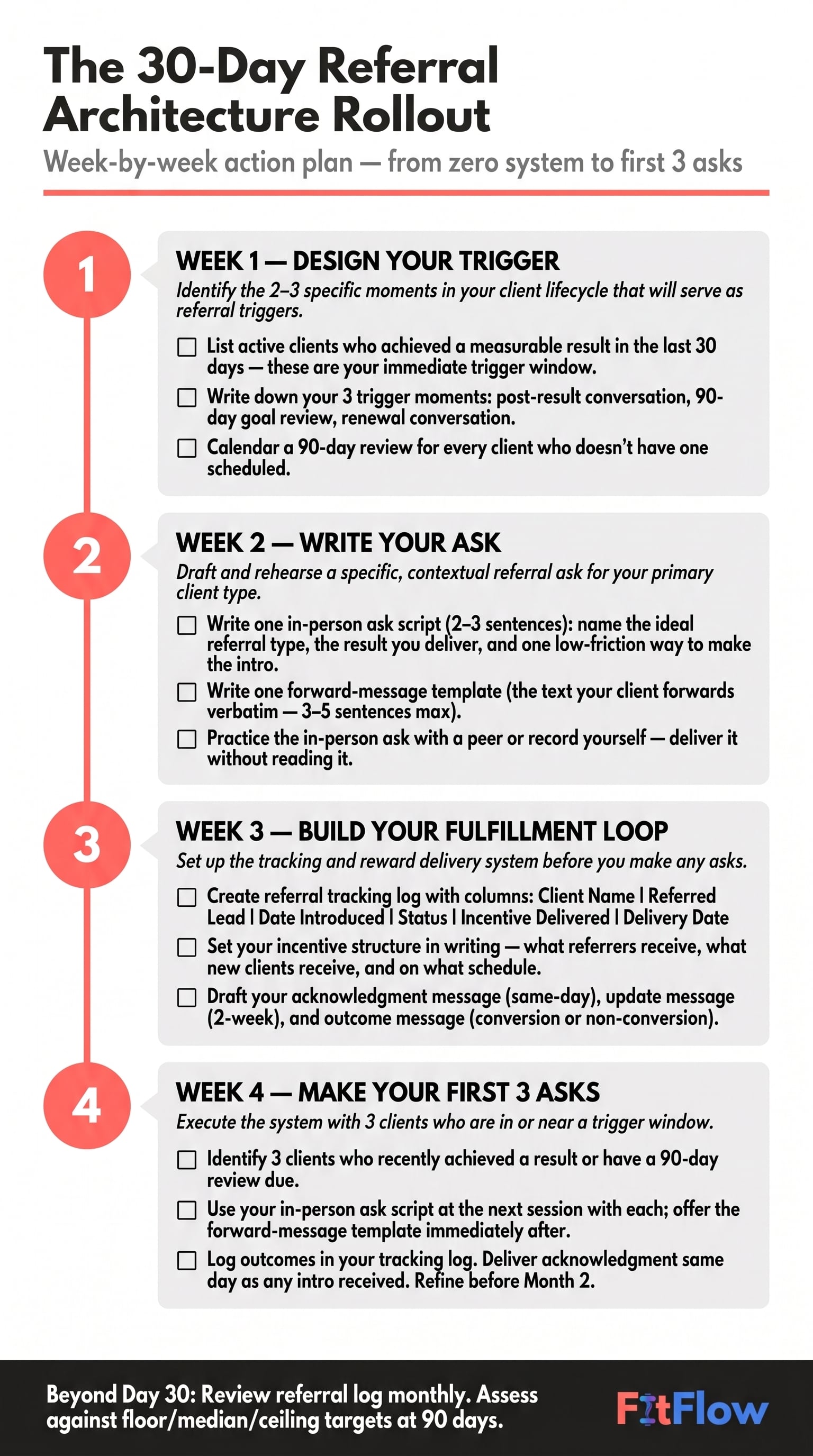
Week 1: design your trigger
Objective: identify the 2 to 3 specific moments in your client lifecycle that will serve as referral triggers.
Actions:
List your active clients. Mark every client who has achieved a measurable result in the last 30 days. That's your immediate trigger window.
Write down the 3 trigger moments you will use: post-result conversation, 90-day goal review, renewal conversation.
Calendar a 90-day review for every client who doesn't have one scheduled.
Success metric: every active client has at least one scheduled trigger event in the next 90 days.
Week 2: write your ask
Objective: draft and rehearse a specific, contextual referral ask for your primary client type.
Actions:
Write one in-person ask script (2 to 3 sentences): named ideal referral type, the outcome you deliver, one low-friction way to make the intro.
Write one forward-message template (3 to 5 sentences max) that your client can forward verbatim.
Practice the in-person ask with a peer or record yourself. Deliver it without reading it.
Success metric: you can deliver your ask out loud, without notes, in under 30 seconds.
Week 3: build your fulfillment loop
Objective: set up tracking and reward delivery before you make any asks.
Actions:
Create a referral tracking log (spreadsheet or CRM tag): Client Name | Referred Lead | Date Introduced | Status | Incentive Delivered | Delivery Date.
Set your incentive structure: what referrers receive, what new clients receive, and the delivery schedule (e.g., "free session credit on the 1st of the month following conversion").
Draft three messages: same-day acknowledgment, two-week update, outcome message.
Success metric: a peer could read your tracking log and three messages and execute the loop without you.
Week 4: make your first 3 asks
Objective: execute the system with 3 clients in or near a trigger window.
Actions:
Identify 3 clients who have recently achieved a result or have a 90-day review due.
Use your in-person ask script at the next session with each of them. Offer the forward-message template immediately after.
Log every outcome in your tracking log. Deliver acknowledgments the same day. Review and refine the script before Month 2.
Success metric: 3 asks made, all outcomes logged, all acknowledgments delivered same-day.
Beyond 30 days: systematize the quarterly review trigger for every new client at intake. Review the tracking log monthly. After 90 days, assess against your persona benchmark.
You've got the system. The kit makes it operational this week. The blog gave you the framework. The kit gives you the scripts, the trigger map, the tracking log, and the 30 days of structure to install all of it. Free. No credit card. Built for trainers, scaling coaches, and gym owners. Get the 9 scripts + 30-day rollout.