Building a Coaching Brand Without Becoming an Influencer: The Architecture That Outlasts the Algorithm
1. The Influencer Tax You Did Not Know You Were Paying
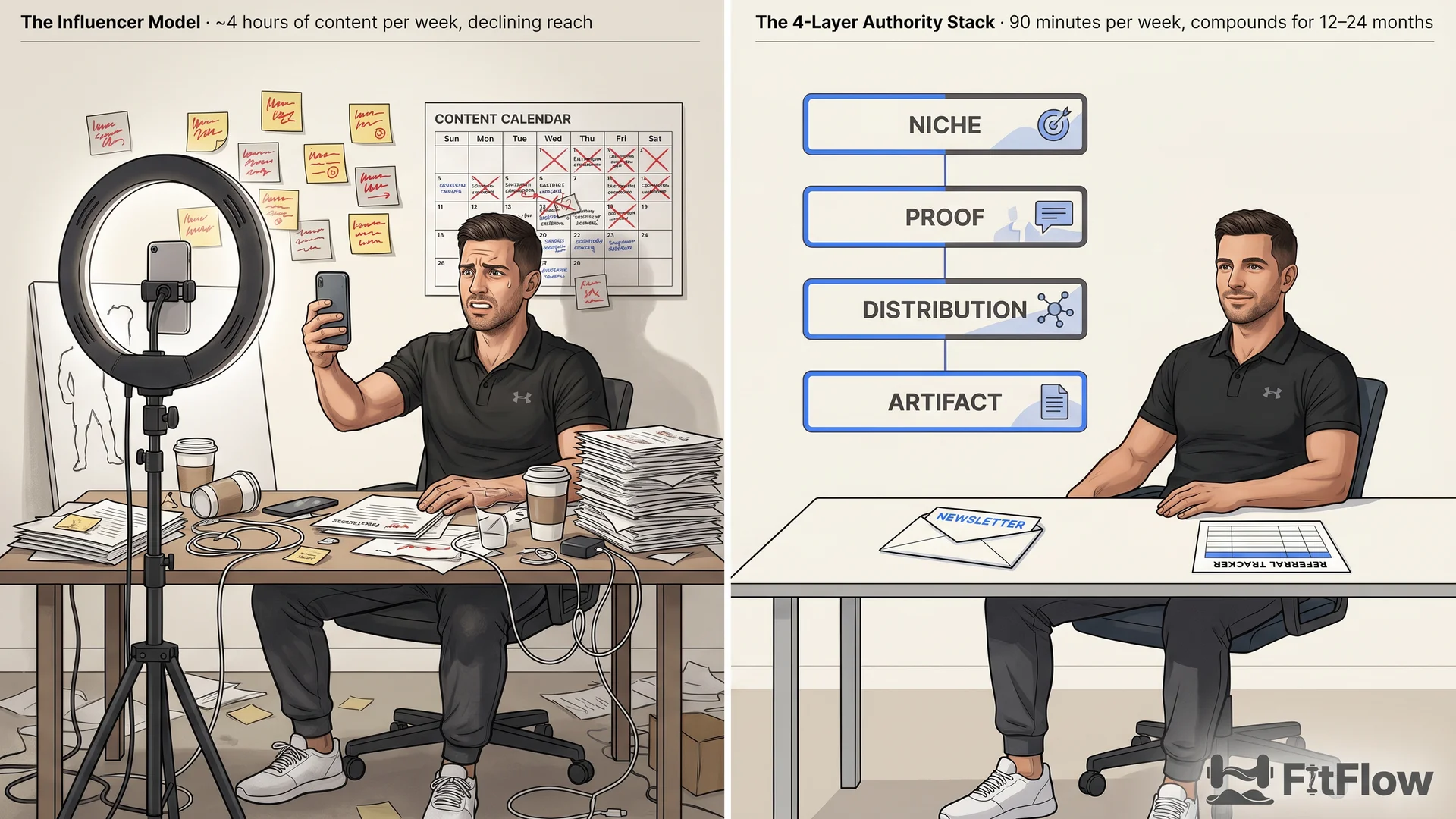
Open the analytics tab on your last 30 social posts. Count the ones that produced a paying inquiry. Compare that count to the hours you spent producing them. The ratio you are looking at is the influencer tax, and it is what most "build your personal brand" advice charges you to pay.
For most trainers, the ratio is somewhere between 0 and 2 paying inquiries per 30 posts, against 20–60 production hours. The unit economics are bad. They have been bad for a while. The market has caught up to the math.
Influencer trust hit a 7-year low in 2026: 32% of consumers report trusting influencer recommendations, down from 41% in 2023, per the Edelman Trust Barometer 2026. Expert and specialist trust moved the other direction, to 68%, the highest in the report's history. Athletech News documented a parallel signal in January 2025: 87% of consumers believe influencers do not actually use the products they endorse, and expert-led content drives 2× higher purchase likelihood with 25% higher average order value.
If you are Sam at 30 clients / $6K/mo / posting 4×/week with declining reach / 0 referable artifacts, you have felt this. If you are Petra with 8 legacy clients she is about to release in order to re-focus on a new niche / 0 niche-aligned clients / 0 published artifacts in the new niche, you have refused to start a TikTok at 42, and the data says your instinct is correct. If you are Amanda at 8 clients / 6 months in / 47 unpublished Notes-app drafts, you are burning out before your business has begun.
Reach is not the problem. The model that demands reach to make a living is.
A scope note before we go further. This post is not about pricing (that lives in Pricing vs Positioning), funnel mechanics (the Client Acquisition Funnel for Personal Trainers), the 90-day Rebuilding Your Fitness Business From Zero sequence, the operating-system internals in Systems Over Tools, the 30-client wall handled in The Operations Playbook for Online Coaches, or the $5K ceiling diagnosis. This post is the source-of-demand architecture: the brand layer that makes a funnel a funnel and a position a position.
Want the architecture as a deployable kit? [Get The Quiet Authority Stack — a 6-asset brand map for trainers who refuse to become content creators →]
2. The Affinity Model vs The Influencer Model
There are two operating models for a coaching brand. Most trainers think there is only one.
The influencer model treats reach as the primary asset. Followers, impressions, and engagement compound into a personal brand that monetizes through volume. The economics work when reach is enormous and the audience is broad. They struggle when reach is moderate and the audience is professional-services-priced.
The affinity model treats narrow expertise and repeat-client outcomes as the primary asset. A coach known by 600 right-fit people earns more than a coach followed by 60,000 misaligned ones. Referrals, owned distribution, and referable artifacts produce pricing power and inbound demand.
The empirical gap is bigger than most coaches realize. Two-Brain Business 2025 documented (and 2026 confirmed) that affinity-model trainers earn floor $6K, median $11.4K, ceiling $18K MRR. Influencer-model trainers earn floor $4K, median $7.8K, ceiling $13K, and report 2.3× the burnout score. Trainerize 2026 found that 73% of trainers earning $5K+/mo identify "narrow positioning + repeat clients" as their primary growth lever; only 18% identify social media following as primary. Fitness Mentors 2025, surveying nearly 500 trainers, found over 50% acquire clients primarily through word of mouth.
Most trainers operate in the affinity model already. They have just not been told this is the model.
Content output is not the problem. Content output as a load-bearing brand asset is.
3. The 4-Layer Authority Stack
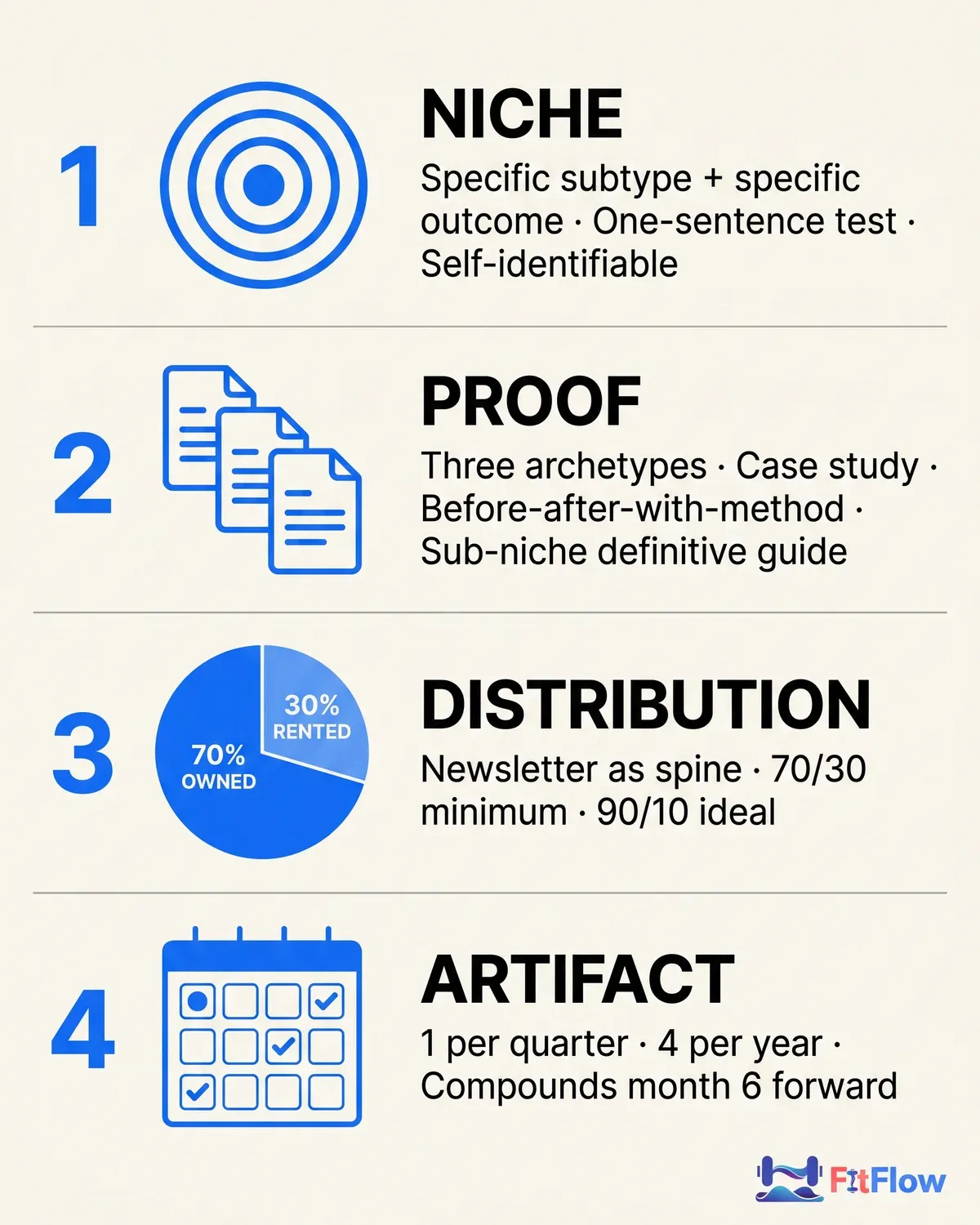
If the influencer model is a content machine, the affinity model is an architecture. Four layers, installed in sequence, compound for 12–24 months.
Layer 1: Niche
Narrow specificity outperforms broad appeal at a magnitude most coaches refuse to believe. Sparktoro 2026 documented that narrow-expert content converts to revenue 2.4–3.1× higher than broad-appeal content across creator categories. MASS Research Review 2026 noted that practitioner-of-record citations (the kind that drive referrals) grow 4× faster for coaches who occupy a sub-niche than for generalists.
The narrow-niche test has two halves. The first is a specific client subtype: not "busy professionals" but "lawyers in their first 5 years of practice with desk-bound back pain." The second is a specific outcome: not "feel better" but "deadlift bodyweight pain-free within 16 weeks." Describable in one sentence. Self-identifiable by someone in the subtype.
For Sam, the niche is probably already implicit in his roster; 8 of his 30 clients are likely the same subtype. For Petra, the pivot niche is a deliberate selection. For Amanda, narrow first and broad later, the inverse of what she has been told.
Layer 2: Proof
Repeatable client outcomes become referable artifacts. There are three archetypes. The client case study — one client, full method, replicable outcome. The before-after-with-method — multiple clients, one outcome, mechanism named. The third is the sub-niche definitive guide: the document you wish had existed when you started.
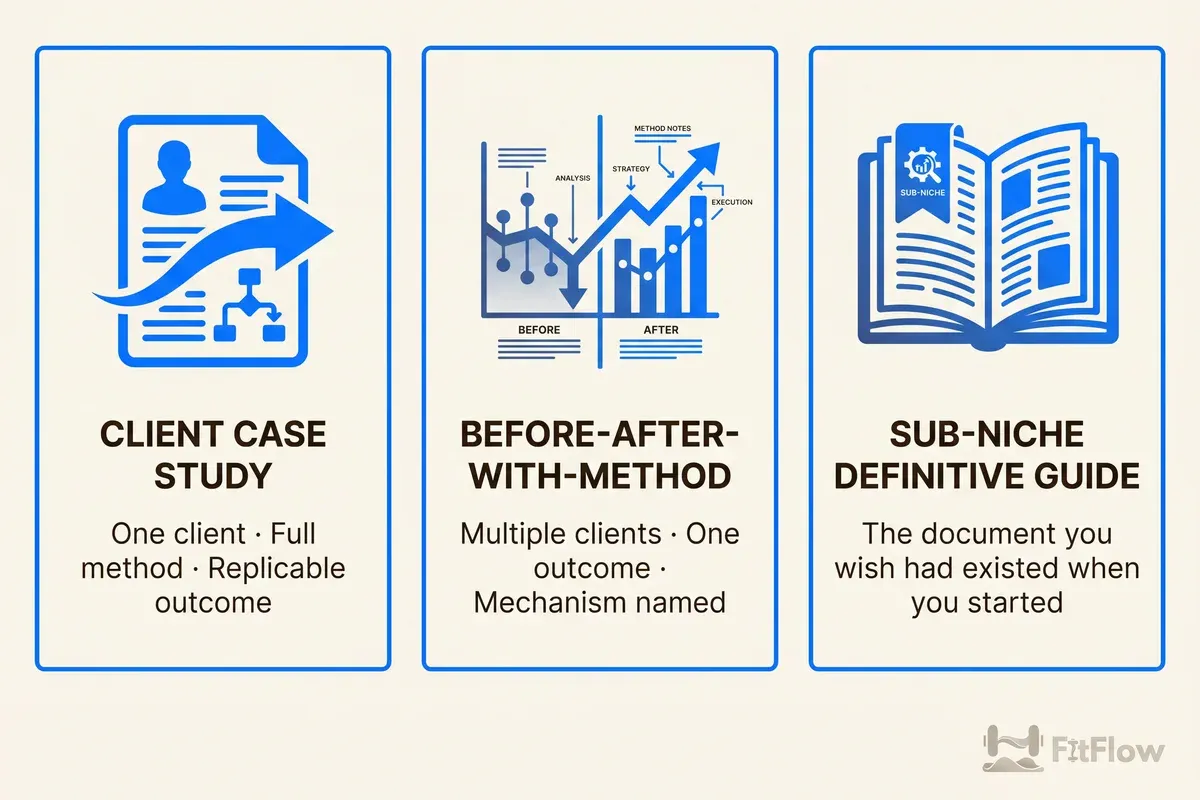
Sprout Social 2026 found that 58% of consumers in health categories trust subject-matter experts over influencers, up from 41% in 2024. NASM 2026 reported referral-driven retention up 22% year-over-year, while social-content top-of-funnel retention is flat. The artifact is not content. Content is consumed and forgotten. The artifact is referenced and referred.
One artifact per quarter is the minimum cadence. Four per year is the median target.
Layer 3: Distribution
Owned channels over rented platforms. The target ratio is 70/30 minimum, 90/10 ideal: 70% on assets you own (email list, podcast, blog, referral network), 30% on assets you rent (platforms whose algorithm can change reach overnight).
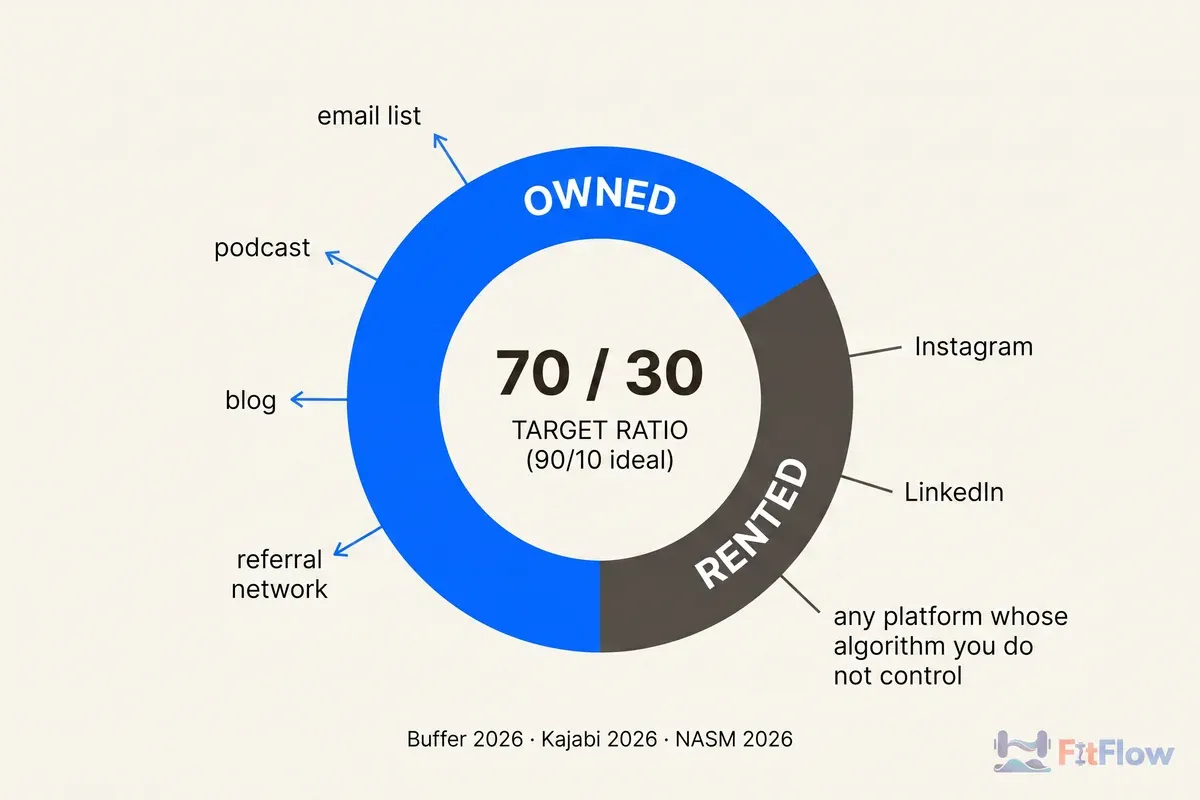
Buffer State of Social 2026 documented Instagram fitness-niche reach down 28% year-over-year. LinkedIn individual-professional reach is up 14%. Newsletter open rates have stayed stable at 38–42%. Kajabi 2026 reported that course and community revenue (owned) grew 31% while sponsorship and ad revenue (rented) fell 12%.
The newsletter is the spine. A 500-person list of right-niche subscribers will out-earn a 20,000-person Instagram following at 2026 reach rates, and the list stays yours when the next platform pivots.
Followers are not the problem. Renting your distribution from a platform you do not own is.
Layer 4: Artifact
Precision Nutrition's 2025 coaching survey found that 78% of certified coaches report "content output anxiety" as a top-3 sustainability concern. The same survey found that coaches who shipped 2–4 quarterly artifacts reported 41% lower output anxiety than coaches posting daily. The trade is real.
Practitioner-of-record citations grew 4× faster than influencer-style citations between 2024 and 2026 per MASS Research Review 2026. The curve is not linear. The first artifact takes 3 months and feels like a waste. The fourth arrives in a month and is your highest-converting asset.
[Get the 4-Layer Stack as a deployable PDF kit — The Quiet Authority Stack →]
4. The Math: Why This Outperforms
Metric | Affinity Model | Influencer Model |
|---|---|---|
MRR (floor / median / ceiling) | $6K / $11.4K / $18K | $4K / $7.8K / $13K |
Hours/week brand work | 1.5 / 2.5 / 4 | 8 / 15 / 28 |
Burnout score (1–10) | 2.1 / 3.4 / 4.8 | 5.7 / 7.8 / 9.1 |
Time to first paying client from Day 1 | 14 / 35 / 90 days | 60 / 120 / 300 days |
(Two-Brain Business 2025 + 2026; Creator Economy Research Institute Q1 2026; Trainerize 2026)
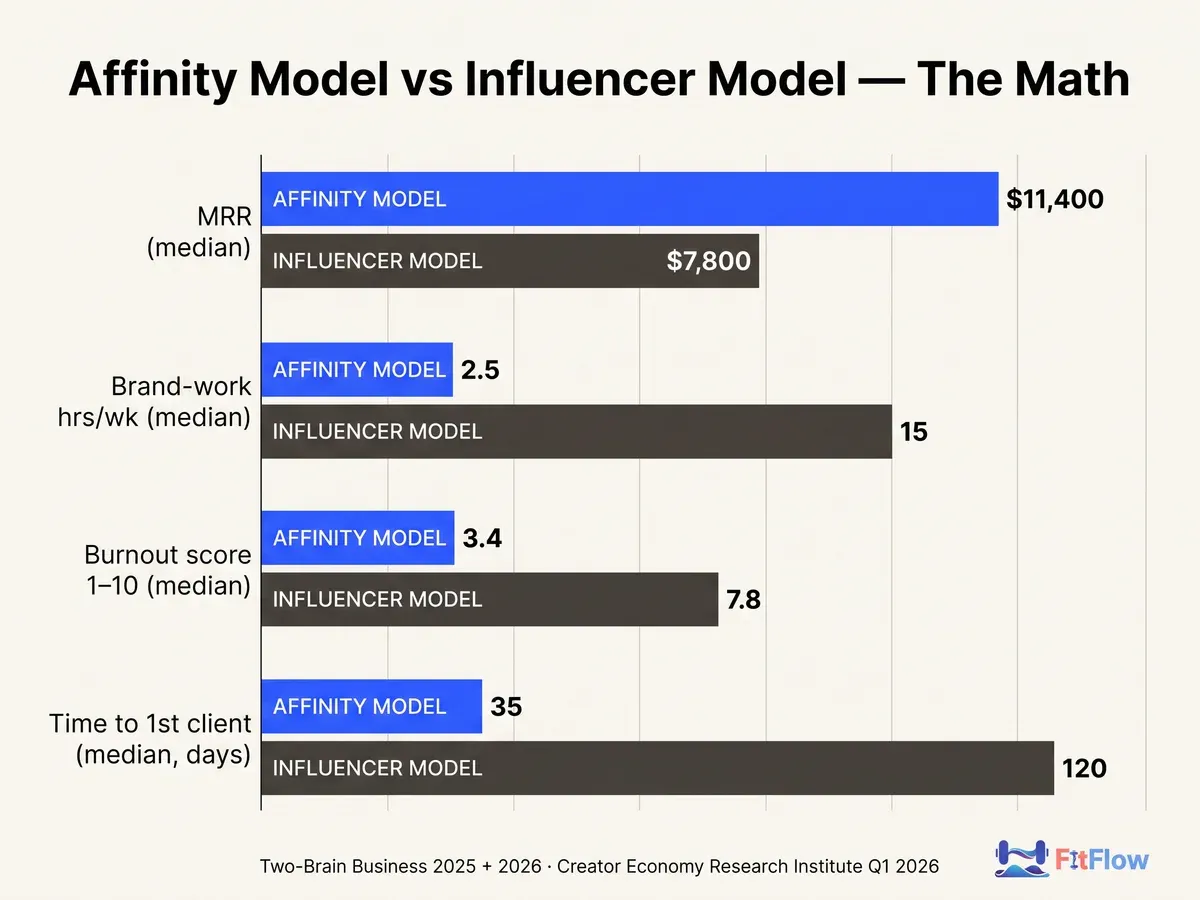
The affinity model earns 46% more median MRR with one-sixth the brand-work hours. ACSM 2026 found that 62% of solo coaches with owned distribution (email list 500+, established referral system) operate sustainably on a 4-day work week. Only 14% without owned distribution do the same. The lifestyle most influencer-model coaches are selling is the lifestyle affinity-model coaches actually live.
The $5K monthly ceiling often dissolves once the authority stack is installed. The client acquisition funnel gets roughly 4× more efficient when authority is doing the qualifying work upstream.
5. The 90-Minute Weekly Authority Routine
The single biggest behavioral swap: 4 hours per week of content creation becomes 90 minutes per week of authority work. The cadence shift is industry-wide, not personal — HubSpot State of Marketing 2026 reports 47% of B2C creators are actively reducing posting cadence.
Four blocks.
20 min, Niche-watch. Read the most important paper, article, or thread in your sub-niche. Listen to one episode. Have one conversation with someone in the niche.
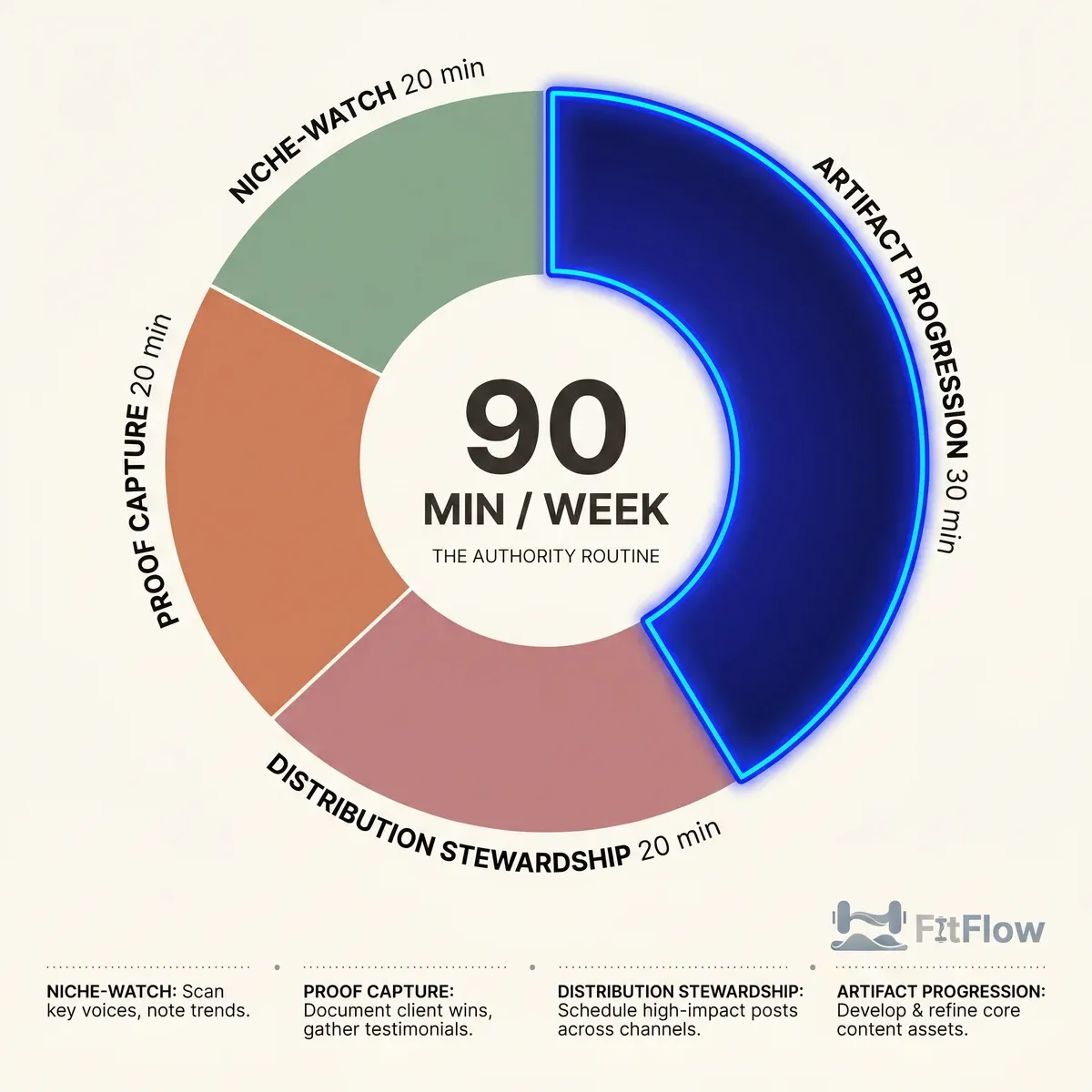
20 min, Proof capture. Document one client win this week. Raw notes, screenshots, the specific intervention, the outcome. Most coaches lose 90% of their proof material because they never write it down.
20 min, Distribution stewardship. Write or schedule the newsletter. Short. Signal, not noise. One observation, one decision rule, one client-relevant link.
30 min, Artifact progression. Chip toward the quarterly artifact. Never more than 30 minutes in one sitting. Twelve weeks at 30 minutes per week works out to about 6 hours per artifact — enough for a case study or position paper. Longer formats (the sub-niche definitive guide) absorb a second 30-minute sitting per week as ship date approaches. Four artifacts per year is the cadence target.
For Sam, swap 3 hours of Tuesday content batching for one 90-minute block. By Month 6, content output is down ~70% and inbound referral rate is meaningfully up. For Petra, the routine is the entire brand-work budget for the new niche; 90 minutes is enough because the niche is narrow. For Amanda, kill 44 drafts, keep 3, run the routine. The drafts were not the brand work. The routine is.
The busy-vs-profitable math shifts when this routine replaces the content batch.
6. Three Worked Examples
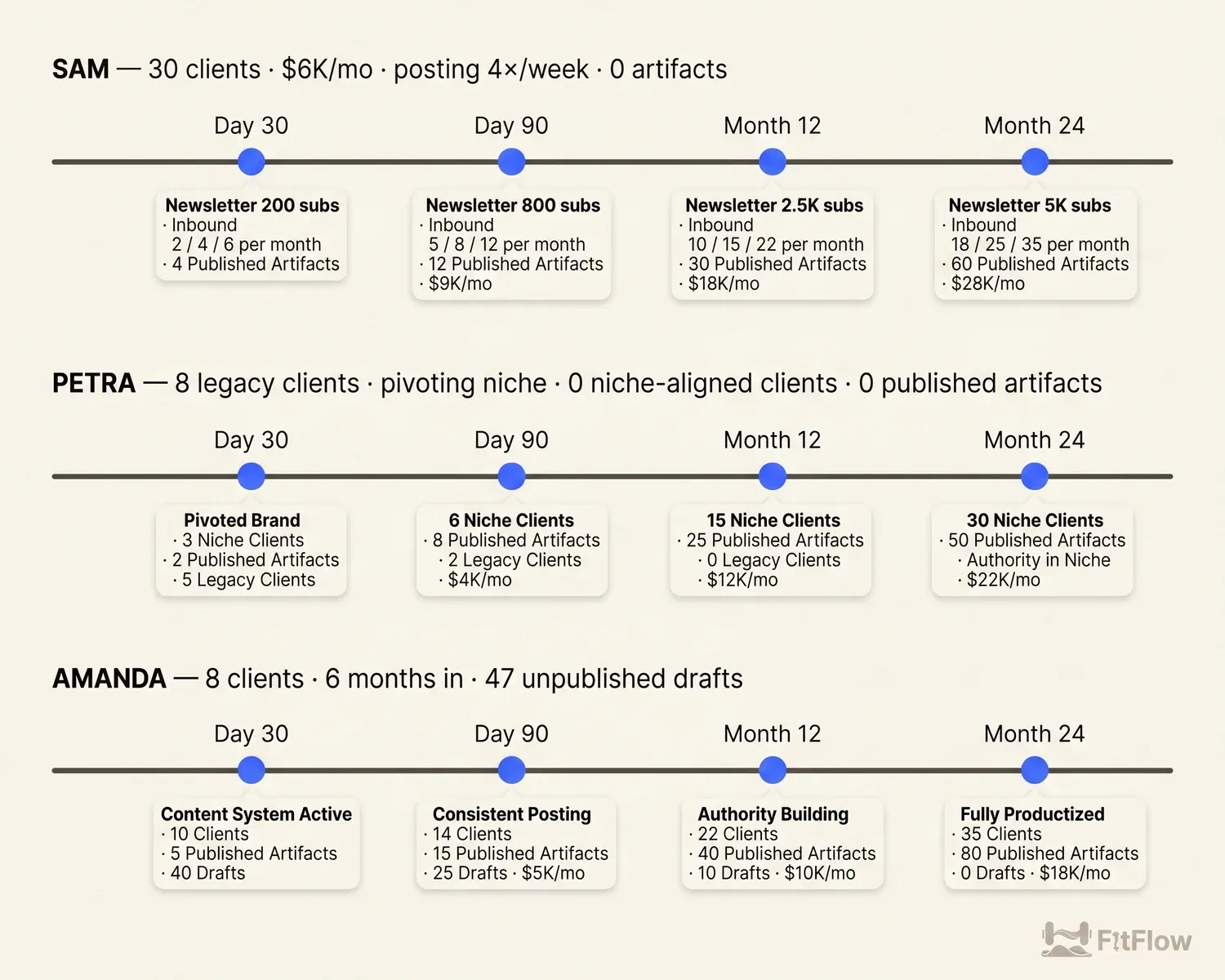
Sam, 30 clients / $6K/mo / posting 4×/week / 0 artifacts.
Day 30: Niche identified (8 of 30 clients share a subtype). First artifact drafted. Newsletter seeded from existing clients (~120 subs).
Day 90: First artifact published. List at 200 subs. Content output down 50%. Inbound referrals: floor 2 / median 4 / ceiling 6 per month.
Month 12: 4 artifacts in rotation. List at 600. MRR: floor $8K / median $11K / ceiling $14K.
Month 24: Sub-niche topical authority installed (Sam is one of the few names a peer would cite for his specific subtype + outcome combination). MRR: floor $11K / median $15K / ceiling $19K.
Petra, 8 legacy / 0 niche-aligned / 0 artifacts.
Day 30: New niche locked. First artifact in progress. Newsletter list ~80 from professional network.
Day 90: First niche artifact published. 3–5 niche-aligned clients onboarded (floor / median / ceiling). Legacy roster down to 4 by deliberate release.
Month 12: 4 niche artifacts. 12 niche-aligned clients at higher rate. New-niche MRR meets or exceeds legacy MRR.
Amanda, 8 clients / 6 months in / 47 drafts.
Day 30: Drafts triaged: 3 kept, 44 archived. First quarterly artifact in progress. List ~60 subs.
Day 90: First artifact published. 80–120 subs (floor / median / ceiling). Clients up to 11–13 via referrals.
Month 12: 3 artifacts shipped (one slipped; 75% cadence is the median for early-career coaches). Sub-niche credibility established.
BLS 2026 projects solo-practice fitness employment growth at 12% through 2030. The affinity model captures more of that growth per practitioner, because the bottleneck stops being audience and starts being delivery capacity. Operations is the lever there (see the 30-client wall operations playbook).
7. What This Architecture Will Not Do
Five honest boundaries.
It will not replace a missing client-result mechanism. If your programming, communication, or retention is structurally weak, no artifact compounds.
It will not compound in under 12 months. The median band is 12–24 months from first artifact to inbound that feels self-sustaining. If you need revenue in 90 days, Rebuilding Your Fitness Business From Zero is the starting point; this post is what you install during the rebuild.
It will not eliminate content output entirely. The 90-minute routine is still output: newsletter, niche-watch synthesis, the occasional artifact preview. What it eliminates is content output as a load-bearing brand asset.
It will not fully insulate you from platform changes — but owned distribution is what turns those changes from a crisis into an inconvenience.
It will not work for every coach. Roughly 15–20% of full-time creators per Creator Economy Research Institute Q1 2026 thrive in the influencer model: broad-appeal personalities with audience-monetizable products. This post is not for them. It is for the 80% paying the influencer tax without the upside.
8. The Close
A coaching brand is a credibility architecture: narrow niche, repeatable proof, owned distribution, referable artifacts. Ninety minutes a week. Twelve to twenty-four months to real compounding. The math is documented, and the market is moving in the same direction.
You are allowed to build a brand that is small, narrow, and quiet. The data says it compounds.
[Get The Quiet Authority Stack — the 6-asset deployment kit (diagnostic, asset map, positioning template, 90-minute routine, distribution checklist, attention-ROI worksheet) → Download free]
Or, if you would rather walk through your own 4-Layer audit with someone who has installed the stack: [Book an authority-stack consultation →]
Frequently Asked Questions
Comments