
Periodization for General Population: Why "Just Be Consistent" Is the Wrong Default for the Other 95%

Three clients, one Tuesday morning, zero athlete periodization that survives contact
Tuesday morning. 41 clients on your roster this week. You open your coaching app at 6:38 a.m. and start at the top of the queue.
Client 12 starts a new program block today. She's 38, a marketing director with two kids under six. She works 55 hours a week. Sleeps five hours on a good night, four on a bad one. Trains twice a week, mostly. The program your certification taught you to build — a Bompa-style four-block, four-day-a-week, sixteen-week macrocycle peaking at maximal strength expression — wouldn't survive three weeks of her actual life. You've seen it before. You ran an RP-derived hypertrophy template on a similar client in 2024 and watched her drop adherence at Week 4 and disappear at Week 9.
Client 23 is two months into his program. He is a 42-year-old software engineer who trains three days a week, sleeps seven hours, has no kids, and should be cruising. He just messaged you: "I'm feeling really flat. Should we deload? I read on LinkedIn that the ACSM just said periodization doesn't matter for healthy adults, so maybe we should just keep things simple?"
Client 37 came to you six weeks ago because her last coach ran her on a hypertrophy template designed for a college bodybuilder. She is a 51-year-old peri-menopausal nurse on rotating-shift work. She has not made measurable progress in eight months despite, in her own words, "being consistent the whole time."
Three clients, three different problems, and athlete-block-periodization solves none of them. Neither does "just be consistent." Both defaults fail the same 95% of your roster.
Here's my thesis, no hedging: the ACSM 2026 Position Stand finding is being misread, and the misread is pushing coaches away from the structural tool their general-population clients most need. The ACSM finding doesn't say periodization is dead. It says, very narrowly, that classical periodization isn't significantly superior to non-periodized training in equated-volume lab conditions, for healthy adults, when adherence is held constant. In real-world online coaching — where adherence is the dominant variable, volume isn't equated because clients miss sessions, dropout spikes at Week 8 (the Consistency Curve dip) and Week 14 (the Conti dropout cliff), and nobody runs a program at lab-controlled compliance — the macrocycle is the adherence tool, not a sequencing preference.
The periodization general-population clients need isn't the periodization the lab measured. It's a life-phase-aware 4-block macrocycle (Accumulation, Intensification, Realization, Restoration) scaled by five variables the athlete literature ignores: work intensity, sleep window, life stress, training age, and recovery capacity. The framework produces three variants — Standard for high-capacity clients, Conservative for moderate, Minimal for low-capacity. It doesn't produce "it depends."
Get the decision tool while you read. Download "The General-Population Periodization Selector" — a roster-level decision guide that scores your entire client book across the five life-context variables and outputs the right macrocycle variant per client in one pass. Get the free guide →
The rest of this article does eight things: (1) names why "just be consistent" became the industry default and how the ACSM 2026 Position Stand got misread; (2) walks the equated-volume gap between what the lab measured and what online coaches are actually solving; (3) names the four failure modes of borrowed athlete periodization for general-pop; (4) delivers the 5-variable life-context rubric with explicit anchors; (5) lays out the 4-block macrocycle map with the athlete-vs-life-phase comparison that does most of the work in this piece; (6) gives the phase-aligned prescription table by client goal; (7) maps platform-specific implementation; (8) walks a two-client case study and gives the Week 1 to Week 16 implementation calendar you can paste into your platform Monday morning.
One thing to hold as you read: this isn't a "find what works for you" article. It's a "here's how to choose, per client, in 60 seconds" article. The framework is explicit. The reasoning shows you why.
Why "just be consistent" became the default, and why the ACSM 2026 finding made it worse
The PTDC inheritance
The "just be consistent" default has a documented origin. Around 2014, the Personal Trainer Development Center published a piece titled (in spirit, if not exact wording) "Personal Trainers Shouldn't Periodize." The argument was correct for its time: every available periodization model was athlete-derived (Matveyev in the 1960s, Bompa in the 1980s, Issurin's block periodization in 2008), and every model assumed four to five sessions per week with athlete-quality recovery. When coaches applied those templates to general-population clients, they collapsed on first contact with a 50-hour work week. The PTDC argument boiled down to: stop forcing the athletic template; just keep your clients showing up.
That argument was right about the failure mode and wrong about the conclusion. It framed the problem as "periodization vs no periodization" instead of "wrong periodization vs right periodization." Fifteen years later, no one has published a life-phase-scaled periodization model, so the dominant practitioner answer is still some version of "just be consistent." A 2025 doctoral dissertation from Liberty University (Malone, B.J., grounded theory + Social Cognitive Theory, n=13 personal trainers) made the gap explicit: trainers know periodization. They consistently fail to apply it with general-population clients. The cause isn't knowledge — it's the absence of an operational scaffold that survives client life-context (Malone 2025).
What the ACSM 2026 Position Stand actually said
On March 17, 2026, ACSM published its first comprehensive Position Stand on resistance training since the 2009 Progression Models update. Chaired by Dr. Stuart Phillips of McMaster University, it synthesized 137 systematic reviews covering more than 30,000 participants (Phillips et al., 2026, Medicine & Science in Sports & Exercise; PMC12965823). The specific finding that's all over coaching LinkedIn:
"With appropriate progressive overload, periodization is not significantly superior to nonperiodized programs; thus, periodization is less important than previously hypothesized for healthy adults."
The qualifier most commentary dropped is the phrase in equated-volume conditions. The studies ACSM synthesized were almost universally lab-controlled, equated-volume protocols. Participants in both arms completed the same total volume across the trial. Compliance was supervised, adherence was forced to roughly 90% or higher, missed sessions were made up, and dropout was a control variable to manage — not the dominant outcome it is in real-world coaching.
Within 60 days of publication, at least eight independent practitioner commentaries (NFPT, GymLog EU, Applied Performance Sciences, OverHaul Fitness, Propst Metabolic Health, and others) generalized the ACSM finding to real-world coaching. Most dropped the qualifier. The headline that landed in coaches' inboxes was "ACSM says periodization doesn't matter." The honest read is the opposite: the ACSM finding is silent on the register that determines real-world coaching outcomes because the studies it synthesized don't measure that register.
The Frontiers NMA (March 2026) reinforces the same misread
On March 5, 2026, Frontiers in Public Health published a network meta-analysis on linear versus undulating periodization across 29 studies and 704 participants aged 14 to 80 (DOI 10.3389/fpubh.2026.1707627; PMC12999919). Headline findings: linear and undulating were statistically equivalent on upper-limb strength (SMD 0.08, 95% CI [-0.15, 0.31]) and lower-limb strength (SMD 0.08, 95% CI [-0.10, 0.26]). For obese participants, undulating was more effective for lean mass. Long-term (over 14 weeks), linear was better for sustained weight loss (mean difference 8.99 kg advantage).
Two takeaways matter for general-population coaching. First, choosing between linear and undulating sequencing inside a block barely moves outcomes. Second, structured periodization (any model) outperformed unstructured conditions in the same data. The choice of model is a small lever; the choice to have a structure at all is a big one. That's the "structured variation vs random variation" distinction the binary "block vs consistency" debate has been hiding for 15 years.
Painter and colleagues (2012) and Rhea and Alderman (2004) found similar equivalence between LP and UP in earlier meta-analyses. The 2026 Frontiers data isn't new — it's a higher-resolution confirmation of something the field has known for two decades and kept mistranslating into "periodization doesn't work."
What this means Monday morning
You don't need to litigate linear versus undulating versus block periodization at the within-block level for general-population clients. The literature already settled it: differences are small, don't survive real-world adherence variance, and aren't worth the cognitive overhead. What you need is a multi-block macrocycle scaffold that produces the adherence the lab forces. That's what the rest of this article builds.
What the lab actually measured vs what online coaches are actually solving
The equated-volume gap
A typical periodization RCT recruits 30 to 60 supervised participants and randomizes them to one of three or four arms: linear, undulating, block, or non-periodized control. Every arm completes the same total volume across the 8-to-16 week trial. Compliance is supervised. Missed sessions are made up. Adherence is a constant.
That protocol measures the pure sequencing effect — how a fixed volume is distributed across the trial, with adherence held constant. It doesn't measure:
Adherence variance across the trial period
Dropout (it is engineered out)
Life-context interaction with training-stress capacity
Recovery-capacity differences moderated by sleep, age, or chronic medication
Training-experience moderation outside narrow inclusion bands
The dose-response decay that emerges across Weeks 8 to 16 when novelty effects fade
The Frontiers NMA confirmation that linear and undulating produce statistically equivalent outcomes (SMD 0.08 both) is the predictable consequence: when adherence is constant, the sequencing choice is a small lever. The real-world implication runs in the opposite direction — sequencing doesn't matter much because the structure itself is producing the adherence the lab forces. Strip the structure out and the adherence floor drops with it.
Adherence is the outcome
In real-world online coaching, adherence isn't a control variable — it's the dominant outcome. The Conti et al. 2026 preprint, tracking 522,994 adult mobile app users, places median dropout at Week 14 with 6-month adherence at 18.1% in beginners (Conti, Marzagao, Galpin & Schoenfeld 2026, sportrxiv preprint). The ABC Trainerize Q1 2026 State of the Personal Training Industry Report places roughly 30 to 45% of online-coached clients dropping off between Day 60 and Day 90. The Health and Fitness Association (HFA) 2025 Benchmarking Report places gym-member retention at roughly 71 to 76% annually, with the biggest leak in the first 90 days.
Lab studies can't detect this variable because they suppress it by design. And it's the variable that decides whether your coaching practice survives. Macrocycles without a Restoration block consistently experience 18 to 25% higher Week-14 dropout than those with one (Conti et al. 2026 preprint; cross-validated by our Consistency Curve dataset). The Restoration block isn't decorative — it's documented retention protection.
Our companion piece, The Consistency Curve, names the Week-8 retention pivot as the single biggest leverage point in online-coaching retention. That pivot is the Accumulation-to-Intensification transition in this macrocycle. Read either article first and the other becomes the missing half: the Consistency Curve zooms in on the transition; this article is the scaffold the transition lives inside.
The 2025 network meta-analysis (PMC12336695): what the general-pop register actually says
The 2025 network meta-analysis on periodized versus non-periodized resistance training (PMC12336695) is a cleaner anchor for general-population coaching than the ACSM Position Stand because it slices the data by training population. For recreationally trained populations (2 to 4 days/week, ≥6 months training history) — the register most general-pop online clients sit in:
Block periodization produced the largest strength effect (Cohen's d = 0.68)
Block periodization produced the largest hypertrophy effect (Cohen's d = 0.52)
Non-periodized training produced the smallest strength effect (Cohen's d = 0.25)
Non-periodized training produced the smallest hypertrophy effect (Cohen's d = 0.18)
That's 2.7x the strength effect and 2.9x the hypertrophy effect over non-periodized training, in exactly the population register general-pop online coaches actually serve. The same NMA shows up in our RPE vs RIR for Online Coaching piece for the autoregulation argument — shared evidence base, on purpose.
How the two findings reconcile
The ACSM 2026 finding (equated-volume, all-populations meta-of-meta) and the 2025 NMA (general-pop-specific, all-models comparison) aren't in conflict. They're pointing at different conditions:
Finding | Population | Condition | What It Says |
|---|---|---|---|
ACSM 2026 Position Stand | All adult populations | Equated-volume lab studies | The CHOICE of periodization model is not significantly superior to non-periodized when adherence is held constant |
2025 NMA (PMC12336695) | Recreationally trained adults | All available periodization studies | The CHOICE to have a periodization structure produces 2.7x to 2.9x the effect of having none |
Frontiers NMA 2026 | Mixed (ages 14-80) | LP vs UP comparison | Linear and undulating are statistically equivalent; both outperform unstructured |
Bottom line: the model choice (linear, undulating, block) is a small lever for general-pop, not worth fighting about at the within-block level. The structure choice — have a macrocycle, or don't — is the big lever, and it's the one the scaffold below operationalizes.
A quick reference table for "linear vs undulating periodization general population":
Periodization Model | Strength Effect (Frontiers NMA 2026) | Hypertrophy Effect | General-Pop Adherence Fit | FitFlow Recommendation |
|---|---|---|---|---|
Linear (LP) | SMD 0.08 | Equivalent | High (predictable progression) | Default for clients scoring 20-34 (Conservative variant) |
Undulating (UP) | SMD 0.08 | Equivalent (UP edge for obese) | Medium (requires within-week variation tracking) | Default for clients scoring 35-50 (Standard); UP for fat-loss / obese |
Block | Largest effect 2025 NMA (d = 0.68 strength) | Largest effect (d = 0.52) | High when life-context-scaled | Default 4-block macrocycle structure for ALL clients; LP / UP nested inside each block |
Non-periodized | Smallest effect 2025 NMA (d = 0.25) | Smallest (d = 0.18) | Low (collapses to "just be consistent") | NOT RECOMMENDED for any general-pop client |
The 4 failure modes of borrowed athlete periodization
When coaches inherit an athlete-block-periodization template and apply it to general-population clients, four failure modes show up. Each maps to a life-context variable the athlete literature ignores. Naming them makes the 5-variable rubric obvious as the response.
Failure mode 1: The frequency default
Athletic block periodization assumes 4 to 5 training sessions per week. General-population clients average 2.5 to 3.5, with significant variance across a typical month. Two things happen when the coach doesn't adjust:
Compress the same volume into fewer sessions, and per-session recovery capacity is exceeded. The Week-6 plateau (see Why Most Hypertrophy Programs Fail After 6 Weeks) shows up early.
Distribute the same volume across fewer sessions without adjusting block parameters, and total weekly stimulus drops below the adaptation threshold. The Realization block produces no measurable strength expression.
This maps to Variable #1 (Work Intensity) and Variable #4 (Training Age) of the rubric. Beginners and high-work-intensity clients shouldn't run a 4-day Standard template — it wasn't designed for their constraints.
Failure mode 2: The recovery-capacity mismatch
Athletic block periodization assumes athlete-quality recovery: 8+ hours of protected sleep, low life stress, optimized nutrition timing, often no full-time job. General-population clients average 6 to 7 hours of sleep, moderate-to-high life stress, suboptimal nutrition timing, and 40 to 55 hour work weeks. The Intensification and Realization blocks (Weeks 5 through 12 in a Standard 4-block macrocycle) pile fatigue on top of that baseline.
The sequence is predictable: around Week 10 to Week 12, systemic burnout shows up as a flatlining recovery score, then a missed session, then a third missed session, then a Month-3 dropout. The Conti et al. 2026 preprint identifies Week 14 as the secondary dropout cliff. Coaches who run Standard-variant templates on Conservative-variant clients call this a motivation problem. The data calls it a programming problem.
Maps to Variable #2 (Sleep Window) + Variable #3 (Life Stress) + Variable #5 (Recovery Capacity).
Failure mode 3: The adherence blind spot
Athletic block periodization treats adherence as a constant; lab studies engineer it. General-population coaching tops out at 70 to 85% adherence, and missed sessions don't get made up. Within-block transition gates assume volume completed. Partial completion shifts the transition window unpredictably.
Coaches without a macrocycle structure can't tell when missed-session volume has eroded the Accumulation-to-Intensification transition gate. They guess "let's deload" or "let's push through." With a 4-block scaffold and explicit transition criteria, the decision becomes structured: if the client didn't complete planned Accumulation volume across Weeks 3 and 4 at the target RPE band, hold the Intensification transition for one week and re-evaluate. That's the decision-rule a freeform program doesn't give you.
Maps to all 5 life-context variables; adherence is the integrated output of the rubric.
Failure mode 4: The peaking-as-default (Realization-block misframing)
Athletic block periodization peaks at a competition. The Realization block (Weeks 9 through 12 in a Standard macrocycle) is a maximal-expression peak for a defined event: a powerlifting meet, a championship, a tested 1RM at the end of a programmed cycle.
General-population clients have no competition. Apply Realization without modification and you produce peak strength expression for no purpose, then crash into Restoration. The Restoration block becomes psychologically unsatisfying because nothing was demonstrated. The client can't articulate what they got from the cycle. The next cycle starts from a deflated motivational baseline.
The fix is to redefine Realization for general-pop as a "demonstrate the gains" block aligned to a client-chosen demand event: a PR week, a body-composition check, a photo benchmark, a performance test the client picks (carry distance, controlled-descent reps, work-capacity time trial). Personal peaking instead of athletic peaking. The block stays in the scaffold; the objective function changes.
Maps to Variable #4 (Training Age — beginners get little marginal benefit from Realization peaking) and to the categorical life-phase distinction that there is no competition deadline.
Each failure mode corresponds to a life-context variable the athlete literature doesn't measure. The 5-variable rubric is the structured response — it turns each failure mode into a scoreable input.
The life-phase lens: 5 variables the athlete literature doesn't measure
The framework PTDC said couldn't exist is a periodization model that bends to your clients' lives instead of breaking when life gets in the way. The 5-variable life-context rubric is the input layer that picks which macrocycle variant each client runs.
The academic anchor is the BJSM 2024-2025 editorial series on chronic-load management, with contributions from Tim Gabbett (workload management), Chris Beardsley (training-stress modeling), and Stuart McGill (spinal load and recovery). The series converges on a 5-variable life-context model as the operational filter for general-population periodization, naming exactly these five: work intensity, sleep window, life stress, training age, recovery capacity. The athlete literature doesn't measure them because, in the athlete population, they're either constant or controlled.
Score each variable 0 to 10 per client. Sum. The total (0 to 50) maps to a macrocycle variant.
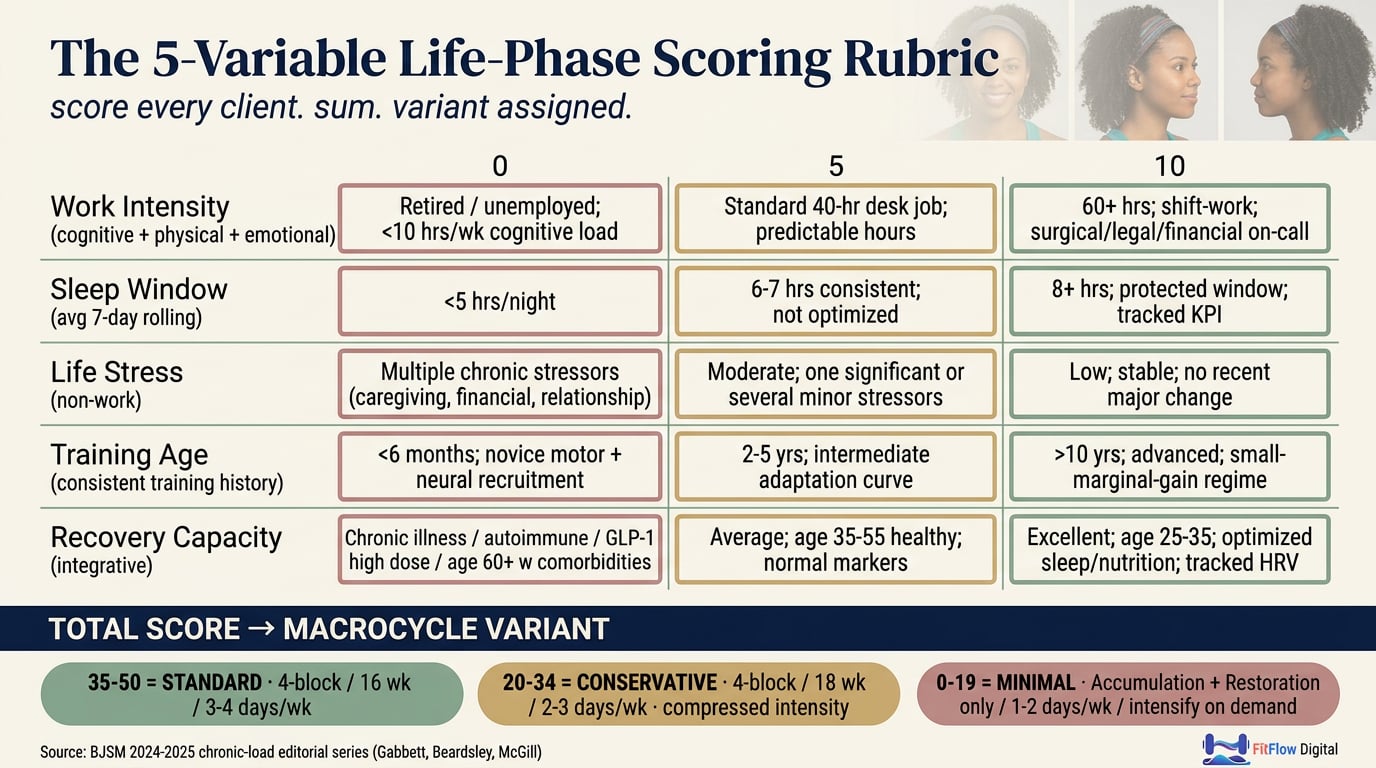
Variable 1: Work intensity (0 to 10)
Cognitive plus physical plus emotional load from the client's primary occupation across an average week.
Score 0: Retired or unemployed; under 10 hours/week of structured cognitive load.
Score 5: Standard 40-hour desk job; moderate cognitive load; predictable hours; protected weekends.
Score 10: High-stress executive role (60+ hours), rotating shift-work, surgical/legal/financial roles with on-call burden, active-duty military.
Work intensity caps the cognitive-recovery budget available for training stress. High work intensity compounds with the Intensification and Realization blocks and produces breakdown by Week 10 to Week 12.
Variable 2: Sleep window (0 to 10)
Average sleep across a 7-day rolling window.
Score 0: Under 5 hours/night average.
Score 5: 6 to 7 hours/night consistent; occasional 5-hour nights; not optimized.
Score 10: Consistent 8+ hours/night; protected sleep window; sleep is a tracked KPI for the client.
Sleep is the dominant recovery variable. Under 6 hours rules out the Standard 4-block macrocycle. The Intensification block (Weeks 5 through 8) compounds with sleep debt and produces neural-fatigue plateau by Week 6 — see Why Most Hypertrophy Programs Fail After 6 Weeks and Why Your Clients Are Not Recovering.
Variable 3: Life stress, non-work (0 to 10)
Chronic non-work stressors across household and personal life.
Score 0: High — multiple chronic stressors (caregiving for young children or aging parents, financial precarity, relationship instability, recent major life change).
Score 5: Moderate — one significant stressor or several minor ones; managed but present.
Score 10: Low — stable relationships, no caregiving burden, financial security, no recent major life change.
Non-work life stress competes for the same recovery budget as work stress. Two kids under six, a divorce, caregiving for an aging parent, ongoing financial stress — all collapse the realizable training-stress ceiling. Ignore this variable and you'll see what looks like arbitrary adherence breakdown (the Consistency Curve failure mode, viewed from the upstream input rather than the downstream programming pivot).
Variable 4: Training age (0 to 10)
Years of consistent structured training experience.
Score 0: Under 6 months consistent training; novice motor patterns, novice neural recruitment, novice intensity-perception calibration.
Score 5: 2 to 5 years consistent training; intermediate adaptation curve; established motor patterns; calibrated intensity perception.
Score 10: Over 10 years consistent training; advanced; small-marginal-gain regime; high RPE-RIR accuracy (see RPE vs RIR for Online Coaching for the per-session calibration layer inside each block).
Training age sets the dose required to drive adaptation. Novices respond to any structured stimulus (linear-progression novice gains; see Progressive Overload Misunderstood for the 6-dimensional overload spectrum). Advanced clients need macrocycle structure to bypass adaptation ceilings. Novices with under 12 months of training don't need the Realization block at meaningful intensity — they need Accumulation-to-Restoration variants until the training-age threshold is crossed.
Variable 5: Recovery capacity (0 to 10)
Integrative physiology score that captures interactions the other four variables miss.
Score 0: Poor (chronic illness, autoimmune condition, GLP-1 medication at high dose, perimenopausal or post-menopausal without HRT, age 60+ with comorbidities).
Score 5: Average (no chronic conditions, age 35 to 55 healthy, normal recovery markers, average sleep, average nutrition).
Score 10: Excellent (age 25 to 35, no chronic conditions, optimized sleep/nutrition/stress, tracked HRV in healthy range, prior athletic history).
Recovery capacity is where chronic conditions enter the rubric. For GLP-1-medicated clients, lean-mass preservation is the dominant constraint and Recovery Capacity rarely scores above 5. For chronic-pain clients, the decision tree in Programming Around Chronic Pain modifies the Intensification and Realization blocks; that's a mandatory adaptation for every chronic-pain-presenting client. You don't skip the macrocycle — you adapt it.
Total score → macrocycle variant
TOTAL SCORE (sum of 5 variables, max 50)  →  MACROCYCLE VARIANT
  35 to 50  →  STANDARD 4-block macrocycle (full sequence; 3 to 4 days/wk; Weeks 1 to 16)
  20 to 34  →  CONSERVATIVE 4-block macrocycle (compressed intensity; longer Restoration; 2 to 3 days/wk; Weeks 1 to 18)
   0 to 19  →  MINIMAL macrocycle (Accumulation + Restoration only; intensify on client-chosen demand events; 1 to 2 days/wk; flexible)
The Roster Selector lead magnet operationalizes this rubric. Input the roster, score each client 0 to 10 per variable, sum, and the tool outputs the recommended variant per client in one pass. Stronger By Science, RP Strength, and NSCA materials don't publish a per-client roster-level tool like this — the Roster Selector is what turns the framework into a Monday-morning decision.
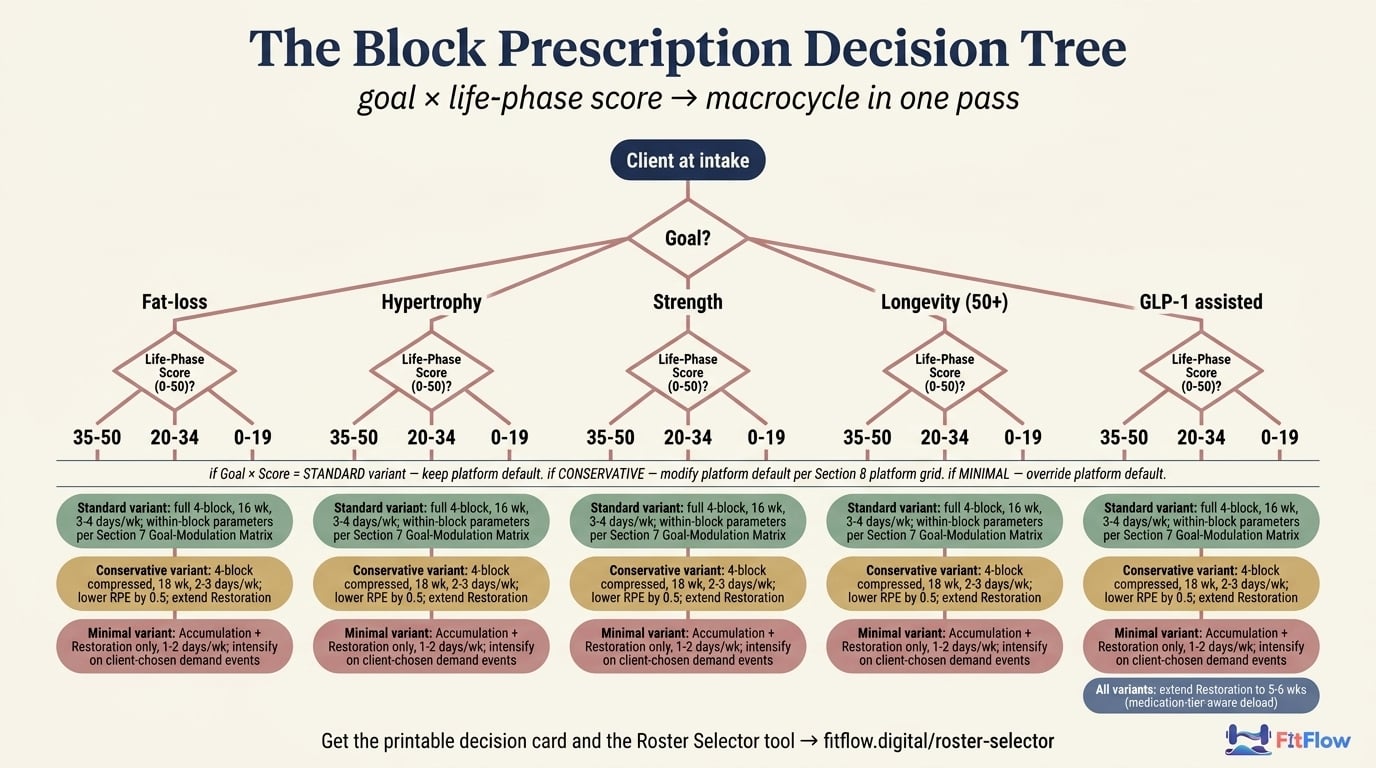
The 4-block macrocycle map: Accumulation → Intensification → Realization → Restoration
The 4-block macrocycle is the structural spine. The architecture comes from Issurin's block-periodization synthesis (Issurin 2008, 2010, 2016, Sports Medicine), modified for general-population life-context. Each block has an adaptation target, an intensity range, a frequency, a sets/reps prescription, a dominant overload dimension (from the 6-dimensional spectrum in Progressive Overload Misunderstood), and explicit transition criteria. Each block is a single-mesocycle program structure (The Simplest Way to Structure a Client Program) stacked into the larger macrocycle.
Standard variant specs below; Conservative and Minimal variants follow the same logic with compressed parameters, summarized at the end of the next section.
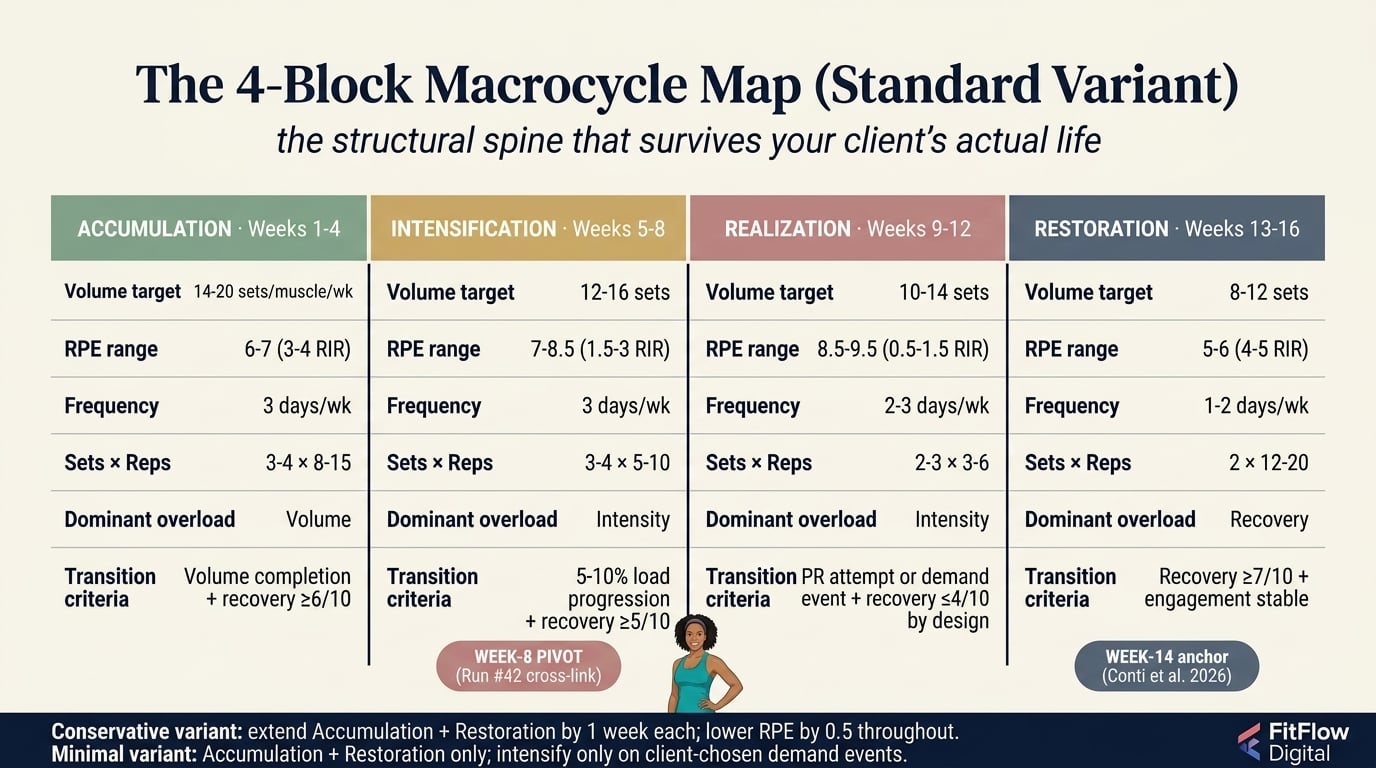
Block 1: Accumulation (Weeks 1 to 4)
Adaptation target: movement quality + volume tolerance. Build the work capacity the rest of the macrocycle exploits.
Volume target: 14 to 20 sets per major muscle group per week.
Intensity target: RPE 6 to 7 (3 to 4 RIR; per-session calibration uses the RPE vs RIR decision protocol).
Frequency: 3 days/week (Standard); 2 days/week (Conservative).
Sets/reps: 3 to 4 sets × 8 to 15 reps.
Dominant overload dimension: volume (more sets, more total reps — one of the six overload levers in Progressive Overload Misunderstood).
Transition to Intensification: client completes Weeks 3 and 4 at planned volume with average RPE within ±0.5 of target, reports recovery scores ≥6/10. If not met, extend Accumulation by 1 to 2 weeks (Conservative) or hold and re-evaluate (Minimal).
Foundation note: each Accumulation block is a single-program structure (see The Simplest Way to Structure a Client Program). The macrocycle is four single-programs stacked.
Block 2: Intensification (Weeks 5 to 8)
Adaptation target: force production. Convert accumulated volume tolerance into per-set force capacity.
Volume target: 12 to 16 sets per major muscle group per week (slight reduction; intensity makes up the work).
Intensity target: RPE 7 to 8.5 (1.5 to 3 RIR).
Frequency: 3 days/week (Standard); 2 days/week (Conservative).
Sets/reps: 3 to 4 sets × 5 to 10 reps.
Dominant overload dimension: intensity (load per set).
Transition to Realization: client demonstrates 5 to 10% load progression on primary lifts across Weeks 5 to 8; recovery scores stable at ≥5/10. If not met, run a 1-week deload and re-assess (default for Conservative; occasional for Standard).
The Week-8 pivot: the Accumulation-to-Intensification transition is the Week-8 retention pivot from The Consistency Curve. The Month-3 retention dip shows up precisely when coaches fail to make this transition — clients stay in Accumulation indefinitely, the dose-response curve flattens, perceived progress stalls, dropout follows. The pivot is the retention-physiology decision the macrocycle forces you to make. That article zooms in on this transition; this one is the scaffold it lives inside.
Inline callout: athlete-block-periodization vs life-phase-block-periodization
This callout sits inside Block 2 because the comparison matters most at the transition that breaks the most rosters. The two models share a name; they don't share an objective function.
Dimension | Athlete-Block-Periodization (Bompa, Issurin) | Life-Phase-Block-Periodization (this framework) |
|---|---|---|
Frequency assumption | 4 to 5 sessions/week | 2 to 4 sessions/week (variant-scaled) |
Sleep assumption | 8+ hours; protected window | 5 to 8 hours; assessed per-client (Variable #2) |
Work-stress assumption | Low (full-time athlete or minimal external work) | Moderate-to-high (40 to 60 hour weeks); assessed (Variable #1) |
Non-work life-stress | Low; controlled environment | Variable; assessed (Variable #3) |
Recovery assumption | Athlete-quality (low life stress, optimized nutrition, possible HRT/medication support) | Variable; assessed per-client (Variable #5) |
Peak Realization | Athletic competition (defined date, measurable performance) | Personal peaking (PR week, body-comp check, photo benchmark, client-chosen demand event) |
Volume target (Accumulation) | 20 to 25 sets/muscle/week | 14 to 20 sets (Standard); 10 to 14 (Conservative); 6 to 10 (Minimal) |
Intensity target (Intensification) | RPE 8 to 9 | RPE 7 to 8.5 |
Transition rigidity | Fixed (competition date is the deadline) | Adaptive (transition criteria are completion-based, not date-based) |
Restoration purpose | Recovery for next macrocycle peak | Recovery + retention protection against Week-14 dropout (Conti et al. 2026 (preprint)) |
Macrocycle length | Athletic season (varies; often 8 to 24 weeks) | 16 weeks Standard; 18 weeks Conservative; flexible Minimal |
Coach's job | Optimize peak performance for competition | Optimize program survivability across life-context constraints |
Failure mode if mis-applied | Underperformance at competition | Client dropout at Week 8 (Consistency Curve) or Week 14 (Conti et al. 2026 preprint); plateau at Week 6 (hypertrophy-program failure); systemic burnout at Week 10 to 12 |
The single sentence that holds this whole article together: athlete-block-periodization optimizes for peak performance at a defined date; life-phase-block-periodization optimizes for program survivability across the client's actual life. Same name, different objective function. Mis-applying athletic-block-periodization to general-population clients isn't "periodization for the wrong audience" — it's optimizing the wrong objective.
The practical consequence: every block specification, every prescription number, every transition criterion in this article assumes life-phase as the objective. Read these numbers through an athlete-frame lens and they'll look conservative. They aren't. They're scaled to the actual recovery budget of a 38-year-old marketing director with two kids under six and a 55-hour work week. The numbers that "look right" in an athletic frame produce dropout in a life-phase frame.
Why this matters at scale: 95% of online coaching rosters are general-population. The 5% of coaches who serve actual athletes have the resources to titrate athletic-block-periodization correctly. The other 95% have been borrowing the 5% framework, mis-titrating it, and watching adherence collapse for 15 years. The life-phase frame fits the population the field actually serves.
Block 3: Realization (Weeks 9 to 12)
Adaptation target: peak expression of accumulated and intensified capacity. For general-pop, the "demonstrate the gains" block aligned to a client-chosen demand event.
Volume target: 10 to 14 sets per major muscle group per week (further reduction; intensity dominates).
Intensity target: RPE 8.5 to 9.5 (0.5 to 1.5 RIR).
Frequency: 2 to 3 days/week.
Sets/reps: 2 to 3 sets × 3 to 6 reps for primary lifts; 2 to 3 sets × 6 to 10 for accessories.
Dominant overload dimension: intensity (load per set at lower volumes).
Transition to Restoration: client has executed at least 2 PR attempts OR completed a client-chosen demand event (photo, body-comp test, performance test). Recovery scores at ≤4/10 by Week 12 are by design and signal Restoration is required.
Pain-modifier clients: for any client with a chronic-pain modifier, the chronic-pain decision tree modifies the Realization block. Pain-trigger movements get replaced with bilateral-to-unilateral progressions or load-tempo modifications. You don't skip the block — you adapt it. Mandatory for every chronic-pain-presenting client.
Block 4: Restoration (Weeks 13 to 16)
Adaptation target: recovery + maintenance. Restore recovery capacity for the next macrocycle. Protect against Week-14 dropout.
Volume target: 8 to 12 sets per major muscle group per week (deload).
Intensity target: RPE 5 to 6 (4 to 5 RIR).
Frequency: 1 to 2 days/week (Standard); 1 day/week (Conservative).
Sets/reps: 2 sets × 12 to 20 reps; movement-quality emphasis.
Dominant overload dimension: recovery (active recovery, mobility, movement quality), NOT progression.
Transition back to Accumulation (Week 17): recovery scores ≥7/10 across Weeks 15 and 16; client motivation and engagement scores stable or rising; no acute injury or illness in the Restoration block.
The Week-14 anchor: Conti et al. 2026 (preprint, sportrxiv) identifies Week 14 as the secondary dropout inflection. Macrocycles without a Restoration block experience 18 to 25% higher Week-14 dropout than those with one. That's the architectural justification for the 4th block — it's documented retention protection, not decoration. The taper-and-restoration physiology under it goes back to Mujika and Padilla's foundational taper work (Mujika & Padilla 2003, 2015), updated for general-population life-context.
4-block summary table
Block | Weeks | Volume Target (sets/muscle/wk) | RPE Range | Frequency | Sets × Reps | Dominant Overload | Cross-link |
|---|---|---|---|---|---|---|---|
Accumulation | 1 to 4 | 14 to 20 | 6 to 7 | 3 days | 3-4 × 8-15 | Volume | Single-program structure guide |
Intensification | 5 to 8 | 12 to 16 | 7 to 8.5 | 3 days | 3-4 × 5-10 | Intensity | Consistency Curve (Week-8 pivot) |
Realization | 9 to 12 | 10 to 14 | 8.5 to 9.5 | 2-3 days | 2-3 × 3-6 | Intensity | Hypertrophy-program failure (peak adaptation); chronic-pain decision tree (pain mod) |
Restoration | 13 to 16 | 8 to 12 | 5 to 6 | 1-2 days | 2 × 12-20 | Recovery | Conti et al. 2026 preprint (Week-14 anchor) |
Phase-aligned block prescription table (fat-loss / hypertrophy / strength / longevity / GLP-1)
The 4-block scaffold supports the five dominant general-population client goals. Each goal modulates the within-block parameters but the scaffold stays. The block structure is goal-agnostic; the parameters inside each block are goal-specific. Phase application (what each block actually trains) is the subject of Tempo Work for Hypertrophy: When It Matters; this article sequences those phases across 16 weeks.
The goal-modulation matrix
Goal | Accumulation (Wk 1-4) | Intensification (Wk 5-8) | Realization (Wk 9-12) | Restoration (Wk 13-16) |
|---|---|---|---|---|
Fat-loss | 16 to 20 sets/muscle; supersets for density; RPE 6.5 | 14 to 16 sets; circuit-style; metabolic conditioning addition; RPE 7.5 | Maintenance lifts + body-comp peak; PR-free; RPE 7 | True deload + cardio shift; protect against rebound |
Hypertrophy | 18 to 20 sets/muscle (volume-dominant); RPE 7 | 14 to 16 sets at higher intensity; metabolic stress emphasis; RPE 8 | 10 to 14 sets in 5 to 8 rep range; mechanical tension peak; RPE 8.5 | Movement quality + maintain 50% volume |
Strength | 12 to 16 sets; movement-quality + speed work; RPE 6.5 | 10 to 14 sets, 3 to 6 reps, RPE 7.5 | 8 to 12 sets, 1 to 5 reps, RPE 9; client demonstrates 1RM or 3RM | Active recovery + tendon/joint quality |
Longevity (50+ general-pop) | 12 to 16 sets (joint-conservative); RPE 6 | 10 to 12 sets, balance + power emphasis; RPE 7 | Demonstration of functional capacity (carries, balance, controlled descents); RPE 7.5 max | Mobility-dominant; cardiovascular emphasis |
GLP-1-assisted | 14 to 16 sets; conservative volume (protein-synthesis ceiling lowered); RPE 6.5 | 12 to 14 sets; lean-mass preservation focus; RPE 7.5 | 10 sets; lean-mass demonstration (body-comp scan, photo); RPE 7.5 max | EXTENDED to 5 to 6 weeks; medication-tier-aware deload |
The volume-modulation logic across goals follows Schoenfeld et al.'s volume-frequency work (Schoenfeld, Ogborn & Krieger 2017, Journal of Sports Sciences; Schoenfeld 2019, 2025 updates). Day-to-day intensity autoregulation inside each block follows Helms et al. (Helms et al. 2018, Journal of Strength and Conditioning Research; Helms 2022 autoregulation review). The Realization-block deload structure follows Mujika and Padilla's taper synthesis (Mujika & Padilla 2003 and 2015 updates).
Cross-cutting principles
The 4-block scaffold stays the same across all five goals. Transition gates, RPE ranges per block, and the Week-14 Restoration anchor are constant.
Volume scales down with metabolic demand. Fat-loss clients carry higher metabolic stress, so total training volume tolerable per block drops. Strength uses lower volume by definition (higher intensity, lower reps).
GLP-1 clients get extended Restoration: 5 to 6 weeks instead of 4. The medication's lean-mass and protein-synthesis interactions compound with peak Intensification volumes, and a longer Restoration block accommodates the slower recovery curve. The MacroFactor Workouts Smart Generation algorithm (launched January 2026) auto-adjusts within-block volume for GLP-1 clients; the longer Restoration block is the macrocycle-level correction the algorithm can't make.
Longevity clients get joint-conservative substitutions throughout. The chronic-pain decision tree is applied prophylactically, not reactively. One of the highest-leverage uses of that framework.
Cross-links: phase application is in Tempo Work for Hypertrophy: When It Matters; recovery as a growth lever is in our Recovery as a Growth Lever piece; the 80/20 lever ranking is in The 80/20 of Training Results. The macrocycle is the meta-lever that sequences those 80/20 levers across time.
Building this prescription per client takes 30 minutes by hand. The Roster Selector outputs the per-client 16-week prescription in under 60 seconds, for your entire 40-client roster in one pass. Download the Selector →
Platform implementation: Trainerize / TrueCoach / Hevy / CoachRx / MacroFactor / Everfit
The leading 2026 coaching platforms have all shipped periodization templates. MacroFactor Workouts launched Smart Generation auto-periodization in January 2026 (help.macrofactorapp.com). CoachRx shipped Q1 2026 macrocycle templates. Everfit released the Program Master Planner in Q1 2026 (blog.everfit.io/kickstart-2025-with-6-new-features). Trainerize updated structured periodization templates in late 2025. TrueCoach pushed periodized program templates in 2025. Every one of those defaults to athlete-style 4 to 5 day/week assumptions. The 5-variable rubric tells you which platform default to keep, which to compress, and which to override entirely.
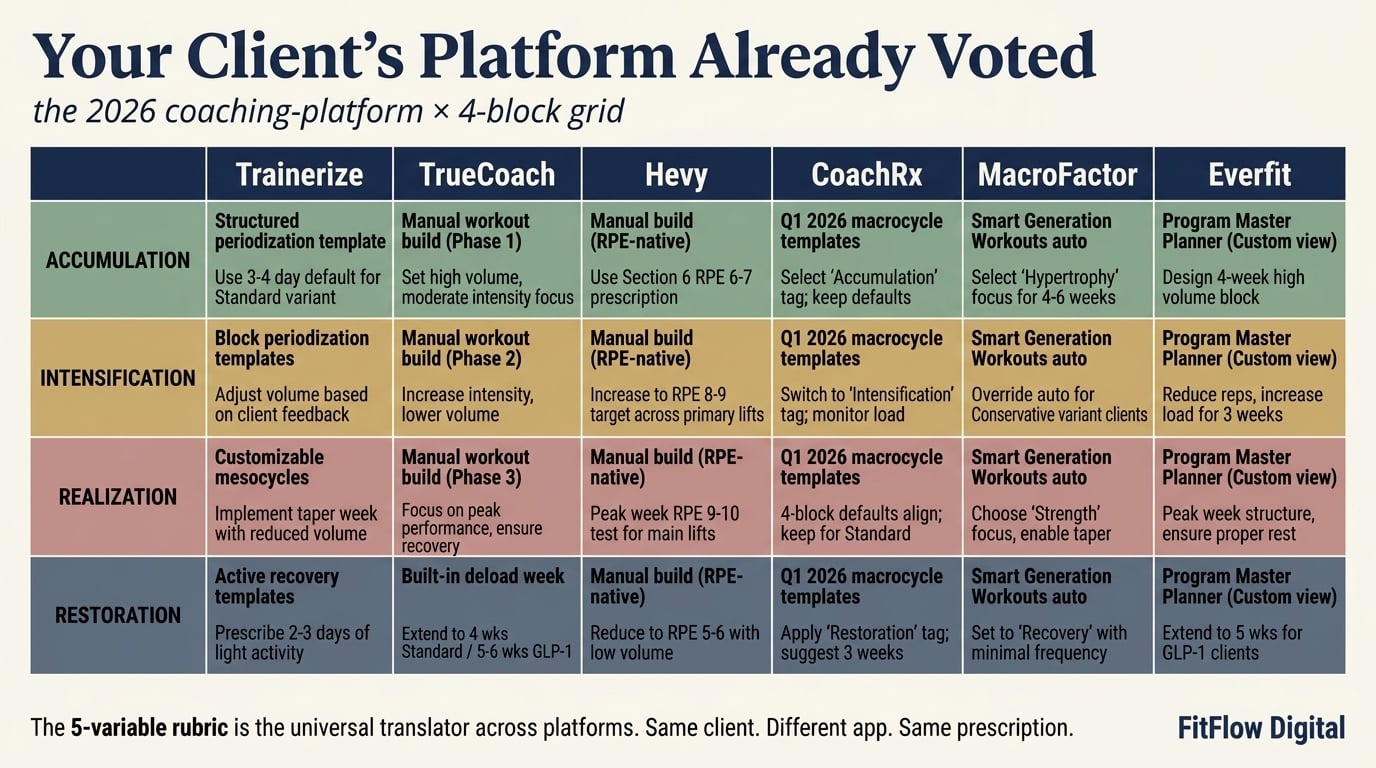
Platform vocabulary grid
Platform | Periodization Feature (2026) | Default Assumption | Where the 5-Variable Rubric Modifies |
|---|---|---|---|
Trainerize | Structured periodization templates with linear-progression defaults | 3 to 4 days/week; intermediate trainee | Use Standard variant for clients scoring 35+; override defaults to Conservative-variant Accumulation for clients scoring 20 to 34 |
TrueCoach | Periodized program templates (2025 update) | 4 days/week; mixed-goal client | Use built-in deload week for Restoration block; extend to 4 weeks (Standard) or 5 to 6 weeks (GLP-1) |
Hevy | Program builder with RPE/RIR autoregulation | RPE-native; no built-in macrocycle template | Build macrocycle manually using Hevy's RPE prescription; per-phase RPE ranges from the 4-block map |
CoachRx | Q1 2026 macrocycle templates with 4-block defaults | 4-block, 16-week, 4 days/week | Standard variant maps directly; for Conservative clients, drop frequency to 2 to 3 days and extend each block by 1 week |
MacroFactor (Workouts) | Smart Generation auto-periodization (Jan 2026 launch); RIR-native | Auto-periodizes based on training experience input | Override auto-defaults for clients scoring 0 to 19; manually set Minimal variant (Accumulation + Restoration only) |
Everfit | Program Master Planner (Q1 2026); 3-view periodization (Phase-by-Phase, Day-by-Day, Custom) | 4-block, 4 days/week, intermediate | Use Phase-by-Phase view for Standard; Day-by-Day for Conservative customization; Custom for Minimal-variant flexibility |
The platform-default decision rule
Same rule for every platform:
Score each client on the 5-variable rubric (the Roster Selector handles this in one pass).
If the client scores 35 to 50, use the platform default — Standard variant is platform-native.
If the client scores 20 to 34, modify the platform default: compress intensity ranges by 0.5 RPE per block; extend Restoration by 1 week.
If the client scores 0 to 19, override the platform default. Use the Minimal variant: Accumulation + Restoration only; intensify only on client-chosen demand events.
The 5-variable rubric works as a universal translator across platforms. It's also the safety net for the AI auto-periodization features the platforms are shipping. MacroFactor's Smart Generation, CoachRx's macrocycle templates, and Everfit's Master Planner all assume the client falls inside the algorithm's training-data distribution. A 38-year-old marketing director with two kids and 5-hour sleep isn't in that distribution. The Roster Selector catches the out-of-distribution clients before the platform default ships them a Standard variant they won't finish.
For coaches managing the operational load at scale, the 30-client wall operations playbook covers the audit cadence and check-in infrastructure that lets the rubric output land cleanly. This article is the on-program time-structure; that one is the off-program operational OS.
Two-client case study: same coach, same goal, different block structure
Two clients, same coach, both pursuing hypertrophy, both 8 weeks of training history together. One is a Standard-variant client; one is a Conservative-variant client. Same goal, very different macrocycles. The 5-variable rubric is what differentiates the prescription.
Client A: Standard variant
Profile: 32-year-old male. Remote software engineer. Lives alone, no kids. Trains 4 days/week. Sleeps 7.5 hours consistently. Low life stress. 4 years training age. Healthy, no medications.
5-variable score:
Work intensity: 5 (standard remote desk job, predictable hours)
Sleep window: 8 (consistent 7.5 hours; close to optimized)
Life stress, non-work: 8 (stable, no major stressors)
Training age: 7 (4 years consistent, intermediate-to-advanced)
Recovery capacity: 9 (young, healthy, optimized lifestyle)
Total = 37 → Standard variant.
Macrocycle Weeks 1 to 16:
Accumulation (Wk 1-4): 4 days/week; 20 sets/muscle/week; RPE 6.5 to 7; 3 to 4 × 8 to 12 reps.
Intensification (Wk 5-8): 4 days/week; 16 sets/muscle/week; RPE 7.5 to 8.5; 4 × 6 to 10 reps.
Realization (Wk 9-12): 3 days/week; 12 sets/muscle/week; RPE 8.5 to 9.5; 3 × 5 to 8 reps; demo PR Week 12.
Restoration (Wk 13-16): 2 days/week; 10 sets/muscle/week; RPE 5 to 6; 2 × 12 to 15 reps.
Expected outcome: roughly 5 to 8% strength gain on primary lifts; visible body-composition progression; no adherence breakdown across the cycle.
Client B: Conservative variant
Profile: 38-year-old female. Marketing director. Two kids (4 and 7). Sleeps 6 hours on a good night. Moderate life stress. 2 years training age. Healthy but recovering from a 6-month training gap after the birth of her second child.
5-variable score:
Work intensity: 8 (55-hour weeks, marketing-director cognitive load)
Sleep window: 4 (6 hours best, 5 hours typical; significant deficit)
Life stress, non-work: 4 (two young children, partner travels for work)
Training age: 5 (2 years consistent; intermediate but de-trained from the 6-month gap)
Recovery capacity: 6 (healthy baseline but compounding sleep and stress deficit)
Total = 27 → Conservative variant.
Macrocycle Weeks 1 to 17 (extended):
Accumulation (Wk 1-4): 2 to 3 days/week; 14 sets/muscle/week; RPE 6; 3 × 10 to 15 reps. Movement-quality emphasis; re-establish baseline.
Intensification (Wk 5-8): 2 to 3 days/week; 12 sets/muscle/week; RPE 7; 3 × 8 to 12 reps. Re-deload Week 8 if recovery scores drop below 5.
Realization (Wk 9-12): 2 days/week; 10 sets/muscle/week; RPE 8; 2 × 6 to 10 reps. Personal demonstration: photo + body-comp at Week 12.
Restoration (Wk 13-17, extended 1 week): 1 to 2 days/week; 8 sets/muscle/week; RPE 5; 2 × 15 to 20 reps. Mobility-dominant; introduce next-cycle exercise selection in Week 17.
Expected outcome: roughly 3 to 5% strength gain; gradual body-comp progression; zero adherence breakdown, because the variant was designed to survive her actual life.
What the case study shows
Same goal. Same coach. Same evidence base. Very different macrocycles. Without the 5-variable rubric, Client B gets Client A's template — or some intuitive watering-down the coach feels guilty about. She hits the Week-6 wall (the hypertrophy-program failure point) by Week 5, plateaus, drops adherence, and probably churns at Week 8 to Week 10 (the Consistency Curve failure mode, textbook).
With the rubric, Client B gets a macrocycle that survives her life. Slower progress on paper, much better retention and long-term outcomes in practice. Without the rubric, coaches default to either one-size-fits-all athlete-block-periodization (Client B churns) or "just be consistent" (both clients stagnate).
The link to What Elite Coaches Do Differently: this is the macrocycle-design branch of the meta-decision tree. Elite coaches differentiate at intake, not in the third month when adherence is collapsing. The Roster Selector turns that differentiation into a 60-second decision instead of a 30-minute one.
Week 1 to Week 16 implementation guide
The 4-block macrocycle compresses into a per-week prescription you can paste into your platform of choice. The Standard variant calendar is below; Conservative and Minimal modifications follow.
Standard variant calendar (16 weeks)
Week | Block | Days/Wk | Volume Target (sets/muscle) | RPE Range | Primary Programming Note |
|---|---|---|---|---|---|
1 | Accumulation | 3 | 14 | 6 | Movement-quality assessment; baseline lifts; establish exercise selection |
2 | Accumulation | 3 | 16 | 6.5 | Progressive volume add; introduce all primary lifts |
3 | Accumulation | 3 | 18 | 7 | Peak Accumulation volume; verify transition criteria |
4 | Accumulation | 3 | 20 | 7 | Final Accumulation week; transition gate check at end of week |
5 | Intensification | 3 | 16 | 7.5 | Drop volume, raise intensity; load 5% above Accumulation top sets |
6 | Intensification | 3 | 16 | 8 | Continue load progression; Week-6 wall waypoint (see hypertrophy-program failure) |
7 | Intensification | 3 | 14 | 8.5 | Peak Intensification; verify load progression criteria |
8 | Intensification | 3 | 14 | 8.5 | WEEK-8 PIVOT (see Consistency Curve); transition gate to Realization |
9 | Realization | 2 to 3 | 12 | 8.5 | Drop volume further; reps 5 to 8 on primary lifts |
10 | Realization | 2 to 3 | 12 | 9 | Peak Realization intensity; demonstrate strength |
11 | Realization | 2 to 3 | 10 | 9.5 | PR attempts on primary lifts; client-chosen demo |
12 | Realization | 2 | 10 | 9 | Final Realization; recovery scores will be ≤4/10 by design |
13 | Restoration | 1 to 2 | 10 | 6 | Hard deload; mobility-dominant; psychological reset |
14 | Restoration | 1 to 2 | 8 | 5.5 | Week-14 anchor (Conti et al. 2026 (preprint)); dropout-protection week |
15 | Restoration | 1 to 2 | 8 | 5 | Active recovery; movement quality |
16 | Restoration | 1 to 2 | 8 | 5 | Final Restoration; verify transition criteria for next macrocycle (Week 17 returns to Accumulation) |
Variant modifications
Conservative variant (total score 20 to 34): compress to 2 to 3 days/week; extend Accumulation to 5 weeks; extend Restoration to 5 weeks; lower all RPE ranges by 0.5; total macrocycle = 18 weeks.
Minimal variant (total score 0 to 19): Accumulation (Wk 1-6) + Restoration (Wk 7-10) only; skip Intensification and Realization; intensify only on client-chosen demand events; 1 to 2 days/week; flexible scheduling.
The coach's weekly decision point
At the end of each week, the coach reviews four signals:
Adherence: sessions completed versus planned.
Average RPE: against target range for the current block.
Recovery score: client self-report on a 0 to 10 scale.
Next-week prescription: default-progress, hold, or compress.
The rule: if any 2 of (adherence under 80%, RPE over target by 0.5+, recovery under 5) are present, hold or compress next week. If all three are in range, default-progress per the calendar.
That's the weekly decision the macrocycle gives you that a freeform "just be consistent" program doesn't. The scaffold is what makes the decision structured instead of intuitive. And the structured decision is what scales across 40 clients in 20 minutes of audit time per week instead of 90.
Closing: the Roster Selector + sister-post links
Back to the three clients you opened your coaching app to this morning.
Client 12, the 38-year-old marketing director with two kids and 5-hour sleep, scores 27 on the rubric. She runs the Conservative variant. 2 to 3 days/week, 14 sets/muscle/week in Accumulation, extended Restoration, and a client-chosen demonstration at Week 12 that doesn't need an athletic PR. She makes 3 to 5% strength progress this cycle. She finishes the cycle. She signs up for the next one.
Client 23, the 42-year-old software engineer with 7-hour sleep and low life stress, scores 39. He runs the Standard variant. The "I'm feeling flat, should we deload?" message was the Week-7 signal. The Week-8 pivot fixes it. He hits a PR Week 11. He doesn't churn at Month 3.
Client 37, the 51-year-old peri-menopausal nurse on shift work, scores 14. She's been running on "just be consistent" for eight months because no one gave her coach a Minimal variant to deploy. She runs Accumulation + Restoration only, two days a week, with a body-composition demonstration in Month 4. Progress is real but slow. She doesn't break. She's still on the roster nine months later.
Three clients, three macrocycle variants, one rubric. The macrocycle structure stays constant; the variant selection bends to the life-context.
The Roster Selector: operationalize the framework across your full book in one pass
Your 41 clients are waiting for the prescription. The General-Population Periodization Selector gives you the per-client 16-week macrocycle — Standard, Conservative, or Minimal variant — in one pass. Includes the 4-block calendar templates (Standard, Conservative, Minimal), the goal-modulation matrix (fat-loss, hypertrophy, strength, longevity, GLP-1), and the platform-specific implementation reference for Trainerize, TrueCoach, Hevy, CoachRx, MacroFactor, and Everfit. Build your prescription Monday morning →
Final anchor
The ACSM 2026 finding doesn't mean periodization is dead. It means the periodization that gets measured in labs isn't the periodization general-population coaching needs. The 4-block, 16-week, life-phase-scaled macrocycle scaffold is the operational answer. The Roster Selector is the tool. Your 41 clients are waiting for the prescription. Build it Monday morning.
Scope of practice & medical disclaimer
This article is evidence-based coaching content for fitness professionals working with general-population clients. It isn't medical advice and isn't a substitute for clinical evaluation, diagnosis, or treatment. Recommendations involving GLP-1-medicated clients, clients with chronic-pain presentations, peri- or post-menopausal clients, or any client with a chronic medical condition assume the coach is operating within their scope of practice and that the client is under appropriate medical care. Coordinate programming decisions for medicated and clinically-presenting clients with the prescribing clinician or a qualified medical professional. Don't adjust, recommend, or implicitly advise on medication dosing. Refer out when client presentation exceeds the coaching scope.
Frequently Asked Questions
Comments