Simple Nutrition Frameworks That Actually Work for Training Clients

Right now, only 2.1% of TikTok nutrition content meets public health accuracy standards. Content from unqualified creators receives almost five times more views than content from qualified professionals. Your clients are not confused about whether nutrition matters. They are confused about what to actually do. The right nutrition frameworks personal trainer teams deploy can cut through that noise -- and that is what this article delivers.
You are the most credible nutrition educator most of your clients will ever have consistent access to. The Trainerize 2026 State of Personal Training Report confirms it: "People aren't just hiring trainers for workouts anymore -- they want help eating better, sleeping better, building routines that stick." If you are managing 20, 30, or 50 clients, you need a nutrition approach that is simple enough to deploy consistently across your entire roster, scope-safe, and actually followed.
Here is the first thing to understand: you almost certainly should not be giving clients meal plans. In most U.S. states, prescribing individual meal plans without a registered dietitian license is a legal gray area that puts you at risk of fines, liability, and certification revocation. And even where it is technically legal, the research shows that clients given simple visual frameworks -- hand portions, balanced plate, habit-based check-ins -- maintain adherence at significantly higher rates over 12 weeks than clients given detailed macro prescriptions.
This article gives you three frameworks, a progressive complexity model for matching the right framework to the right client, and a 3-question check-in system. No meal plans. No certification required. All scope-safe. For the full evidence base, see our Evidence-Based Nutrition & Recovery Guide. This article is the translator: frameworks you hand to clients.
Nutrition Templates You Can Hand to a Client Today. No Meal Plans Required. Get the Free Templates.
Why Meal Plans Fail Your Clients (And Your Practice)
IDEA Fit calls it "the elephant in the room": "In some states it is a matter of law, and violators can be prosecuted." State variation exists -- Colorado and Arizona have minimal requirements, while New Mexico and Nevada require licensure for nutrition practice -- but the legal risk is only half the problem.
Even where trainers legally can create individualized meal plans, the practical evidence argues against them. In a 12-month weight management study, only participants who tracked more than 66% of days sustained significant weight loss (PMC5568610) -- but macro-specific tracking is the most abandoned nutrition behavior, with most clients discontinuing by week 4-6. Precision Nutrition, coaching over 150,000 clients, reports that most achieve body composition goals with hand portions alone.
Trainers who anchor on meal plans face two failure modes -- legal exposure or client dropout. As the MyPTHub 2026 Guide puts it: "The best nutrition plan is the one your client will actually follow for 12 weeks." This is one of the systemic failures that undermine client results at scale.
What Counts as "Within Scope" for Nutrition Coaching
In Scope | Out of Scope |
|---|---|
General nutrition education based on public health guidelines (USDA MyPlate, Harvard Healthy Eating Plate) | Individualized meal plans with specific caloric prescriptions |
Visual portion teaching (hand portions, plate method) | Medical nutrition therapy for disease or clinical conditions |
Habit-based coaching (food awareness, hydration targets, protein prioritization) | Eating disorder intervention or diagnosis |
General protein and hydration targets based on body weight | Specific dietary protocols for medical conditions (diabetes, renal disease) |
Accountability for client-selected nutrition behaviors | Supplement prescriptions for therapeutic purposes |
References: NSCA, ACE, NASM scope-of-practice positions. Note: this is general guidance. Verify your specific state's regulations.
Framework 1: The Hand Portion Method
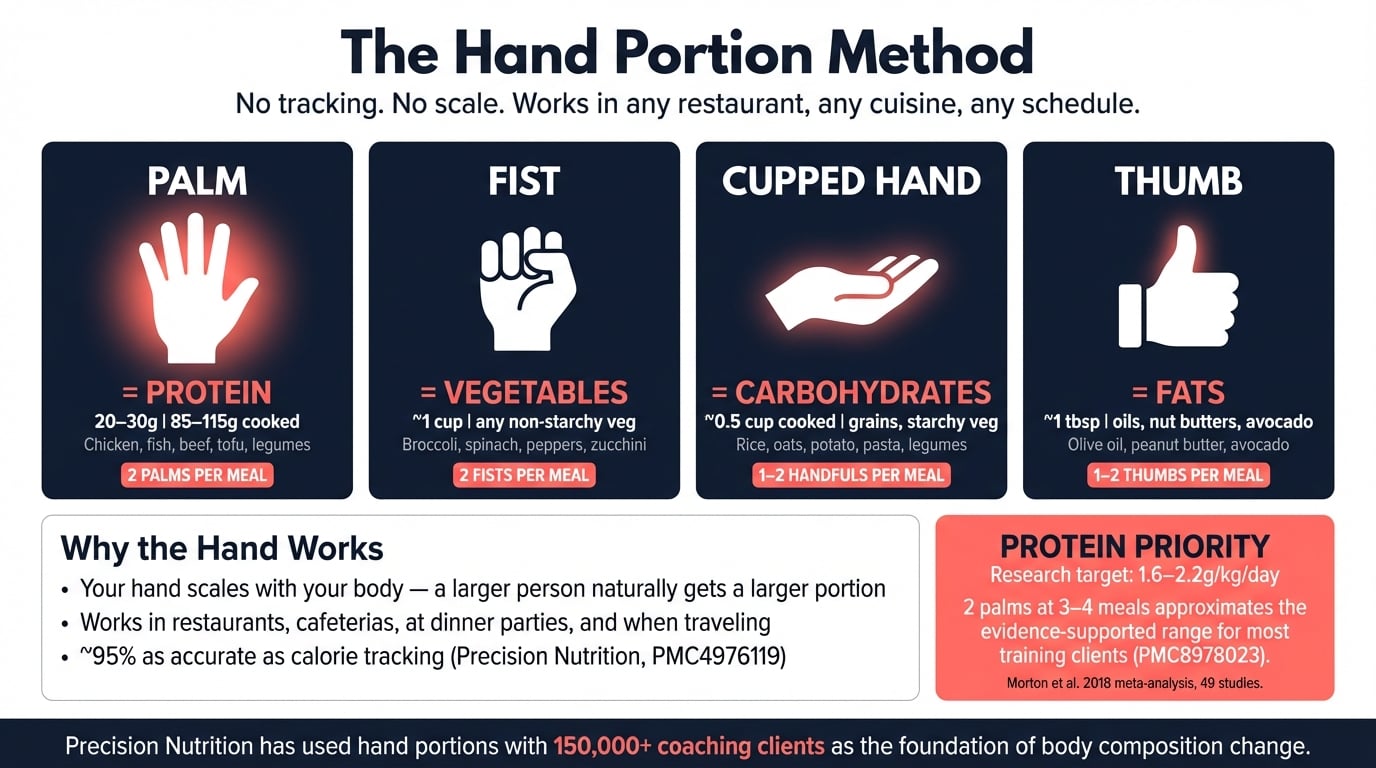
The hand portion method is the most portable, evidence-backed alternative to calorie and macro tracking for general fitness clients. No app, no food scale, no calorie arithmetic. Precision Nutrition reports it is approximately 95% as accurate as calorie tracking across 150,000+ coached clients, and peer-reviewed research confirms reliable portion accuracy compared to household measures (PMC4976119).
The four measures:
Palm = 1 protein serving (~20-30g protein). A palm-sized portion of cooked meat, fish, poultry, or equivalent legume/tofu.
Fist = 1 vegetable serving (~1 cup). Any non-starchy vegetable.
Cupped hand = 1 carbohydrate serving (~0.5 cup cooked). Any grain, starchy vegetable, or legume.
Thumb = 1 fat serving (~1 tablespoon). Oils, nut butters, avocado portions.
Baseline targets for most active clients:
Measure | Per Meal Target | Daily Total (3-4 meals) |
|---|---|---|
Palm (protein) | 1-2 palms | 4-8 palms |
Fist (vegetables) | 1-2 fists | 4-8 fists |
Cupped hand (carbs) | 1-2 cupped hands | 3-8 cupped hands (adjust for activity/goals) |
Thumb (fats) | 1-2 thumbs | 3-8 thumbs |
These are starting guides, not prescriptions. Trainers adjust based on observable client progress -- energy levels, body composition trends, and session performance.
Why it works: The hand scales with the individual -- a larger person has a larger hand and naturally gets a larger portion. It works across all cuisines, at any restaurant, at a dinner party, and during travel. App-based tracking fails in all of those contexts.
The protein target connection: Research consensus supports 1.6-2.2g/kg of body weight daily for training clients seeking muscle preservation or growth (Morton et al. 2018 meta-analysis -- 49 studies, 1,863 participants). Two palms of protein at 3-4 meals per day approximates this range without clients needing to calculate. For the full protein distribution and post-exercise nutrition research, see our Evidence-Based Nutrition & Recovery Guide.
When to use this framework: Best for motivated clients who will not track macros -- those with family obligations, busy schedules, or cultural eating contexts. Works well for moderate body composition and performance goals. Not ideal for competitive physique athletes who require precision beyond hand measures.
Giving Clients the Hand Portion Method in Practice
Here is the 60-second script for introducing this framework at a session:
"At your next three meals, build your plate this way: a palm of protein, two fists of vegetables, a cupped hand of carbohydrates, and a thumb of fat. That is it. Do not track anything. Just build the plate. We will check in at our next session."
What to track as the trainer: energy levels, body composition trends, session performance. Not calorie totals.
Red flags for a higher-precision approach: persistent weight gain despite adherence, clinical conditions (diabetes, GLP-1 medications, eating disorder history), or competitive physique goals. Refer to a registered dietitian for individualized therapy and continue supporting the habit layer within your scope.
Framework 2: The Balanced Plate
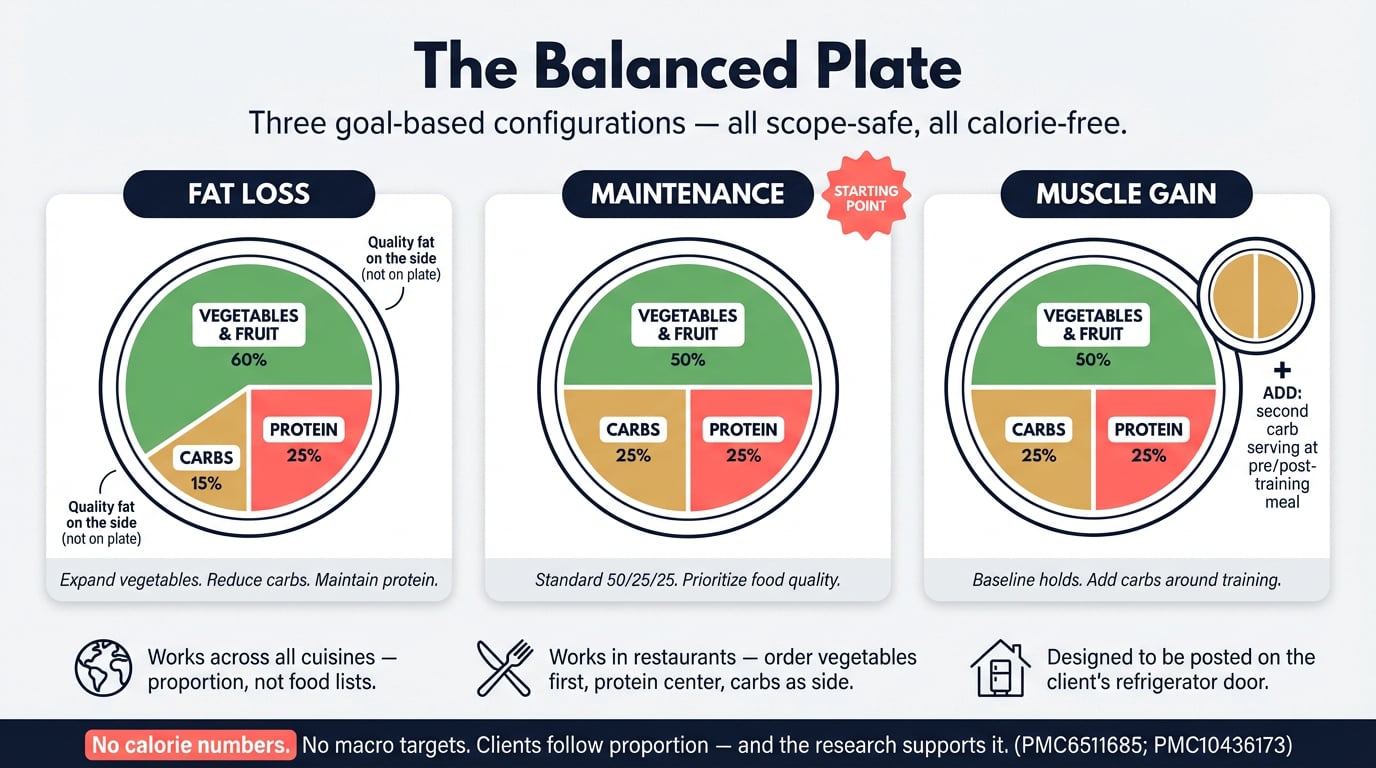
The balanced plate translates visual nutrition logic into a meal container context. For clients who cook at home or eat from a cafeteria, the proportions are even simpler than counting palms. Based on the Harvard Healthy Eating Plate and USDA MyPlate -- both public health resources squarely within trainer scope.
The standard balanced plate:
Half the plate: vegetables and/or fruits (non-starchy vegetables preferred)
One quarter of the plate: quality protein (lean meat, fish, legumes, eggs)
One quarter of the plate: complex carbohydrates (whole grains, starchy vegetables)
A side of quality fat: olive oil, nuts, avocado -- not part of the plate division itself
Goal-based variations:
Client Goal | Vegetables | Protein | Carbs | Notes |
|---|---|---|---|---|
Fat loss | 60% of plate | 25% of plate | 15% of plate | Expand vegetables, reduce carb portion |
Muscle gain / performance | 50% of plate | 25% of plate | 25% of plate | Add a second carb serving at pre- or post-training meal |
Maintenance | 50% of plate | 25% of plate | 25% of plate | Standard proportions; prioritize food quality over adjustments |
Research supports the approach: a scoping review (PMC8874720) found plate-based methods improve dietary adherence and reduce energy intake, and an RCT in cardiac rehabilitation (PMC6511685) confirmed acceptability and positive dietary outcomes. The plate method consistently outperforms food journaling for long-term self-monitoring burden.
The TikTok misinformation antidote: With 97.9% of TikTok nutrition content failing accuracy standards, the plate method gives trainers a visual counter-message that is evidence-grounded, intuitive, and faster to understand than any TikTok nutrition narrative. It can be communicated in a single image. TikTok itself has an official Healthy Plate channel -- a platform-level endorsement of plate-based visual nutrition.
When to use this framework: Best for clients who cook at home regularly, respond to visual cues, or need the most simplified starting point. The plate method is the lowest barrier to entry of the three frameworks.
Adjusting the Plate for Client Context
The plate method works across all cuisines because it is a proportion model, not a food list. Mediterranean eating (high-vegetable, olive oil-heavy) aligns naturally. Asian eating (rice-centered) adjusts by treating rice as the smaller carbohydrate quarter. Latin American eating (bean and rice staple) counts beans as protein.
Client-friendly framing: "No foods are off the plate. The question is proportion, not permission."
When clients eat out, the plate method still applies: vegetables as the bulk of the order, protein as the center, carbohydrates as the side.
Framework 3: Habit-Based Nutrition Coaching
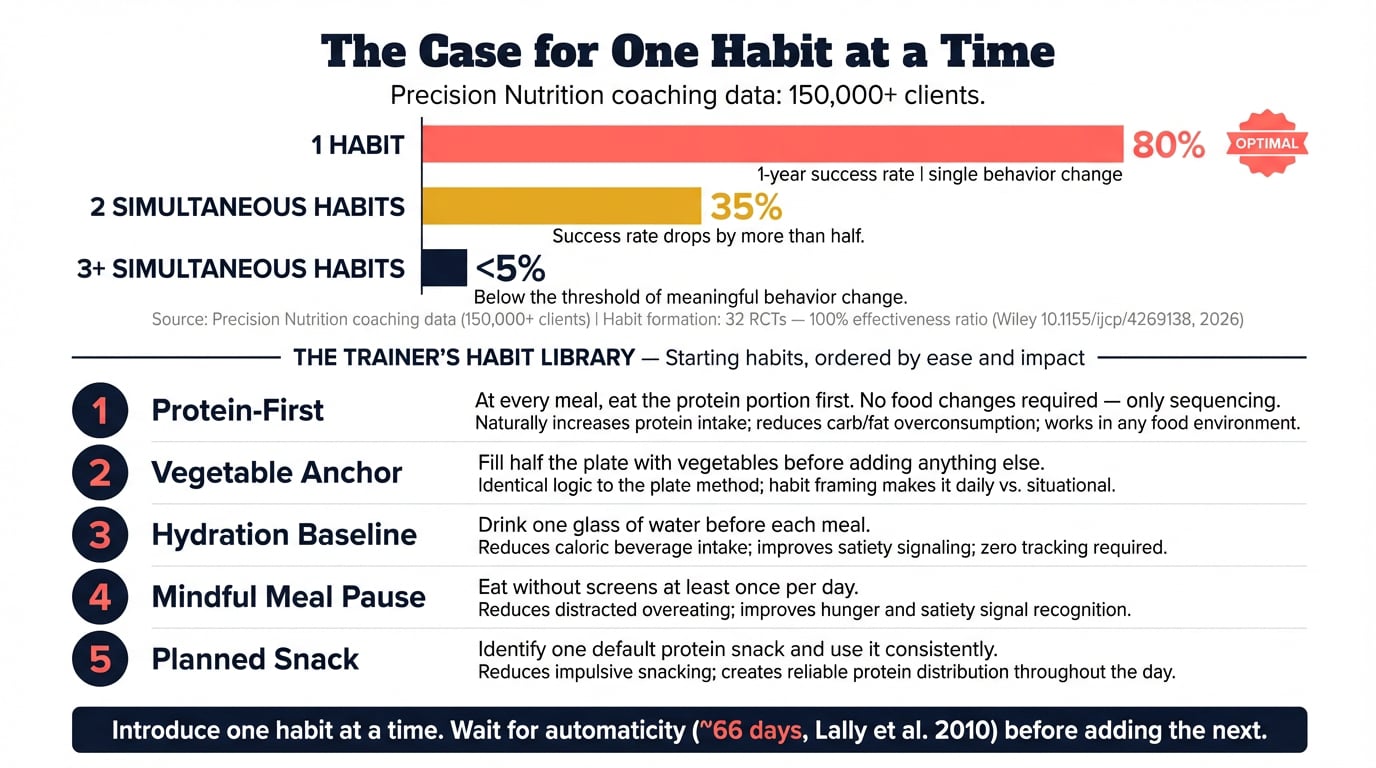
Precision Nutrition's analysis of over 150,000 coaching clients found that single habit change maintained an 80% success rate at one year. Two simultaneous habits dropped success to 35%. Three or more simultaneous habits: below 5%. A 2026 meta-analysis of 32 randomized controlled trials on coaching-supported dietary interventions found habit formation to be the highest-effectiveness behavior change technique evaluated -- with a 100% effectiveness ratio across included studies (International Journal of Clinical Practice, 2026).
Instead of prescribing food quantities or meal structures, the trainer introduces one nutrition behavior at a time -- a specific, repeatable action the client practices daily.
The habit library for trainers (ordered by ease of implementation and impact):
Protein-first: At every meal, eat the protein portion first. Reduces overconsumption of carbohydrates and fats, naturally increases protein intake, and works in any food environment.
Vegetable anchor: Fill half the plate with vegetables before adding anything else. Identical to plate method logic, but the habit frame makes it a daily practice rather than a situational structure.
Hydration baseline: Drink one glass of water before each meal. Reduces caloric beverage intake, improves satiety signaling, and requires zero tracking.
Mindful meal pause: Eat without screens at least one meal per day. Reduces distracted overeating and improves hunger/satiety signal recognition.
Planned snack: Identify one default snack that contains protein, and use it consistently. Reduces impulsive high-calorie snacking and creates reliable protein distribution throughout the day.
The progressive introduction model: Introduce one habit at a time. The client practices it for 2-4 weeks until it is automatic -- research suggests full automaticity develops over an average of 66 days (Lally et al. 2010). Only when the current habit feels effortless does the trainer introduce the next one.
Why this beats macro tracking for most clients: Macro tracking requires sustained high-cognitive-load behavior -- logging every food, weighing portions, calculating macronutrients at every meal. It works for motivated, detail-oriented clients. It fails for clients with variable schedules, family cooking responsibilities, or low tech comfort. Habit-based coaching reduces the cognitive load to a single daily behavior.
The 80/20 rule context: The MyPTHub 2026 Guide explicitly frames sustainable nutrition adherence at 80%: "Clients need permission to be imperfect while still moving forward; a B-minus effort sustained over time beats an A+ effort that burns out in three weeks." Habit-based coaching is structurally designed to achieve the 80% adherence threshold by targeting one achievable behavior at a time.
The connection between low-compliance nutrition habits and poor client recovery outcomes is the diagnostic layer covered in Why Your Clients Are Not Recovering -- the root causes that reveal which habits are the highest priority to introduce first.
Starting the First Nutrition Habit Conversation
Here is the session script for introducing the first nutrition habit:
"I want to suggest one nutrition practice that does not require any tracking or cooking changes. For the next two weeks, at every meal, eat the protein portion first -- whatever that is in your meal. That is it. Can we try that?"
This is general nutrition education -- squarely in scope. Zero tracking burden. Zero recipe requirement. The client simply changes the order in which they eat what they are already eating.
At the 2-week check-in, ask: "Did you do it? How many meals? What got in the way?" These answers guide whether to continue the habit, simplify it further, or introduce the next one.
The Progressive Complexity Model: Matching the Framework to the Client
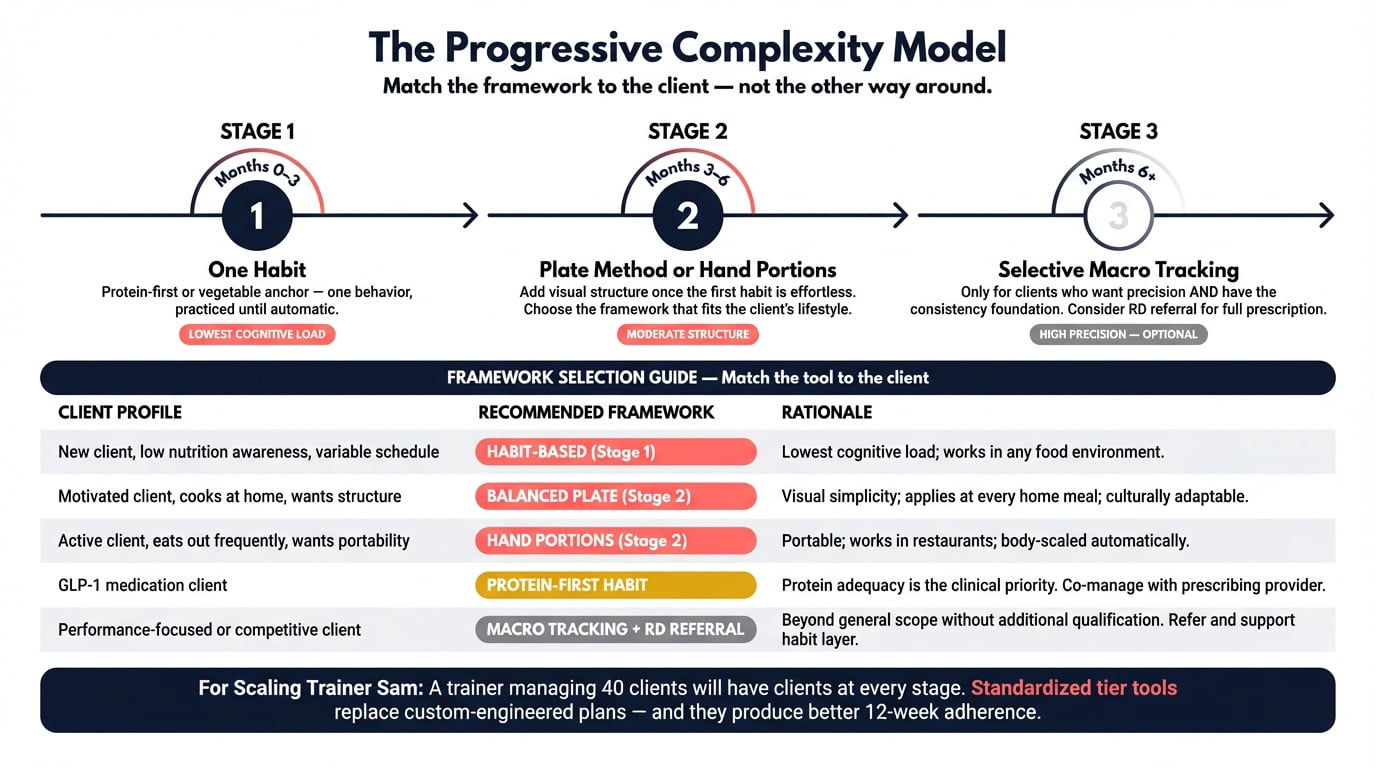
No single nutrition framework works for all clients. The trainer's job is to assess client readiness, lifestyle, and goals and select the right tool. This is the decision logic absent from every other nutrition coaching guide -- and the skill that separates trainers who produce consistent results from those who give every client the same sheet.
The framework selection guide:
Client Profile | Recommended Framework | Rationale |
|---|---|---|
New client, low nutrition awareness, variable schedule | Habit-Based (Framework 3) | Lowest cognitive load; one behavior at a time; works in any food environment |
Motivated client, cooks at home, wants structure | Balanced Plate (Framework 2) | Visual simplicity; applies at every home meal; culturally adaptable |
Active client, eats out frequently, wants precision without tracking | Hand Portions (Framework 1) | Portable; works in restaurants; scales to individual body size |
Performance-focused client, competitive athlete | Macro tracking (advanced -- beyond scope without additional qualification) | Refer to RD for full macro prescription; trainer supports the habit layer |
GLP-1 medication client | Protein-first habit (Framework 3 variant) | Protein adequacy is the clinical priority; hand portion protein minimum is the anchor; co-manage with prescribing provider |
The progression path: Clients typically move through nutrition frameworks as their literacy develops:
Stage 1 (months 0-3): One single habit -- protein-first or vegetable anchor
Stage 2 (months 3-6): Plate method or hand portions -- adding structure to the habit foundation
Stage 3 (months 6+): Selective macro tracking for specific goals, if appropriate and desired -- with RD referral for individualized prescription
What this means for trainers managing a full roster: A trainer with 40 clients will have clients distributed across all three stages. Each stage is standardizable -- you apply the same stage-appropriate tool consistently without custom-engineering a nutrition approach for every individual. This is one of the key operational practices that separate trainers who scale to 50+ clients from those who plateau at 20.
Upgrading a Client From One Tier to the Next
Habit-based to Plate Method: The client is consistently doing the first 1-2 habits automatically. When you ask "Does it feel effortless?" and the answer is yes, introduce the plate proportions at home meals.
Plate Method to Hand Portions: The client wants portability for restaurants, travel, or social eating. Hand portions add precision without adding complexity: "You have the plate down. Now let us make it portable."
The upgrade conversation: "You have been doing this consistently for 6 weeks -- your brain has filed it as automatic. You are ready to add a layer."
The 3-Question Nutrition Check-In: Your Repeatable Client System
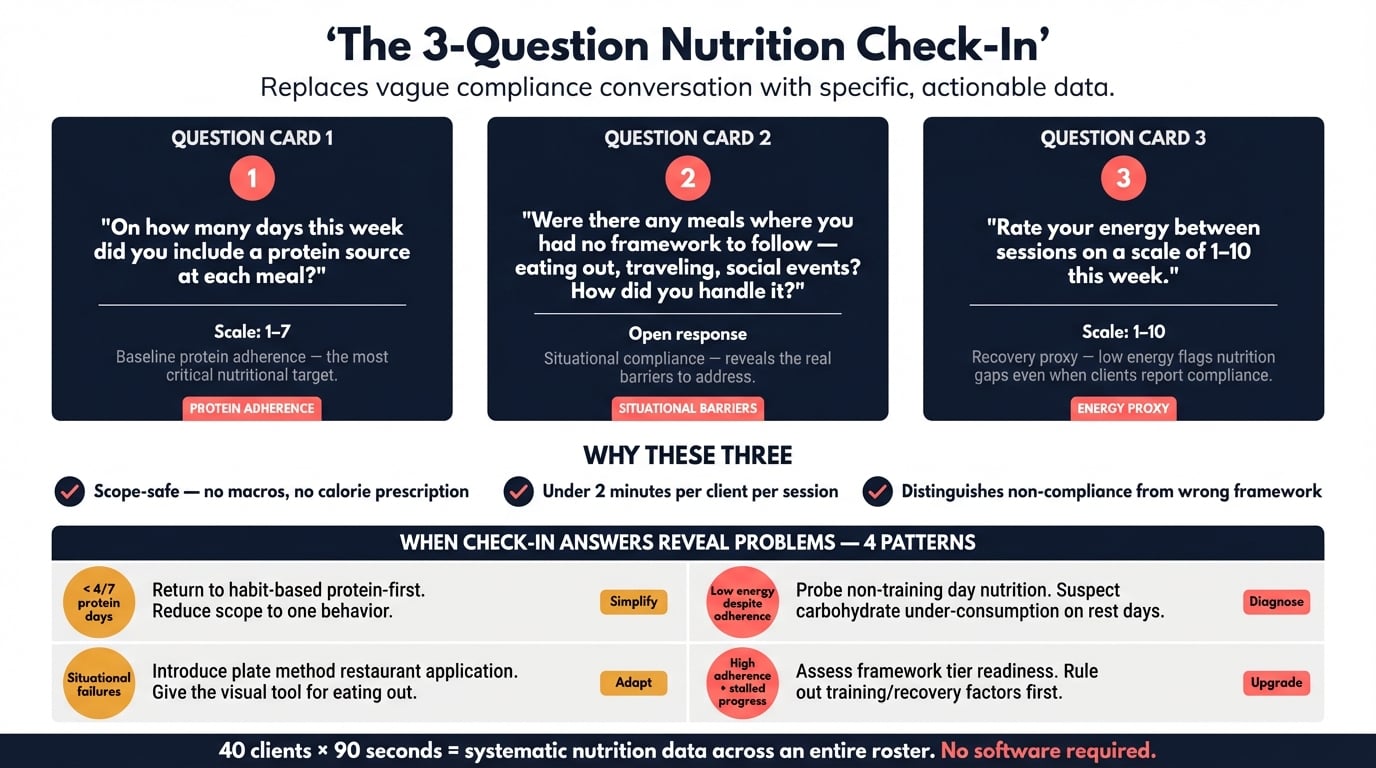
Trainers who ask "How is your nutrition going?" get "Good" or "Not great" -- neither of which is actionable. A structured 3-question check-in replaces vague compliance conversation with specific, programming-relevant data.
The 3 questions:
"On how many days this week did you include a protein source at each meal?" (1-7 scale. Baseline adherence to the most critical nutritional target.)
"Were there any meals where you had no framework to follow -- eating out, traveling, social events? How did you handle it?" (Situational compliance. Reveals barriers to address with framework adjustment.)
"Rate your energy between sessions on a scale of 1-10 this week." (Recovery proxy. Low energy flags nutrition gaps even when clients report compliance.)
Why these three questions: They are scope-safe (no macros, no calories, no prescriptions), they take 90 seconds per client, they distinguish between non-compliance and framework mismatch, and they create a data trail for adjusting the nutrition approach over time. A trainer managing 40-50 clients can run this check-in at every session without software or a tracking platform.
You Just Read the Framework. Now Hand It to Your Client. Download All 3 Templates.
Build your nutrition check-in score (protein adherence days out of 7, for example) into your client tracking dashboard alongside performance and body composition metrics for a complete picture of client progress drivers.
What to Do When Check-In Answers Reveal Problems
Four common patterns and the trainer's response:
Low protein adherence (fewer than 4 out of 7 days): Return to habit-based coaching. Reduce scope back to one habit -- protein-first at every meal. The client needs a simpler system, not more pressure.
Situational compliance failures (eating out, travel, social events): Introduce the plate method's restaurant application. Give the client the visual tool for eating out: "Half vegetables, quarter protein, quarter carbs -- at any restaurant, any cuisine."
Low energy despite reported compliance: Probe for non-training-day nutrition. Suspect carbohydrate under-consumption on rest days. This is one of the most common and most correctable recovery failures -- covered in detail in Why Your Clients Are Not Recovering.
Consistent high adherence but stalled progress: Consider whether the current framework is the right tier. Assess whether macro tracking (with RD referral if needed) is appropriate. Rule out training and recovery factors first -- the framework may not be the bottleneck.
Simplicity Is Not the Compromise. Simplicity Is the Strategy.
Three frameworks. One progressive model. One repeatable check-in system. No meal plans, no macro prescriptions, no apps required.
The research is unambiguous: clients who follow a simple framework at 80% adherence for 12 consecutive weeks produce better outcomes than clients who attempt precise macro tracking and abandon it at week 4. Simplicity is not the compromise. Simplicity is the strategy.
Here is what to do next: choose one of the three frameworks for your most challenging nutrition client. Introduce it at your next session using the script in the framework section above. Check in with the 3-question protocol at the following session. Evaluate. Adjust. That is the system.
If you are not sure why a specific client's nutrition is breaking down before you implement a framework, start with the diagnostic layer in Why Your Clients Are Not Recovering.
Three Frameworks. Three Templates. Zero Meal Plans. Get the Free Templates.