
AI Video Form Review: Coach Killer or Your Best Triage Tool? (The Honest 2026 Verdict)
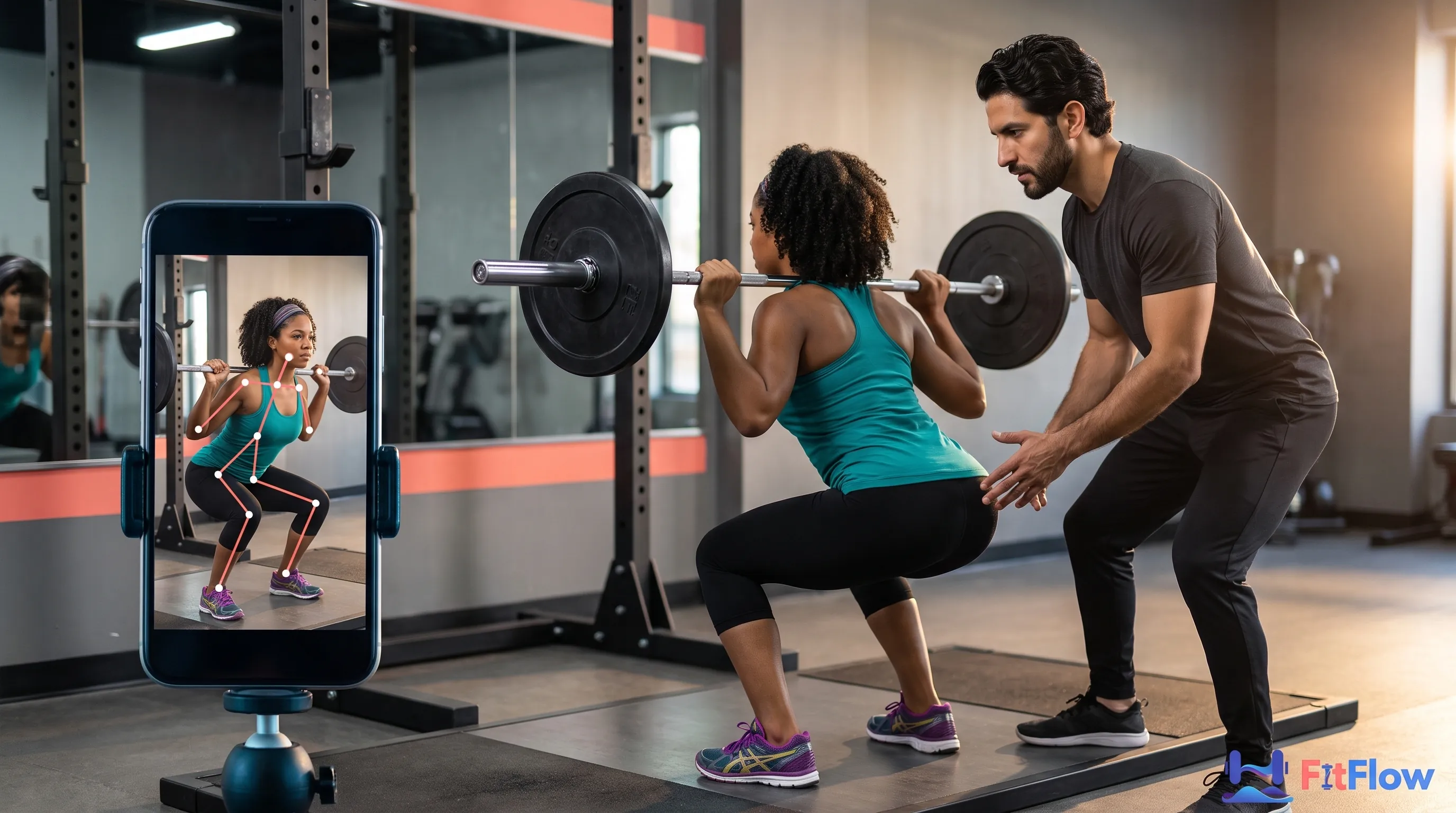
Async video review is scaling online coaching faster than almost any workflow in the industry — async platforms report a single coach can serve up to 5–10x the clients they could ever reach in person (Clarityflow/StoryPrompt; Coachway). At the same time, the technology promising to automate that review runs into a hard measurement ceiling: single-camera markerless pose estimation carries roughly a 5.8° joint-angle error, degrades under occlusion, and its own industry reviewers call these tools "screening aids, not measurement instruments" (SensAI, 2026).
That gap is where every practical decision about AI video form review lives — the space between how fast review is scaling and how little the camera can actually judge. It is tempting to read it as a threat. It is not. It is the opportunity. The coach who automates the part the camera is good at, and owns the part it cannot touch, wins both ends.
This is not an app ranking, and it is not a doom piece. It is an honest account of what automated form review can and cannot judge, and a concrete workflow for using it to scale without commoditizing your eye. So let's name the anxiety directly, because you already feel it: if an app can grade a squat, what are your clients paying you for?
Here is the short answer. The app grades the position. You coach the person. Those are different jobs, and the difference is the whole business. Below, you get two things you can use this week: a mental model for splitting the work — Detect → Interpret → Decide → Deliver — and a 4-step workflow for running AI-assisted review without losing the client relationship. If you want the wider context first, this is the sharp edge of the bigger augment-vs-replace decision every trainer is facing.
The Camera Can Tell Your Client What the Rep Looked Like. Only You Can Tell Them What It Means.
There's a line in every form review where detection ends and coaching begins — and most trainers cross it by accident, either trusting the app too much or drowning trying to do it all by hand. This 5-section checklist draws the line for you: what to automate, what to judge, and the exact scripts for the handoff. 30 items, under 20 minutes to set up. Free.
What Automated Form Review Actually Does Well
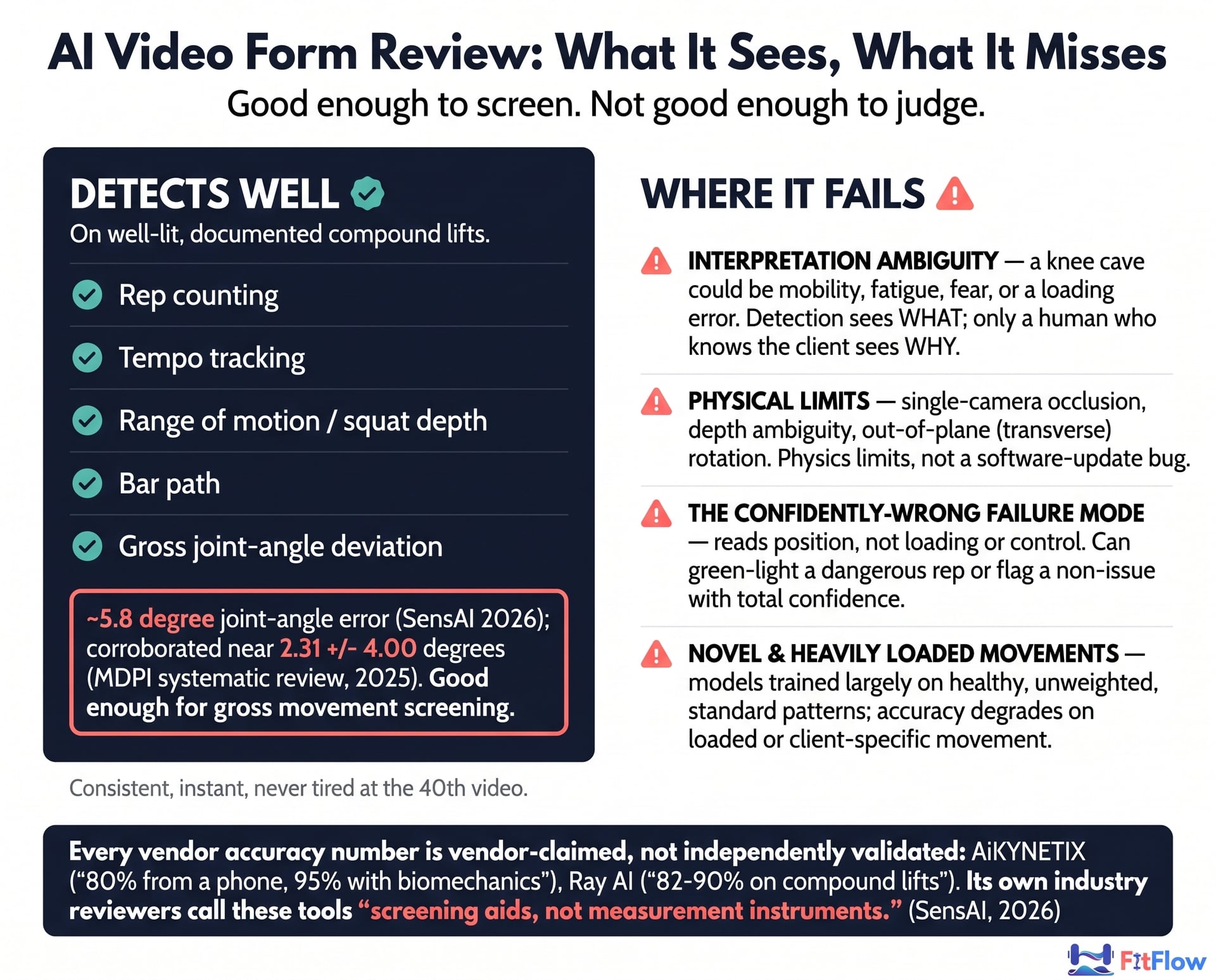
Give the technology real credit, plainly, because it earns it. On well-lit, well-documented compound lifts — squat, bench, deadlift — automated review is genuinely good at a specific, valuable set of tasks: rep counting, tempo tracking, range of motion and squat depth, bar path, and gross joint-angle deviation like an obvious knee cave. These are objective, repeatable, high-volume measurements, and the machine does them without getting bored on the 40th video.
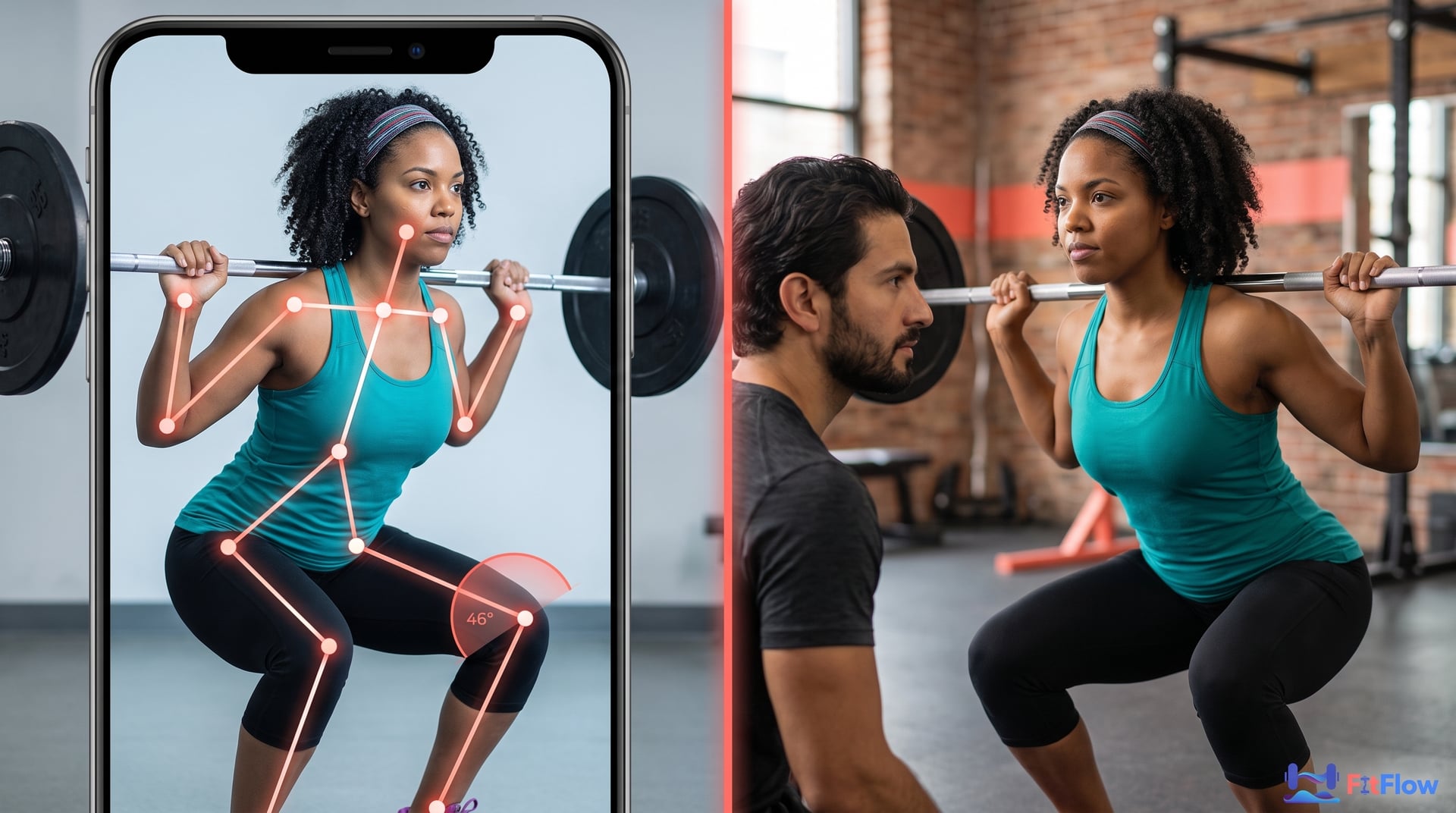
Here is roughly how it works, without the jargon. Markerless pose estimation finds a person's joints frame by frame from ordinary video and builds a moving stick figure. From that skeleton it measures the angles between joints, tracks the bar, and counts reps. No sensors on the body, no lab — just a phone camera and a model trained on a lot of movement.
The honest accuracy picture is better than skeptics assume and worse than vendors claim. Independent industry testing puts single-camera markerless systems at around a 5.8° overall joint-angle error versus lab-grade marker-based capture (SensAI, 2026), corroborated by a peer-reviewed systematic review landing near 2.31° ± 4.00° for depth-sensor and AI pose estimation (MDPI Sensors systematic review, 2025). Translate that into coaching terms: it is good enough to screen gross movement, not precise enough to be a measurement instrument.
For a working coach reviewing at volume, that reliability is a real win. The camera is consistent — it applies the same threshold to every client. It is instant. And it flags the obvious stuff so it never reaches your queue as a surprise. That is worth having. But "good enough to screen" is not "good enough to judge," and the entire decision in front of you sits on that line. If you're deciding where form-review tools fit your overall tech stack, this is the capability you are actually buying: fast, tireless detection. Not judgment.
Where It Fails — And Why That Matters More Than the Wins
The failures here are not edge cases. They are the daily reality of coaching real people under real load, and they cluster in one place: the camera reads position, not cause.
The interpretation ambiguity is the core failure. A camera sees a knee cave. It cannot tell you whether that cave is an ankle-mobility restriction, a fatigue artifact showing up at rep 8, a fear-and-bracing response under a heavier-than-usual load, or a genuine motor-control error. The coaching response to each of those is completely different — mobility drill, deload, confidence cue, or technique regression — and the camera has no way to choose. Detection sees what happened. Only a human who knows the client sees why. That "why" is not a nice-to-have; it is the entire coaching act.
The physical limits are real and permanent. Single-camera systems fight occlusion (a limb hides the joint you need), depth ambiguity (the model guesses distance from a flat image), and out-of-plane rotation, where accuracy drops most — exactly the transverse-plane movement where markerless models diverge from lab systems (SensAI, 2026). These are physics limits, not bugs a software update quietly fixes next quarter. A second camera helps; it does not erase them. This is the same interpretation gap that trips up wearable data — the sensor produces a confident number, and the number still needs a human to mean anything. Understand that gap before you trust a form score more than a resting-HR reading.
The confidently-wrong failure mode is the dangerous one, so name it plainly. Because the app reads position and not loading, muscle co-activation, or control, it can green-light a genuinely dangerous rep or flag a total non-issue — both with complete confidence and no hedge. A lifter can hit textbook depth while dumping load onto a rounding lower back the model never evaluates. False confidence in front of a beginner, before load, is exactly where injuries start. An app that says "good rep" is not the same as a coach who watched the rep.
Novel and heavily loaded movements break it further. These models are trained largely on healthy, standard, often unweighted movement. Accuracy degrades on loaded, atypical, or client-specific patterns — the rehab variation, the competition-style low-bar squat, the movement you regressed for one person's shoulder. The less the movement looks like the training data, the less you can trust the output.
For the evidentiary anchor, scope it correctly. A fresh, credible review by exercise scientist Hunter Bennett found that across three comparative studies, human-led programs beat AI-guided ones on muscle, strength, endurance, and jump outcomes, and it recommends beginners and injured clients start with a human (The Conversation, 2026). Read it honestly: that work tests program design, not form-check computer vision. It does not prove anything about cameras. It is a directional signal on the durable human advantage — and it points exactly where the camera is weakest and the stakes are highest.
The Detect → Interpret → Decide → Deliver Stack
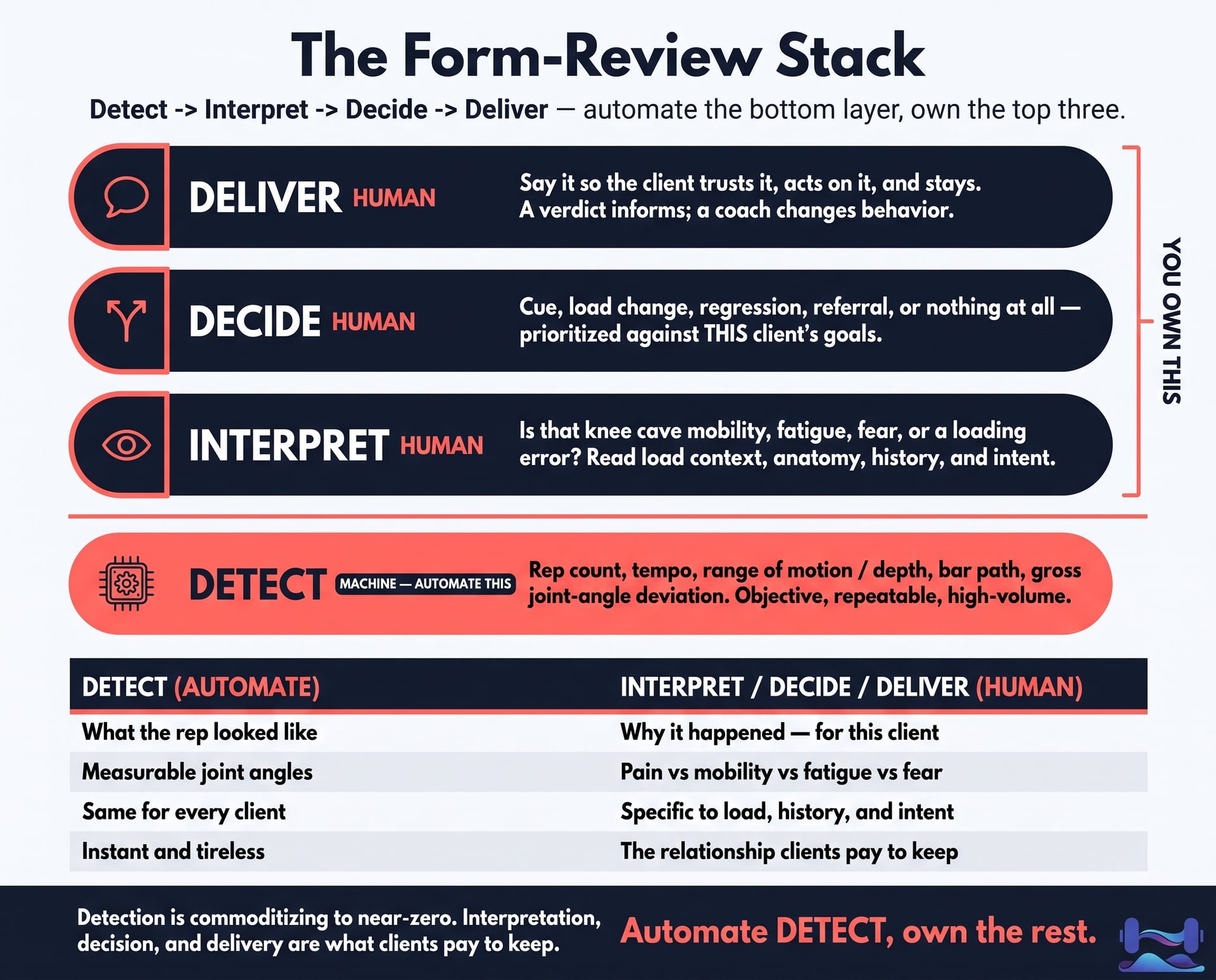
Here is the model that makes the whole decision simple. Form review is not one job; it is four stacked layers, and only the bottom one belongs to the machine.
Detect (automate this). Rep count, tempo, range of motion and depth, bar path, gross joint-angle deviation. Objective, repeatable, high-volume. Let the machine do it — it is faster and more consistent than you are at this, and that is fine.
Interpret (human). Read the person. Is this deviation pain, mobility, fatigue, fear, or a loading error? Factor in load context, individual anatomy, training history, and intent. The camera cannot; you can, because you know this client.
Decide (human). Contextual judgment. Does this need a cue, a load change, a regression, a referral, or nothing at all? Prioritized against this client's goals and history — not a generic threshold.
Deliver (human). The coaching relationship. How you say it so the client trusts it, acts on it, and stays. A verdict informs. A coach changes behavior.
The line to remember: automate Detect, own the rest. Detection is commoditizing toward zero — six-plus apps now do it and undercut each other monthly. Interpretation, decision, and delivery are precisely what clients pay to keep. The comparison below is the whole argument on one screen.
Layer | What it is | Machine capability | Human advantage |
|---|---|---|---|
Detect | Measuring what the rep looked like: rep count, tempo, ROM/depth, bar path, gross joint-angle deviation | Strong on well-lit, documented compound lifts; consistent, instant, tireless | Slower and less consistent at volume — cede this layer |
Interpret | Reading why the deviation happened: pain vs mobility vs fatigue vs fear vs loading error | None — it reads position, not cause | Knows the client's history, anatomy, load context, and intent |
Decide | Choosing the response: cue, load change, regression, referral, or nothing | None — no goals, no history, no priorities | Prioritizes the call against this client's actual goals |
Deliver | Communicating so the client trusts it, acts, and stays | None — it outputs a score | The relationship that turns feedback into behavior change |
Confusing these two halves is how vendors oversell ("95% accurate, replaces the coach's eye") and how skeptics under-adopt ("automated review is worthless"). Both are wrong. Detection is real and worth automating. Interpretation, decision, and delivery are real and not going anywhere. The winners hold the honest middle.
How to Automate the Review Without Losing the Client: A 4-Step Workflow
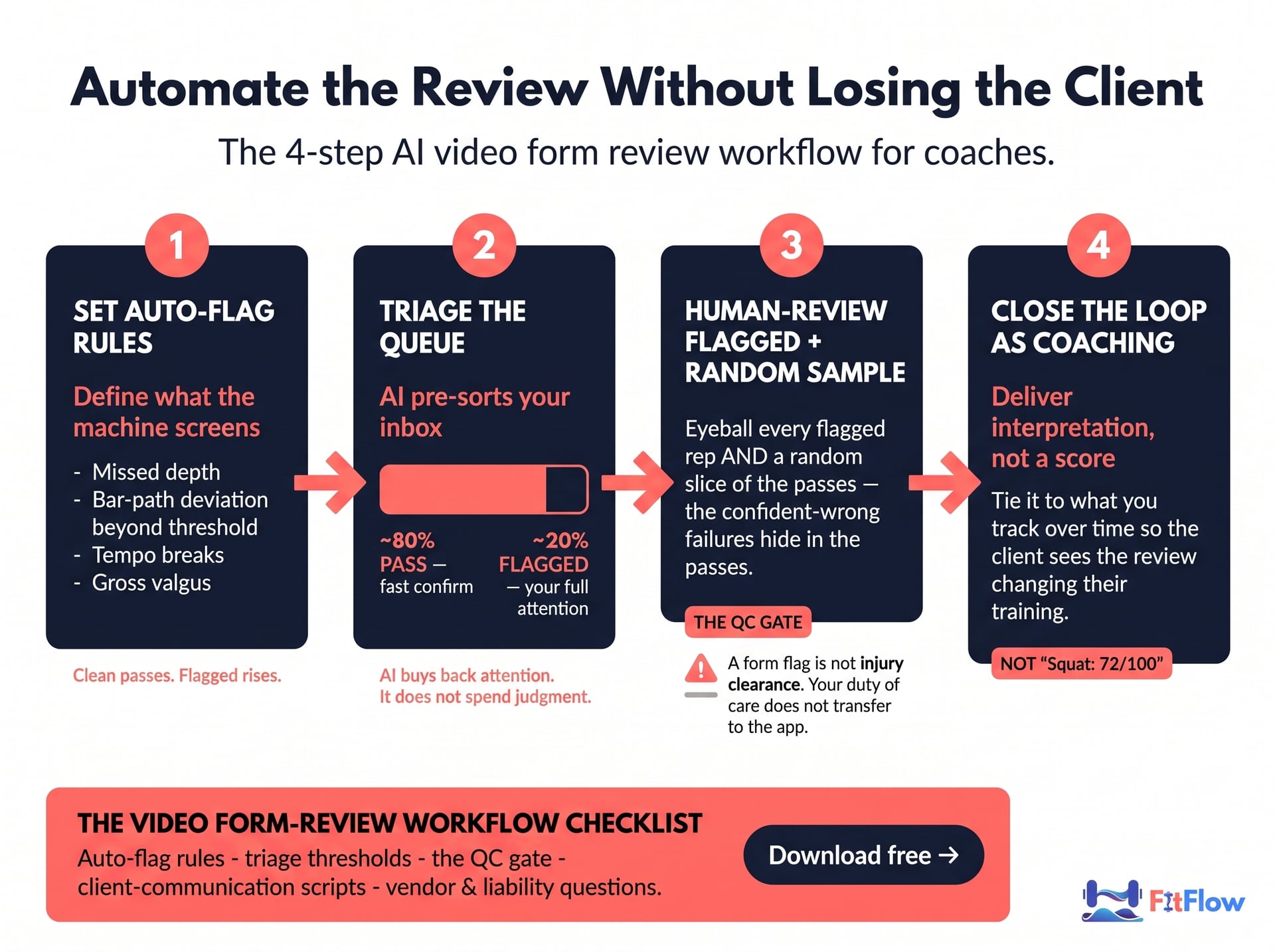
This is the operational payoff — a numbered system you can stand up this week. It treats AI as a triage layer that buys back your attention, never as a verdict that spends your judgment.
Set your auto-flag rules. Define exactly what the AI layer screens for on each movement: missed depth, bar-path deviation beyond a threshold, tempo breaks, gross valgus. Everything clean passes automatically; anything flagged rises to you. You are not asking the machine to coach — you are asking it to raise its hand when a rep crosses a line you drew.
Triage the queue. Your async review inbox — the pending/reviewed dashboard coaches already run (Coachway) — now sorts itself. The clean roughly 80% get a fast confirm; the flagged roughly 20% get your full attention. This is the core scale move: AI is not reviewing for you, it is pointing your limited attention at the reps that actually need a human. This is where async review fits the hybrid coaching model — the triage layer is the piece most coaches are still missing.
Human-review the flagged set — plus a random sample of the passes. Always eyeball every flagged rep. Then eyeball a random slice of the "passed" ones too, because the camera's confidently-wrong failures hide inside the passes, not the flags. This random-sample gate is your quality control, and it is not optional: a form flag is not injury clearance. Most AI fitness tools disclaim liability in their terms; your duty of care does not transfer to the app. Beginners and injured clients are exactly where the camera is weakest and the stakes are highest — so they get human eyes first, every time, regardless of what the model says.
Close the loop with the client — as coaching, not a score. Deliver the interpretation, not the number. "Your depth is fine; that knee cave is your right ankle, here's the drill" is coaching. "Squat score: 72/100" is not. Tie the feedback to what you track over time so the client sees the review actually changing their training — the point of review is behavior change you can track on a real dashboard, not a report card they forget by Thursday.
Run those four steps and AI expands your capacity without ever touching the relationship that justifies your rate. The auto-flag rules, the triage thresholds, the QC gate, and the client-communication scripts are exactly what the checklist operationalizes — so you can run this tomorrow instead of rebuilding it from scratch.
You Just Read the 4-Step Workflow. This Checklist Makes It Run Tomorrow.
The Video Form-Review Workflow Checklist operationalizes all four steps you just read — the auto-flag rules for Step 1, the triage and random-sample QC gate for Steps 2–3, and the client-communication scripts for Step 4. 5 sections, 30 items, including 4 fill-in-the-blank message templates that turn a machine flag into a coached moment. Configure it in under 20 minutes. Free download.
The Business Case: Scale, Trust, and What Clients Actually Pay For
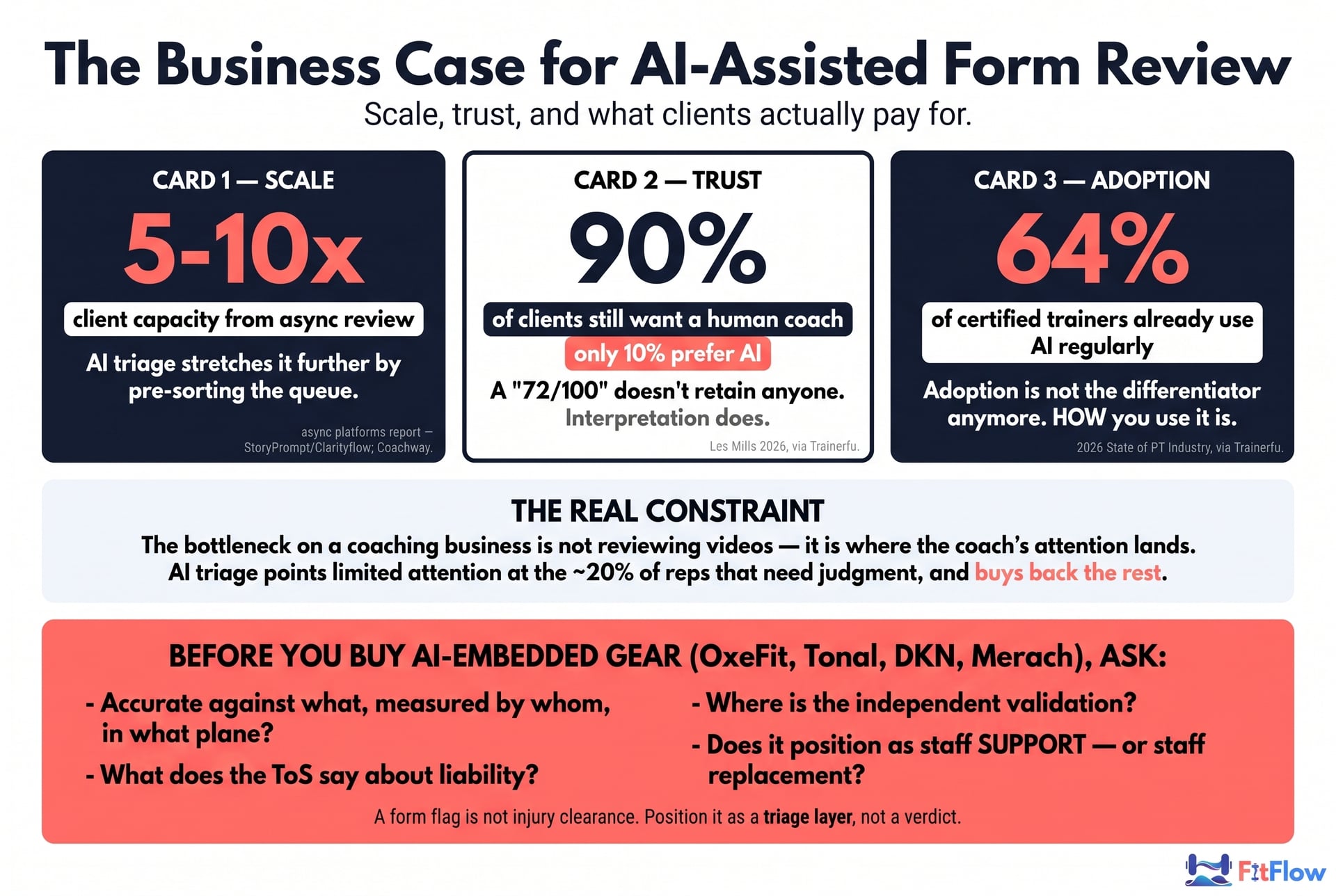
Strip it to the money question. The constraint on a coaching business was never "can I review videos" — it is where your attention lands. Async review already multiplies capacity; async platforms report a coach can cover up to 5–10x their in-person client load (Clarityflow/StoryPrompt). AI triage stretches that further by pre-sorting the queue so your judgment lands on the 20% of reps that need it. That is the whole scale math: you are buying back attention, not replacing your eye.
Trust is where the business is won or lost, and the demand data is blunt about it. Only about 10% of consumers prefer AI over a human coach — roughly 90% still want the human (Les Mills 2026, via Trainerfu). Clients do not churn because your detection was slow. They stay because your interpretation makes them feel known. A "72/100" retains no one — the tool alone never retains the client. Retention lives in the layers the camera can't reach.
If you own or manage a gym, the same split governs your equipment decisions. AI is now embedded directly in hardware — OxeFit, Tonal, and DKN build "AI trainers" into resistance equipment, and Merach showed an LLM-powered coaching treadmill at CES 2026 (via Virtuagym/HARISON trend coverage). Position that technology as staff support, not staff replacement, and ask vendors the questions that separate a real tool from a pitch: Accurate against what, measured by whom, in what plane of motion? Where is the independent validation? And what do the terms of service actually say about liability? Those questions belong on the table before a purchase order, not after an incident.
One more number sets the strategy. About 64% of certified trainers already use AI regularly (2026 State of the PT Industry, via Trainerfu). Adoption is no longer the differentiator — nearly everyone is in. How you use it is the differentiator now. Automating detection is table stakes. Owning interpretation is the edge. And note the discipline required here: every vendor accuracy figure you meet — AiKYNETIX's "80% from a phone, 95% with biomechanics" (ScienceForSport), Ray AI's "82–90% on compound lifts" — is vendor-claimed and not independently validated. Treat those numbers as marketing until someone outside the company publishes the study.
What's Next — And Why the Human Layer Holds
The technology is advancing on a predictable track, and it is worth watching so you are not surprised. Three things are coming.
Multi-camera and depth rigs will shrink the occlusion and out-of-plane error that limit single-camera systems today. Better geometry, better detection. Agentic, proactive review is genuinely new: the app flags a pattern and messages the client before they ask — "your last three squats lost depth, film the next set." That changes check-in cadence in a real way. And equipment-embedded computer vision (OxeFit, Tonal, Merach) moves detection onto the gym floor and into the machine itself.
Here is the through-line, and it is the whole reason the moat holds. Every one of those advances improves detection. Not one of them closes interpretation. A sharper camera still cannot tell pain from mobility from fatigue from fear. A proactive alert still needs a human to decide what the pattern means for this specific client and what to say about it. The moat is not a temporary technology gap that a better model erases next year — it is the permanent gap between measuring a rep and coaching a person. Trainers who keep owning interpretation, decision, and delivery stay ahead of every detection upgrade, indefinitely.
Your Three Moves This Week
You have the model and the workflow. Do three concrete things before this goes stale.
Move 1: Define your Detect layer. Pick your most-used compound lift and write your auto-flag rules for it. What does a "flag it for me" rep actually look like — missed depth, bar path past what threshold, tempo break, gross valgus? Write it down. That is your detection layer defined, and it is the foundation of everything else.
Move 2: Run one week through the workflow. Put a week of client reviews through all four steps — AI first-pass screen, triage the queue, human-review the flagged set plus a random sample of the passes, and deliver every result as coaching. Download the checklist to set it up cleanly instead of improvising it.
Move 3: On your next flagged rep, resist the score. Do not send the number. Tell the client why it happened and what it means for them specifically. That one sentence — the interpretation — is the thing no camera can take from you.
The camera can tell your client what the rep looked like. Only you can tell them what it means. Automate the first. Own the second. That is not the coach getting killed — that is the coach getting leverage.
Download the Video Form-Review Workflow Checklist for Coaches and run AI-assisted review tomorrow without losing the client. Get the free checklist here.
Comments