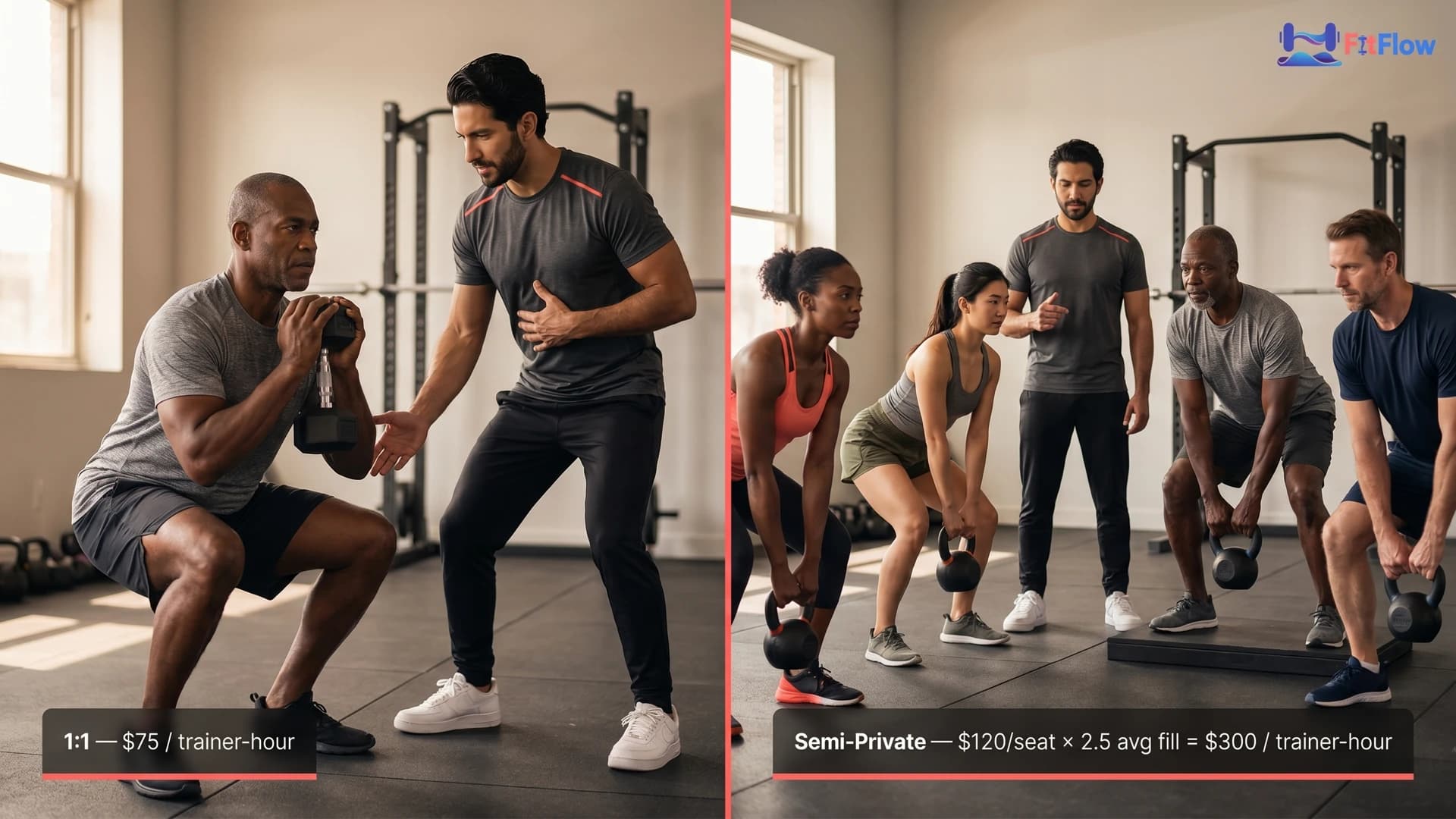
Hiring Your First Assistant Coach Is Not a Hiring Problem. It Is a Systems Problem.

Section 1 — Open the calendar
Open the calendar of any trainer who hired their first assistant six months ago. The Saturday morning blocks that used to be deep-work are "quick syncs." The Sunday night blocks that used to be off are "catch-up." The hours did not come back. The revenue did not come back. The hire did not come back.
If you are Sam (28–38, 30 clients, 1.5 hrs/week on acquisition, $4–8K/mo), you have already had this thought. You priced your time, mapped the math, and on paper the hire pays for itself by month four. So why does the average first hire stall? SHRM puts ~30% of new hires out within their first 90 days, and a bad hire runs 3–5× annual salary once you load in training, lost output, and replacement search (SHRM, 2024–2025). In fitness, where undocumented onboarding is the norm, the rate trends higher.
The hire is not the problem. The system you hand them is.
Hiring your first assistant coach does not fail because you picked the wrong person. It fails because you handed an undocumented business to a stranger and called it onboarding.
Section 2 — The misdiagnosis: "find the right person" is the wrong frame
Search "how to hire a personal trainer assistant" and the dominant advice is some version of "find the right person." Hire for character. Hire slow, fire fast. Trust your gut. It is not wrong, just incomplete. It treats the bottleneck as who. The bottleneck is what.
When a first hire fails, the post-mortem almost always reveals an undocumented business: no role scorecard, no written onboarding sequence, no measurable 90-day outcome the assistant could pass or fail against. Two-Brain Business Career Roadmap audits show the same pattern: hires fail at the architecture layer, not the candidate layer (Two-Brain Business, 2024–2026).
And the wall underneath it is operational. The 30-client wall is an operations problem before it is a personnel problem. Hiring without solving operations does not fix operations. It converts an operations problem into a people problem, now with a salary attached.
The 30-client wall is not a personnel problem. It is an operations problem.
The First-Hire Architecture treats the system as the deliverable. The hire executes the system. If the system is undocumented, the hire is set up to fail before they accept the offer.
Section 3 — The 3 Failure Modes
Your first-hire risk pattern almost always matches one of three named modes. Pattern-match yours before writing the job post.
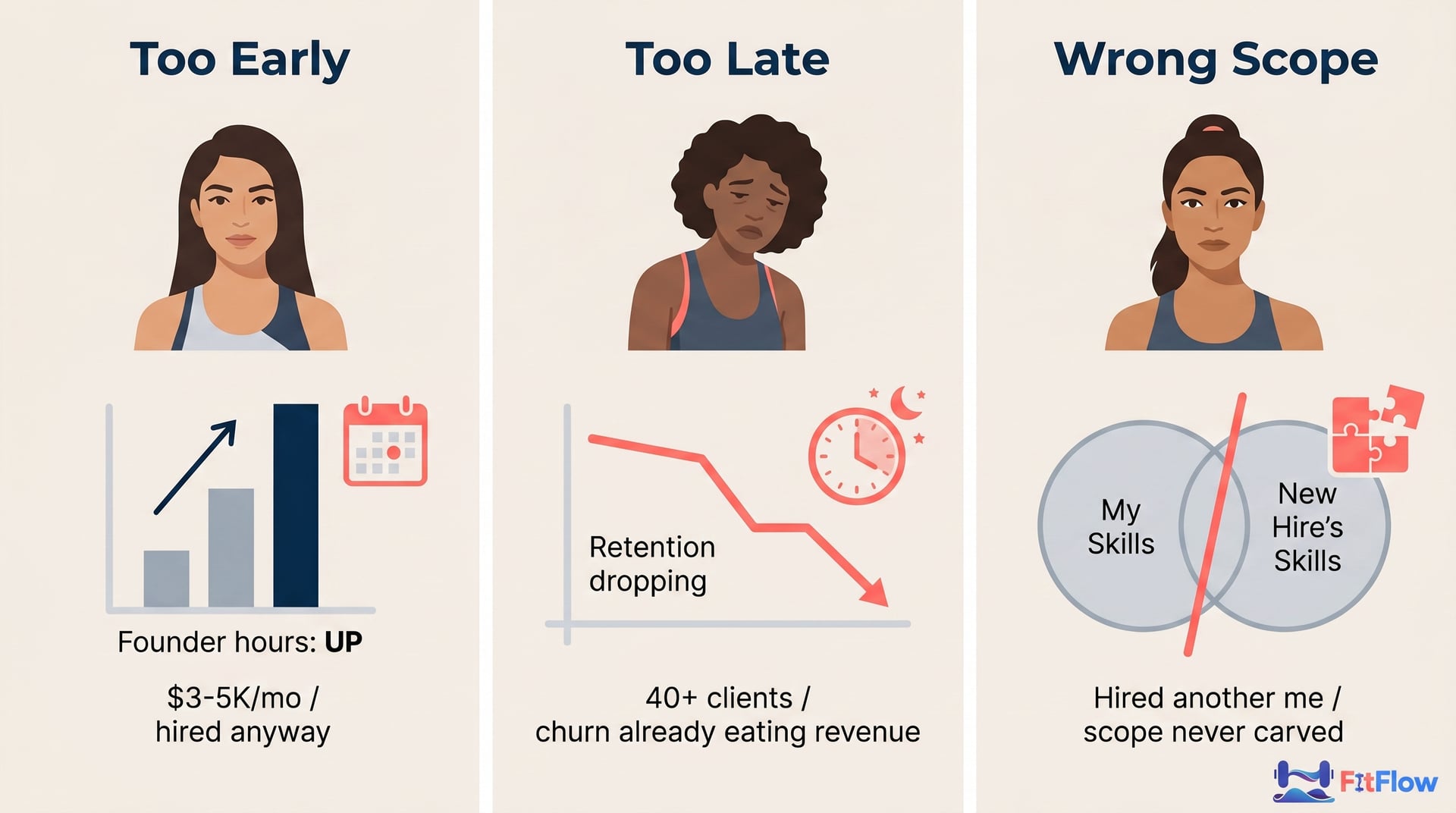
Failure Mode A — hired too early
Move: trainer at $3–5K/mo brings on a 1099 coach to "free up time for marketing." Why it backfires: revenue sits below the floor that justifies the hire; the role consumes cash and calendar the business does not have. Symptom: founder works more hours after the hire, not fewer, because supervising undocumented work is a full-time job. At this stage, group coaching is often the leverage event before headcount is: same hours, 2–4× the gross.
Failure Mode B — hired too late
Move: trainer at 40+ clients runs through burnout for 6–12 months past the hire-by date. Why it backfires: quality slips, check-ins shorten, programs get recycled, retention drops 10–25% in the back half of that window (Two-Brain Business, 2025). Symptom: hire arrives, founder is too cooked to onboard, assistant inherits a churning roster, both fail inside 90 days.
Failure Mode C — hired the wrong scope
Move: trainer hires "another me" — a full-stack coach for programming, check-ins, onboarding, and admin. Why it backfires: assistant is unmotivated by the half they hate and underperforms on the half they love. The scope was never carved. Symptom: founder redoes the assistant's work and feels worse than before. SHRM puts ~30% first-90-day attrition as the structural baseline (SHRM, 2024). Without a scope carve, expect the high end of that band.
Mode B and Mode C are the default cases. Mode A means stop here.
Skip the failure modes. Get the 30-day decision tree. Get the kit (8 files, free).
Section 4 — The Readiness Gate (4 checks)
The hiring decision is not "do I want help?" It is "have I passed four pre-hire checks?" You hire when you pass all four. Three of four is a red light with one fewer obstacle.
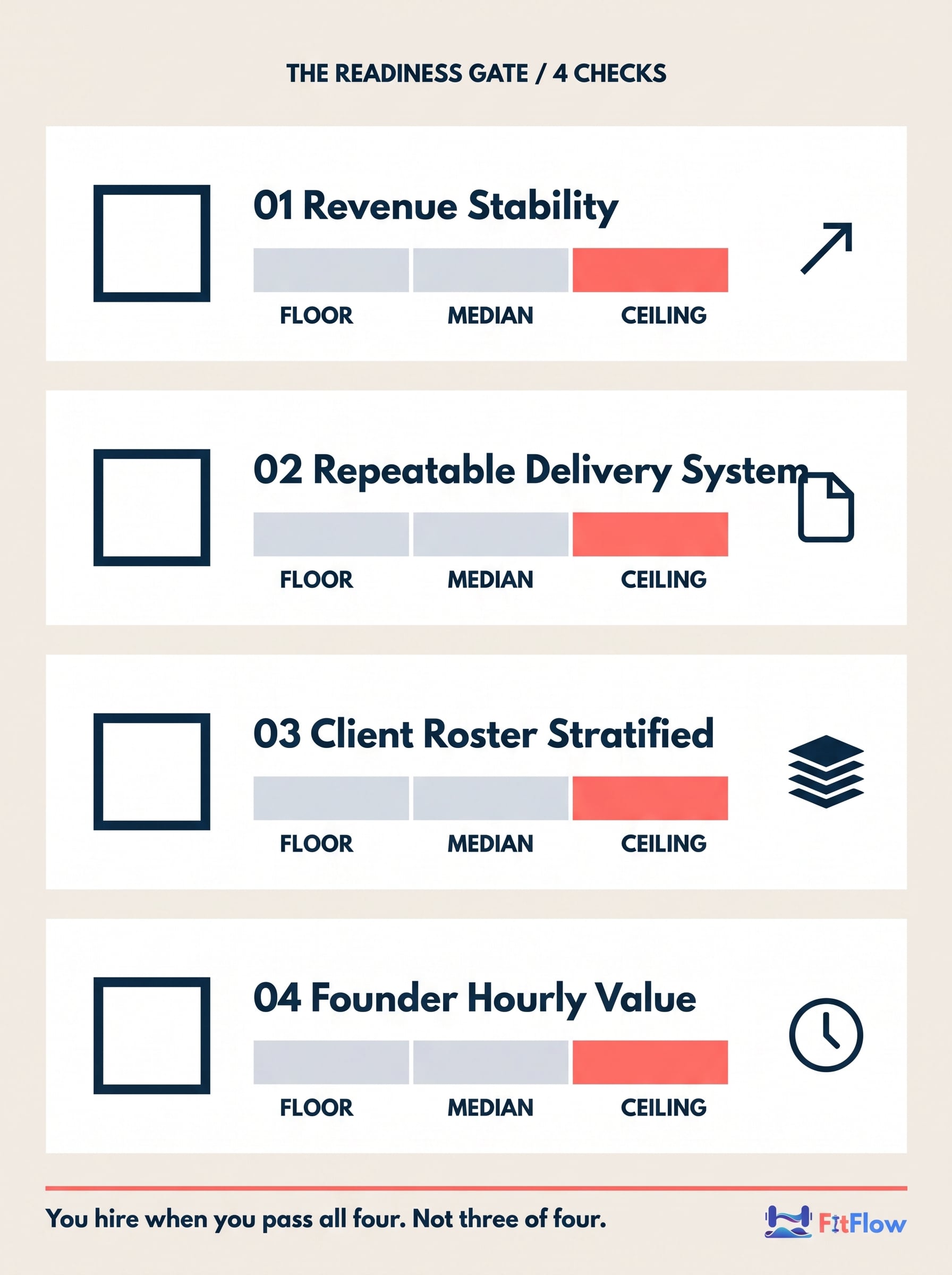
Check 1 — revenue stability
Floor: $6,000/mo founder revenue, sustained 3 months.
Median: $8,000/mo, sustained 6 months.
Ceiling: $12,000/mo+, sustained 6 months. Above this without help, you are hiring late.
Revenue must come from a working acquisition engine, not a referral spike. A working acquisition system precedes the hire. If yours leaks, fix the funnel before hiring to plug it.
Check 2 — repeatable delivery system
Floor: documented program-building, check-in, and client-onboarding protocols.
Median: floor + documented client-comms cadence + escalation protocol.
Ceiling: full SOP library covering 80% of weekly recurring work.
Without the floor, the hire inherits chaos and the failure is preordained. Automate before you delegate to a human: Trainerize 2026 and TrueCoach 2026 both ship workflow automations that remove 5–8 hours/week of admin before any hire.
Check 3 — client roster stratified
Floor: you can name your top-5 highest-LTV and bottom-5 lowest-effort-fit clients.
Median: documented A/B/C tiers by revenue × effort.
Ceiling: explicit reassignment plan naming which clients move to the assistant, which stay with you, and why.
Check 4 — founder hourly value
Floor: reclaimed hours × effective hourly rate must exceed all-in hire cost (~$32K–$48K Year-1, part-time W-2 or fully loaded 1099, BLS 39-9031 anchored).
Median: 10–15 hrs/week reclaimed at $80–$120/hr effective = $42K–$93K/yr reclaimed value.
Ceiling: 20+ hrs/week reclaimed, which means you should have already hired. Your margin must clear the hire.
Run the four checks before you write the job post.
Section 5 — The First-Hire Architecture framework (4 stages)
The First-Hire Architecture is a 4-stage protocol: Scope Carve-Out → Role Scorecard → 90-Day Onboarding Protocol → Comp + Economics Model. Run them in order. Skip none.
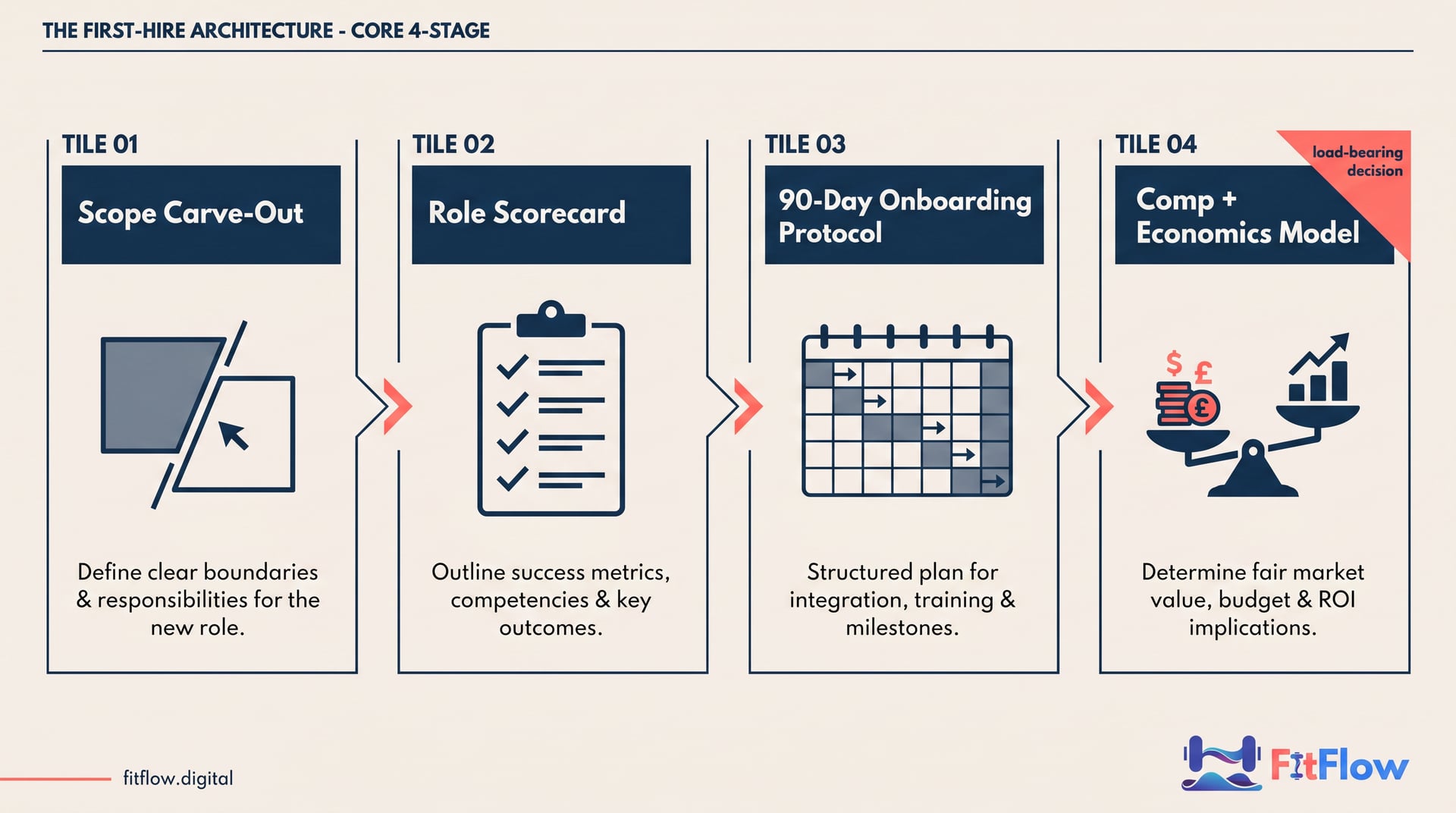
Stage 1 — Scope Carve-Out
Start with the work that leaves the founder, not the role the assistant will fill. A one-coach business has four categories: (a) program building, (b) check-ins / async messaging, (c) new-client onboarding, (d) admin (scheduling, invoicing, content). Your first hire owns 1–2 categories, not all four.
Decision rule: carve the category that consumes the most founder hours AND has the lowest founder-skill premium. Program building is high-premium — do not carve first. Admin is low-premium — carve first. Check-ins sit in the middle — carve second.
Anti-pattern: carving "everything I do not like." That is venting, not scope.
Measurable outcome: a 1-page doc naming 1–2 categories the assistant owns and 2–3 the founder keeps.
Stage 2 — Role Scorecard
Replace the job description with a Role Scorecard: 3–5 measurable 90-day outcomes. A task says "send check-ins on Mondays." An outcome says "95% of check-in messages responded to within 24 hours, weekly." Tasks produce activity. Scorecards produce results you can audit.
Example outcomes for a check-ins-and-admin first hire:
95% of client check-in messages responded to within 24 hours (weekly).
New-client onboarding completed within 7 days for 100% of new clients (monthly).
Weekly scheduling and invoicing complete with zero founder touches by Day 60.
Maintain or improve client NPS over the 90-day window.
Anti-pattern: a task-list job description.
Measurable outcome: a 1-page Scorecard with 3–5 outcomes, each with metric, frequency, target. SHRM's 30/60/90 framework is the parent pattern (SHRM, 2024–2025).
Stage 3 — 90-Day Onboarding Protocol
Treat onboarding as a 5-phase cadence over 12 weeks, not a Week-1 orientation:
Week 1 — Shadow: assistant observes; founder narrates decisions out loud.
Week 2 — Co-execute: assistant performs; founder watches live, corrects in private after.
Weeks 3–4 — Supervised solo: assistant performs alone; founder audits 100% within 24 hours.
Weeks 5–8 — Spot-audited solo: founder spot-audits 20% randomly.
Weeks 9–12 — Owned outcome: assistant owns Scorecard Outcome 1. Spot-audit drops to 10%.
Day 90 review: Outcomes 1 and 2 owned; 3 and 4 move into supervised solo for Q2.
Anti-pattern: a Week-1 orientation followed by sink-or-swim.
Measurable outcome: by Day 60, assistant is at supervised-solo on Outcome 1. If not, surface the failure now, not at Day 90.
Stage 4 — Comp + Economics Model
Comp is a structural choice, not a number. Three structures dominate fitness:
(a) Flat hourly W-2: $22–$32/hr entry, $32–$45/hr experienced. Gross margin to founder ~55–65%. Lowest classification risk.
(b) Base + per-client retention bonus W-2: $45–$60K base + $25–$50 per retained client/month. Two-Brain's preferred first-hire structure (Two-Brain Career Roadmap, 2024–2026).
(c) Revenue share 1099: 40–60% if assistant owns acquisition; 25–35% if founder retains it. Heavy classification risk — do not use for the first hire unless legally vetted (Section 9).
Worked gross-margin example (Sam's numbers): W-2 base $48K + payroll taxes ~$4K + benefits/equipment ~$3K = $55K all-in. Assistant manages 25 of Sam's 30 clients at $250/mo = $75K/yr revenue. Gross margin to Sam ≈ $20K/yr (~27% Year 1). Year 2 improves as the fixed cost spreads. Two-Brain's 4/9ths model (4/9ths to coach, 4/9ths to gym/owner, 1/9th to taxes/overhead) is the structural benchmark.
Anti-pattern: setting comp by what feels fair instead of what the math clears.
Measurable outcome: a 1-page comp worksheet showing all-in cost, revenue covered, and Year-1 gross margin in three scenarios.
Section 6 — Per-persona walkthrough
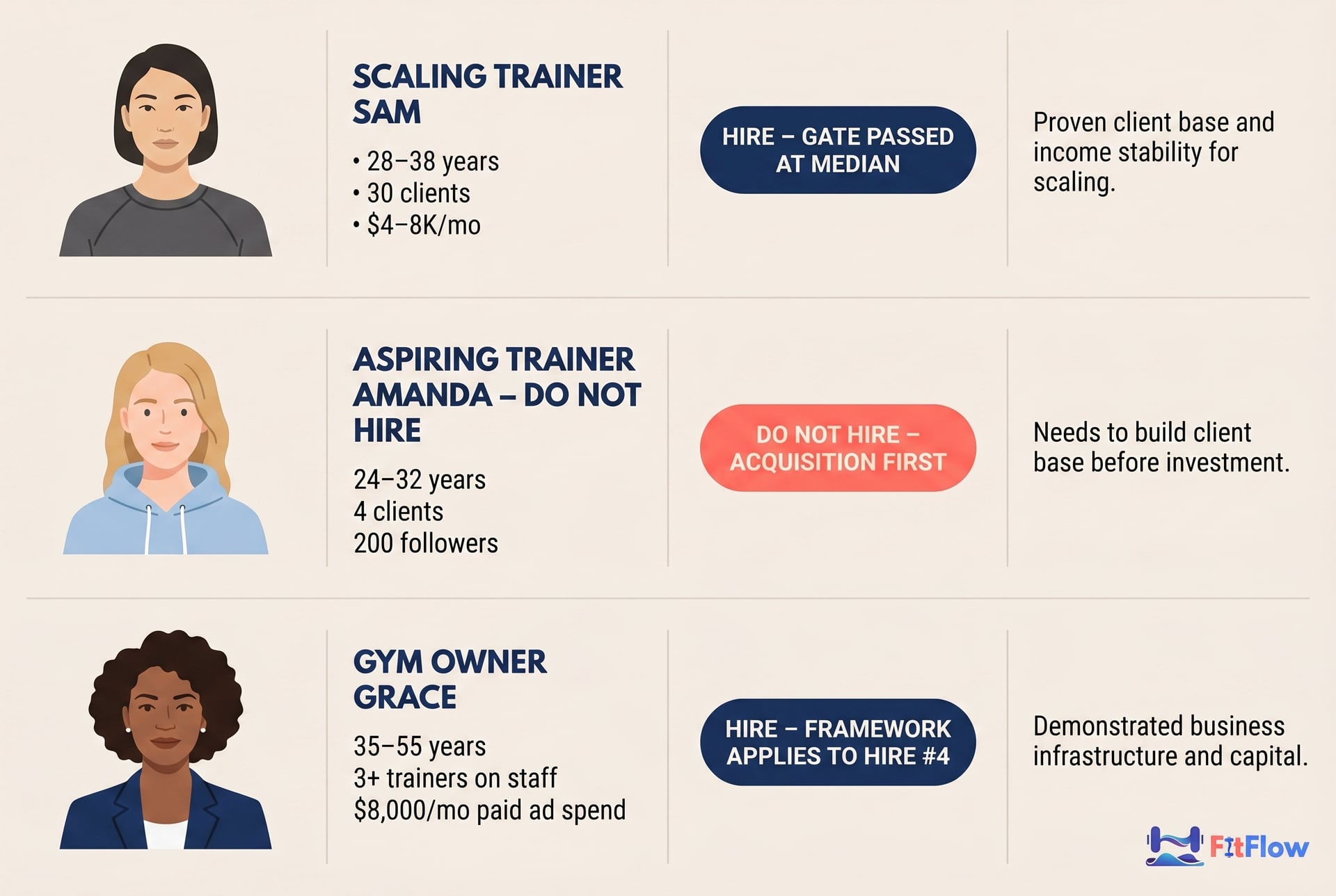
Scaling Trainer Sam (PRIMARY)
Sam (28–38, 30 clients, 1.5 hrs/week on acquisition, $4–8K/mo) passes the Readiness Gate at the median. Check 1: $8K/mo sustained 6 months. Check 2: floor met. Check 3: done. Check 4: 10 hrs/week reclaimed at $90/hr = $46.8K/yr value.
Sam carves admin + check-ins (Stage 1). First hire: part-time W-2 at $25/hr × 20 hrs/week = $26K base + ~$2K payroll + benefits stipend = ~$30K all-in Year 1. Scorecard = the four Stage 2 outcomes. Sam audits weekly through Day 60, monthly thereafter. Day 90: Outcomes 1 and 2 owned. Reclaimed hours go to acquisition and a higher-tier offer build.
Aspiring Trainer Amanda (TERTIARY — DISQUALIFIED)
Amanda (24–32, 4 clients, 200 followers) fails the Readiness Gate. Check 1: ~$600/mo, not the $6K floor. Check 4: no hours to reclaim that justify $32K–$48K all-in cost. Amanda is disqualified at Stage 4 of the gate. Do not hire.
Verbatim disqualifier: Amanda, you do not have a hiring problem. You have an acquisition problem. The 4-client trainer who hires an assistant is the 0-client trainer in six months. Read the referral systems post. Read the trial-offer post. Hiring is not the leverage event for you. Acquisition is.
Gym Owner Grace (SECONDARY)
Grace (35–55, 3+ trainers on staff, $8,000/month paid-ad spend) is past first-hire. The Architecture still applies to hire #3, #4, #5. Grace uses Stage 4 for revenue-share negotiations with experienced coaches and Stage 3 verbatim because it scales without redesign. Her edge: a Role Scorecard with documented owned-outcome benchmarks from prior hires — she walks into hire #4 with a calibrated target, not a guess.
Section 7 — The Benchmarks
Floor/median/ceiling on five hiring outcomes: the numbers surface-only SERP competitors do not publish.
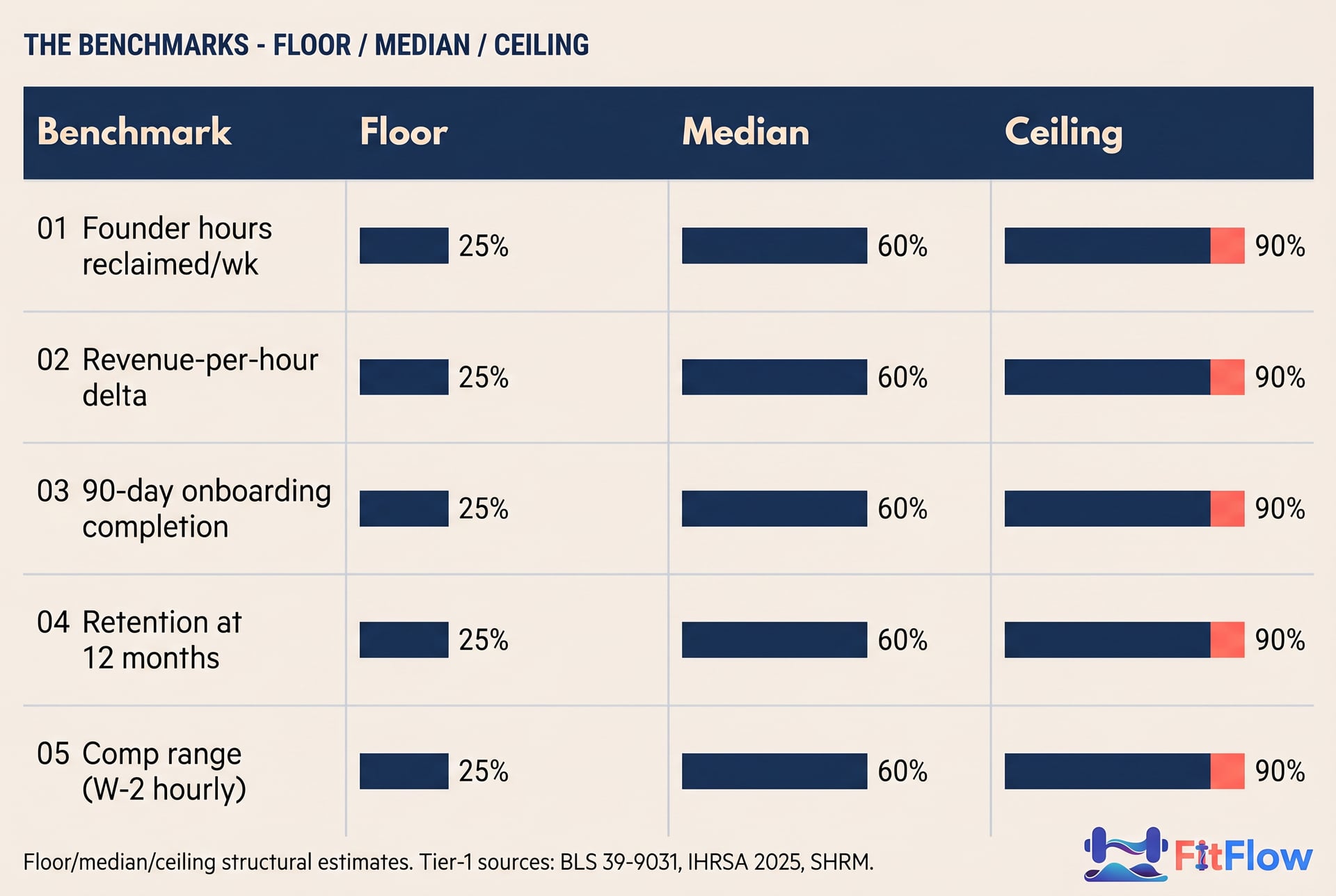
Benchmark 1 — Founder hours reclaimed per week
Floor: 5 hrs/week (under-scoped hire; review Stage 1).
Median: 10–12 hrs/week (well-scoped first hire).
Ceiling: 18–20 hrs/week (full-scope assistant; usually Year 2 or hire #2).
Benchmark 2 — Revenue-per-founder-hour delta, pre/post hire
Floor: 10–15% increase (the hire pays for itself; no scaling gain).
Median: 25–40% increase (founder spends reclaimed hours on acquisition or higher-tier offers).
Ceiling: 60%+ increase (founder moves to a pure CEO/sales role; rare in Year 1).
Benchmark 3 — 90-day onboarding completion rate
Floor: 2 of 4 Scorecard outcomes owned by Day 90 (plan adjustment needed).
Median: 3 of 4 owned, 1 in supervised-solo (target).
Ceiling: 4 of 4 owned (rare; usually under-scoped or exceptional hire).
Benchmark 4 — Assistant retention at 6 and 12 months
6-month floor: 70% retention. IHRSA studio-format industry baseline runs ~50–65% annual (IHRSA, 2025–2026).
12-month floor: 60% retention. Median for trainers using the First-Hire Architecture: 75–85% at 12 months (FitFlow practitioner-estimate; structural estimate, not yet published industry-wide).
Ceiling: 90%+ at 12 months (rare; correlates with revenue-share comp + a named-outcome Scorecard).
Benchmark 5 — Comp ranges by model
W-2 flat hourly: $22–$32/hr entry; $32–$45/hr experienced.
W-2 base + retention bonus: $45–$60K base + $25–$50 per retained client/month.
1099 revenue share: 25–35% (founder retains acquisition); 40–60% (assistant owns acquisition).
BLS 39-9031 (fitness trainers and instructors): median annual ~$45,380 (BLS, 2023 latest published; verify 2024/2025 update at moment of writing). 90th percentile ~$80,000+.
The $5K/mo ceiling rarely justifies a hire. Sam at $8K/mo sits at the median across all five. Grace on hire #4 sits at the ceiling on Benchmarks 1, 2, and 4.
Section 8 — The 3 Anti-Patterns
Anti-Pattern 1 — "Hire your friend."
The Move: trainer hires a training partner or gym friend as the first assistant. Why It Backfires: social proximity creates accountability gaps. The friend resents being managed; the founder resents needing to manage. Boundary collapse hits both the Scorecard and the friendship. PTDC community threads cite this as the most common first-hire failure mode (PTDC, 2024–2026). The Fix: hire a stranger with Scorecard fit. If the candidate is also a friend, separate the friendship from the role in writing — the Scorecard is the contract.
Anti-Pattern 2 — "Promote your best client."
The Move: trainer offers a free or discounted membership to a high-engagement client in exchange for assistant work. Why It Backfires: it violates the IRS independent-contractor framework — the "client" is now both customer and worker, and classification gets messy. The client also perceives the demotion from "served by founder" to "served by the peer." Retention risk and classification risk in one move. The Fix: hire a non-client. If the candidate was a former client, terminate the client relationship cleanly before starting the work relationship.
Anti-Pattern 3 — "1099 a coach to avoid HR work."
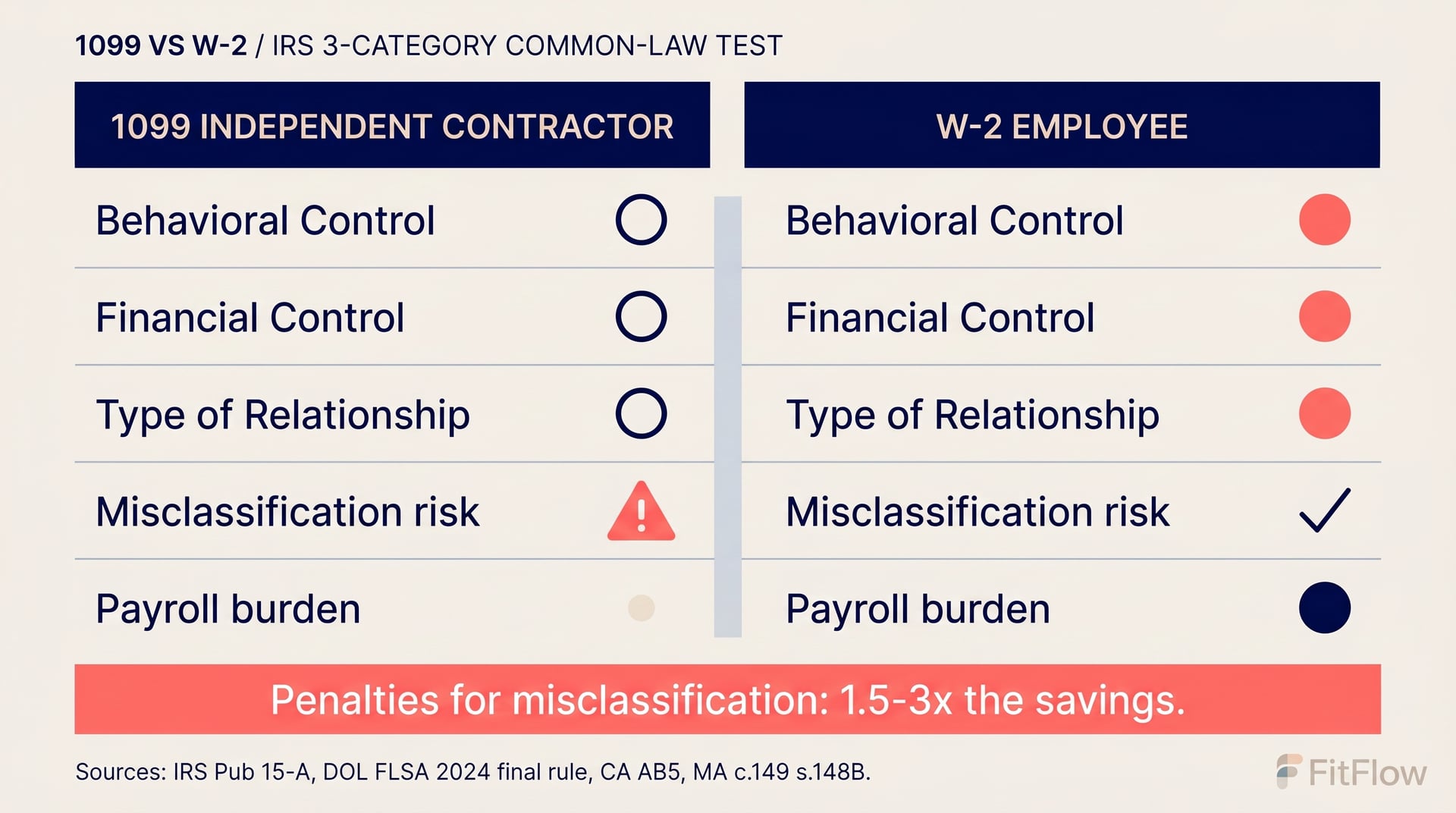
The Move: trainer classifies the first hire as 1099 to skip payroll, taxes, and W-2 paperwork. Why It Backfires: the IRS 20-factor common-law test and DOL economic-realities test do not care about the trainer's preference. If you control schedule, methods, branding, and tools, the worker is W-2 regardless of contract language. Misclassification penalties — back taxes, interest, and potential multiple damages — typically run 1.5–3× the savings the trainer thought she was getting (IRS, 2024–2026). California AB5 makes this near-automatic in CA. The 1099 question is not a tax question. It is a liability question. The Fix: apply the IRS 3-category test honestly (Section 9). If you cannot say yes on all three, classify W-2 from Day 1.
Section 9 — Legal + compliance notes (inline, not appended)
Classification, non-competes, and liability sit inside the comp decision, not after it. Status flags appear where rules are in motion.
W-2 vs 1099 — IRS 3-category common-law test
The IRS evaluates classification on three categories (IRS Pub 15-A, 2024–2026): Behavioral Control (schedule, methods, training, tools), Financial Control (investment, reimbursement, profit/loss, market availability), and Type of Relationship (contracts, benefits, permanence, integral to business). When in doubt, request a determination via IRS Form SS-8. Most first hires in a one-coach business — same schedule, founder tools, founder methods — will not pass as 1099 under honest evaluation.
DOL FLSA economic-realities test (current status flag)
The DOL's January 2024 final rule (effective March 11, 2024) restored a six-factor economic-realities test: profit/loss opportunity, investments, permanence, control, integral to business, skill/initiative. Current 2026 status is in flux — the rule has been challenged in multiple courts and the current administration has signaled review or rescission. Verify the operative DOL test with current counsel before classifying (DOL, 2024–2026).
FTC non-compete final rule (current status flag)
The FTC's April 2024 final rule banning most non-competes was enjoined by the U.S. District Court (N.D. Tex.) in Ryan LLC v. FTC; Fifth Circuit appeal pending as of mid-2026. Verify status at publication (FTC, 2024–2026). Replacement clauses that work in nearly every state: non-solicitation of clients + confidentiality. Both address the real concern — the assistant walking with your roster.
State-level high-risk (CA, MA, NJ, IL)
California AB5 (ABC test): W-2 unless (A) free from control, (B) work outside the usual course of business, (C) independently established trade. AB2257 carve-outs do not include fitness coaches. Established by Dynamex (CA, 2018).
Massachusetts: Mass. Gen. Laws ch. 149, § 148B applies the ABC test.
New Jersey: NJ Wage Payment Law applies the ABC test.
Illinois: Employee Classification Act adds steeper misclassification penalties.
Reporting + insurance
Issue Form 1099-NEC for non-employee compensation of $600/year or more (IRS, 2024–2026). Most professional liability carriers (NPI, K&K, IDEA) require the named trainer to carry their own coverage; the assistant must be added or carry their own. Client-of-record agreements should name the founder's business as the owner — material for retention if the assistant departs.
Verify with a CPA and an employment attorney annually. These rules change. Classification is a legal determination, not a preference. The penalties for getting it wrong are 1.5–3× the savings of getting it right.
Section 10 — The 30-day decision checklist
Convert the playbook into a 30-day rollout. The decision tree is hire / wait / fire.
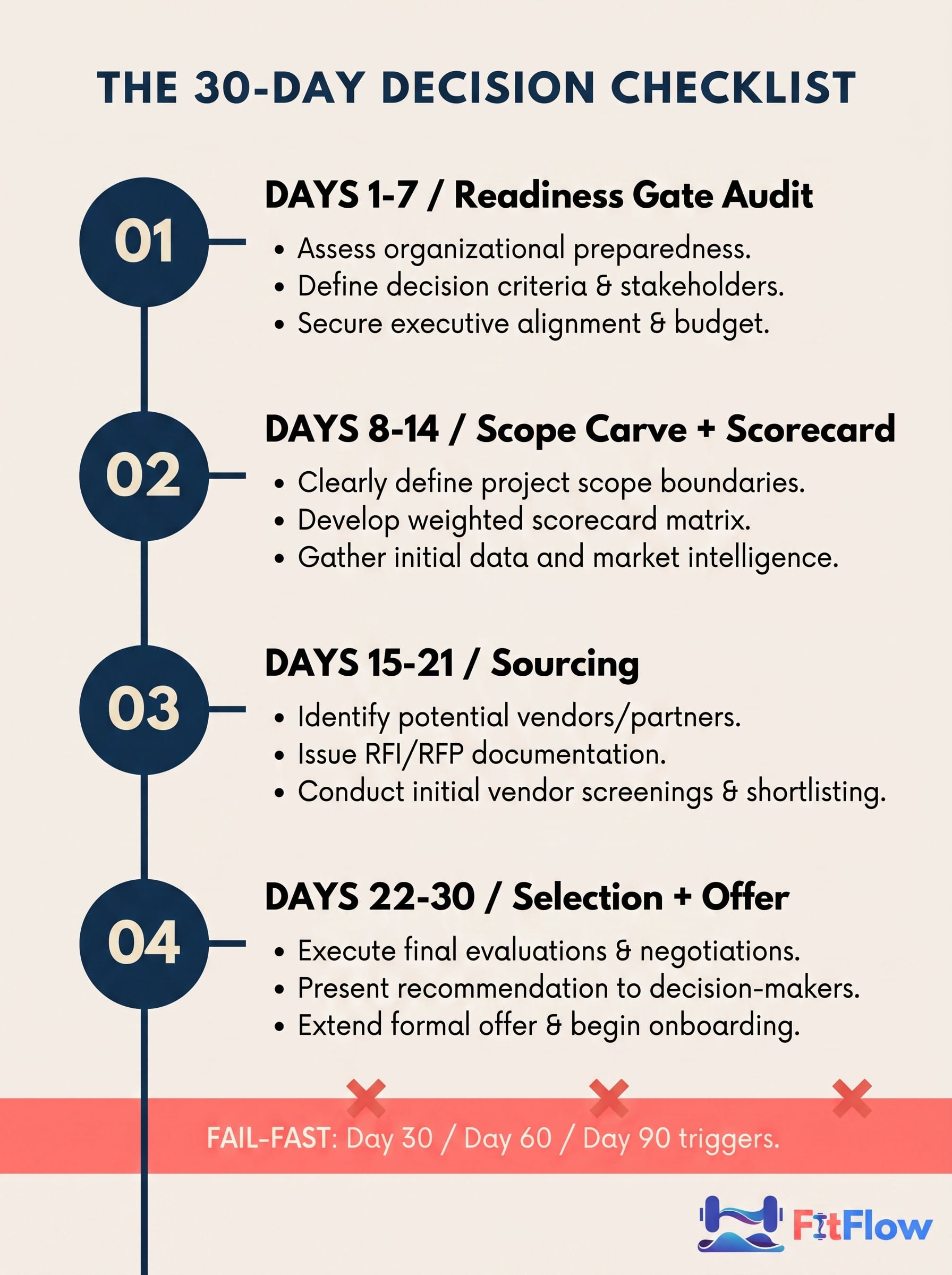
Days 1–7 — Readiness Gate audit
Run all four Readiness Gate checks (Section 4) with real numbers. If you fail any check, the decision is wait + fix that check, not hire.
Days 8–14 — Scope Carve + Scorecard
Carve the Stage 1 work category. Draft the Stage 2 Role Scorecard (3–5 outcomes, measurable, 90-day window). Validate against an outside reader — a peer, a mentor, or a Two-Brain coach.
Days 15–21 — Sourcing
Post the role with the Scorecard as the job description (not a task list). Source order: (1) certification body alumni networks — NFPT, ISSA, NSCA, PTDC (2024–2026 alumni boards are the highest-fit source); (2) your network (with the no-friend, no-best-client disqualifier from Section 8); (3) Indeed/LinkedIn last (high volume, low fit).
Days 22–30 — selection + offer
Three-conversation interview structure: (1) culture + Scorecard alignment; (2) scenario walkthrough, giving the candidate a real anonymized client check-in and asking how they would respond; (3) reference checks + comp negotiation. Offer in writing with the Scorecard, the Comp + Economics Model (Stage 4), and W-2 vs 1099 classification per Section 9.
When to fire the hire (any day)
Day 30: assistant not at Week-2 co-execute level on Outcome 1 → fail-fast conversation now.
Day 60: assistant not at supervised-solo on Outcome 1 → second probation conversation; surface the gap, not the firing yet.
Day 90: assistant not at owned-outcome on Outcome 1 → fail. Document termination per the offer letter; replace.
Six more files. The full First-Hire Operating Kit. Get all 8 files (free).
Section 11 — Conclusion: the system before the stranger
Hiring your first assistant coach does not fail because you picked the wrong person. It fails because you handed an undocumented business to a stranger and called it onboarding.
If you are Sam (28–38, 30 clients, 1.5 hrs/week on acquisition, $4–8K/mo) and you passed the Readiness Gate at the median, this is your week. If you are Amanda (24–32, 4 clients, 200 followers), this is not. If you are Grace (35–55, 3+ trainers on staff, $8,000/month paid-ad spend), the framework is the same and the stakes are larger.
Hiring is not the leverage event. The system you hand them is.
The system before the stranger. The First-Hire Operating Kit — 8 files, free. Get the kit (8 files, free).
Frequently Asked Questions
Comments