
Why Most Trainers Never Cross $5K/Month (It Is Not About Clients)

The $5K Question Nobody Is Asking
The Bureau of Labor Statistics projects 14% job growth for fitness trainers and instructors from 2023 to 2033 — nearly three times the national average for all occupations. Demand is not the problem. The industry is expanding.
And yet, an estimated 80% of personal trainers quit within their first two years (FitBudd; Striive; BrainzMagazine). Not because they are bad coaches. Not because clients stopped wanting help. Because the default business model for personal training has a structural income ceiling — and most trainers hit it somewhere between $3,000 and $5,000 per month. That is the zone where the math stops working. Rent is due. Student loans are due. And no amount of passion for coaching covers the gap.
The trainers who quit did not fail because they lacked clients, certifications, or marketing skills. They failed because nobody showed them the business model that breaks through $5K/month.
This is not another "10 ways to make more money" listicle. You can find fifty of those on the first page of Google right now, and they have not moved the needle for the industry. This is a structural diagnosis — four specific business model failures that create the ceiling, and a three-part framework that breaks it. If you are looking for the comprehensive business-building playbook, start with our guide to building a thriving personal training business. This article is the diagnostic entry point: why the default model fails, and what to do instead.
Find Your Income Ceiling in 60 Seconds. Enter your session rate, commission, and weekly sessions. See your effective hourly rate, your mathematical income ceiling, and three data-backed scenarios to break through $5K/month — based on your actual numbers. Calculate My Ceiling.
What Personal Trainers Actually Earn (The Numbers Nobody Wants to Publish Together)
The salary data for personal trainers is publicly available. What is not publicly available — in any single source — is a side-by-side comparison that reveals the structural gap between business models. The same certification, the same skills, the same city. Completely different income realities.
Here is what the data shows when you put it in one table.
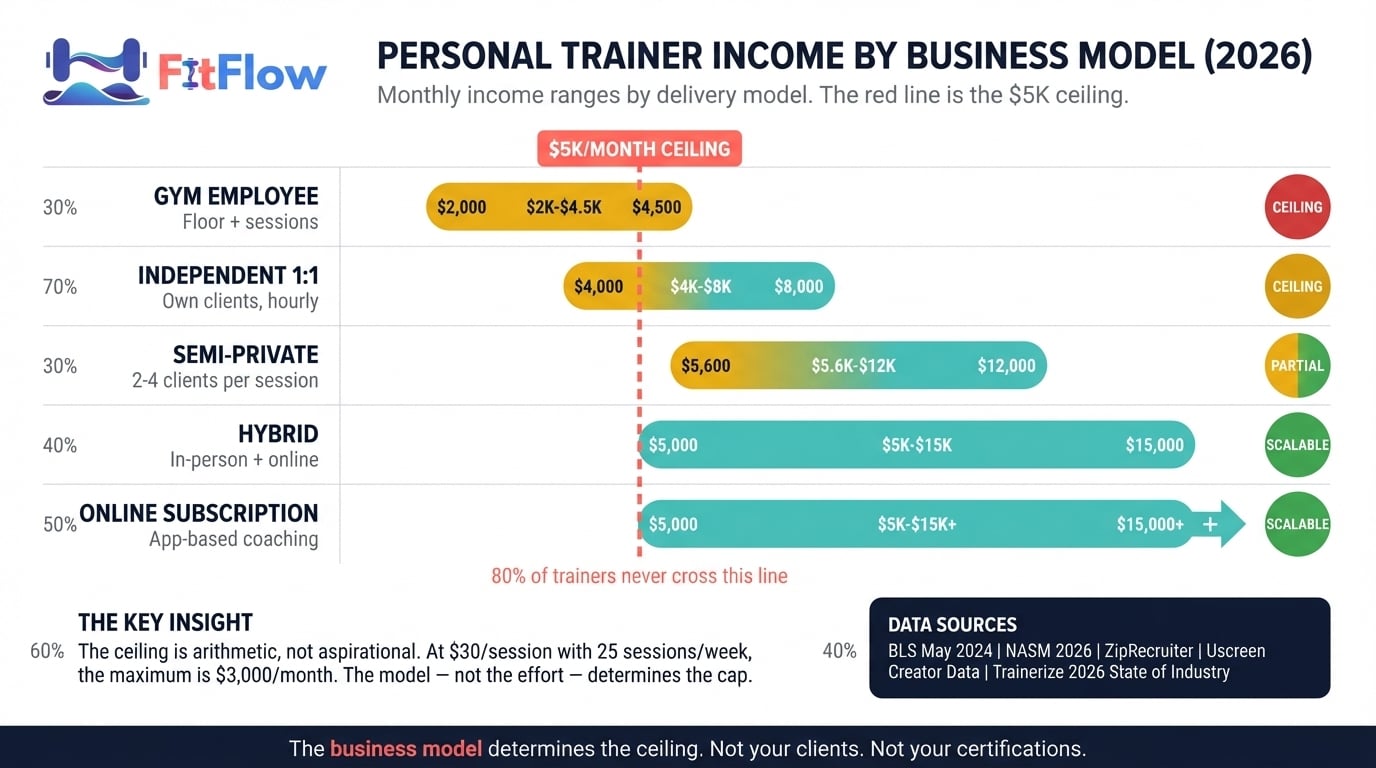
Business Model | Hourly / Per-Client Rate | Monthly Income (est.) | Annual Income (est.) | Ceiling? |
|---|---|---|---|---|
Gym employee (floor + sessions) | $12-$35/hr | $2,000-$4,500 | $24K-$54K | YES — capped by gym rates and hours |
Independent (1:1 only) | $50-$100/hr | $4,000-$8,000 | $48K-$96K | YES — capped by available hours |
Semi-private (2-4 clients) | $35-$60/person/session | $5,600-$12,000 | $67K-$144K | PARTIALLY — better leverage but still time-bound |
Hybrid (in-person + online) | Varies | $5,000-$15,000 | $60K-$180K | NO — scalable component breaks the hour ceiling |
Online subscription | $100-$300/client/mo | $5,000-$15,000+ | $60K-$180K+ | NO — client count not limited by schedule |
The BLS reports a median annual wage of $46,180 for fitness trainers and instructors as of May 2024. ZipRecruiter places the national average at $61,014 per year ($5,084/month). Glassdoor reports $75,521 per year, though that figure skews toward metropolitan markets and higher-experience roles.
The range matters more than any single average. A gym-employed trainer working floor shifts at $12-$19 per hour (ISSA) lives in a fundamentally different income reality than an online subscription coach averaging an estimated $7,503 per month (Uscreen).
These are not two tiers of the same career. They are two different economic structures wearing the same job title. The trainers earning $7,500 per month are not necessarily better coaches. They made a business model decision.
Why the Ceiling Exists: 4 Structural Business Model Failures
The $5K/month ceiling is not mysterious. It is arithmetic. Four structural failures in the default personal training business model create it, and diagnosing them is the first step to breaking through.
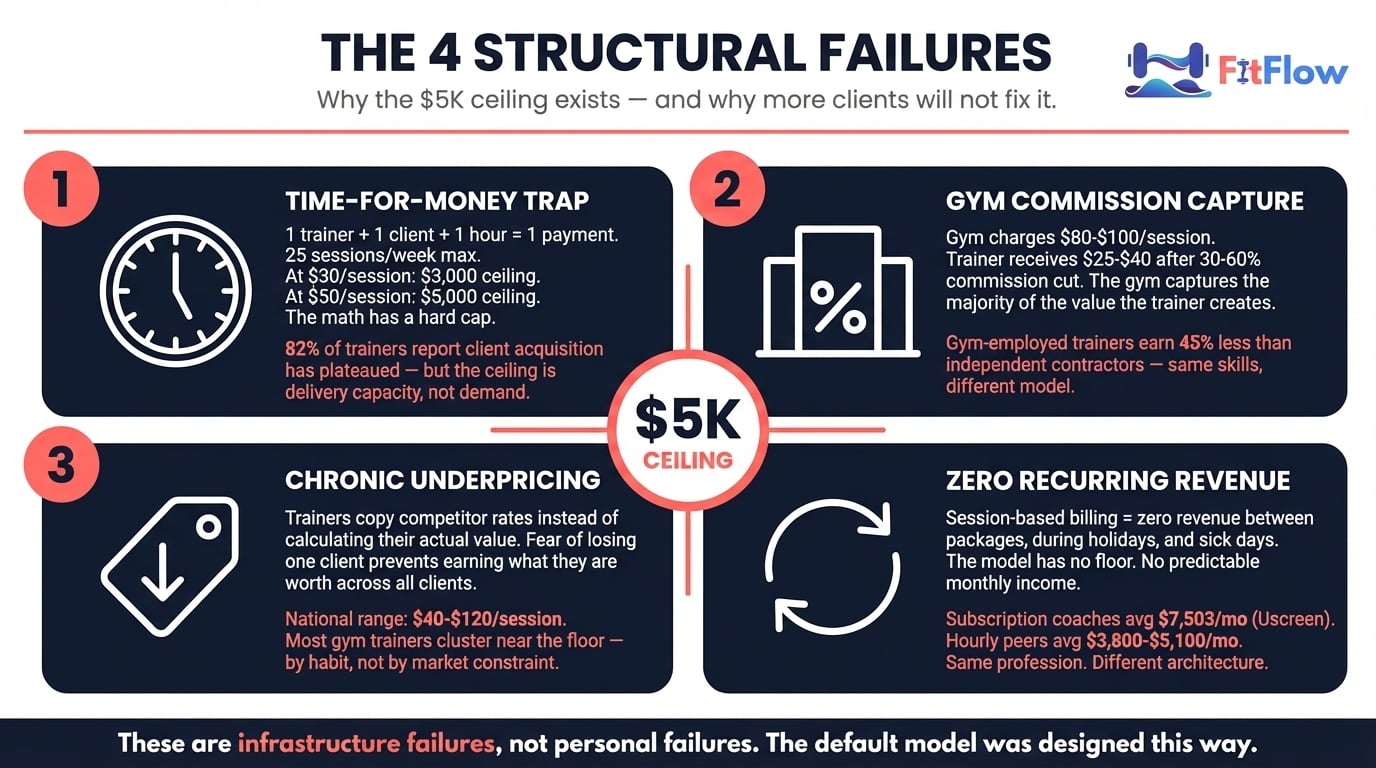
1. The Time-for-Money Trap
The default personal training model is the simplest transaction in business: one trainer, one client, one hour, one payment. That simplicity is also its constraint.
The math has a hard limit. A realistic training schedule caps at 25-30 sessions per week before quality degrades and burnout accelerates. Research published in the Journal of Strength and Conditioning Research found that 32.8% of fitness professionals experience personal burnout and 28.5% experience work-related burnout — numbers that climb as session volume increases.
At $50 per session after expenses, 25 sessions per week produces $5,000 per month. At $30 per session — typical for a gym-employed trainer after the gym takes its cut — 30 sessions per week produces $3,600 per month. That is the ceiling. Not a market ceiling. Not a demand ceiling. A mathematical ceiling baked into the model itself.
The Trainerize 2026 State of Personal Training Industry Report frames it directly: "The old model hits a ceiling fast. Your income depends on your schedule." The same report found that four in five trainers say client acquisition has become harder or has plateaued — but that is a misleading signal. The problem is not that demand disappeared. The problem is that even if you filled every available hour, the model caps your income at a level that most trainers find unsustainable.
You cannot outwork an arithmetic ceiling. You can only change the equation.
2. The Gym Commission Capture Problem
Here is the math most trainers do not see clearly until year two. A gym charges a client $80-$100 per session. The trainer who delivers that session receives $25-$40. The gym captures 30-60% of the value the trainer creates (ISSA; Two-Brain Business).
Two-Brain Business frames it starkly: "70% of zero is zero" — arguing that a revenue split means nothing if the business cannot sustain the trainer. Entry-level gym rates compound the problem: $12-$19 per hour for floor shifts, $25-$40 per session for training. At those rates, a 40-hour work week produces $2,500-$3,200 per month before taxes.
Industry salary data indicates that gym-employed trainers typically earn significantly less than independent contractors with comparable experience and certifications. That gap is not primarily about skill. It is about revenue capture structure.
This is not inherently exploitative. Gyms provide overhead, facilities, insurance, and client access that trainers would otherwise need to acquire independently. But trainers need to understand the math to make informed career decisions. The commission structure is not a temporary discount on your way to a higher rate. It is a permanent revenue ceiling unless you change the model.
3. Chronic Underpricing
Most trainers set their session rate by looking at what the trainer across the street charges. That trainer did the same thing. Neither has done the math on what the market would actually bear for the specific results they deliver.
The underpricing cycle works like this: a new trainer checks local rates, sees $50-$60 per session as the norm, sets their price at $50, and never revisits it. National session rates range from $40 to $120 for in-person training, but the median gym-based trainer stays near the floor of that range regardless of experience, specialization, or client outcomes.
The behavioral driver is fear. Trainers fear client objection more than they fear financial failure. The prospect of losing one client to a $15 price increase overrides the math showing that the increase across 20 clients adds $300 per month — $3,600 per year — with minimal attrition risk. One awkward conversation stands between most trainers and meaningful revenue growth.
The Trainerize 2026 report confirms the underlying dynamic: four in five trainers say client acquisition is harder or has plateaued. The common response is to pursue more clients at the same low rate. The more effective response is pricing that reflects the value delivered — which starts with understanding how to structure programs worth charging more for. If your program design does not justify premium pricing, start with the simplest way to structure a client program and build from there. The confidence to charge more comes from delivering results worth more, and evidence-based program design is what justifies it.
4. Zero Recurring Revenue Architecture
Session-based billing has no floor. When a client cancels, there is no revenue. Between session packages, there is no revenue. During holidays, sick days, and vacations — no revenue. The model produces income only when the trainer is physically delivering a session. Every gap is a gap in pay.
Compare this to a subscription model: 30 clients paying $200 per month equals $6,000 in predictable revenue before the month begins. The same 30 clients buying four-session packages at $50 each produces $6,000 in potential revenue — but only if every client buys a package every month, uses every session, and never takes a break. In practice, session-based billing produces roughly 60-80% of its theoretical maximum due to gaps, cancellations, and inconsistent purchasing patterns.
The income data reflects the structural difference. Trainers on subscription platforms report averaging approximately $7,503 per month (Uscreen). Their hourly-billing peers in gyms typically earn $3,800-$5,100 per month for comparable work with comparable skills. The variable is not talent. The variable is revenue architecture.
The absence of recurring revenue is the single biggest structural difference between trainers below $5K and trainers above $5K per month. The Trainerize 2026 report shows that roughly half of trainers now run a hybrid model as their primary delivery method — a number that has been climbing steadily. The shift is happening, but for those still on pure session-based models, the revenue ceiling remains firmly in place.
Building recurring revenue requires operational systems that make subscription delivery viable. The pricing shift without the systems shift creates a different kind of chaos. Both changes matter.
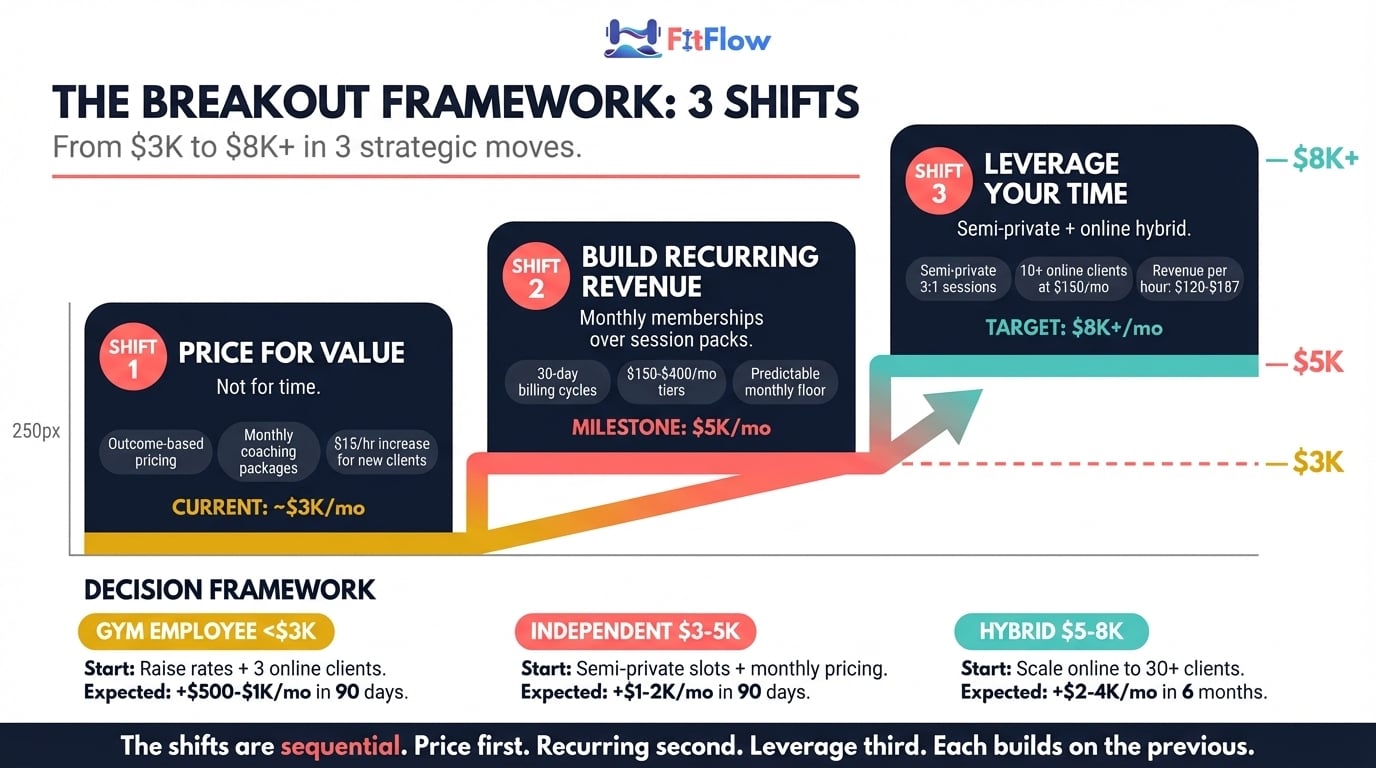
The Breakout Framework: From $3K to $8K in 3 Shifts
The diagnosis is clear. The time-for-money trap, gym commission capture, chronic underpricing, and zero recurring revenue create a ceiling that no amount of hustle breaks through. The fix is not working harder within the same model. It is changing the model.
Three shifts. Each builds on the previous one. The order matters.
Shift 1 — Price for Value, Not for Time
Stop charging per hour. Start charging per outcome, per month, or per program.
The reframe is straightforward: a $60 session and a $250 monthly coaching membership both deliver training. But the session sells an hour of time. The membership sells a result — programming, check-ins, support, and accountability delivered across the month. The perceived value is higher because the scope of service is broader, and the client relationship deepens rather than remaining transactional.
Here is what the pricing math looks like across models:
Tier | Service | Price Range | Revenue Per Client Per Month | Clients Needed for $5K |
|---|---|---|---|---|
Floor Rate | 1:1 sessions (gym employed) | $30-$50/session | $240-$400 | 13-21 |
Independent 1:1 | Sessions (own clients) | $60-$100/session | $480-$800 | 7-11 |
Monthly Coaching | Program + check-ins + support | $150-$300/month | $150-$300 | 17-34 |
Hybrid Premium | 2-4 sessions/mo + full online coaching | $250-$500/month | $250-$500 | 10-20 |
Semi-Private (3 clients) | Group session rate | $35-$50/person | $420-$600 per session slot | 9-12 slots/month |
The specific move: raise rates for all new clients by $15 per session or transition to monthly pricing. Offer existing clients a smaller increase ($5-$10 per session) with a 12-month loyalty rate lock. Lead with the value addition — "I have added nutrition coaching and app-based programming to my service" — not the price change.
Most trainers who raise prices report that the majority of clients stay. The ones who leave over a $15 increase were often the most price-sensitive clients in the roster — and frequently the ones consuming the most time and energy per dollar.
Shift 2 — Build a Recurring Revenue Base
Move from session packs to monthly memberships. The client pays monthly. The trainer delivers sessions, programming, and support as a unified package.
Three subscription tiers that work:
$150/month: App-based programming with weekly check-ins. No in-person sessions. High scalability.
$250/month: 2 in-person sessions per month plus full app programming plus nutrition coaching. The hybrid sweet spot.
$400/month: 4 in-person sessions per month plus nutrition plus priority support. The premium accountability tier.
The math at the middle tier: 20 clients at $250 per month equals $5,000 in predictable monthly revenue. No gaps between packages. No income loss from one-off cancellations (with a 30-day cancellation policy). Stable enough to plan around — rent, taxes, savings, reinvestment.
This shift requires a technology layer. Recurring billing, program delivery, progress tracking, and client communication need to run through a platform rather than text messages and spreadsheets. Client management software is not a luxury here — it is the infrastructure that makes the subscription model operationally viable.
Shift 3 — Leverage Your Time (Semi-Private + Online)
The first two shifts fix pricing and revenue structure. The third shift breaks the time ceiling by serving more clients per hour without a proportional increase in working hours.
Semi-private math: One session with 3 clients at $40 per person produces $120 per hour. A 1:1 session at $60-$80 per hour produces $60-$80. That is 50-75% more revenue per hour with a slight reduction in individualization — a trade-off most clients accept when the programming is still personalized.
Online component math: 10 online-only clients at $150 per month produces $1,500 per month with approximately 2-3 hours per week of programming and check-in time. Effective rate: $125-$187 per hour.
The hybrid combination: A trainer running 15 semi-private sessions per week (3 clients each at $40 per person) plus 20 online clients at $150 per month could potentially generate $7,200-$10,800 per month. That is the math of a specific, executable schedule — not a ceiling, but an illustration of what the model allows.
Here is the decision framework based on where you are now:
Your Current Situation | Recommended First Move | Expected Revenue Shift |
|---|---|---|
Gym employee, under $3K/mo | Raise rates + start 3 online clients | +$500-$1,000/mo in 90 days (estimated) |
Independent 1:1, $3-5K/mo | Add semi-private slots + monthly pricing | +$1,000-$2,000/mo in 90 days (estimated) |
Hybrid, $5-8K/mo | Scale online to 30+ clients + premium tier | +$2,000-$4,000/mo in 6 months (estimated) |
For trainers who have already crossed the $5K threshold and are ready to scale further, the playbook for scaling to 50+ clients covers the next phase in detail.
Ready to Apply the Framework? Start With Your Numbers. You just read the three shifts — price for value, build recurring revenue, leverage time. The Revenue Ceiling Calculator models all three against your actual rate, sessions, and commission. See which shift has the biggest estimated impact for your situation. Calculate My Breakout.
The Exact Conversation: How to Raise Your Rates This Week
Frameworks are useful. Scripts are usable. Here are word-for-word conversations you can adapt this week.
Script 1: New Client Rate Announcement
"My current rate for new clients is $X per session / $X per month. That includes [programming, nutrition coaching, app-based tracking, check-ins]. I have availability on [days/times]. Would you like to schedule an introductory session?"
No justification. No apology. New clients have no reference point for your old rate.
Script 2: Existing Client Rate Increase (The Loyalty Conversation)
"Hey [Name], I wanted to let you know about some changes starting [date, minimum 30 days out]. I am expanding my services to include [nutrition coaching / app-based programming / progress tracking], and my new client rate will be $X per session. Because you have been with me since the beginning, your rate will increase by only $Y — and that rate is locked for 12 months. The added services start immediately."
Lead with the value. Name the loyalty discount. Lock the rate.
Script 3: Transitioning a Client to Monthly Membership
"[Name], I have been thinking about how to give you better support between our sessions. I am moving to a monthly coaching model where you get [2-4 sessions per month + full app programming + nutrition coaching + weekly check-ins] for $X per month. It is a better value than session packs because you get continuous support, not just the hour we are together. I would like to transition you starting [date]. Does that work for your schedule?"
Frame the membership as an upgrade in value, not a change in billing structure. The client hears "more support." You get predictable revenue.
For a detailed, step-by-step pricing and business-building guide, the business-building deep dive covers the full implementation.
Key Takeaways
The $5K/month ceiling is a business model problem, not a client problem. An estimated 80% of trainers who quit never crossed $4K/month — not because they lacked skills, but because the default model has a built-in cap.
Four structural failures create the ceiling: the time-for-money trap, gym commission capture, chronic underpricing, and zero recurring revenue.
Three shifts break through it: price for value (not time), build recurring revenue, and leverage your time with semi-private and online delivery.
The math works in your favor: 20 clients at $250/month equals $5,000 in predictable revenue. That requires fewer clients than most trainers think.
The $5K threshold is not the finish line — it is the point where the business becomes sustainable. What comes after is where real growth begins.
Individual results vary based on market, pricing strategy, client volume, and execution. The income figures in this article are estimates drawn from industry data and should not be interpreted as guarantees.