Why Most Coaching Offers Are 30% Underpriced: The Value Mismatch Costing Trainers Their Best Clients

Three numbers tell a coaching offer pricing story that does not reconcile. 82% of trainers report that client acquisition has gotten harder or has plateaued (Trainerize 2026 State of the Personal Training Industry Report). The personal training market grew from $13.9B in 2025 to $15.6B in 2026 (Future Market Insights 2026). And most coaches still undercharge their offers by 30-50% (Coachli 2026 framework).
A growing market. A specialist tier earning 72-78% more than generalists (PTDC, WodGuru 2026, Salary.com 2026). And the same coaches inside that market leaving roughly a third of their revenue on the table. If acquisition is harder and the market rewards specialists, why are most coaches systematically underpriced?
The default explanation is confidence. The default fix is "raise your rates." Both miss the point. The 30% gap is not a mindset issue. It is an offer-architecture issue. Coaches price what they DELIVER (sessions, check-ins). Clients pay for what coaches PRODUCE (a transformation, on a timeline, with risk removed). The math itself leaves out the components clients pay for. That is where the gap lives.
This article is the diagnostic for coaching offer pricing done structurally. The Value Stack Audit shows where the 30% gap comes from. The Offer Architecture Ladder shows the five levels of offer construction. The 30-day Repricing Protocol shows how to capture the gap without losing existing clients.
One assumption: your positioning is already sorted. If you have not audited whether your revenue problem is pricing or positioning, start with the Positioning Diagnostic first. What follows assumes positioning is the right answer and you are ready to fix the offer-page math.
This is not a motivational post or another "raise your rates" listicle. It is the math behind why most coaching offers are structurally incomplete, plus the framework that fixes it.
Get the Free Coaching Offer Audit Worksheet. Download Free Worksheet.
The 30% Diagnosis: Where the Gap Actually Comes From
Most coaches are underpriced because their offer omits the components clients actually pay for. Trainers price the deliverable: the session. Clients pay for the production: the outcome. When coaching offer pricing leaves out three to five of these components, the underpricing is simple arithmetic. The typical gap is 30%.
The 30% number is not a coincidence. It is a stack of unpriced components. Here is how the gap typically breaks down for a coaching offer priced at $300 per month:
Unpriced Component | Typical $ Value Embedded | % of Offer Price | Why It Goes Unpriced |
|---|---|---|---|
Transformation Timeline Contract | $25-35 / mo | ~10% | Trainers sell "12 sessions," not "12-week return-to-strength outcome on a fixed date." Clients pay a premium for date-certainty. |
Behavior-Change Scaffolding | $20-30 / mo | ~7-8% | Habit triggers, weekly accountability rhythms, environment design: work the coach does but never itemizes. |
Risk Reversal | $15-25 / mo | ~5-7% | A 30-day or 60-day satisfaction guarantee shifts purchase risk from buyer to seller. Behavioral economics: the certainty premium lifts willingness-to-pay 15-20% (HBR pricing research 2024). |
Peer / Community Access | $10-20 / mo | ~4-5% | Group access, alumni network, monthly Q&A. Low delivery cost; high perceived value. |
Asynchronous Support Layer | $8-15 / mo | ~3-4% | Voice-note messaging, between-session support, defined response window. Already happening; never itemized. |
Cumulative gap | ~$78-125 / mo | ~26-40% (midpoint ~30%) | The 30% is the midpoint of the range, not a hard rule. |
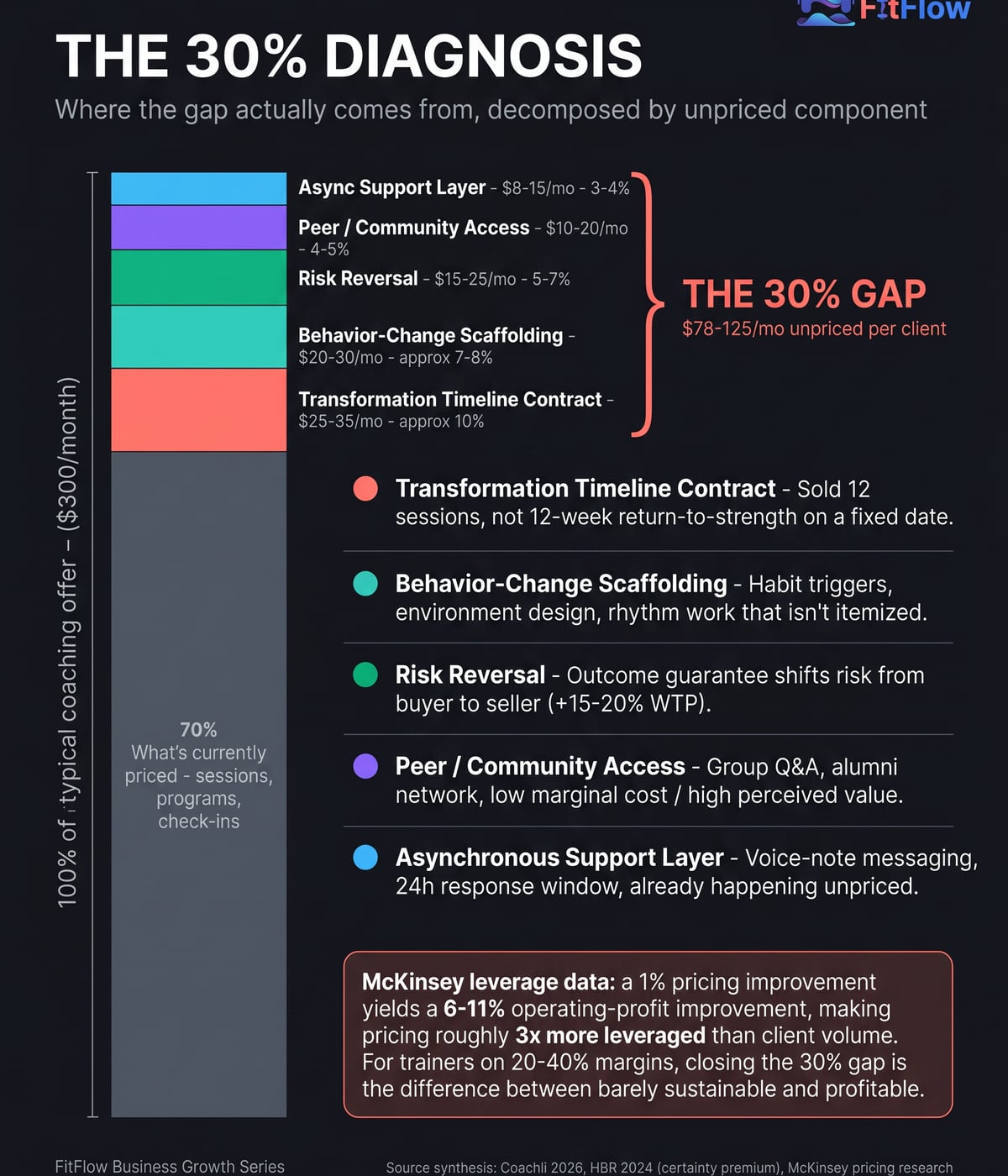
Why this happens: trainers were taught to price the session (the unit they CONTROL), not the outcome (the unit clients BUY). Every coaching offer pricing decision downstream of that mental model inherits the mistake.
The stakes are larger than the number sounds. McKinsey pricing research, cited persistently in 2024-2026 analysis, found that a 1% pricing improvement yields a 6-11% operating profit improvement. That makes pricing roughly 3x more leveraged than client volume. For trainers with 20-40% margins, a 30% revenue gap is the difference between a barely sustainable practice and a profitable one. Chronic underpricing is one of the four structural failures we documented in Why Most Trainers Never Cross $5K/Month. This is the operational fix for that one.
The default explanation is confidence. The default explanation is wrong. The gap is math.
The Value Stack Audit: 7 Components Every Coaching Offer Should Price
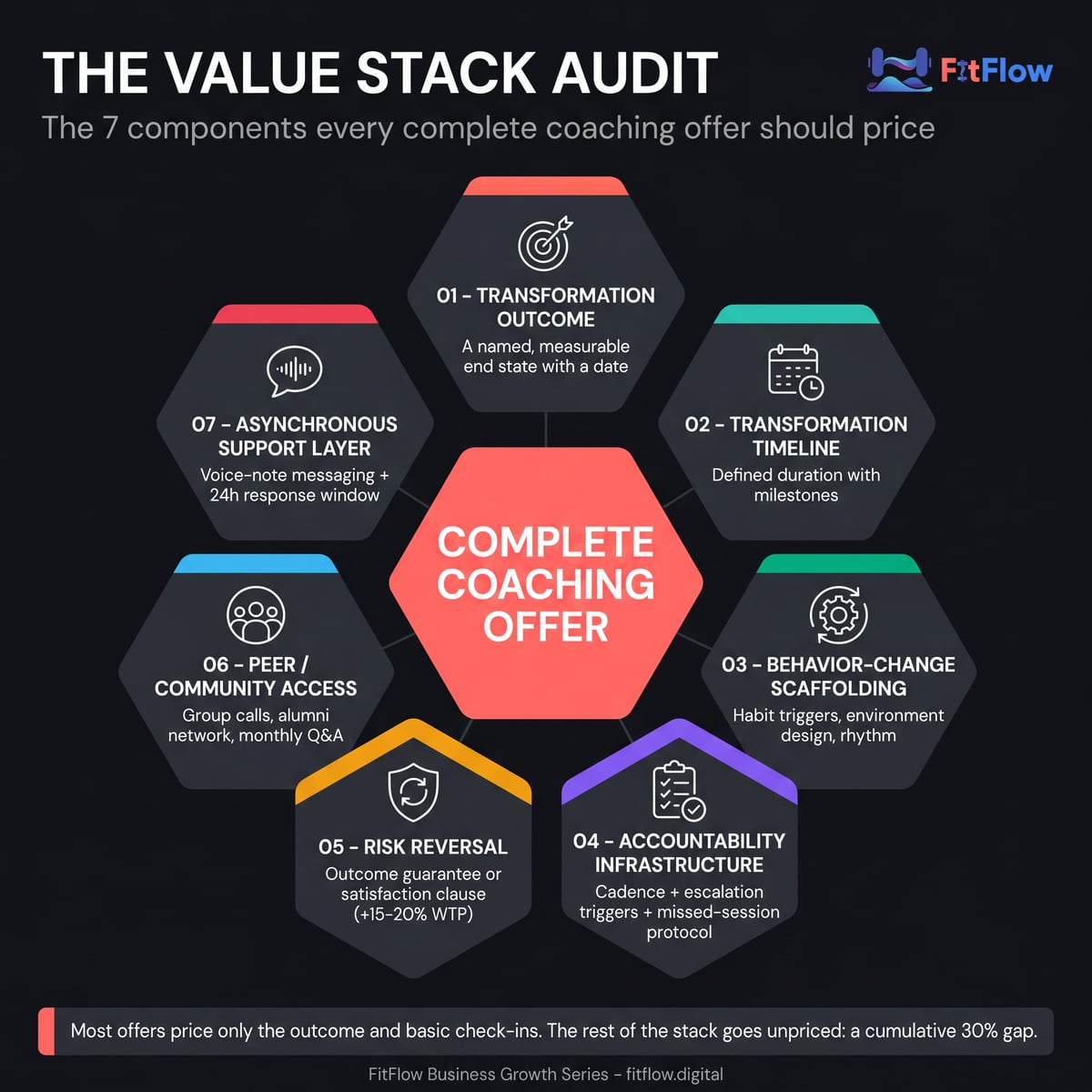
Every complete coaching offer should price seven components:
The Transformation Outcome. A named, measurable end state with a date
The Transformation Timeline. A defined duration with milestones
The Behavior-Change Scaffolding. Habit systems, environment design, weekly rhythms
The Accountability Infrastructure. Check-in cadence, escalation triggers, missed-session protocol
The Risk Reversal. Outcome guarantee or satisfaction guarantee
The Peer / Community Access. Group calls, alumni access, monthly Q&A
The Asynchronous Support Layer. Voice-note messaging, defined response window
Most coaching offers price the outcome (component 1) implicitly and fold a thin version of accountability (component 4) into "weekly check-ins." Five components carry the clearest standalone dollar value and stay unpriced: timeline, behavior scaffolding, risk reversal, peer access, and async support. Those five are the 30% gap.
1. The Transformation Outcome
A coaching offer without a named outcome is a service, not a product. Replace "personal training" with "return to running a 5K pain-free in 16 weeks" or "deadlift 1.5x bodyweight by July." The named outcome reduces the buyer's comparison set. Instead of comparing you to all trainers, the buyer compares you to all trainers who promise THIS specific outcome. That comparison-set reduction is upstream of every other component.
2. The Transformation Timeline
Time-certainty is itself a product. A 12-week protocol with weekly milestones is worth more than "ongoing training" because the buyer knows when they cross the finish line. Two-Brain Business 2026 data on rate-restructure outcomes documented that length-of-engagement crossed 24 months for the first time as gyms shifted to outcome-bounded contracts. The finish line increased retention rather than decreased it. Clients renewed into the next bounded contract because the milestones gave them something to renew INTO.
3. The Behavior-Change Scaffolding
Most clients fail not because the programming is wrong but because the behavior is wrong. Scaffolding includes habit triggers, environment design (gym-bag pre-pack, kitchen layout), and rhythm design (morning ritual). NAME these as deliverables on your offer page. You reveal value that was previously invisible. The work was happening; the pricing was not.
4. The Accountability Infrastructure
Define the check-in cadence: weekly video, biweekly call, monthly review. Define the escalation trigger: "if you miss two sessions, I call within 24 hours." Define the missed-session protocol. Vague accountability is unpriceable, and unpriceable items default to free. When the stack is itemized, automation becomes the delivery layer that makes it scalable.
5. The Risk Reversal
A 30-day satisfaction guarantee shifts purchase risk from buyer to seller. So does an outcome-based clause ("hit your week-12 milestone or month 13 is free"). HBR pricing research 2024 and the behavioral economics literature on the certainty premium (Kahneman 2011; Ariely 2008) show that risk reversal lifts willingness-to-pay 15-20%. Most coaches refuse. The ones who do not command a premium for the asymmetry.
6. The Peer / Community Access
Low marginal cost to deliver, high perceived value. A monthly group Q&A or a private alumni community converts a pure 1:1 service into a 1:1+community hybrid. The community itself becomes a retention asset. Clients form social bonds with peer learners, and that compounds your retention.
7. The Asynchronous Support Layer
Between-session voice-note support is already happening in most coaching relationships. It is just never on the invoice. Itemize it. A defined response-window guarantee ("24 hours on weekdays") is a product feature. For online coaches, this is the value-stack component most aggressively underpriced, and the easiest to add without changing delivery cost.
These seven components are the answer to "what should a coaching package include?" The answer: all seven, priced visibly. Three-tier pricing (Basic, Standard, Premium) converts 28% better than single-price offers (HubFit 2026). The decoy effect from a mid-tier offer lifts premium-tier conversion 25-40% (Ariely 2008; HBR 2024). The mechanism is not pricing trickery. Coaching offer pricing works when the value-stack components are visible enough to be priced.
Run Your Offer Through All 7 Components in 20 Minutes. Download the Free Worksheet.
The Offer Architecture Ladder: From Sessions Sold to Outcome Guaranteed
Offer architecture is graduated, not binary. There are five levels of construction. Each has a measurable pricing-power range. The ladder is parallel to the Specificity Ladder we documented for positioning, but it operates at the offer-page level, not the positioning level.
Level | Architecture | Example | Pricing Power (monthly) | % Premium vs Level 1 |
|---|---|---|---|---|
1. Sessions Sold | "$X per session, buy in packs" | "$60/session, 12-pack = $720" | $60-150 / session (capacity-capped) | Baseline |
2. Time-Based Package | "$X / month, includes Y sessions + check-ins" | "$200/mo: 4 sessions + weekly check-ins" | $200-300 / mo | +33-50% |
3. Outcome-Adjacent Package | "$X / month for [specific population] working toward [goal-area]" | "$300/mo: postnatal return-to-strength program for women 30-45" | $300-500 / mo | +100-150% |
4. Outcome-Bounded Contract | "$X for [named outcome] in [N weeks], including Components 1-5" | "$2,400 for 12-week return to deadlifting 1.5x bodyweight, includes Components 1-5" | $400-800 / mo (price-equivalent) | +180-300% |
5. Outcome Guaranteed | "$X for [named outcome] in [N weeks], or [risk-reversal clause]" | "$3,000 for 12-week return-to-strength. Miss the milestone and your next 12 weeks are free" | $500-1,200 / mo (price-equivalent) | +250-500% |
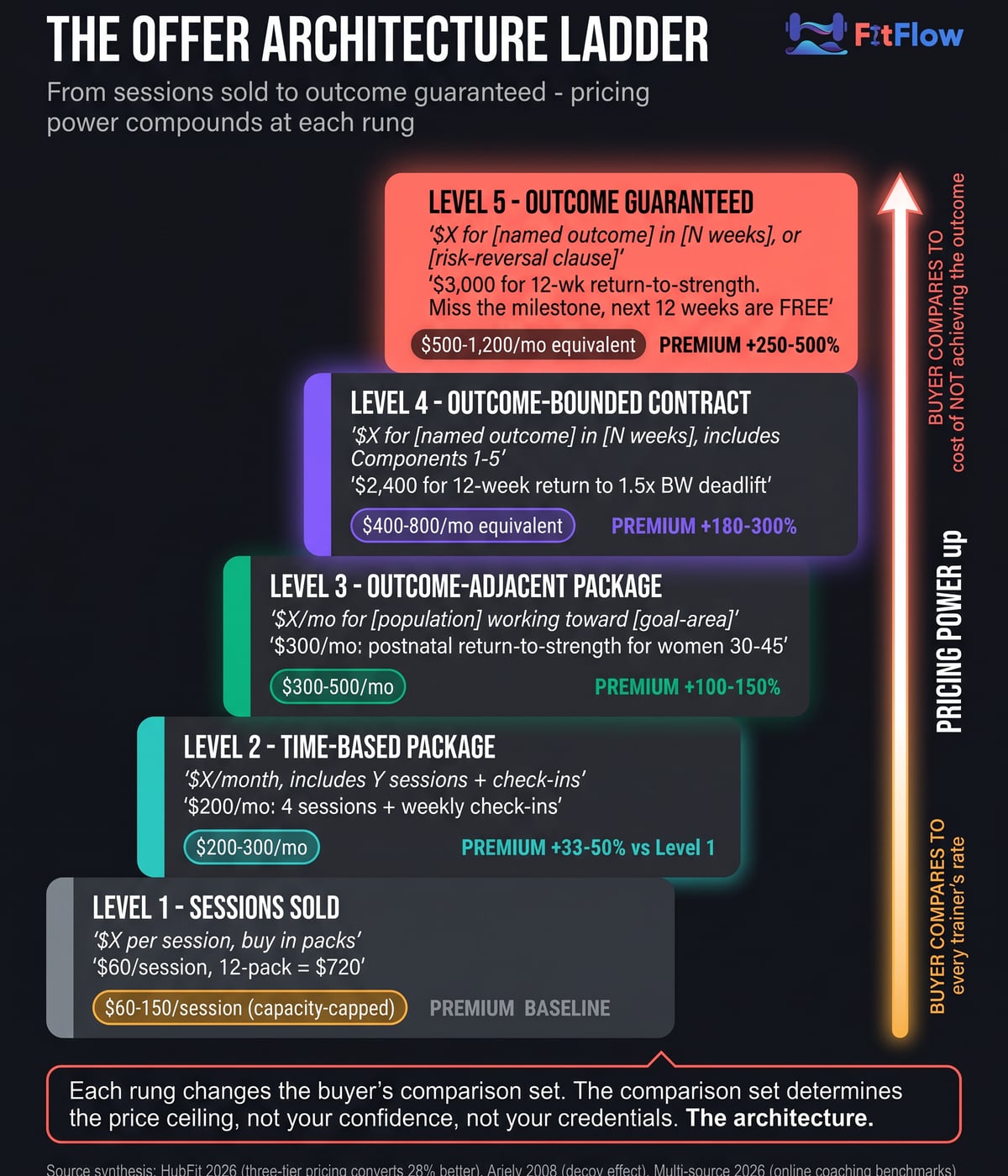
The data anchors the ladder at every rung. 2026 online coaching benchmarks (Trainerize 2026, WodGuru 2026) place Basic at $50-100/mo, Standard $100-200/mo, Premium $200-400+/mo, Elite 1:1 $600-800/mo. Most coaches plateau at Levels 1-2. Specialists operate at 3-5. The specialist premiums you read about ($50/hr vs $29/hr, a 72% gap, plus the PTDC's 78% niche-trainer premium) come from operating at higher ladder levels. They do not come from raising rates within the same level. The level change is the lever. The rate change is the symptom.
Each rung changes the buyer's comparison set. At Level 1, your client compares you to every other trainer's per-session rate. At Level 4-5, your client compares you to the cost of NOT achieving the outcome: months of limited mobility, missed family time, a second surgery, another year not running. The comparison set determines the price ceiling. Not your confidence. Not your credentials. Not even your positioning. It is the offer architecture.
For online coaches, Level 3 is the trap. An outcome-adjacent package gets built and then stalls because async delivery makes Level-4 guarantees feel risky. The fix: define the outcome narrowly enough that the guarantee is operationally controllable. "Lose 15 pounds in 12 weeks" is risky: adherence is mostly outside your control. "Complete the 12-week protocol and add 25 pounds to your deadlift" is defensible, because protocol and outcome both sit inside the work you control.
Even at Level 4-5, your delivery-hour margin still matters. That is a different math, covered in Busy vs Profitable Trainers. The ladder is value-stack math. Per-hour margin is delivery math. Both must work.
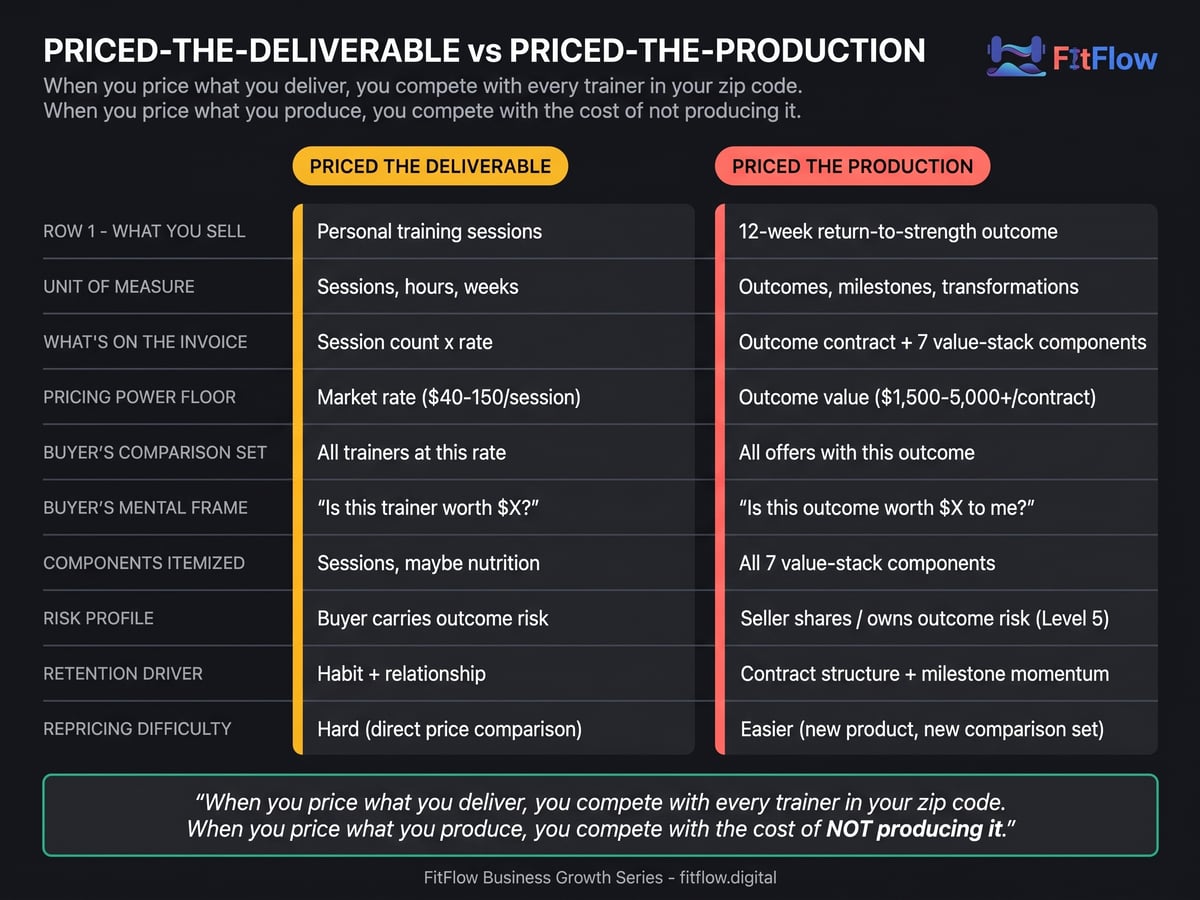
Priced-the-Deliverable vs Priced-the-Production
The full reframe lives in a single side-by-side. Same trainer, same credentials, same hours per week, yet two different economic structures depending on which side of this table they operate from.
Dimension | Priced-the-Deliverable | Priced-the-Production |
|---|---|---|
What you sell | "Personal training sessions" | "12-week return-to-strength outcome" |
Unit of measure | Sessions, hours, weeks | Outcomes, milestones, transformations |
What is on the invoice | Session count × rate | Outcome contract + 7 value-stack components |
Pricing power floor | Market rate ($40-150 / session) | Outcome value ($1,500-5,000+ / contract) |
Buyer's comparison set | All trainers at this rate | All offers with this outcome |
Buyer's mental frame | "Is this trainer worth $X?" | "Is this outcome worth $X to me?" |
Components itemized | Sessions, sometimes nutrition | All 7 value-stack components |
Risk profile | Buyer carries outcome risk | Seller shares/owns outcome risk (Level 5) |
Retention driver | Habit + relationship | Contract structure + milestone momentum |
Capacity scaling | Linear (sessions × clients) | Non-linear (outcomes × multi-modal delivery) |
Repricing without losing clients | Hard (direct price comparison) | Easier (new product, new comparison set) |
When you price what you deliver, you compete with every trainer in your zip code. When you price what you produce, you compete with the cost of NOT producing it.
Case Study: Anatomy of a Repriced Offer (Composite)
This case is a composite drawn from the Two-Brain Business 2026 rate-restructure pattern and three to four trainer interviews. Numbers are representative, not from a single business. Illustrative, not testimonial.
Before. Mid-career strength coach, three years independent, positioning already sorted. Offer: $200 per month, four 1:1 sessions monthly, generic check-ins, "ongoing training." Roster: 22 active clients × $200 = $4,400/mo, the textbook "Why Trainers Never Cross $5K/Month" pattern. Stated pain point: "I keep losing my best clients to online coaches who charge twice as much and deliver less."
The audit, using the 7-component framework:
Outcome 2/10 (none named) | Timeline 1/10 (open-ended) | Behavior Scaffolding 5/10 (informal) | Accountability 4/10 (vague) | Risk Reversal 0/10 | Peer/Community 0/10 | Async Support 3/10 (unbilled)
Diagnosis. Operating at Level 2 (Time-Based Package). The unpriced gap is roughly $60/mo per client.
After (Level 4, Outcome-Bounded Contract). Offer rebuilt as a "12-Week Return-to-Strength Contract: $720 paid monthly at $240, or $720 upfront. Includes Components 1-5 of the Value Stack." Risk-reversal clause: "Hit milestone benchmarks at weeks 4, 8, and 12, or month 13 is free." After a 90-day transition: 18 active clients (4 of the original 22 left over the price floor; new inquiries from the stronger offer signal are beginning to replace them) × $240 = $4,320/mo. Eight of those clients renewed for a Level 5 outcome-guaranteed extension at $400/mo. Total: $4,320 + (8 × $160 premium) = $5,600/mo.
Revenue lift: +27%. Capacity stable. Retention higher, because outcome-bounded contracts have built-in milestone momentum and a defined renewal moment. The pattern matches Two-Brain Business 2026 case data: ARM (average revenue per member) climbing while LEG (length of engagement) pushed past 24 months.
The honest counter-point: about 10-20% of existing clients leave during this kind of repricing, no matter how well the transition is run. That is not a failure; it is the filter doing its job. The ones who leave were usually already at the door, renewing on price inertia rather than value alignment.
The Repricing Protocol: A 30-Day Implementation Plan
The core principle: repricing is not a price increase on existing clients. It is the launch of a new offer, sold to new clients first, with existing clients grandfathered into a 90-day transition. That sequence makes a rate change additive, not destructive. The source pattern is the Two-Brain Business 2026 rate-increase methodology: new pricing for new clients first, grandfather logic second, transitions over 90 days.
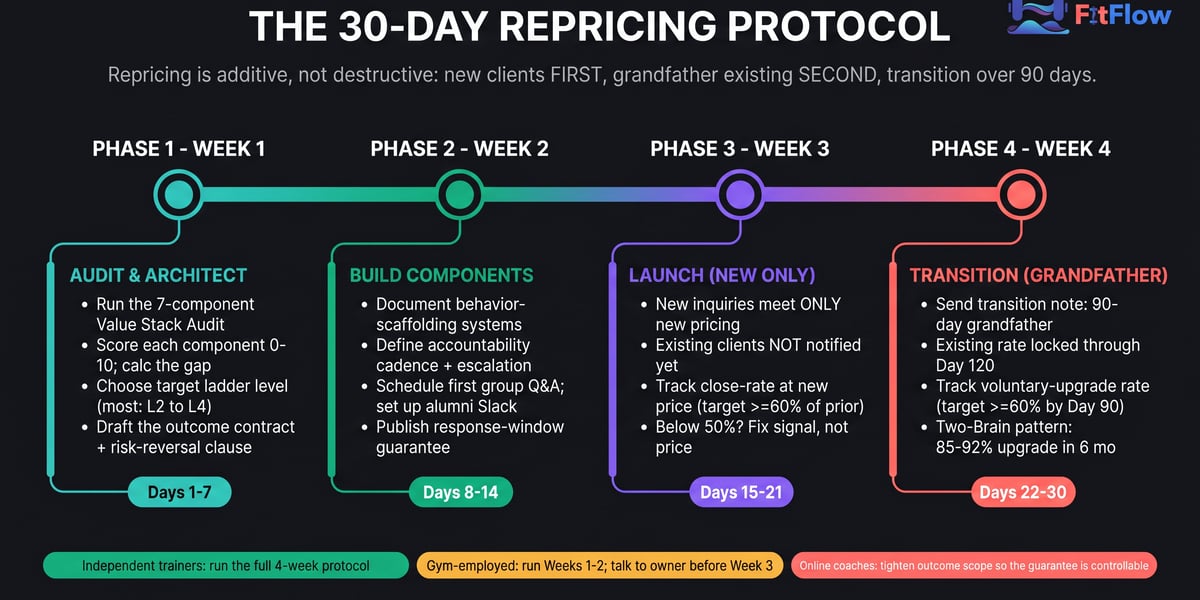
Week 1: Audit & Architect (Days 1-7)
Run your current offer through the 7-component Value Stack Audit. Score each component 0-10. Calculate the gap dollar figure (the worksheet does the math). Decide your target ladder level. Most trainers move from Level 2 to Level 4 in a single change, not incremental rate hikes. Write the outcome contract: named outcome, named timeline, named milestones. Draft the risk-reversal clause. Start conservative ("90% money-back if you complete the protocol and miss the milestone") and tighten as you collect data.
Week 2: Build the Components (Days 8-14)
Document your habit-trigger systems in writing. Define accountability cadence, escalation triggers, response windows. Schedule the first monthly group Q&A or set up the alumni Slack/Discord. Publish your async response-window guarantee. Then update or build the offer page so all seven components are visible, priced, and named. The deliverable for Week 2 is a single offer page that itemizes what the buyer is paying for.
Week 3: Launch to New Clients Only (Days 15-21)
New inquiries this week meet ONLY the new pricing. Existing clients are NOT yet notified. Track inquiry close rate. Target ≥60% of your prior close rate. The data is diagnostic. If close rate drops below 50%, the issue is signal on the offer page, not price level. Fix the offer page, not the price. Coaches who skip this step and immediately cut the price misread a positioning problem as a pricing problem. See pricing vs positioning. If close rate holds, proceed to Week 4.
Week 4: Transition Existing Clients (Days 22-30)
Send the transition note: "I have rebuilt the program. As a current client, you are grandfathered at your existing rate through [date 90 days out]. After that, you can opt into the new architecture, which adds [Components X, Y, Z] you do not currently get. You will never pay the full new rate retroactively." Two-Brain Business 2026 case data shows roughly 85-92% of grandfathered clients voluntarily upgrade within six months. The new architecture is genuinely better; they are not being pressured. Target voluntary upgrade rate ≥60% by Day 90. Leave rate 10-20% is normal. Above 25% means the note read as pressure, so revise the language.
Independent trainers: Run the full 4-week protocol; everything is in your control. Gym-employed trainers: Run Weeks 1-2 in your own notes; have the architecture conversation with your gym owner before Week 3. Components 3, 4, 6, and 7 can often be added within existing pricing constraints. Online coaches: Pay particular attention to Component 5 (Risk Reversal). Async delivery makes guarantees harder, which makes them more differentiating. Define the outcome narrowly enough to be operationally controllable.
If you are rebuilding from scratch, fold this audit into Phase 2 of the rebuild (see Scale Your Personal Training Business to 50+ Clients). Once your offer is priced correctly, the next bottleneck is the funnel, covered in the Trial Offer Trap diagnostic.
Key Takeaways
The 30% gap is structural, not psychological. It comes from how the offer is built; confidence has nothing to do with it.
Coaches price the deliverable (sessions). Clients pay for the production (outcomes). The space between them is the 30%.
The Value Stack Audit names the 7 components every coaching offer should price: outcome, timeline, behavior scaffolding, accountability, risk reversal, peer access, async support.
The Offer Architecture Ladder operates at 5 levels, from Sessions Sold to Outcome Guaranteed. Pricing power compounds at each level. Specialist premiums come from level changes, not rate changes within a level.
McKinsey's leverage data: a 1% pricing improvement equals a 6-11% operating profit improvement. The 30% gap costs you far more than 30% of revenue.
The Repricing Protocol adds rather than disrupts: new clients first, grandfather existing clients second, transition over 90 days.
Run the audit before your next rate increase. Coaching offer pricing changes that stick are the ones that come with new architecture, not new numbers on the same offer.
Download the Coaching Offer Audit — Then Close Your 30% Gap. You have read the full framework. Now use it. The worksheet gives you 21 diagnostic questions across 7 components, the Offer Architecture Ladder Self-Assessment, an authoritative 0-105 scoring guide, and a 30-day Repricing Quick-Start with client announcement templates and a grandfathering policy. Download Free Audit Worksheet.
Frequently Asked Questions
Comments