
Group Coaching Isn't More Profitable Than 1:1. It's More Profitable Than the Version of 1:1 Most Trainers Are Selling.
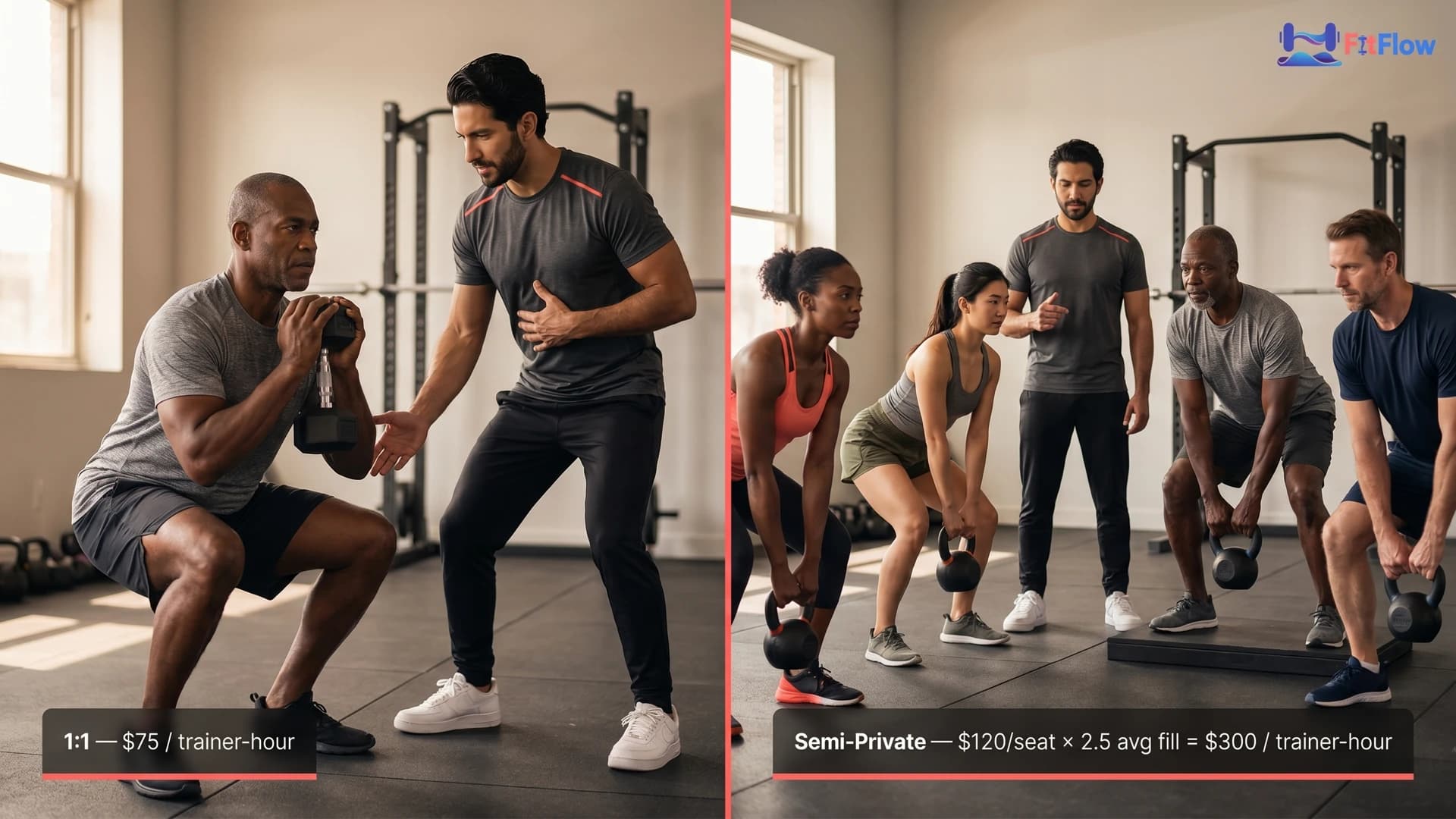
Most "group is leverage" arguments skip the math. This one runs it — revenue per trainer-hour, gross margin per seat, and the break-even seat count where group actually beats 1:1.
The margin math most trainers never do
Thirty active clients. Thirty-two 1:1 sessions a week at $75 each. That's $2,400/wk gross, ~$9,600/mo at full capacity — and you are at full capacity, because the calendar is full and you sleep on Sundays.
On the same desk: twelve hours of small-group coaching at $45/seat across five seats. That's $2,700/wk. Same trainer-hours. One number is bigger. Most articles stop there.
The numbers that decide whether the bigger number is actually better are not on that page. Seat fill rate. Gross margin per seat (group has lower variable cost per seat, higher fixed delivery infrastructure). Churn-adjusted 12-month LTV per client. The break-even seat count where group genuinely beats 1:1 once you fold all three together. That is the actual question, and almost none of the top results for group coaching vs 1:1 personal trainer answer it.
The thesis, in one line: group coaching isn't more profitable than 1:1. It's more profitable than the version of 1:1 most trainers are selling, which is under-priced, capacity-capped, and stuck below 32 sessions a week. Trainerize 2026 puts that 1:1 income ceiling at ~$7,000–$10,000/mo for solo trainers, and BLS 2026 OES data for SOC 39-9031 confirms it across most US markets. Adding group on top of a broken 1:1 doesn't fix the 1:1. Usually it breaks the group offering too.
You don't have a delivery-model problem. You have a margin-stack problem. The calculator runs the math on yours. Get the calculator (free).
This post is the delivery-model decision. If you haven't audited whether your 1:1 offer is itself priced 30% under floor, do that first — the pricing logic that determines whether group is leverage or self-sabotage is the upstream decision. The unit used throughout, margin per active hour, is defined in the difference between filling hours and earning margin.
It's not that group doesn't work. It's that you built it wrong.
The standard industry advice — "add group coaching, it covers multiple seats simultaneously" — fails for most trainers for one reason. They bolt group onto a 1:1 model without redesigning capacity, pricing, delivery, or retention. The half-built offering loses on all four dimensions versus the 1:1 it replaced.
When trainers say "group coaching isn't profitable for me," they usually mean they ran a discounted 1:1 with extra people in the room. That is not group coaching. That is a 1:1 sold for less.
The problem isn't that group coaching is less profitable. You sold a discounted 1:1 and called it group. That's a margin-stack problem before it's a delivery one, and it's also the positioning problem behind the wrong revenue problem: if the market reads your group seat as "1:1 minus the rebate," the price ceiling collapses before delivery even begins.
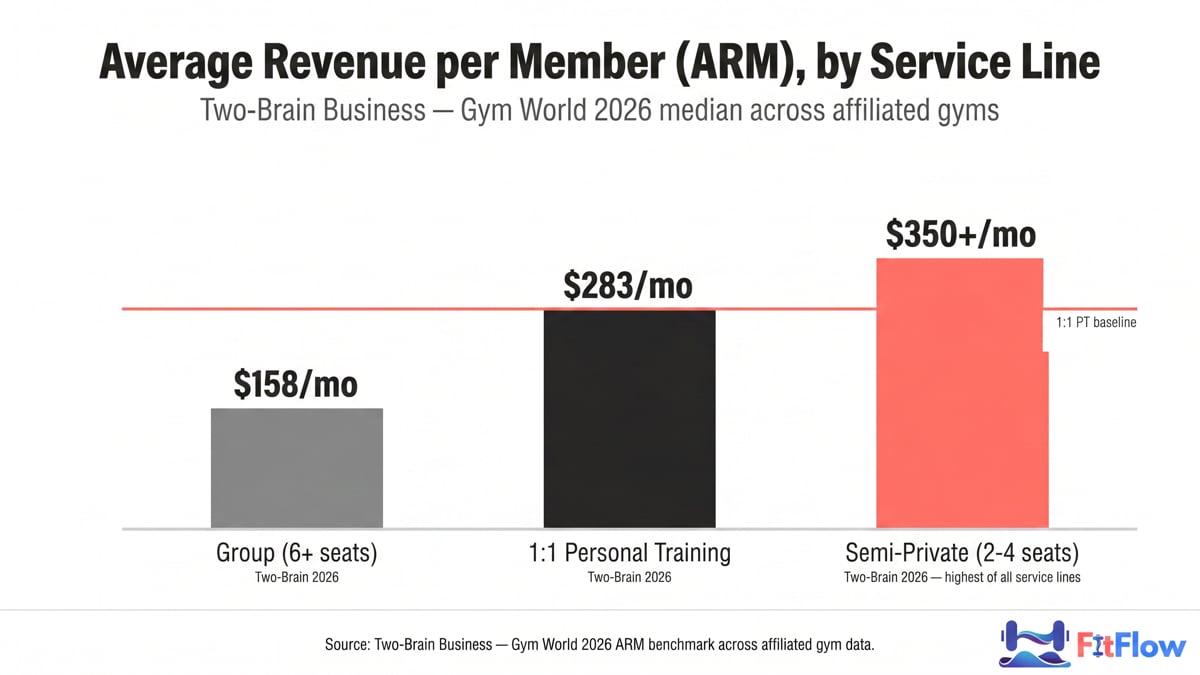
The Two-Brain Business Gym World 2026 leaderboard puts numbers on it. Across surveyed affiliates, ARM runs $283/mo for 1:1 PT, $158/mo for group (6+ seats), $350+/mo for semi-private. The highest-ARM tier is semi-private, not group and not 1:1, and the reason is structural: semi-private is built from scratch as a distinct product. Bill Cates' advocate-priming framework (Referral Coach International) makes the same point. Cohort members need to be primed for a group experience, not retrofitted into one as a downgrade.
Precision Nutrition Pro Coaching's curriculum approach formalizes the same idea: delivery is a stacked product line, with 1:1, group cohort, and continuing-care as separate products rather than interchangeable units. IHRSA 2026 backs the margin claim: small-group gross margin floor 62%, median 71%, ceiling 78% versus 1:1 at 38% / 46% / 52%, but only when group is structurally separate from 1:1. Trainerize 2026 finds ~50% of trainers operate hybrid, yet margin variance within that cohort is wider than across pure-1:1 trainers. Hybrid done right beats both. Hybrid done as a bolt-on loses to both.
The 3 unit-economic levers
Three numbers decide whether group beats 1:1 for your book. Every other variable rolls into one of these.
A note on terms, because the margin math turns on keeping them distinct: semi-private is 2–4 seats, small group is a designed 6–12 seat cohort, and group (6+ seats) is the broad Two-Brain ARM category (the $158/mo line). They are not interchangeable.
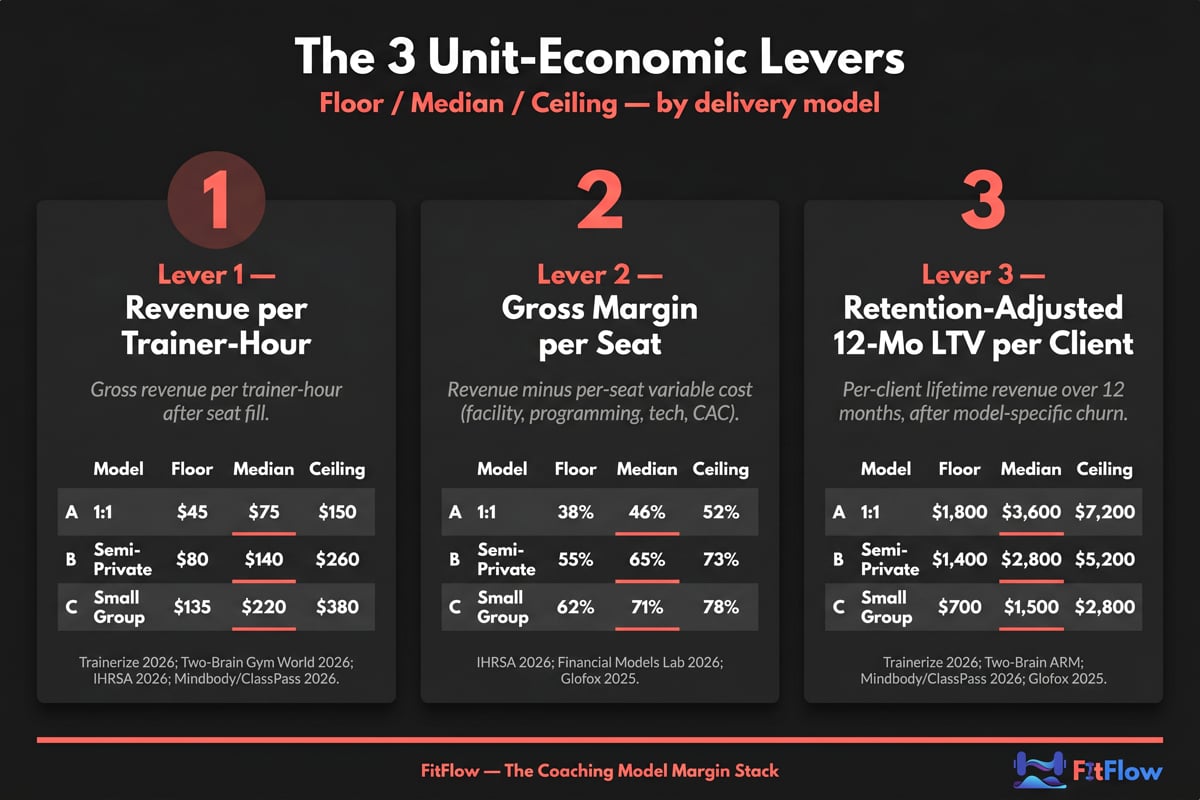
Lever 1: Revenue per trainer-hour. Gross revenue a trainer-hour generates after seat fill rate is applied — not session price (a vanity number). Per Trainerize 2026 and BLS 2026 OES: 1:1 floor $45/hr, median $75/hr, ceiling $150/hr. Semi-private (2–4 seats): $80 / $140 / $260/hr (Two-Brain Gym World 2026; IHRSA 2026). Small group (6–12 seats): $135 / $220 / $380/hr (Two-Brain Gym World 2026; Mindbody/ClassPass 2026). At median, semi-private beats 1:1 by ~85%; small group by ~190%.
Lever 2: Gross margin per seat. Revenue minus variable cost per seat (facility, programming amortization, technology, CAC). Per IHRSA 2026 and Financial Models Lab 2026: 1:1 38% / 46% / 52%. Semi-private 55% / 65% / 73%. Small group 62% / 71% / 78% (IHRSA 2026; Glofox 2025). Variable cost rises faster than headcount once you cross 8+ seats — the curve is concave.
Lever 3: Retention-adjusted 12-month LTV per client. Per-client lifetime revenue over 12 months after model-specific churn. Per Trainerize 2026 and Two-Brain ARM data: 1:1 LTV $1,800 / $3,600 / $7,200 (4–8% monthly churn, $300–$600 avg billing). Semi-private $1,400 / $2,800 / $5,200 (Two-Brain Business; IHRSA 2026). Small group $700 / $1,500 / $2,800 (Glofox 2025; Mindbody/ClassPass 2026). Per-client LTV is lower in group, but trainer-hour-aggregate LTV is higher because the seat multiplier compounds. The decision is per-client LTV (lower) versus per-trainer-hour LTV (higher). Most trainers optimize the wrong one.
The Coaching Model Margin Stack
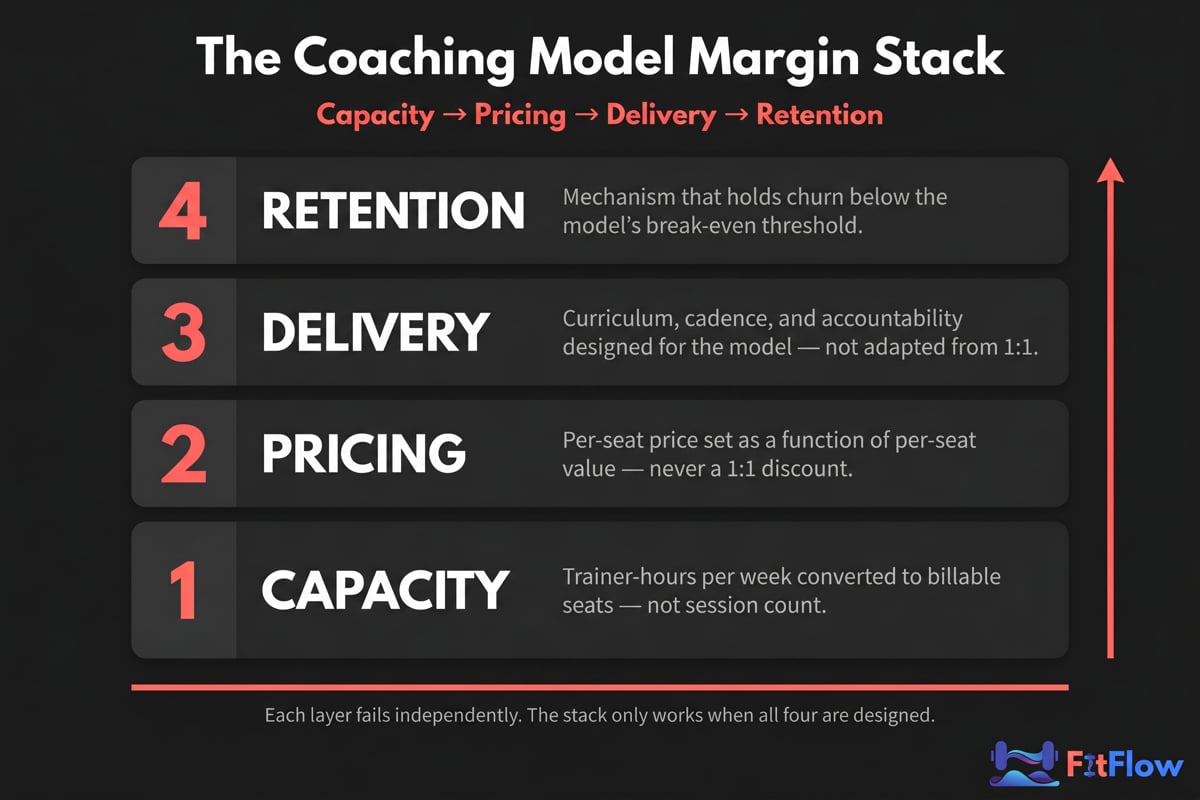
Four layers, in order: Capacity → Pricing → Delivery → Retention. Order matters. Pricing without capacity is a forecast; delivery without pricing is a craft project; retention without delivery is a leaky bucket.
Layer 1: Capacity
Definition. How many trainer-hours per week your model converts to billable seats. Not session count — billable seat count.
Action steps.
Audit your weekly capacity ceiling. Thirty-two 1:1 sessions per week is the typical hard ceiling for a solo trainer per Trainerize 2026 — also the capacity wall every trainer hits at around 30 clients.
Compute billable seat capacity by model. 1:1 = 1 seat per session-hour. Semi-private (2–4) = 2.5 seats average. Small group (6–12) = 9 seats average.
Map your trainer-hour-to-seat-multiplier per model. For most trainers the binding constraint is at 1:1, not at the program level.
Anti-pattern. Treating capacity as fixed at the trainer-hour level instead of variable at the seat-multiplier level.
Layer 2: Pricing
Definition. Per-seat price set as a function of perceived per-seat value, not as a 1:1 discount. Never priced as "1:1 minus the rebate."
Action steps.
Set group seat price as a standalone product. Bands: $45–$120/seat for small group, $80–$220/seat for semi-private (IHRSA 2026; Two-Brain Gym World 2026).
Apply the Two-Brain semi-private pricing rule: revenue per trainer-hour at median fill must be at least 2x the 1:1 hourly rate (Two-Brain Business Gym World 2026). If the math doesn't clear the floor, raise the price or redesign.
Anchor pricing to outcome value, in the Precision Nutrition Pro Coaching frame — not to session count (Precision Nutrition Pro Coaching).
Anti-pattern. Pricing group as "your 1:1 rate divided by seats, times 1.25." IHRSA 2026 confirms gross margin collapses below 50% under this logic.
Layer 3: Delivery
Definition. The structural design of the session or cohort — curriculum, cadence, programming, accountability. Designed for the model, not adapted from 1:1.
Action steps.
Design a separate curriculum. Precision Nutrition Pro Coaching's curriculum framework is the documented reference; NASM, ACE, and ISSA business modules cover small-group programming as a distinct professional competency.
Build a cohort cadence — typical small-group cohort length is 8–12 weeks, with rolling enrollment or fixed-start. Pick one.
Stack accountability — group check-ins, peer accountability, async messaging. Group retention depends on social bonds more than programming quality (Glofox 2025; Mindbody/ClassPass 2026).
Anti-pattern. "Everyone does their own 1:1 program in the same room at the same time." Kills programming leverage and retention (no cohort identity, no peer bonds, no shared finish line).
Layer 4: Retention
Definition. The mechanism that holds churn below your model's break-even threshold. Group churn runs higher than 1:1; design has to be stronger.
Action steps.
Set target churn by model. 1:1: floor 4%/mo, median 6%/mo, ceiling 8%/mo (Trainerize 2026; Two-Brain Business). Group: floor 8%/mo, median 11%/mo, ceiling 14%/mo (Glofox 2025; Mindbody/ClassPass 2026).
Build cohort-end transitions. The end of a small-group cohort is the #1 churn moment. Every cohort needs a documented re-enrollment, upgrade-to-semi-private, or hybrid-stack-up path.
Track retention by cohort, not individual. Cohort metrics surface design failures earlier.
Anti-pattern. Applying 1:1 retention tactics (one-on-one check-ins) to group. The personal-attention mechanism is structurally absent in group — it needs its own retention design: cohort identity, peer accountability, defined transitions.
The framework above is the stack. The calculator runs the math for your specific numbers. Run the stack on your numbers.
How Sam, Amanda, and Grace build the mix differently
Same framework. Different implementation.
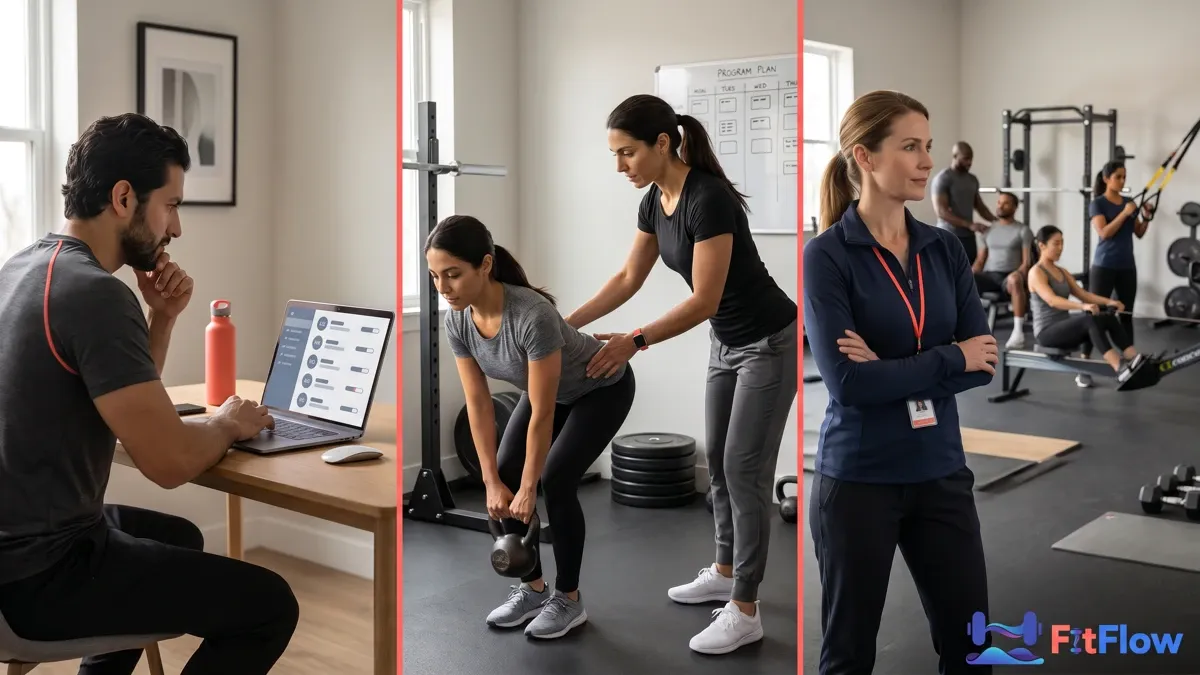
Sam: 30 clients, 32 sessions/week, $5K–$8K/month
Sam is at the ceiling. His 30 clients fill ~32 1:1 sessions a week; at $75 a session that's $2,400/wk, ~$9,600/mo at full capacity — the top of the Trainerize 2026 solo income band. His real-world months land in the $5K–$8K range once gaps, no-shows, and unbilled time eat the calendar. He needs ~12 capacity-equivalent seats/wk to clear $12K/mo. Impossible at 1:1, achievable at semi-private.
The move. Add a semi-private tier (2–4 seats/session, 4 sessions/wk) at $120/seat. Replace 4 of his 32 weekly 1:1 sessions.
Revenue/trainer-hr: 28 1:1 × $75 = $2,100/wk; 4 SP × $120 × 2.5 = $1,200/wk. Total $3,300/wk, ~$13,200/mo.
Gross margin: 1:1 GM 46% × $2,100 = $966; SP GM 65% × $1,200 = $780. Weekly GM $1,746 versus $1,104 pure 1:1 — a 58% lift without adding a trainer-hour.
Break-even: floor 8 / median 10 / ceiling 16 weekly SP seats.
Churn-adjusted 12-mo LTV: SP churn ~8%/mo versus 6% for 1:1; per-hour lift absorbs the delta.
Target: $12K–$13K/mo by month three (floor $11K, median $12.5K, ceiling $14K).
Amanda: 4 clients, 200 followers, sub-$3K/month
Amanda is the opposite of Sam. 4 clients × $250/mo avg = $1,000/mo gross. Capacity-rich, seat-poor. Group at her stage isn't a leverage play — it's a customer-acquisition play.
The move. Small-group challenge (6–8 seats, 8-week cohort) at $179/seat = $1,432–$1,910/cohort. Each participant becomes a referral source for the next.
Revenue/trainer-hr: 4 1:1 × $75 = $300/wk; 2 group × $179 × 6 / 8 wks = $268/wk effective. Total $568/wk, ~$2,270/mo.
Gross margin: 1:1 GM 46% × $300 = $138; group GM 71% × $268 = $190. Weekly GM $328 versus $138 pure 1:1 — a 138% increase.
Break-even seats/cohort: floor 4 / median 6 / ceiling 8.
Churn-adjusted 12-mo LTV: lower per-client LTV (8-wk commitment versus ongoing 1:1), but ~30% of grads convert to ongoing 1:1 (Precision Nutrition Pro Coaching; IDEA Health 2026 Trends Report — structural estimate; conversion floor 12% / median 22% / ceiling 38%). The cohort doubles as a $179 paid trial.
Target: 1 full 8-seat cohort/quarter = $1,432 incremental quarterly revenue, with 2–3 cohort-to-1:1 conversions/cohort (floor 1, median 2, ceiling 3).
Grace: 3+ trainers, $8K/month ad spend
Grace runs three trainers on ~$8K/mo 1:1 books, for $24K/mo gym gross. ARM at $283/mo per Two-Brain is below the $350+ semi-private target — she's leaving ~$5K–$8K/mo on the table.
The move. Build a semi-private tier across all three trainers (4 dedicated SP hrs/trainer/wk, 2.5 avg seats at $120/seat). Keep 1:1 as the premium tier.
Revenue/trainer-hr (per trainer): 24 1:1 × $75 = $1,800/wk; 4 SP × $120 × 2.5 = $1,200/wk. Per trainer: $3,000/wk, ~$12K/mo. Gym: $36K/mo versus $24K pure 1:1 — a 50% lift with the same staffing.
Gross margin (per trainer): 1:1 GM 46% × $1,800 = $828; SP GM 65% × $1,200 = $780. Per-trainer weekly GM $1,608. Across three: $4,824/wk gym GM versus $2,484 pure 1:1 — a 94% increase.
Break-even (per trainer): floor 8 / median 10 / ceiling 16 SP seats/wk. Across three: 24–48/wk total.
Churn-adjusted 12-mo LTV: SP members churn ~8%/mo versus 6% for 1:1; ARM at $120 × 2.5 = $300/member-month — comparable to 1:1 with much higher per-trainer-hour revenue.
Target: 50% gym-wide gross revenue increase within 90 days (floor 30%, median 50%, ceiling 75%+, per the Two-Brain Bolt Fitness $900k semi-private case study).
FTC note (16 CFR Part 255). If SP members post testimonials while receiving material benefit (referral discounts, complimentary upgrades), the gym is responsible for FTC endorsement disclosure (FTC.gov). Results may vary — endorsement disclosure should accompany any testimonial that implies typical results. IRS note. Prepaid 8-week or 12-week cohort enrollments create multi-month prepayment liabilities. On an accrual basis, revenue is recognized ratably over the delivery period as deferred revenue, not at point of sale (IRS.gov; consult a CPA for entity-specific treatment).
The benchmarks: what good actually looks like
Every benchmark below is Tier-1 sourced and framed floor / median / ceiling. Results may vary by market, model maturity, and operator. The underlying unit, margin per active hour, is defined in the difference between filling hours and earning margin, which is where this post borrows it from.
Revenue per trainer-hour and gross margin
Model | Revenue per Trainer-Hour (floor / median / ceiling) | Gross Margin % (floor / median / ceiling) |
|---|---|---|
1:1 | $45 / $75 / $150 | 38% / 46% / 52% |
Semi-Private (2–4 seats) | $80 / $140 / $260 | 55% / 65% / 73% |
Small Group (6–12 seats) | $135 / $220 / $380 | 62% / 71% / 78% |
Sources: Trainerize 2026; Two-Brain Business Gym World 2026; IHRSA 2026; BLS 2026 OES; Financial Models Lab 2026; Glofox 2025; Mindbody/ClassPass 2026.
Churn and 12-month LTV
1:1: churn floor 4% / median 6% / ceiling 8% per month (Trainerize 2026; Two-Brain Business). LTV: $1,800 / $3,600 / $7,200.
Semi-private: churn 5% / 8% / 10% (Two-Brain Business; IHRSA 2026). LTV: $1,400 / $2,800 / $5,200.
Small group: churn 8% / 11% / 14% (Glofox 2025; Mindbody/ClassPass 2026). LTV: $700 / $1,500 / $2,800.
Two-Brain ARM (Gym World 2026)
1:1 PT: $283/mo median. Group (6+ seats): $158/mo. Semi-private (2–4 seats): $350+/mo — the highest of all service lines.
Cohort-to-ongoing conversion
Floor 12% / median 22% / ceiling 38% from group trial or 8–12 week cohort to ongoing 1:1 or recurring semi-private (Precision Nutrition Pro Coaching; IDEA Health 2026 Trends Report; structural estimate based on Trainerize 2026 graduate-survey aggregates).
Hybrid adoption
~50% of surveyed trainers operate hybrid per Trainerize 2026 — but margin variance within that cohort is wider than across pure-1:1 trainers (Trainerize 2026; corroborated by Two-Brain Gym World 2026). Hybrid is not a guaranteed margin win. It is a guaranteed variance amplifier.
The 3 anti-patterns (and why they backfire)
Anti-pattern 1: Group as a discount
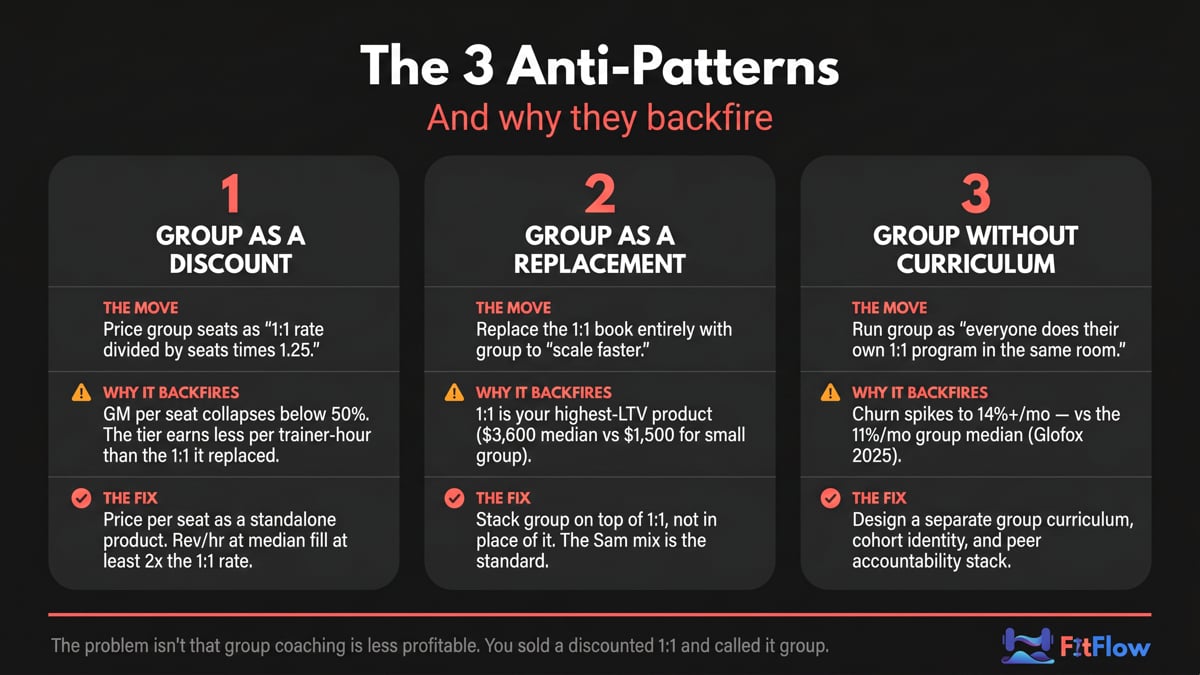
The move. Pricing group seats as your 1:1 rate ÷ seats × 1.25. At $75/hr and 4 seats: $24/seat.
Why it backfires. This bakes a structural discount into gross margin and signals to clients that group is a downgrade. IHRSA 2026 confirms gross margin per seat collapses below 50% under this logic — the tier produces less revenue per trainer-hour than the 1:1 it replaced.
The fix. Price group as a standalone product ($45–$120/seat small group, $80–$220/seat semi-private). The Two-Brain semi-private pricing rule (revenue/trainer-hour ≥ 2x the 1:1 hourly rate at median fill) is the floor.
Anti-pattern 2: Group as a replacement
The move. Replacing your 1:1 book entirely with group coaching to grow faster.
Why it backfires. 1:1 is your highest-LTV product — median $3,600/client over 12 months versus $1,500 for small group (Trainerize 2026; Glofox 2025). Replacing 1:1 with group lowers per-client LTV and concentrates churn risk in a higher-churn model (group median 11%/mo versus 1:1 median 6%/mo). The problem isn't that group can't carry your business. It's that it can't carry your business alone.
The fix. Stack group on top of 1:1, not in place of it. The Sam walkthrough above is the standard pattern. For the full architecture, see where group, 1:1, and async meet in a single coaching offer. This post is the binary decision; that one is the stacked operating system you build once the decision is made.
Anti-pattern 3: Group without curriculum
The move. Running group as "everyone does their own 1:1 program in the same room at the same time" — no shared curriculum, no cohort identity, no peer accountability.
Why it backfires. This kills both things that make group structurally profitable: programming leverage (one curriculum serves all seats) and retention leverage (social bonds drive cohort retention). Churn typically spikes to 14%+/mo within three months versus the 11%/mo group median (Glofox 2025).
The fix. Design a separate curriculum. Build cohort identity (named cohorts, shared start dates, group channels). Stack peer accountability. The mechanism is the design, not the room.
The 30-day implementation rollout
Four weeks. One objective and a short action checklist per week. Lift this section directly into the calculator workbook.
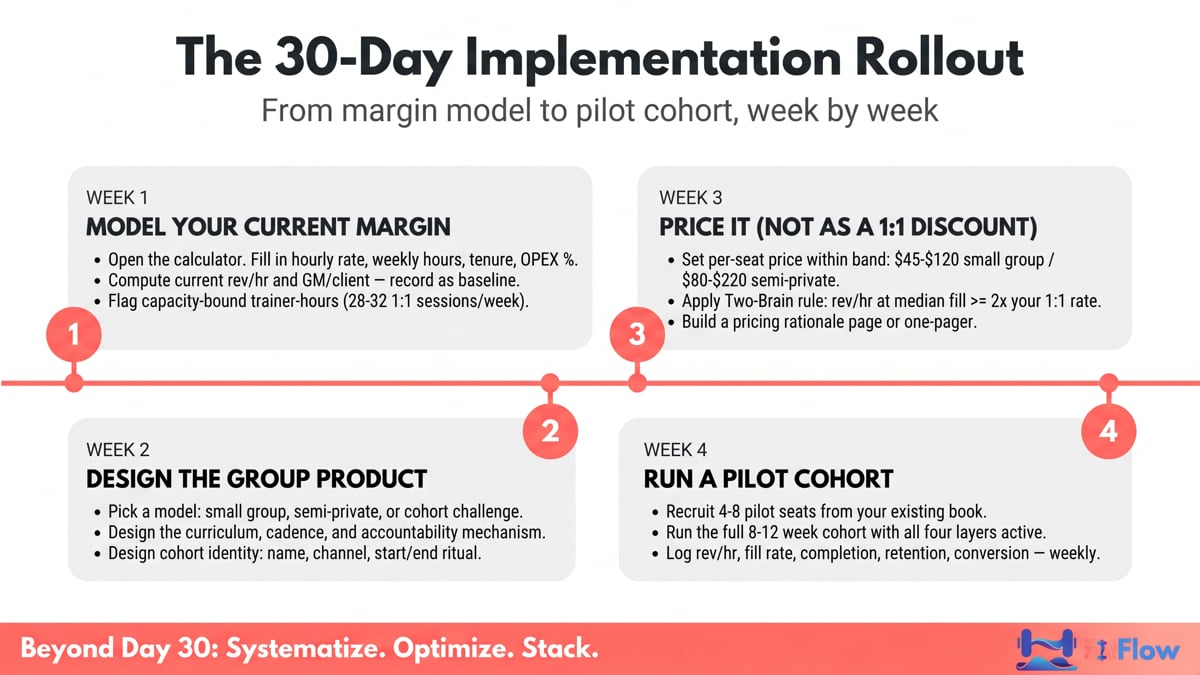
Week 1: Model your current margin
Objective. Quantify current revenue per trainer-hour, gross margin per seat, and 12-month LTV per client across your existing 1:1 book.
Open the Coaching Model Margin Calculator. Fill in hourly rate, weekly billable hours, average client tenure, and operating cost percentage.
Compute current revenue per trainer-hour and gross margin per client. Record both as baseline.
Identify your capacity-bound trainer-hours — weeks at 28–32 1:1 sessions with the calendar full. These are the hours where group leverage matters most.
Week 2: Design the group product
Objective. Design the group offering as a standalone product, not a 1:1 derivative.
Pick a model: small group (6–12 seats, recurring), semi-private (2–4 seats, recurring), or cohort challenge (6–8 seats, 8–12 weeks, defined start/end).
Write the curriculum — week-by-week programming, accountability mechanisms, success metrics.
Design cohort identity — name, communication channel, start/end rituals.
Week 3: Price it (not as a 1:1 discount)
Objective. Set per-seat pricing as a function of per-seat value.
Place the price inside the band ($45–$120/seat small group, $80–$220/seat semi-private). Position by local market and value-add.
Apply the Two-Brain semi-private pricing rule. Revenue per trainer-hour at median fill must be ≥ 2x your 1:1 hourly rate.
Build a one-page pricing rationale. Frame it as priced for the group outcome stack, not as "less than 1:1 because shared trainer time."
Week 4: Run a pilot cohort
Objective. Launch one cohort with 4–8 seats. Run the full margin loop end-to-end.
Recruit 4–8 pilot seats from your existing book. Offer a $50 pilot discount only if needed.
Run the full 8–12 week cohort with the curriculum, channel, and accountability you designed in Week 2.
Track weekly — revenue per trainer-hour, fill rate, completion rate, retention to next cohort, and conversion to ongoing 1:1.
Beyond 30 days. Systematize a recurring cohort schedule. Review fill rate, retention, and gross margin monthly; adjust if any metric falls below floor. Once one model is dialed in, add the next.
Key takeaways
Group coaching isn't more profitable than 1:1 in the abstract. It's more profitable than the under-priced, capacity-capped 1:1 most trainers are running (Trainerize 2026; Two-Brain Gym World 2026).
Three unit-economic levers: revenue/trainer-hour, gross margin/seat, retention-adjusted 12-mo LTV. Median per-hour, group beats 1:1 by 190%. Median per-client, 1:1 beats group by 2.4x.
The Coaching Model Margin Stack — Capacity → Pricing → Delivery → Retention — is the architecture. The most common failures: pricing group as a 1:1 discount; running it as 1:1-with-extra-bodies; applying 1:1 retention tactics to a cohort.
Per-persona: Sam (30 clients, 32 sessions/wk) adds 4 SP hours at $120/seat for a 58% GM lift. Amanda (4 clients, 200 followers, sub-$3K/mo) runs 8-wk cohorts at $179/seat. Grace (3+ trainers, $8K/mo ad spend) layers SP across staff for a 50% gym-gross lift.
Compliance: FTC endorsement disclosure required for material-benefit testimonials (16 CFR Part 255; FTC.gov). Multi-month prepaid cohort enrollments create deferred revenue liability on accrual basis (IRS.gov; consult a CPA).
Group is leverage. But only on top of a 1:1 model whose unit economics already work.
You've got the four-layer stack. The calculator turns it into a decision you can defend with numbers. Get the calculator + the kit.