
The Hidden Cost of Admin Work: Every Non-Billable Hour Is Costing You More Than You Think

The Admin Tax Nobody Calculates
Trainers who crossed $5K/month are working more hours, not fewer. The extra hours are not training clients. They are answering messages, chasing invoices, rebuilding schedules after cancellations, reformatting workout spreadsheets, and following up on no-shows.
At a $75/hour billing rate, 10 hours of admin per week is $3,000 per month in lost revenue capacity. That is more than many trainers pay in rent. And yet almost nobody tracks it. The typical full-time trainer works 40-50 hours per week but bills only 25-35 of those hours (BusinessDojo, PT Distinction). The gap is admin. According to ISSA, trainers spend 5-10 hours weekly on administrative tasks alone, and that figure climbs to 15 hours for trainers managing 30 or more clients.
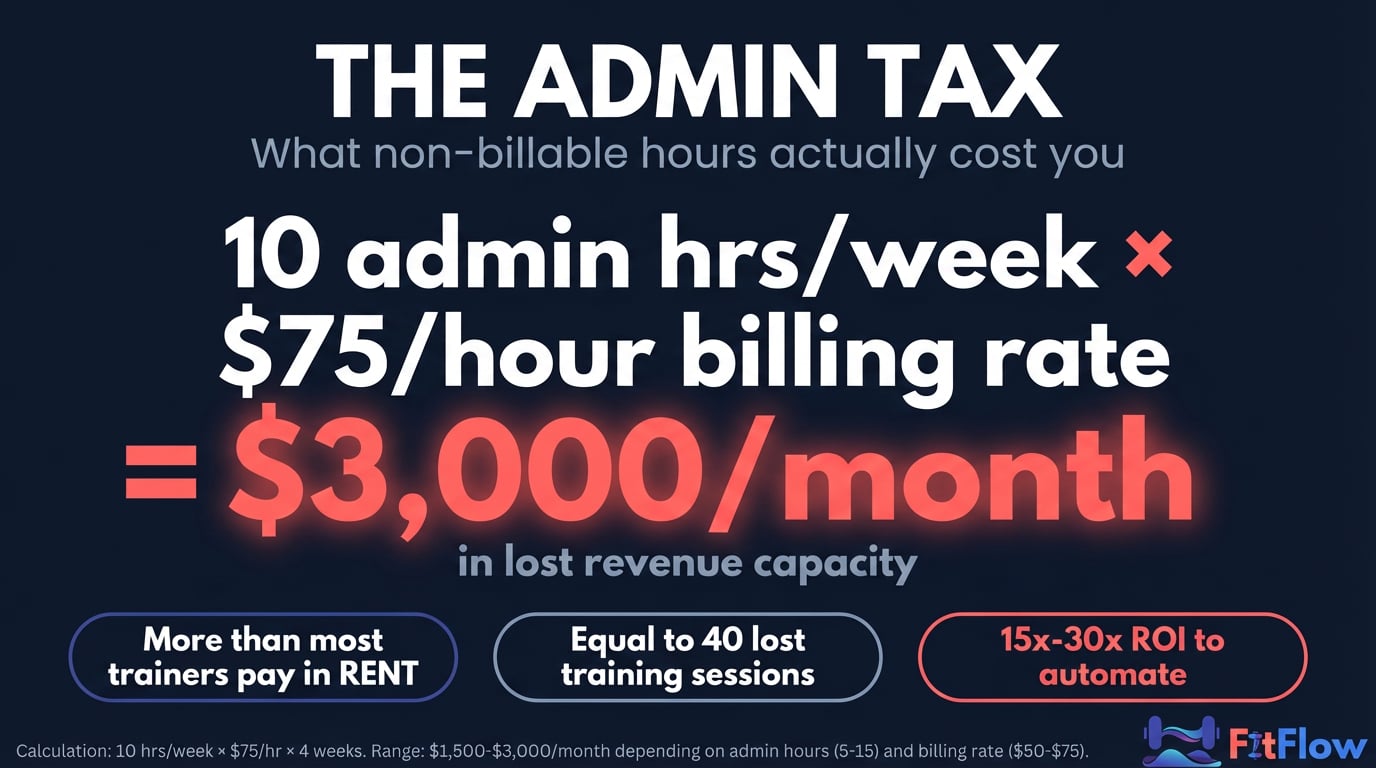
This is not about getting organized or waking up earlier. It is not about batching your tasks or color-coding your calendar. It is about a specific dollar amount you are losing every month, and you have probably never calculated it.
This post is a financial diagnosis. It breaks down where the money goes across five categories, gives you a decision framework for what to automate, delegate, or keep, and walks you through a 30-day audit to calculate your exact number. Not a time-management tips article. Not a software recommendation. The math.
If you have not yet crossed $5K/month, start with the structural diagnosis first. This post is about what happens after you cross it: the admin overhead that prevents $5K from becoming $8K.
The 80% trainer attrition statistic gets blamed on burnout. The data tells a different story. Business operations failure is a top-three reason trainers quit within two years (ISSA, FitBudd, Striive). The admin overhead is not a discipline problem. It is an architecture problem.
Trainers Lose an Estimated $1,500-$3,000/Month to Admin Overhead. Industry data shows personal trainers spend 5-15 hours per week on scheduling, billing, and communication. This free audit spreadsheet calculates your specific cost based on your rate and hours. Individual results vary. Calculate Your Number.
Want to see your exact admin cost? Download the free Admin Time Audit Spreadsheet and run your numbers this week.
Where Trainer Time Actually Goes: The Real Data
Before the explanation, here is what the numbers look like for a trainer earning $6,000 per month with 30 active clients.
Activity | Hours/Week | % of Total | Revenue Generated |
|---|---|---|---|
Client training sessions | 25-30 | 55-65% | $6,000/month (all revenue) |
Scheduling and rescheduling | 3-5 | 7-11% | $0 |
Billing, invoicing, payment follow-up | 2-3 | 4-7% | $0 |
Program design and workout updates | 2-4 | 4-9% | $0 (indirect value) |
Client communication (texts, DMs, emails, check-ins) | 3-5 | 7-11% | $0 |
Marketing content creation | 2-3 | 4-7% | $0 (indirect value) |
Total | 37-50 | 100% | $6,000/month |
Non-billable admin total | 12-20 | 26-45% | $0 direct |
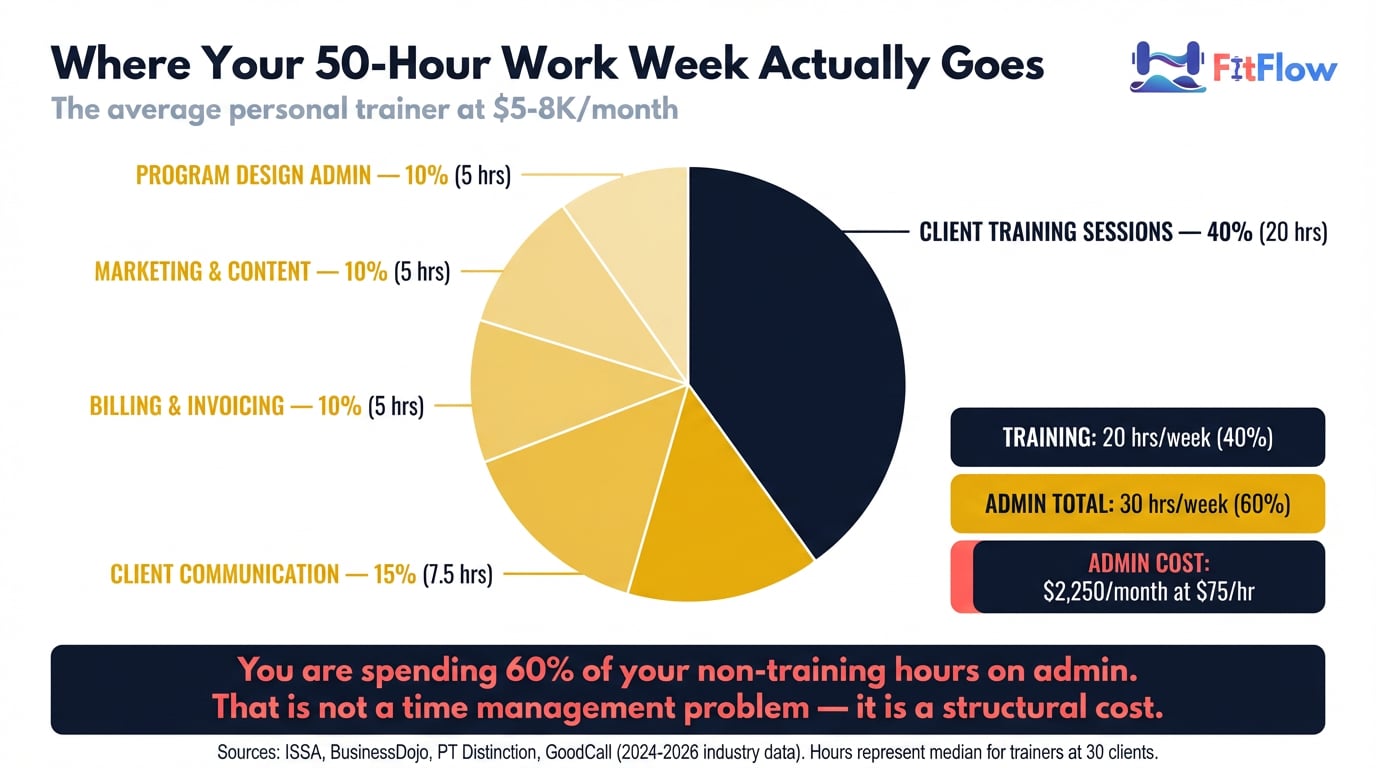
A trainer billing $50 per session, running 30 sessions per week across four weeks, generates $6,000 per month. That same trainer works 45 hours per week total. The effective hourly rate is not $50. It is $6,000 divided by 180 total monthly hours: $33 per hour.
The $17 gap between the billed rate and the effective rate is the admin tax.
Industry data confirms this consistently. Full-time trainers work 40-50 hours weekly but only 25-35 are billable (BusinessDojo). ISSA confirms 5-10 hours per week on admin as a baseline. Experienced trainers billing at $75 per hour report effective rates of $30-$50 after overhead (Happy Human Fitness).
The trainers who break through the $5-8K plateau are not working harder. They identified the gap, measured it, and closed it.
The 5 Hidden Admin Costs That Compound With Every New Client
These are not signs of disorganization. They are predictable, measurable costs that every trainer accumulates, and they grow non-linearly with client count. A trainer with 30 clients does not spend twice the admin time of a trainer with 15 clients. The math is closer to 2.5-3x, because scheduling complexity, communication threads, and billing events scale faster than the number of clients.
1. Scheduling and Rescheduling Overhead
The math: 3-5 hours per week for a trainer managing 15-30 clients. At $75 per hour, that is $225-$375 per week, or $900-$1,500 per month in lost revenue capacity.
Fifteen clients with regular weekly sessions make for a simple calendar. Thirty clients introduce overlapping availability windows, back-and-forth text negotiations, time-zone confusion for online clients, and recurring reschedule requests that cascade through the rest of the week. Every new client adds friction not just for their own sessions but for every existing client whose schedule might conflict.
Layered on top is the no-show problem. Industry data suggests a baseline no-show rate of 20-30% for trainers without automated systems. Each no-show creates a 60-minute revenue gap plus 15 minutes of follow-up admin. Research from Imperial College London found that automated SMS reminders reduce no-shows by approximately 38% (via Koalendar). Credit-based booking drops the rate to under 10% within 60 days.
2. Billing and Invoicing Friction
The math: 2-3 hours per week on invoice creation, payment follow-up, package tracking, and failed payment recovery. At $75 per hour, that is $150-$225 per week, or $600-$900 per month.
Session-based billing is the compounding mechanism. Every client purchase, every package renewal, every expired-package follow-up is a separate billing event. More clients means more billing events per week. Recurring billing with auto-charge eliminates this category almost entirely.
There is also a hidden cost that does not appear in any time audit: the emotional labor of asking clients for money. The trainer shifts from coach to collections agent, even if only for two minutes. Automated billing removes the trainer from the transaction entirely, preserving the coaching relationship.
3. Program Design Admin
The math: 2-4 hours per week creating, customizing, and updating workout programs from scratch. At $75 per hour, that is $150-$300 per week, or $600-$1,200 per month.
The critical distinction: program design — assessing needs, selecting exercises, structuring progression — is high-value work requiring the trainer's expertise. Program admin — copying exercises into a new template, reformatting a spreadsheet, emailing a PDF, re-entering the same warm-up for the tenth time — is repetitive low-value work.
Fifteen clients might share 3-4 program templates with customizations. Thirty clients need 8-12 variations. Without a template system, every new client requires creation from scratch. For a streamlined approach to program delivery that cuts admin time, start with template systems.
The Trainerize 2026 State of the Industry Report found that AI-assisted program tools show early results of a "75% reduction in workout build time." Template libraries reduce program admin from 4 hours per week to under 1 hour. The trainer's expertise stays in the design decisions. The copy-paste work disappears.
4. Client Communication Sprawl
The math: 3-5 hours per week across WhatsApp, text messages, email, Instagram DMs, and in-app messages. At $75 per hour, that is $225-$375 per week, or $900-$1,500 per month.
This is the "Frankenstein business" problem. PT Distinction named it in its 2026 systems guide: trainers running their business across WhatsApp, email, Venmo, Calendly, and a notes app. Each platform has its own notification pattern, conversation history, and search function. Context-switching between them is the overhead that no single tool metric captures.
As PT Distinction put it: "You didn't become a personal trainer to spend your days staring at spreadsheets, chasing down payments, or manually emailing welcome packets."
Every new client adds communication in at least 2-3 channels. At 30 clients, that is 60-90 active conversation threads across multiple platforms. The solution is platform consolidation. Automated client tracking that replaces manual check-ins eliminates the largest share of communication overhead.
5. Marketing Content Creation Time
The math: 2-3 hours per week on social media posts, email newsletters, lead magnets, and content planning. At $75 per hour, that is $150-$225 per week, or $600-$900 per month.
Same distinction as program design: marketing strategy is high-value. Marketing production — filming, editing, captioning, scheduling, uploading — is admin.
Content creation time does not scale with client count directly. But the pressure to create content increases as trainers try to grow. The irony: trainers spend admin time creating content to attract new clients when the admin load from existing clients is the bottleneck preventing them from serving more.
The Trainerize 2026 report found that 67% of trainers rank AI and automation tools as the top industry trend. Content production is one of the most AI-automatable admin categories — scheduling tools, caption generators, and template libraries can reduce production time significantly while maintaining quality.
The combined cost: at $75 per hour and 12-20 admin hours per week, the estimated overhead is $3,600-$6,000 per month. Even at a conservative $50 per hour and 10 admin hours, the estimated annual admin tax exceeds $24,000.
The Admin ROI Framework: What to Automate, What to Delegate, What to Keep
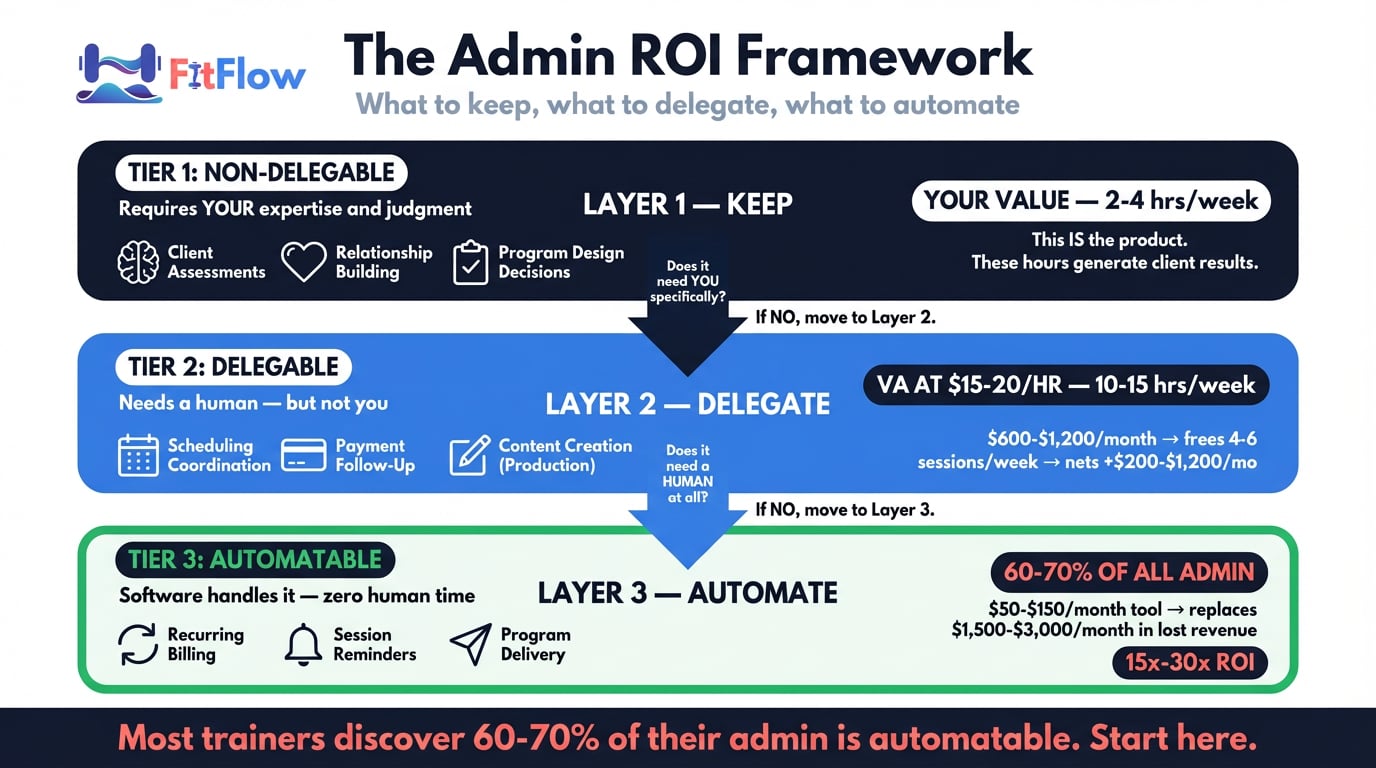
Not all admin is equal. Some tasks require your expertise and should stay with you. Some can be handled by a $15 per hour virtual assistant. Some can be eliminated entirely by a $50 per month tool. The framework below tells you which is which.
Tier 1: Non-Delegable (Keep These)
Some tasks categorized as "admin" are actually service delivery. Initial client assessments, program design decisions, motivational coaching, complex communication about injury modifications or goal resets — these require your specific expertise and the personal relationship your client is paying for.
This category typically accounts for 2-4 hours per week. It looks like admin because it happens outside sessions. It is not. It is the product. The trainer's expertise is what distinguishes a $75 per hour session from a $15 per month app subscription.
These hours are not costs to eliminate. They are service delivery that happens off the gym floor. Protecting them from the noise of low-value admin is exactly why the next two tiers matter.
Tier 2: Delegable (Hand These Off)
Delegable tasks require a human but not the trainer's expertise. Scheduling coordination, payment follow-up, onboarding paperwork, progress data entry, email inbox triage, social media posting (execution, not strategy) — any competent assistant can handle these after a one-page briefing.
The decision threshold: when admin consistently exceeds 15 hours per week and costs more than an estimated $1,200 per month in lost billable time, hiring a part-time virtual assistant becomes ROI-positive.
Line Item | Estimate |
|---|---|
VA cost | $15-$20/hr x 10-15 hrs/week = $600-$1,200/month |
Time recovered | 10-15 hrs/week = 4-6 additional training sessions |
Revenue from recovered sessions | $200-$600/week = $800-$2,400/month |
Net monthly ROI | Estimated +$200-$1,200/month + reduced burnout |
Fitness Taxes estimates that a $900-$1,200 monthly VA cost can free up enough time for 4-6 additional weekly sessions, potentially recovering an estimated $30,000-$35,000 annually in revenue capacity. Start small: five to ten hours per week on scheduling and email. Expand only after the first month confirms the ROI.
Tier 3: Automatable (Eliminate These)
Automatable tasks follow predictable rules and require zero human intervention once configured. These should be eliminated before you consider hiring anyone.
Here is the automation priority list, ordered by estimated ROI:
Recurring billing. Auto-charge clients monthly. Eliminates payment chasing entirely. Estimated time saved: 2-3 hours per week. This is almost always the highest-ROI first move.
Session reminders. Automated SMS sent 24 hours and 2 hours before each session. Reduces no-shows by an estimated 38% based on published research (Koalendar, Imperial College London). The ROI is measured in recovered sessions, not just recovered time.
Self-service scheduling. Clients book themselves within your availability rules. Scheduling admin drops to near zero for routine bookings. Complex rescheduling still needs a human, but routine booking does not.
Onboarding sequences. Automated welcome email, intake form, and waiver delivery triggered by new client signup. Estimated savings: 30-45 minutes per new client.
Program template delivery. Pre-built workout templates assigned and customized per client in minutes instead of hours. Estimated savings: 1-3 hours per week.
Tool cost for comprehensive personal training software covering all five categories: $30-$150 per month. A $100 per month tool replacing an estimated $1,500-$3,000 per month in lost revenue capacity represents an estimated 15x-30x return on investment, based on industry averages. Individual results vary depending on client volume, billing rate, and implementation.
The Trainerize 2026 State of the Industry Report confirms the adoption curve: 64% of trainers now use AI regularly, 49% specifically for admin and automated communications, and over 70% report improved efficiency. My PT Hub's 2026 analysis found their Check-Ins AI feature can reduce coaching admin by up to an estimated 80%.
Now that you know what admin is costing you, here is how to build the operational systems that eliminate it.
The Decision Matrix
Admin Task | Hrs/Week | $/Month Lost | Automate? | Delegate? | Keep? | Priority |
|---|---|---|---|---|---|---|
Recurring billing | 2-3 | $600-$900 | YES | No | No | 1 (highest ROI) |
Session reminders / no-show follow-up | 1-2 | $300-$600 | YES | No | No | 2 |
Scheduling / rescheduling | 3-5 | $900-$1,500 | YES (self-service) | Partial | No | 3 |
Onboarding sequences | 0.5-1 | $150-$300 | YES | No | No | 4 |
Program template delivery | 2-4 | $600-$1,200 | YES (templates) | No | Design only | 5 |
Client check-in messages | 2-3 | $600-$900 | Partial (prompts) | YES | Personalized only | 6 |
Payment follow-up / collections | 1-2 | $300-$600 | YES (auto-retry) | YES (escalation) | No | 7 |
Social media posting | 2-3 | $600-$900 | Partial (scheduling) | YES | Strategy only | 8 |
Email inbox triage | 1-2 | $300-$600 | Partial (filters) | YES | Complex only | 9 |
Client relationship conversations | 2-4 | N/A (high value) | No | No | YES | Keep |
Stop Estimating. Start Measuring. You have seen the industry data on admin overhead. Now run your own numbers. This 7-day spreadsheet calculates your specific admin cost per category, ranks your delegation priorities, and estimates the annual revenue you could recover. Based on your inputs. Download the Audit Spreadsheet.
See your exact numbers. The Admin Time Audit Spreadsheet calculates your cost per category, generates an automation priority list, and shows your effective hourly rate before and after automation. Free, instant download.
The 30-Day Admin Audit: Exact Steps to Reclaim Your Time
The framework above is generic. Your numbers are specific. Here is how to calculate them.
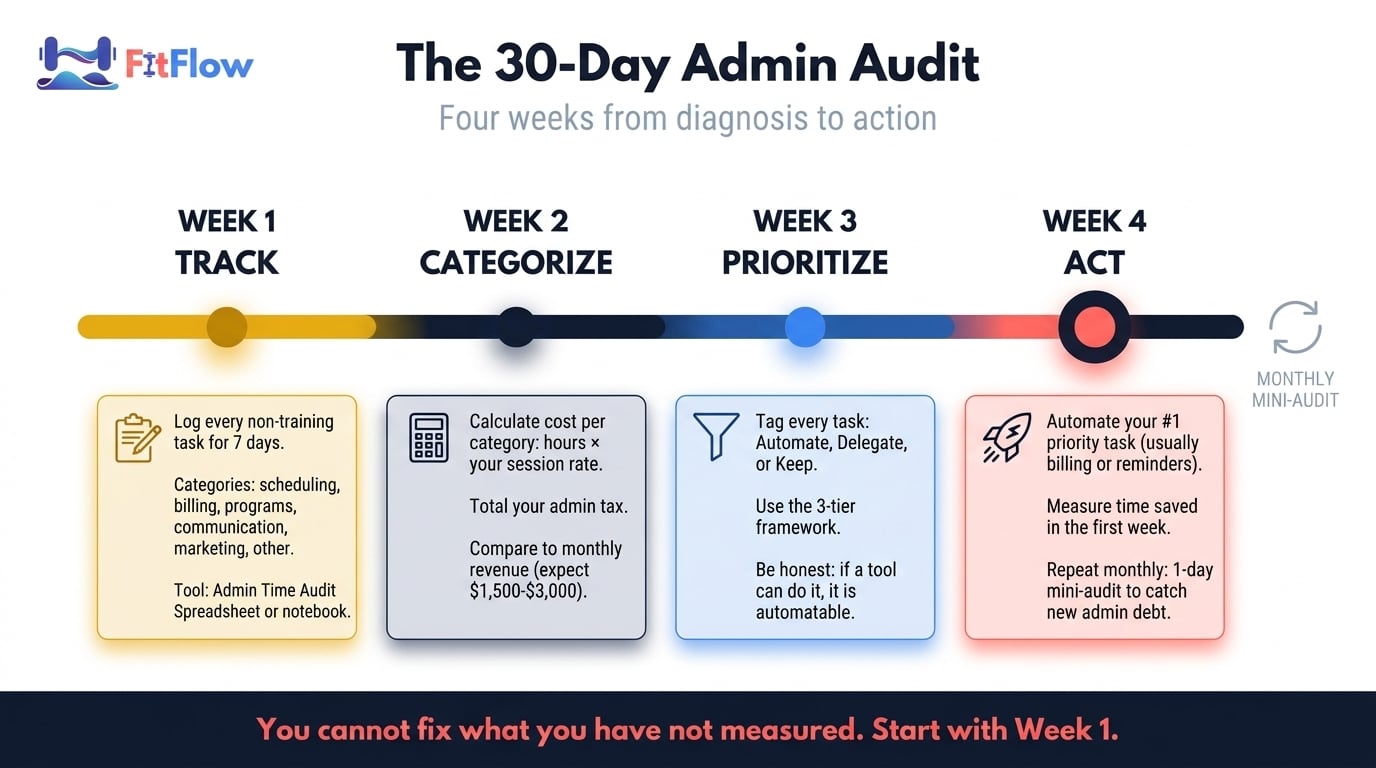
Week 1: Track everything. For seven days, log every task that is not directly training a client. Use the Admin Time Audit Spreadsheet or a notebook. Record start and end time; tag each task: scheduling, billing, program updates, client communication, marketing, or other. Do not estimate. Time it.
Week 2: Calculate your cost. Multiply each category's weekly hours by your session rate. Total it. Compare to your monthly revenue. For most trainers earning $5-8K per month, the admin tax falls between an estimated $1,500 and $3,000 per month, based on industry averages.
Week 3: Classify each task. Using the three-tier framework, tag every task. If software can do it, it is automatable. If a human who is not you can do it, it is delegable. If it requires your expertise, it stays.
Week 4: Automate your highest-priority task. Pick the number-one item from the Automatable tier. For most trainers: recurring billing or session reminders. Set it up. Measure the time difference in the first week after launch.
Ongoing: Repeat monthly. Your admin mix changes as client count grows. A one-day mini-audit monthly catches new admin debt before it compounds.
A word-for-word delegation script for your first VA task:
"Hi [VA name], I need help with scheduling coordination. Here is how it works: when a client messages to book or reschedule, check my availability in [calendar tool], confirm the slot, send the confirmation message using this template [attach template], and update the calendar. If there is a conflict, flag it for me. Start with these 10 clients [list]. I will check your work daily for the first week, then weekly after that."
For trainers who have already eliminated admin drag and are ready for the next stage, here is the scaling playbook for growing beyond 50 clients.
Key Takeaways
Personal trainers spend an estimated 5-15 hours per week on non-billable admin — scheduling, billing, communication, program updates, and marketing content. At $50-$75 per hour, that is an estimated $1,500-$3,000 per month in lost revenue capacity.
Admin costs compound non-linearly. A trainer with 30 clients does not spend twice the admin time of a trainer with 15 clients — the math is closer to 2.5-3x because scheduling complexity, communication threads, and billing events grow faster than client count.
The 3-tier framework classifies every admin task as non-delegable (keep), delegable (VA at $15-$20/hr), or automatable (software at $30-$150/month). Most trainers discover that an estimated 60-70% of their admin is automatable.
Automate first, delegate second. A $100 per month tool replacing an estimated $1,500-$3,000 per month in lost revenue capacity represents an estimated 15x-30x ROI. Start with recurring billing and session reminders.
Run a 30-day admin audit to quantify your specific cost. You cannot fix what you have not measured.
For the full picture of building a sustainable personal training business, see our comprehensive guide to building a thriving PT business.
Individual results vary based on client volume, business model, and implementation. Figures cited are based on industry averages and published survey data.
Turn This Article Into Your Personal Admin Diagnosis. You now understand the 5 hidden admin costs and the 3-layer delegation model. This free spreadsheet turns the framework into a 7-day audit you can run on your own business this week. Includes auto-calculated priority scores and estimated annual recovery. Get the Audit Spreadsheet.
The admin tax is real. Your numbers are specific. Download the Admin Time Audit Spreadsheet to calculate exactly what admin is costing you — and which tasks to automate first. Free.
Ready to automate? Explore tools built for personal trainers.
Frequently Asked Questions
Comments