The Future of Hybrid Coaching: How In-Person, Online, and AI-Assisted Models Are Merging Into the Default Operating System for Personal Training
The debate is over. 48% of personal trainers now run hybrid as their primary delivery model, according to the Trainerize 2026 State of the Personal Training Industry Report. Another 32% are online-only. Only 14% remain strictly in-person. Trainers still asking "should I go online or stay in-person?" are working from a 2022 mental model. The market already answered. It's both, by design.
Here's the problem most trainers actually face. They've accumulated hybrid. They added a coaching app, then a WhatsApp thread, then a Google Sheet, then ChatGPT, and now their clients show up wearing WHOOP and Oura devices. The result feels like duct tape. It works, but the seams are visible, the pricing hasn't caught up, and the trainer spends evenings reconciling data across four tools.
That's hybrid coaching by accumulation. There is another version: hybrid coaching by design. In-person sessions, async messaging, AI-assisted programming, wearable data, outcome dashboards, pricing tiers, and the trainer's own judgment, all composed into one deliberate architecture. The American College of Sports Medicine's 2026 Worldwide Fitness Trends report describes AI as becoming "the backbone of programming, member communication, scheduling, personalization and staffing." That isn't a tool list. It's an infrastructure description. Hybrid coaching, done right, is an operating system, and like any OS the components only work because they were built to work together.
What follows is that architecture. Seven components, every one required, with named failure modes, minimum viable versions at 10, 30, and 50 clients, and a self-diagnostic question per layer. If you're running hybrid coaching by accumulation right now (and most scaling trainers already are, just accidentally), this post is the architectural review your business didn't know it needed.
For the studio owner reading this: the same architecture applies at the business level. Your facility is the in-person anchor for multiple trainers' hybrid models simultaneously. The hybrid coaching shift is not a threat to your floor. It is a threat to any trainer whose business model ends at your floor.
Score Your Hybrid Coaching Practice Across All 7 Components in 10 Minutes.
Before diving in: rate your practice against the 7-component hybrid coaching OS. Get a 21-point readiness score, identify your weakest dimension, and receive a personalized 90-day priority recommendation. Free, vendor-independent, data-anchored against Trainerize 2026 and Les Mills 2026. Get the Free Scorecard.
Why hybrid coaching is now the default, not the alternative
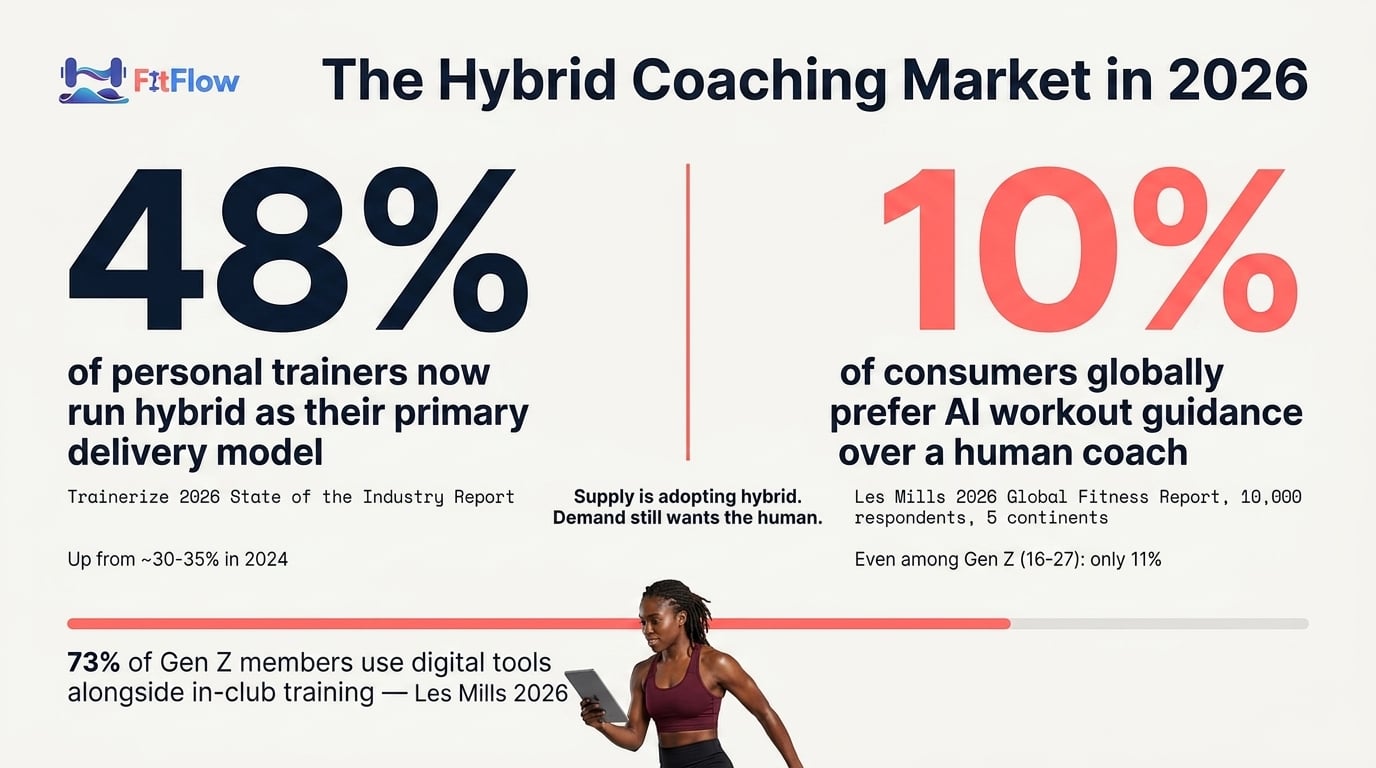
The Trainerize 2026 split is the cleanest single picture of the market today: 48% hybrid, 32% online-only, 14% in-person-only. Adoption of hybrid as the primary model is up from roughly 30-35% in 2024.
The institutional bodies have caught up. ACSM 2026 lists Wearable Technology as the #1 fitness trend of the year and explicitly frames AI as infrastructure. The Les Mills 2026 Global Fitness Report, surveying more than 10,000 respondents across five continents, found that 73% of Gen Z members use digital tools alongside in-club training. Three in four younger members say they would consider leaving a facility without a strong digital ecosystem. The generational handoff isn't coming. It already happened.
Then there's the competitive ground floor. In April 2026, Hotworx launched TrainingTRAX, a company-wide selfie-to-avatar AI coach now deployed across roughly 1,000 US locations. Independent trainers without their own hybrid architecture are bringing a per-session price sheet to a fight about week-long client experience. The question is no longer whether to design for hybrid. It's how.
Four myths that keep trainers from getting hybrid right
Myth 1: "Hybrid coaching is just online coaching with extra steps." (FALSE)
Online coaching adds digital delivery to an in-person foundation. Additive. Hybrid coaching is structurally different. It rebuilds what each layer is responsible for. The in-person session is no longer the primary delivery mechanism for programming; it's the relationship-and-assessment layer of a seven-component system. The async cadence carries more client touchpoints per week than the in-person layer ever did. The AI programming layer absorbs the routine 20% of session-design work. Wearable data flows in continuously. Hybrid is a different architecture, and the in-person session has a different job inside it.
Myth 2: "AI will collapse hybrid coaching back into pure-AI coaching by 2028." (FALSE)
The data points the other direction. Les Mills 2026 found that only 10% of consumers globally prefer AI workout guidance over a human coach. Even among Gen Z, only 11% prefer AI-generated fitness content. In February 2026, Apple scaled back its standalone AI health coach plans and moved AI features into its existing Health ecosystem instead. A $3.5T company concluding that a standalone AI coach isn't a defensible product. The integration architecture is. The market is trending toward AI-augmented human coaching, not AI replacement.
Myth 3: "You need to pick a lane: in-person OR online." (FALSE)
The Trainerize 2026 data is unambiguous: 48% hybrid, 32% online-only, 14% in-person-only. The "pick a lane" position is now a structural minority among practicing trainers. The market made the choice. Both, composed deliberately.
Myth 4: "Hybrid is just a transition phase between in-person and online." (FALSE)
The transition framing assumes a linear progression: in-person → hybrid → online-only. The data contradicts it. Hybrid adoption hasn't declined as online coaching matured. It has increased. ACSM 2026 calls AI the backbone of "programming, member communication, scheduling, personalization and staffing." That's infrastructure language, not transition language. Hybrid isn't a stepping stone. It's the destination.
Cleared. Here's what hybrid coaching actually is.
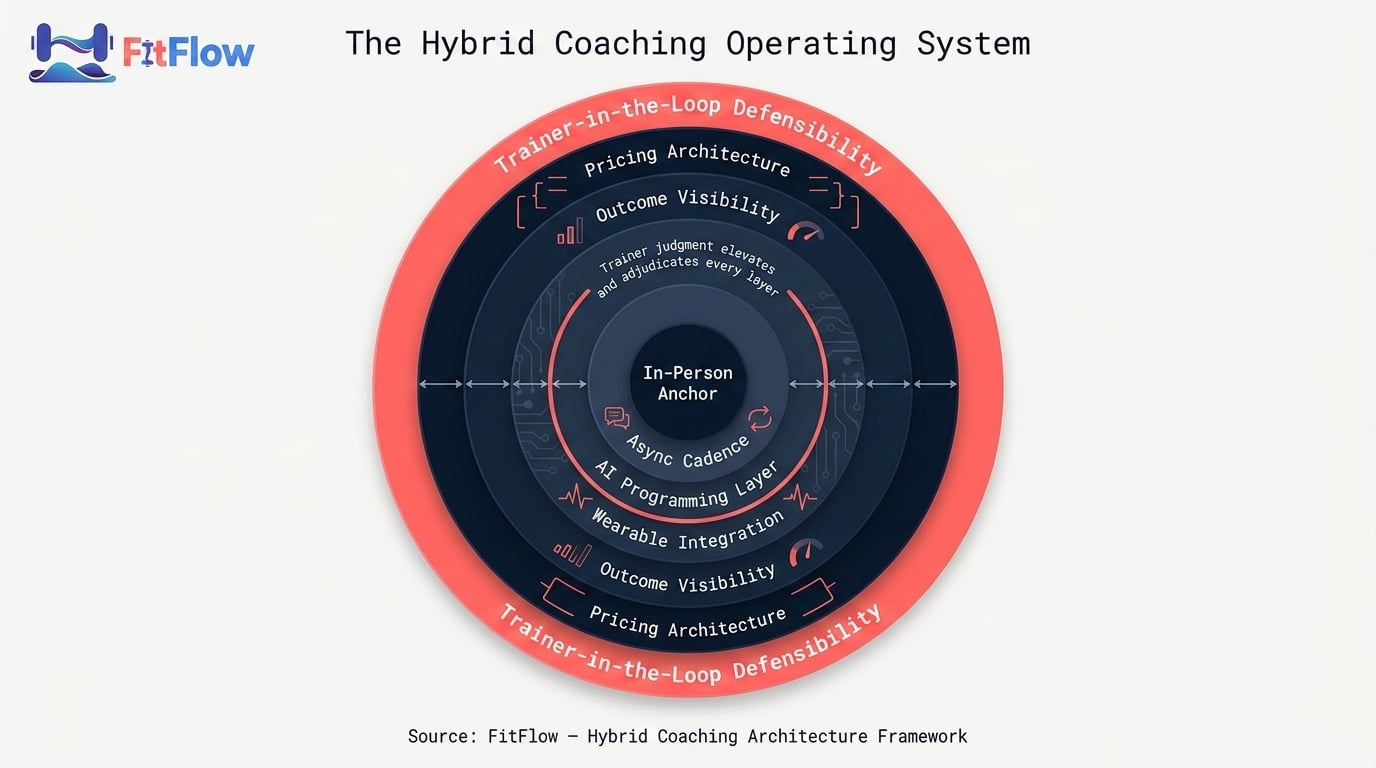
The hybrid coaching operating system: 7 components that must all function together
Featured definition: A hybrid coaching model is a personal training architecture that combines in-person anchor sessions, async messaging cadence, AI-assisted programming, wearable-informed adjustments, outcome dashboards, intelligent pricing tiers, and trainer-in-the-loop defensibility into a single coordinated operating system. The trainer is present (by design, not by hustle) across all 167 hours of a client's week, not just the 1-5 spent in session.
Each component below follows the same structure: a one-sentence definition, the data that makes it non-removable, the failure mode when missing, a trainer-facing diagnostic question, and a minimum viable version at 10, 30, and 50 clients. None of these components stands alone.
Component 1: the in-person anchor session
Definition: The scheduled, physical interaction where the trainer establishes movement baselines, builds relational trust, and gathers the observational data that cannot be captured remotely or algorithmically.
Why it cannot be removed: Movement assessment requires physical observation. Video check-ins and AI motion analysis can't replicate the trainer's real-time judgment on compensation patterns, load-selection errors, and pain response. Les Mills 2026 found that 52% of consumers either "strongly prefer" (31%) or "lean toward" (21%) a human trainer. The demand for in-person touch hasn't vanished. It's being supplemented.
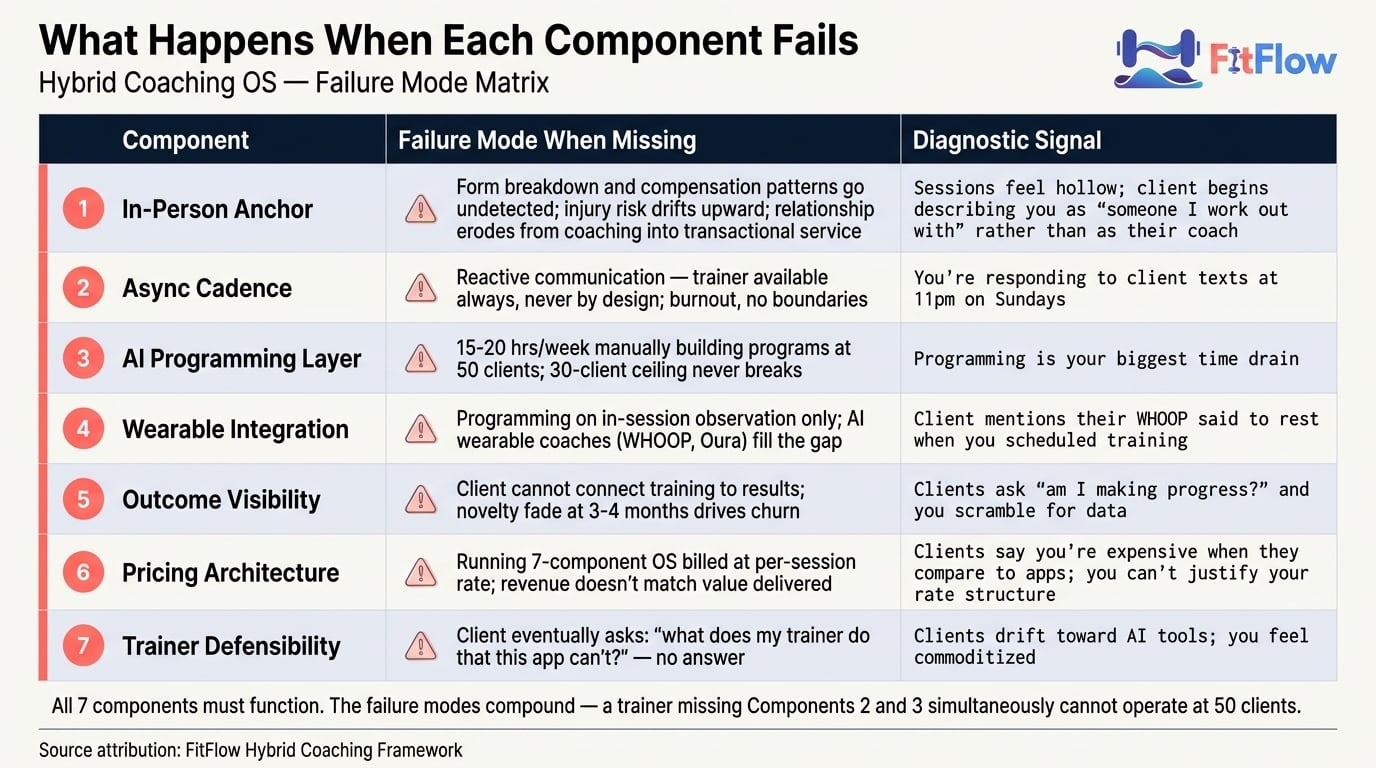
Failure mode: A trainer running fully async or online without periodic in-person anchors finds that form breakdown goes undetected, injury risk drifts upward, and the relationship erodes from coaching into transactional service. Eventually the client can't articulate what they're paying for, and they churn. It's the same failure mode generic consumer fitness apps face at scale (see why standalone fitness apps fail clients for the diagnostic).
Trainer-facing diagnostic question:
Does every client have a minimum viable in-person session frequency defined — not by your schedule, but by their baseline, goals, and stage of training?
Minimum viable version:
At 10 clients: 2-4 in-person sessions per client per week. The anchor IS the model at this scale.
At 30 clients: 1 in-person anchor every 2-4 weeks, supplemented by async and AI layers. The anchor becomes diagnostic and relational.
At 50 clients: 1 anchor per month for some clients, quarterly for advanced clients. The anchor is now a calibration event.
Studio owner note: For the studio owner, the facility is the in-person anchor infrastructure for every trainer who operates from it. The strategic question is not whether to offer in-person — it is whether to position the facility as the anchor layer for trainers' hybrid OS models, or as a standalone offering that competes on floor space alone.
Component 2: the async messaging cadence
Definition: The structured, non-real-time communication system through which the trainer maintains coaching presence, accountability, and behavioral influence between in-person sessions.
Why it cannot be removed: ACSM 2026 names "member communication" as one of the explicit operational layers AI is becoming the backbone of. The institution recognizes async communication as a distinct, designed function. Trainerize 2026 reports that nearly four in ten trainers have observed a shift in client expectations toward comprehensive support beyond workouts. A client who only hears from their trainer during sessions has 1-5 hours of coaching presence per week. A client with a structured async cadence has coaching presence across 30-50+ additional touchpoints, without consuming additional in-person time.
Failure mode: Without a designed cadence, the trainer becomes reactive: responding when the client texts, never triggering communication at planned intervals. Reactive async is the WhatsApp problem. Technically available at all times, no boundary, no system, no leverage. See the full fragmentation cost analysis for what fragmented async tools actually cost, and how the 30-client wall breaks through architecture for the operations playbook.
Trainer-facing diagnostic question:
Does your async communication run on a defined cadence — scheduled check-ins, automated touchpoints, triggered responses — or does it run on client-initiated contact?
Minimum viable version:
At 10 clients: Manual async is sustainable. Weekly check-in via WhatsApp or voice note is fine.
At 30 clients: Semi-automated cadence required. Platform-based check-in sequences save 4-6 hours per week. This is where most trainers hit the wall.
At 50 clients: Full cadence automation essential. See the automation implementation layer for the framework.
Component 3: the AI-assisted programming layer
Definition: The deliberate use of AI tools to generate, draft, and iterate training programs for the routine 20% of programming decisions where volume, variety, and personalization at scale exceed human bandwidth, while preserving trainer judgment for the 80% that requires contextual expertise.
Why it cannot be removed: This is the component with the strongest recent evidence. The Journal of Sports Science and Medicine, Vol. 25 (Feb 2026) published a peer-reviewed study in which ChatGPT outperformed personal trainers in answering 9 common exercise training questions when graded by PhD experts on comprehensibility, actionability, and scientific correctness. At the level of standard exercise Q&A, program-structure generation, and conventional periodization, AI is competent. Trainerize 2026 reports that 64% of trainers are actively using or exploring AI tools and that AI workflows can eliminate up to 80% of coaching admin tasks. ACSM 2026 calls AI "the backbone of programming." Not the whole program. The backbone the trainer's judgment runs on top of. For the broader landscape view of where this layer sits in the full stack, see the complete guide to fitness technology for professionals and the tech stack guide for personal trainers in 2026.
The 80/20 split:
AI handles: program structure generation, exercise substitution libraries, nutrition framework drafting, session scheduling, progress report drafting, standardized client Q&A.
Trainer handles: load selection from real-time observation, movement correction, contextual override ("she's stressed, we deload"), relationship-based adjustments, safety-and-liability decisions, goal recalibration.
The JSSM 2026 finding isn't evidence that AI replaces trainers. It's evidence that AI is competent at the type of work that shouldn't be consuming the trainer's specialized time in the first place.
Failure mode: A trainer with no AI layer manually builds every program from scratch. At 50 clients, that's 15-20 hours per week of programming alone, the ceiling that pins most trainers between 20 and 30 clients. The opposite failure: a trainer who uses AI without a review protocol generates programming that is technically safe but undifferentiated. Trust erodes. See the full AI adoption framework for trainers for the implementation guide that prevents both failure modes.
Trainer-facing diagnostic question:
Have you explicitly decided which programming decisions AI generates for you and which decisions you make — or are you using AI ad hoc when you feel overwhelmed?
Minimum viable version:
At 10 clients: Optional. Use AI for variety, exercise substitution, and reference lookups.
At 30 clients: Essential. Use AI to draft initial programs; trainer reviews and personalizes. Saves 6-8 hours per week.
At 50 clients: Non-negotiable. AI generates the framework; the trainer makes context-specific adjustments. Without this layer, 50 clients with quality outcomes is not operationally possible.
Scored Yourself on Component 3? Get the Full 7-Dimension Score in the Free Scorecard.
You just answered the AI-Assisted Programming diagnostic. There are 6 more components in the OS — async cadence, wearable integration, outcome visibility, pricing architecture, in-person anchor, and trainer defensibility. The scorecard rates all 7 in 10 minutes and gives you a single readiness score. Score All 7 Components.
Component 4: wearable-informed adjustment
Definition: The systematic use of client biometric data — HRV, resting heart rate, sleep quality, recovery scores — to make evidence-based modifications to programming intensity, volume, and scheduling that the trainer could not make based on in-session observation alone.
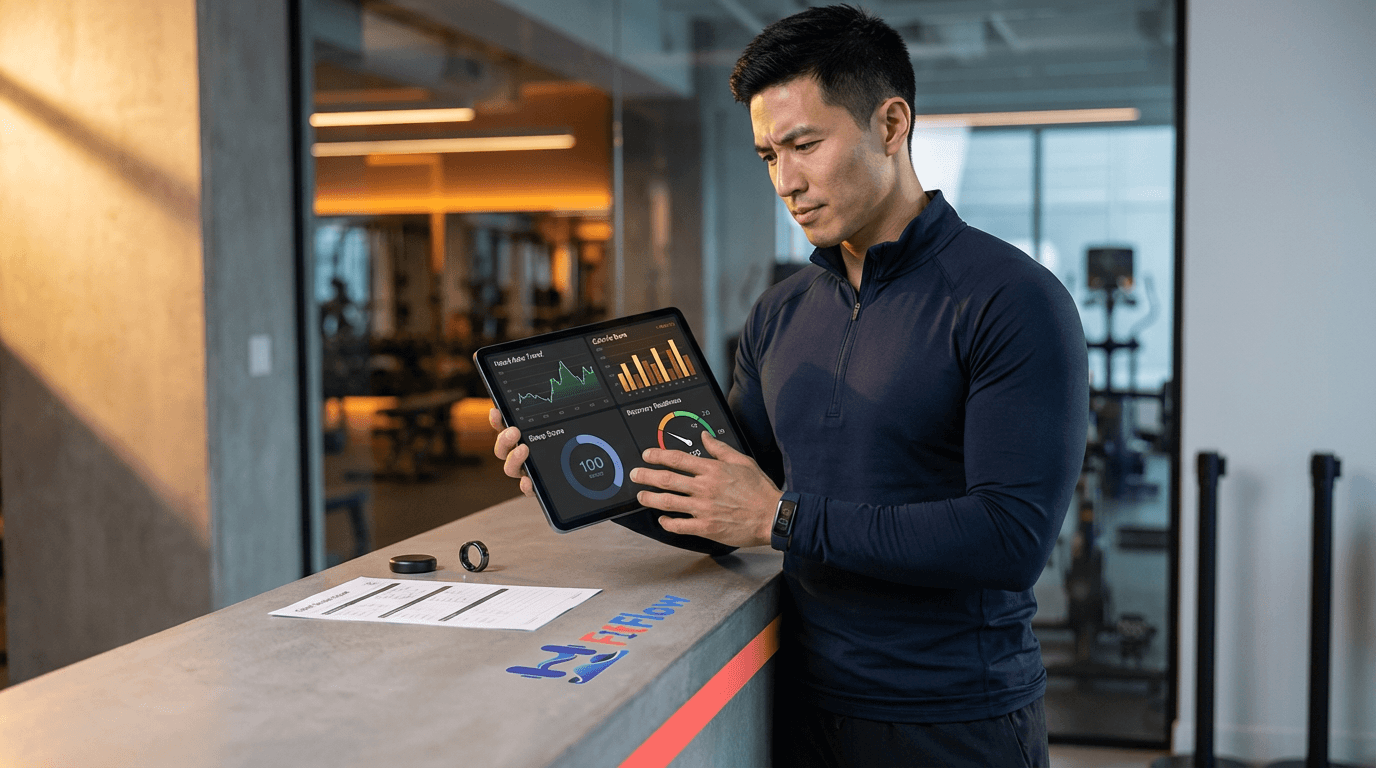
Why it cannot be removed: ACSM 2026 ranks Wearable Technology as the #1 fitness trend of 2026. Institutional confirmation that wearables are infrastructure. MyPTHub 2026 reports that almost 50% of clients now wear some form of fitness tracking device. The harder reality: AI-powered wearable coaches are now in the hands of your clients. WHOOP Coach, GPT-4 powered and 24/7 available, translates each user's biometric data, goals, and journal entries into specific personalized training and recovery plans. When a client's wearable is recommending one thing and their trainer is recommending another, the trainer with no protocol for resolving that conflict loses by default. Not all wearable data is equally useful (see the full concordance analysis for which signals across Oura Gen 4, WHOOP, and Garmin are reliable enough to drive programming decisions).
Failure mode: A trainer with no wearable integration is programming based on in-session observation alone, missing roughly 163 hours of biometric signal between sessions. The wearable AI coach fills the vacuum. Over time, the client starts following the wearable, not the trainer. A subtler failure: tracking only steps while ignoring HRV and sleep filters out the high-signal data and integrates the low-signal data.
Trainer-facing diagnostic question:
Do you have a protocol for reviewing client wearable data before programming — not after? And do you know which wearable metrics to trust versus which to discard?
Minimum viable version:
At 10 clients: Optional but recommended. Manual HRV and sleep review via weekly check-in form.
At 30 clients: Structured weekly protocol — green/yellow/red HRV threshold, with auto-adjustment templates per tier.
At 50 clients: Automated flag integration. Your platform pulls wearable data and surfaces red-flag clients for trainer review weekly.
Component 5: outcome visibility
Definition: The systematic display of client progress data — body composition, strength metrics, habit adherence, energy scores — in a format the client can see, interpret, and feel ownership over between sessions.
Why it cannot be removed: Les Mills 2026 found that 3 in 4 younger members would consider leaving a facility without a strong digital ecosystem. The "ecosystem" they describe is one in which clients can see and interact with their data continuously. Trainerize 2026 frames the broader market shift as a move from time-bound delivery (more sessions) to outcome-bound delivery (more support across the week), and outcome-bound delivery requires visible outcomes as the proof mechanism. Without visible progress, the client's perceived value of coaching is bounded by what they consciously experience during sessions. The other 162-167 hours of work become invisible. And unmonetized. For the 5 metrics that consistently move clients from passive viewing to active ownership, see the client progress dashboard framework.
Failure mode: No visibility means the client can't connect their training to their results. Churn risk spikes at the 3-4 month mark, when novelty fades. A misconfigured visibility layer is almost as bad: tracking force-plate output without context creates noise rather than signal, and the client tunes out the dashboard altogether.
Trainer-facing diagnostic question:
Does every client have a progress dashboard they check independently — not because you asked them to, but because the data is visible, relevant, and motivating?
Minimum viable version:
At 10 clients: Manual monthly check-in report shared as a PDF or screenshot.
At 30 clients: In-app progress tracking with weekly auto-generated summary.
At 50 clients: Automated client-facing dashboard with anomaly flags routed back to the trainer when something falls outside expected range.
Component 6: pricing architecture
Definition: The deliberate design of service tiers, package structures, and price levels that reflect the multi-component value of hybrid coaching — not legacy per-session pricing inherited from an in-person-only model.
Why it cannot be removed: Athletech News reports that the industry's most data-driven players are now reserving human coaching for the premium tier and using AI to occupy lower price points. Future charges $199/month for human-coach-led coaching, with the AI engine at a lower tier. Caliber follows the same pattern. This is the market actively demonstrating that the human-led hybrid model commands a premium, and that the AI-only product belongs at a structurally lower price. A trainer running a full 7-component OS but charging per-session pricing is, in plain terms, underselling six of seven components.
The pricing principle:
In-person-only model → price per session (scarcity-based).
Online-only model → price per month (access-based).
Hybrid OS model → price per outcome period (value-based). The client pays for the coaching relationship, the AI layer, the wearable protocol, the outcome visibility, and the trainer's judgment. Not just the hours the trainer is physically present.
For the full diagnostic on why most trainers' revenue problems are pricing problems rather than acquisition problems, see the full pricing model framework.
Failure mode: A trainer who runs a hybrid OS but charges per-session bills for one component while delivering seven. The mirror failure: charging hybrid premium pricing without delivering all seven components. Overcharging without infrastructure. The client churns at the 90-day mark.
Trainer-facing diagnostic question:
Does your pricing reflect the value of all 7 components of your hybrid OS, or are you still pricing as if your clients are only paying for the hours you are physically present?
Minimum viable version:
At 10 clients: Test by transitioning 2 clients to a hybrid monthly retainer above your current session rate.
At 30 clients: All new clients onboarded at hybrid retainer pricing. Existing clients migrated on renewal cycle.
At 50 clients: Tiered pricing — multiple tiers reflect different async cadence frequencies, AI personalization depths, and in-person anchor frequencies.
Component 7: trainer-in-the-loop defensibility
Definition: The explicit architectural decision to preserve the trainer's judgment at every decision point where AI, wearables, or async systems cannot provide context-aware, relationship-informed, liability-qualified guidance.
Why it cannot be removed: Les Mills 2026 found that only 10% of consumers globally prefer AI workout guidance over a human coach. The other 90% are specifically paying for the judgment layer AI can't provide. ISSA 2026 reports that 64% of certified trainers believe AI will increase, not decrease, the value of their certification, precisely because AI commoditizes the routine 20% and elevates the scarcity of the contextual 80%. The competitive context is sharper still. Hotworx TrainingTRAX has now placed an AI coach in roughly 1,000 US locations. The independent trainer's defensibility is no longer "I have an AI in my coaching." It's "I have judgment the AI can't replicate, and I've designed my service so my clients see exactly where that judgment lives." Apple's February 2026 decision to scale back its standalone AI health coach is the same call on a different scale: a stand-alone AI isn't defensible. AI as a layer beneath human judgment is.
What it looks like in practice:
Identify the specific decisions in your coaching model that (a) require contextual knowledge of the individual client, (b) carry liability if made wrong, and (c) require real-time observation or relationship trust.
These are your defensible core: load selection, movement override, deload-under-stress decisions, behavioral coaching, medical-referral threshold judgments, goal recalibration.
Build the rest of the OS so AI handles everything else, and so the client clearly understands which decisions are yours.
Failure mode: A trainer who lets AI handle everything loses defensibility. The client eventually asks "what exactly are you doing that this app can't?" and has no answer. The opposite failure is the trainer who refuses AI altogether and retains 100% defensibility but can't scale past 20-30 clients. See the full AI adoption framework for the implementation guide that resolves both.
Trainer-facing diagnostic question:
Have you explicitly mapped the decisions in your coaching model that only you can make — and have you communicated that list to your clients?
Minimum viable version:
At 10 clients: Informal. The relationship establishes implicit trust; defensibility exists by default.
At 30 clients: Explicit. Communicate your "human layer" value during onboarding. Clients should be able to articulate, in their own words, why they need you.
At 50 clients: Structural. Your training agreements explicitly describe your role versus the AI layer's role. Pricing reflects this hierarchy.
Studio owner note: For the studio owner, trainer-in-the-loop defensibility operates at the business level. The studio's defensibility is the quality control, certification standard, and trainer development infrastructure that ensures human judgment is consistently excellent across every trainer who operates from the floor. A studio that deploys AI tools but maintains no trainer-quality standard has commoditized itself faster than Hotworx — because Hotworx at least has scale and brand.
How the 7 components work together (and why each fails in isolation)
A trainer with strong in-person sessions and an AI programming layer but no async cadence has good workout design and weak behavioral adherence. A trainer with async cadence and outcome visibility but no wearable integration has good communication and missing objective data. A trainer with all six technical components but no pricing architecture has built a Ferrari and is renting it for the price of a session at the local rec center.
That's the operating-system frame. The accumulated hybrid model is, almost by definition, a model where some components were added reactively and others were never added at all. The designed hybrid model is one where each component was specified, built, and stress-tested for its interdependencies. For the broader diagnostic on why standalone apps, fragmented tools, and AI-only models fail in the same patterns, see why standalone fitness apps fail clients and the full fragmentation cost analysis.
Building the hybrid OS at your current client count
Component | At 10 Clients (MVV) | At 30 Clients (MVV) | At 50 Clients (MVV) |
|---|---|---|---|
1. In-Person Anchor | 2-4x per week | 1x per 2-4 weeks | Monthly to quarterly |
2. Async Cadence | Manual, weekly | Semi-automated check-in | Fully automated cadence |
3. AI Programming | Optional | Essential (drafting) | Non-negotiable (framework) |
4. Wearable Integration | Optional, manual | Structured weekly protocol | Automated flagging |
5. Outcome Visibility | Manual monthly report | In-app weekly summary | Automated client dashboard |
6. Pricing Architecture | Test 2 clients on retainer | All new clients on retainer | Tiered by service depth |
7. Trainer Defensibility | Implicit | Explicit (onboarding) | Structural (agreements) |
If you're at 30 clients reading this (which is where the data says most scaling trainers are), the two highest-leverage components to build next are async cadence automation (Component 2) and a structured AI programming layer (Component 3). These are where the 30-client wall breaks through architecture rather than through working harder. See how the 30-client wall breaks through architecture for the operations playbook, and reaching 50 clients sustainably for the broader scaling framework.
Building a full 7-component OS doesn't require becoming a technology expert. Each component has a minimum viable version. The goal isn't perfection. It's intentional design, replacing accumulation with architecture, one component at a time, in the order your business actually needs them.
The 167-hour question, and why hybrid is the first model that answers it
A week has 168 hours. A client trains roughly 1 hour with their personal trainer in a typical session, leaving 167 hours of living, eating, sleeping, working, recovering, walking, and not-quite-recovering that the training relationship historically did not reach. Across a heavier 3-5 session week, that figure shrinks to 163-167, but the order of magnitude is the same. The defining limitation of in-person-only coaching isn't that it's expensive or unscalable. It's that it touches 1-5 hours of a roughly 167-hour week.
Here's what each model actually reaches:
In-person-only: 1-5 of 167 hours.
Online-only with async: 5-10 of 167 hours.
Hybrid OS: present in all 167 hours, by component:
In-person anchor: 1-5 hours of direct observation.
Async cadence: continuous through scheduled triggers.
AI programming layer: in every workout the client executes.
Wearable integration: every hour of biometric signal between sessions.
Outcome visibility: a persistent dashboard the client references on their own time.
Pricing architecture: the commercial signal of what the relationship is worth.
Trainer-in-the-loop defensibility: the judgment that elevates and adjudicates all of the above.
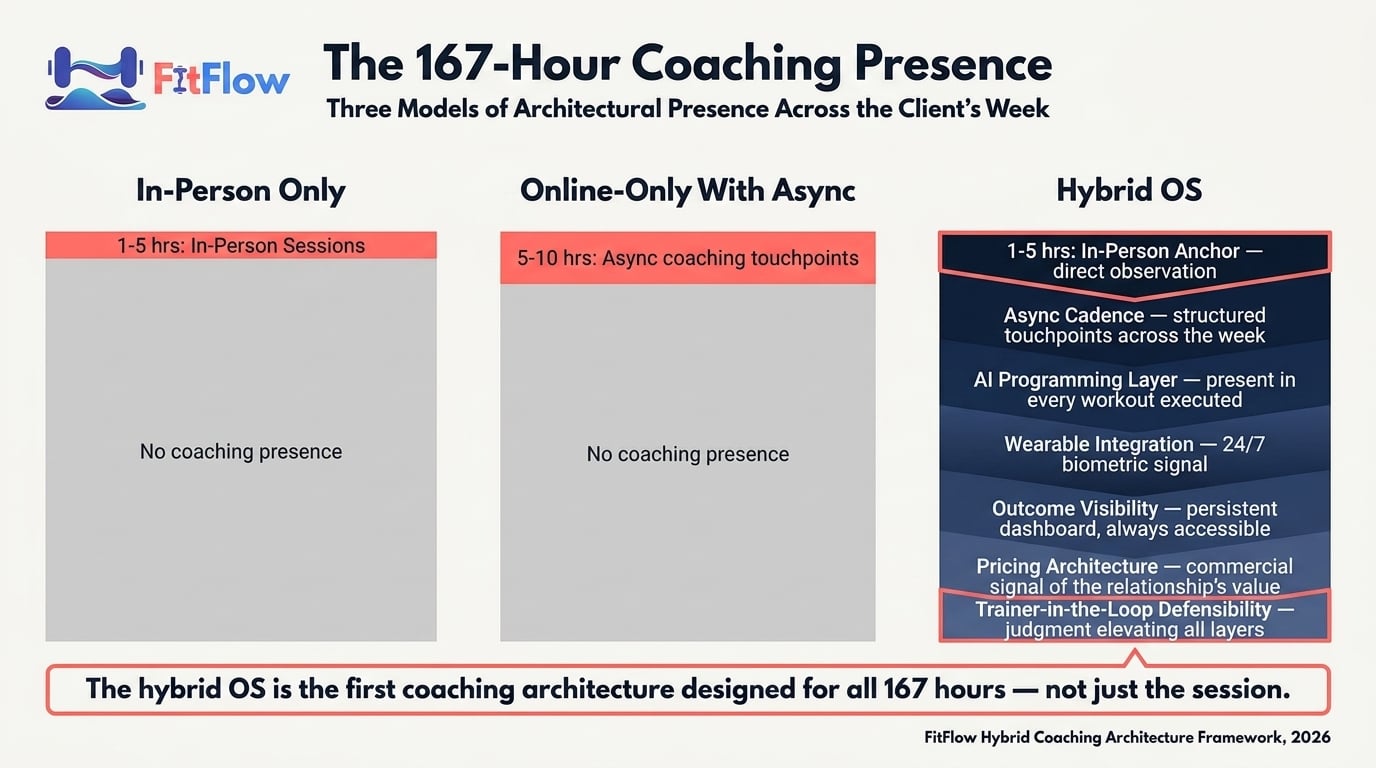
That's the difference the four myths obscure. Hybrid isn't in-person plus extras. It isn't online with a session bolted on. It's the first model whose architecture reaches the entire week, by design rather than by hustle.
The contrarian conclusion: hybrid coaching isn't a compromise between in-person and online. It's strictly better than either pure in-person or pure online coaching alone. Within 24 months, it will be the default expectation for professional personal training. Not the premium tier. Trainers who build this architecture now aren't ahead of the curve; they're on time. The trainers still arguing about which lane to pick will discover, sometime in 2027, that the lane has already been paved over by a multi-component architecture they didn't design and now have to retrofit.
The operating system has been described. The components are defined. The only remaining question is whether you'll design it deliberately, or keep accumulating it reactively until the seams start to fail.
Key takeaways
The market has chosen: 48% hybrid, 32% online-only, 14% in-person-only (Trainerize 2026). The "pick a lane" debate is over.
Hybrid is an architecture, not a delivery channel: 7 interdependent components, where the failure of any one degrades the entire model.
AI is a layer, not a replacement: only 10% of consumers globally prefer AI coaching over human (Les Mills 2026); peer-reviewed JSSM 2026 evidence confirms AI is competent at the routine 20%, not the contextual 80%.
The minimum viable version scales with client count: each component has different MVVs at 10, 30, and 50 clients.
Pricing must reflect all 7 components: per-session pricing on a hybrid OS undersells six of seven components. Future at $199/mo is the market signal.
Defensibility lives in trainer judgment: 64% of certified trainers (ISSA 2026) believe AI increases the value of certification.
The 167-hour throughline: hybrid is the first model present across all 167 hours of a client's week.
Contrarian conclusion: hybrid isn't a compromise. It's strictly better than either pure model, and within 24 months it will be the default, not the premium tier.
The 7-Component OS Is the Architecture. The Scorecard Is the Diagnostic. Get Yours Free.
You now know what the hybrid coaching operating system is. The scorecard tells you where your practice stands across all 7 dimensions, gives you a 21-point readiness score, identifies your weakest component, and outputs a personalized 90-day priority. 10 minutes. Vendor-independent. Free. Download the Scorecard.
Frequently Asked Questions
Comments