
How AI Is Changing Personal Training — And What Trainers Should Actually Do About It

78% of personal trainers now use AI to build custom workout plans (Create.fit, 2025). Only 10% of gym-goers globally prefer AI coaching over a human trainer (Les Mills 2026 Global Fitness Report, 10,442 respondents across 5 continents). That gap tells you everything you need to know about AI for personal trainers.
It tells you trainers are already adopting AI. It tells you clients do not want AI to replace their trainer. And it tells you the strategic question is not "should I use AI?" — that question is already decided for 78% of your profession. The real question is: where does AI belong in your practice, and where does it not?
This is not a tool comparison. It is not a trend overview. It is an honest, evidence-based assessment of what AI can actually do in a personal training practice, what it cannot do, and a concrete framework for making adoption decisions that improve your business without undermining what your clients pay you for. If you are wondering whether AI is coming for your clients — you are asking the right question. Here is what the evidence actually says.
The short version: roughly 20% of a trainer's work is non-judgment administrative and programming-prep work that AI can do as well or better. 80% — the coaching, the behavioral change, the relationship — requires a human. AI does not threaten your value. It can free you to deliver more of it. This article gives you the 20/80 framework and a four-step adoption process — Evaluate, Pilot, Measure, Scale — to implement that split starting this week.
For a complete map of technology reshaping personal training, start with our technology professionals guide. This post focuses specifically on AI: what the research shows, where the opportunity is, and what to do about it.
Before you start: download the AI Readiness Checklist for Personal Trainers. It maps directly to the framework below and gives you a 15-question evaluation scorecard...
The Statistical Paradox: What the AI Adoption Data Actually Shows
The conversation about AI in personal training is louder than it has ever been. ACE named AI the number one fitness trend for 2026, with CEO Cedric X. Bryant stating that "AI is now central to fitness." But volume is not the same as clarity. Here is what the data actually shows when you look past the noise.
The Trainer Adoption Numbers
AI adoption among personal trainers has crossed the majority threshold:
78% of personal trainers use AI for workout programming (Create.fit, 2025)
67% of trainers rank AI as the top expected industry trend (Trainerize 2026 State of Industry Report)
52% use AI at least several times per week (ISSA Human Advantage Survey, Q1 2026, n=90)
70% report that AI has improved their efficiency (ISSA, Q1 2026)
These are not projections. These are usage statistics from the first quarter of 2026. The adoption question — "should trainers use AI?" — has already been answered by the profession.
The Client Preference Numbers
Now look at the demand side:
10% of consumers globally prefer AI coaching over a human trainer (Les Mills 2026, 10,442 respondents)
52% lean human-first
37% are undecided
Even among Gen Z (ages 16-27), only 11% prefer AI coaching — the preference for human trainers is not a generational issue waiting to resolve itself
The 78% adoption and the 10% preference are not contradictions. They are a competitive map.
The Strategic Insight: The 20/80 Rule
The gap between trainer adoption (78%) and consumer preference (10%) reveals exactly where AI belongs. Trainers are adopting AI for backend tasks clients never see or feel — programming structure, admin scheduling, progress report summaries. Clients are rejecting AI as a replacement for the relationship they pay for. These two data points are compatible and exploitable.
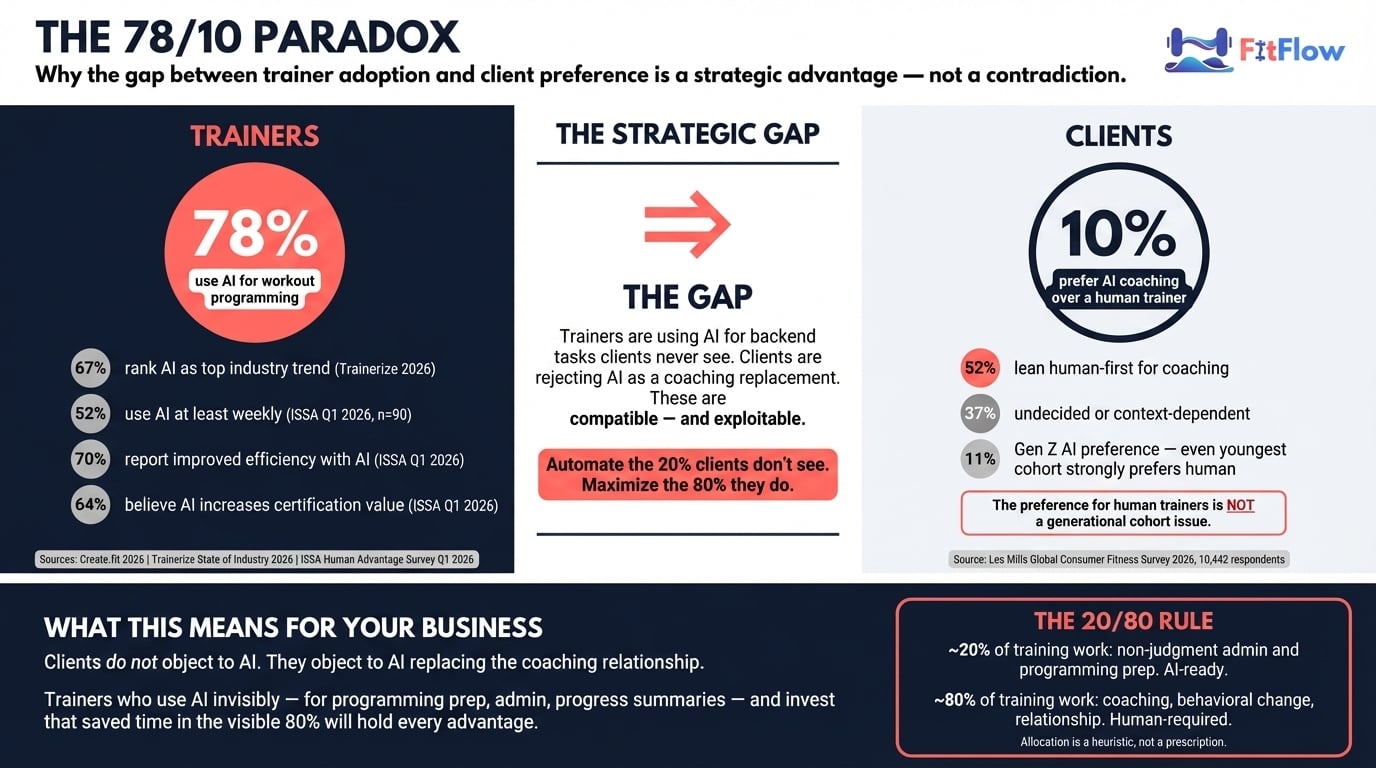
Roughly 20% of a trainer's work is non-judgment administrative and programming-prep work. AI is genuinely useful there. 80% is the coaching, the behavioral change, the relationship. That 80% is why clients stay. No current AI comes close to doing it.
Here is the 20/80 rule applied to personal training:
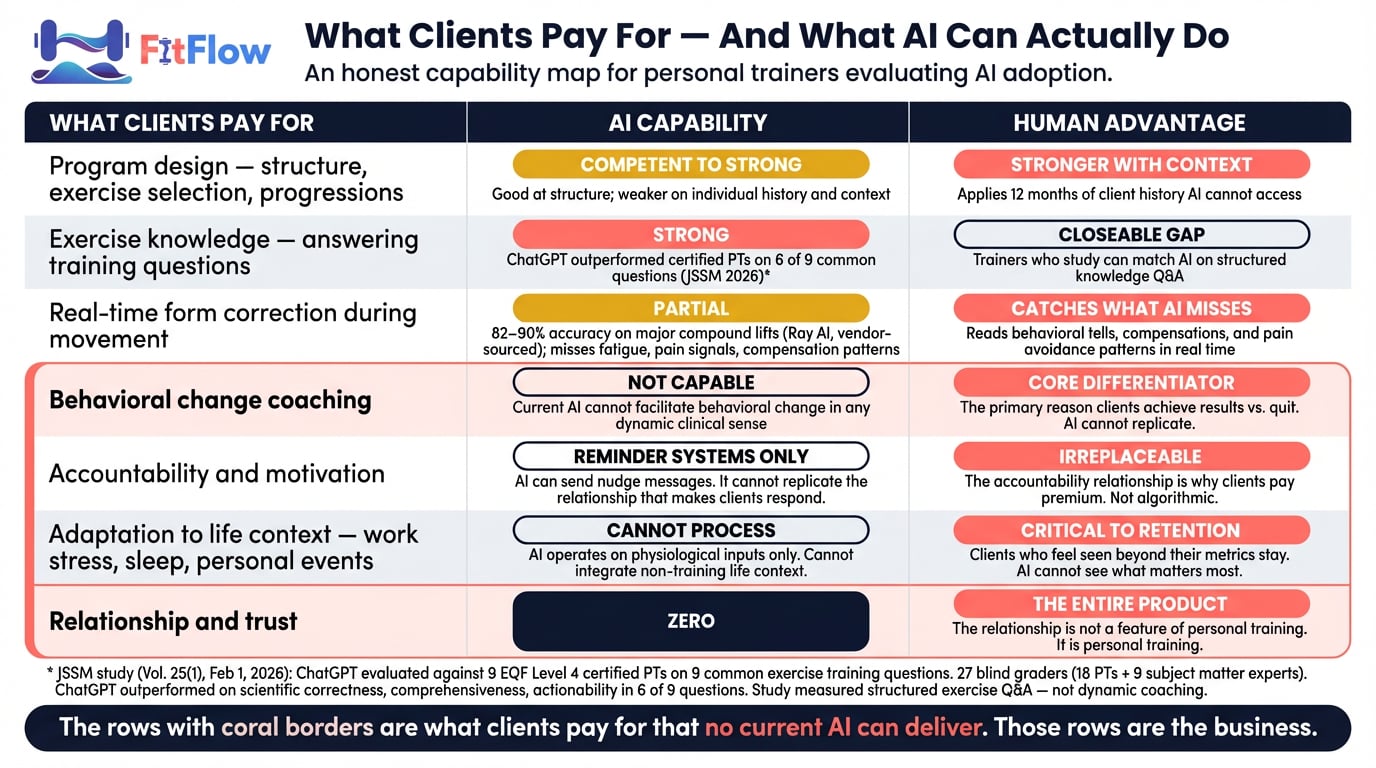
What Clients Pay For | AI Capability | Human Advantage |
|---|---|---|
Program design (structure, exercise selection, progressions) | Competent to strong | Stronger with individual context and history |
Exercise Q&A knowledge | Strong — ChatGPT outperformed certified PTs in 6 of 9 common questions (JSSM, Feb 2026) | Knowledge gap is closeable with continued education |
Real-time form correction | 82-90% accuracy on major compound lifts (according to Ray AI, vendor-sourced) | Catches fatigue, pain signals, and behavioral cues AI misses |
Behavioral change coaching | Not capable | Core differentiator — no AI simulation available |
Accountability and motivation | Reminder systems only | Irreplaceable relationship factor |
Adaptation to life context | Cannot process non-physiological inputs | Critical to client retention |
Relationship and trust | Zero | The entire product |
The bottom four rows of that table represent roughly 80% of the value clients pay for. AI cannot touch them. The top three rows represent the 20% where AI is competent — and where trainers can reclaim hours to invest in the 80% that keeps clients.
What the Research Actually Says: ChatGPT vs. Personal Trainers
The headlines write themselves: "ChatGPT Outperforms Personal Trainers." The study behind the headlines deserves accurate treatment, not dismissal — and not sensationalism.
The Study
A peer-reviewed study published February 1, 2026 in the Journal of Sports Science & Medicine (Vol. 25(1), pp. 235-261, PMC-indexed) found that ChatGPT outperformed certified personal trainers (European Qualifications Framework Level 4) in 6 of 9 common exercise training questions. The evaluation metrics: scientific correctness, comprehensiveness, and actionability. The methodology: 9 personal trainers submitted their most frequently asked client questions; ChatGPT 3.5 received identical questions; 27 independent graders (18 PTs and 9 subject matter experts) evaluated all answers blind.
This is a real finding from real peer-reviewed research. It deserves honest engagement.
What the Study Measured
The study measured exercise Q&A — structured knowledge questions about training concepts. "What is progressive overload?" "How do I structure a deload week?" "What rep ranges build hypertrophy?" ChatGPT answered these competently. In several cases, it answered them more comprehensively and with greater scientific accuracy than certified trainers.
What the Study Did Not Measure
The study did not evaluate AI's ability to watch a client squat and detect compensation patterns developing at rep 7. It did not measure whether AI could recognize that a client's plateauing bench press reflects the divorce they are going through, not a programming variable. It did not test the motivational relationship that keeps a client showing up on the Wednesday they would rather skip. It measured structured knowledge questions. It found ChatGPT does well on structured knowledge questions.
The Practitioner Implication
If your value as a trainer is primarily in delivering exercise knowledge answers — the exact kind of question a client could type into ChatGPT — the study is a genuine threat signal. If your value is in coaching — applying knowledge to a specific human in a dynamic relationship over time — the study is not about you. It is about the 20%. You need to be competing on the 80%.
The Unfavorable Data Worth Including
Honest assessment requires including the other side. An independent 2024 study found that ChatGPT exercise recommendations were only 41% comprehensive when evaluated for safety and completeness (cited in multiple 2026 analyses, including Tom's Guide). AI exercise knowledge is uneven: strong on well-documented training concepts, unreliable on individualized protocol design, medical contraindications, and edge-case safety scenarios.
The program was never the hard part. Coaching is. AI can handle some of the program. It cannot do any of the coaching — yet.
The 20/80 Framework: Where AI Belongs in Your Training Practice
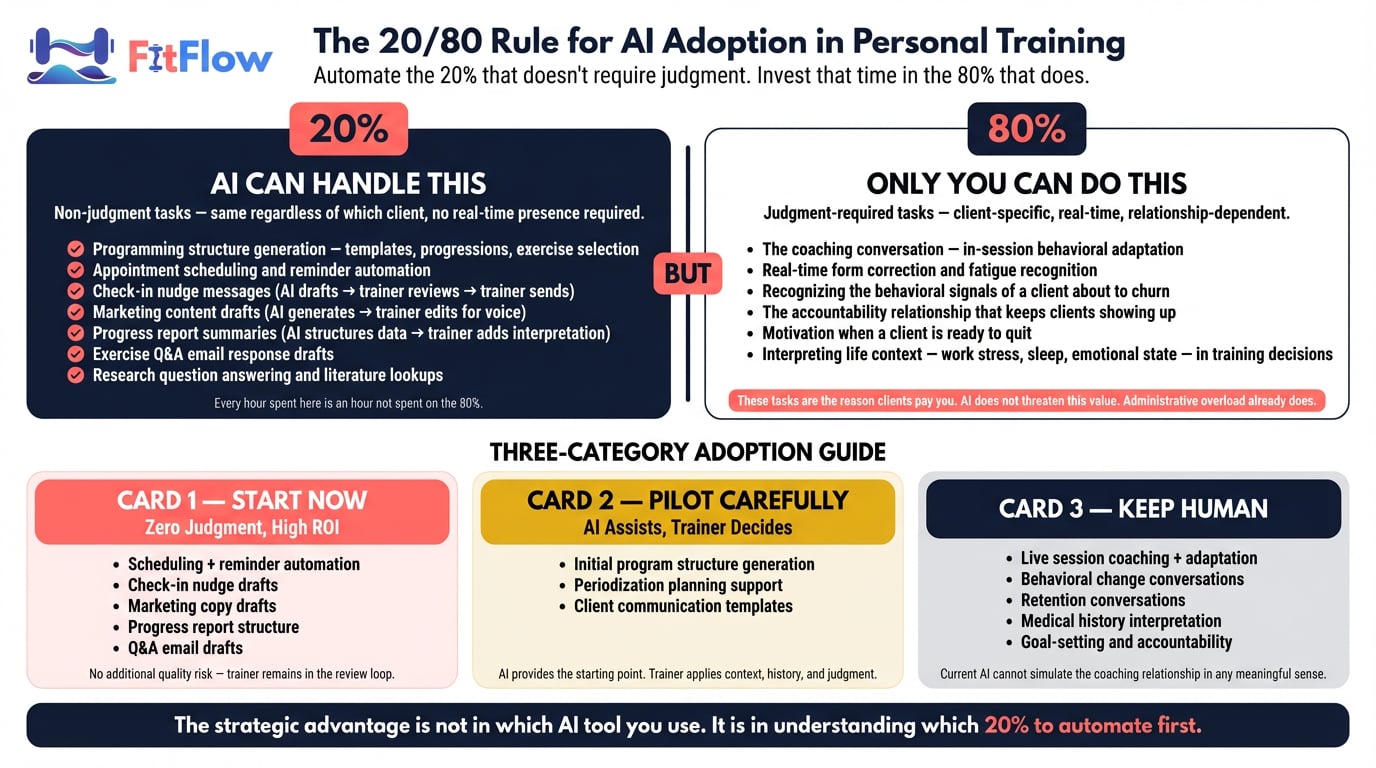
The question is not "should I use AI?" — 78% of trainers already do. The question is "where does AI belong, and where does it not?"
Every hour you spend on the 20% — scheduling, templated check-in messages, exercise library lookups, progress report formatting — is an hour not spent on the 80% — the coaching conversation, real-time session adaptation, the accountability relationship, the behavioral change work that keeps clients for years instead of months. AI does not threaten your value. Administrative overload already does. AI can eliminate the threat.
Here is the framework, organized by risk level and judgment required. Use this to make your first adoption decision, not a tool comparison list. For a practical framework for evaluating and selecting your tools, see our tech stack guide.
Start Now — Zero Judgment, High ROI
These tasks are the same regardless of which client you are doing them for. A competent non-trainer could do them with the right template. They do not require you to be present with the client:
Appointment scheduling and reminder automation — AI handles calendar management, sends session reminders, manages cancellations
Check-in nudge messages — AI drafts the "how did yesterday's session feel?" text; you review and send with your voice
Marketing content drafts — AI generates social posts, email newsletters, client acquisition copy; you edit for authenticity
Progress report summaries — AI structures the data from your tracking system into a readable format; you add interpretation and coaching context
Exercise Q&A email responses — AI drafts answers to common client questions; you approve before sending
According to Trainerize's 2026 State of Industry Report, AI tools can eliminate up to 80% of coaching admin tasks (Trainerize, 2026). That is time returned to the 80% that differentiates you.
Pilot Carefully — AI Assists, Trainer Decides
These tasks require judgment, but AI can provide a useful starting point that you then modify:
Initial program structure generation — AI provides a template based on client goals and training history; you apply individual context, injury history, and the nuance you know from coaching the client
Periodization planning support — AI suggests mesocycle structure; you modify for lifestyle factors, stress patterns, and recovery capacity that AI cannot read
Client communication templates — AI drafts; you preserve the relationship voice that your specific client responds to
The distinction matters: in these tasks, AI is a first draft, not a final answer. Your judgment is the value layer. Without it, the output is generic — and generic is what clients can get from a $20/month app.
Not Ready Yet — Keep Human
These tasks require real-time judgment, relationship context, or behavioral reading that no current AI can provide:
Real-time session coaching and adaptation
Form correction during live movements
Behavioral change conversations
Retention conversations when a client is considering quitting
Medical history interpretation and contraindication assessment
Goal-setting and progress accountability
This is the 80%. This is what the 90% of clients who prefer a human trainer are paying for. Protect it.
Evaluate, Pilot, Measure, Scale: The AI Adoption Framework
Before you adopt any AI tool, you need a decision process — not a product recommendation. This four-step framework gives you one. It targets the specific question trainers are asking: "How do I start using AI in my training practice without breaking what already works?"
Step 1: Evaluate — Map Your 20%
Before spending a dollar on AI tools, identify which tasks in your practice are genuinely non-judgment administrative or programming-prep work. List every task you do in a typical training week. Mark which ones require client knowledge, real-time adaptation, or relationship context. Everything else is a candidate for AI augmentation.
Three questions to classify each task:
Is this task the same regardless of which client I am doing it for? (If yes, it is in your 20%.)
Would a competent non-trainer be able to do this with the right template? (If yes, it is in your 20%.)
Does this task require me to be present with the client? (If no, it is in your 20%.)
If a task fails all three — it is personal, judgment-dependent, and requires presence — it belongs in your 80%. Keep it human.
Before mapping your tasks to AI tools, make sure the foundational systems in your practice are working. AI amplifies what you already have — it does not fix system failures that no AI tool will solve for you.
Step 2: Pilot — One Tool, One Use Case, 30 Days
Choose one task from your 20% list. Choose one AI tool to pilot for that specific task only. Set a 30-day window. Do not switch tools or expand scope during the pilot. The goal is a clean signal on whether this specific tool, used for this specific task, saves time and maintains quality.
Rules for a clean pilot:
One tool, one task — do not pilot three tools simultaneously
Document your baseline — how long does this task take today, without AI?
Keep the quality checkpoint — every AI output gets trainer review before reaching the client
30 days, then evaluate — no premature scaling, no premature abandonment
The AI Readiness Checklist provides the complete pre-pilot evaluation scorecard for Steps 1 and 2: which tasks qualify for AI augmentation, which tool categories address which task types, and what to measure in your 30-day pilot.
Step 3: Measure — Three Signals Worth Tracking
After 30 days, evaluate three signals:
Time saved per week — direct measurement: how many hours did this task take before versus after?
Output quality maintained — did the AI-assisted output require significant trainer editing, or was it usable with light review?
Client experience unchanged — did any client notice a change in communication quality, program quality, or responsiveness?
If all three signals are positive, expand. If any signal is negative, adjust the tool, the use case, or the workflow before expanding.
Build these measurements into your client progress dashboard alongside performance and body composition data. The same tracking discipline that makes you a better coach makes you a better AI adopter.
Step 4: Scale — Systematize What Works
Once a pilot passes all three measures, systematize it: document the workflow, establish the quality-review checkpoint (always keep trainer judgment in the loop), and build the process so it runs consistently without per-instance effort.
This is the moment AI adoption creates leverage: not just time saved this week, but a documented system that scales to 50 clients with the same quality it delivered at 15. This is the operational framework that AI tools support at scale — not replacing your coaching, but extending the infrastructure underneath it.
Step | Action | Duration | Key Question |
|---|---|---|---|
Evaluate | List tasks, classify 20% vs. 80% | 1-2 hours once | "Does this task require my judgment or presence?" |
Pilot | One tool, one task, quality checkpoint | 30 days | "Does this specific tool save time without degrading output?" |
Measure | Track time saved, quality, client experience | End of 30-day pilot | "Are all three signals positive?" |
Scale | Document workflow, systematize, expand | Ongoing | "Can this process run at 50 clients with the same quality as 15?" |
The Displacement Anxiety: What the Evidence Actually Says
If you have read this far with a quiet fear that AI is coming for your career — you are not alone. The anxiety is understandable. The question is whether the data supports it.
The Fear
A "40% displacement risk" figure for personal trainers has circulated in AI-risk assessments (WhatAboutAI.com). It deserves an honest look rather than dismissal.
The Actual Data
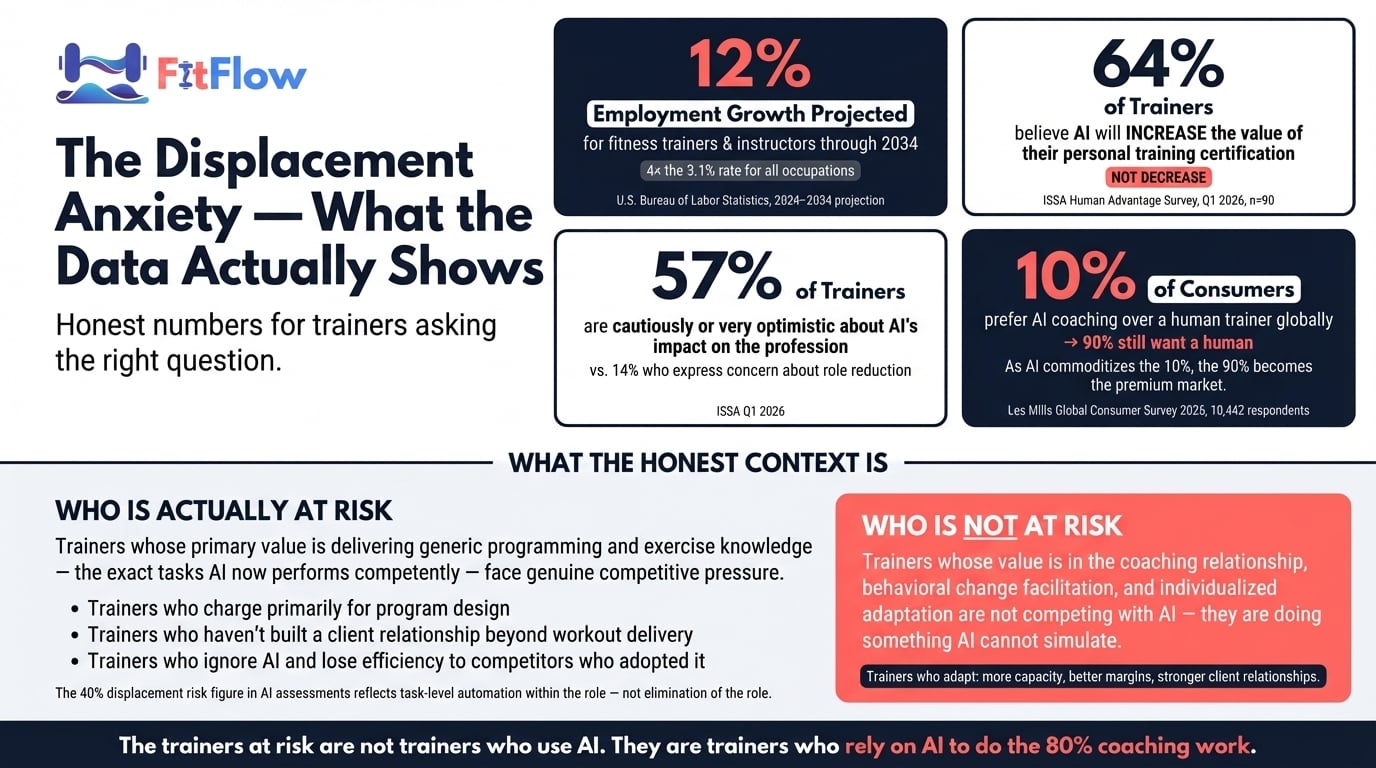
The 40% displacement risk reflects AI's potential to automate task-level work within the trainer role — not to eliminate the role itself. It is the 20% at risk, not the job.
The U.S. Bureau of Labor Statistics projects 12% employment growth for fitness trainers and instructors through 2034 — four times the 3.1% average growth rate for all occupations (BLS, cited in ISSA 2026)
64% of trainers surveyed by ISSA believe AI will increase the value of their personal training certification (ISSA, Q1 2026)
57% of trainers are cautiously or very optimistic about AI's impact on the profession
Only 14% express concern about role reduction
What the data tells consistently: AI will change what the trainer does, not whether the trainer exists. The trainers at risk are those whose primary value proposition is delivering generic programming and exercise knowledge — the exact tasks AI now performs competently. Trainers whose value is in the coaching relationship, behavioral change facilitation, and individualized adaptation are not competing with AI. They are doing something AI cannot simulate.
The Human Advantage
Look at the demand side again:
10% of consumers want AI-only coaching (Les Mills, 2026)
90% prefer a human trainer — and that 90% will pay a premium for the human once AI alternatives commoditize the 10% who want purely algorithmic programming
The "luxury service" framing of human personal training (Athletech News, 2026) is not a threat — it is a positioning opportunity for trainers who can articulate what they provide that AI cannot
Trainers who use AI to eliminate the 20% non-judgment work will have more capacity, better margins, and stronger client relationships than trainers who ignore AI. Trainers who rely on AI to do the 80% coaching work will lose clients to the trainers who understand what the 90% of consumers are actually paying for.
What Is Coming: The Next Wave of AI in Fitness
Two developments on the horizon will change how trainers interact with AI. Neither replaces the coaching relationship. Both change the operational dynamic.
Agentic AI: From Reactive to Proactive
Current AI fitness tools respond when a trainer or client asks. The next generation — agentic AI — reads wearable data and acts before anyone asks. "Your HRV is 18% below baseline today — your program is moving to recovery. Here is why." A genuinely new capability. It changes the check-in dynamic from trainer-initiated to AI-initiated for data-driven nudges.
Trainers who integrate this proactively — using agentic AI for the data-driven nudge, keeping themselves for the interpretation and response — have a structural advantage over trainers who use AI reactively. The AI sends the alert. You have the conversation about what it means.
ChatGPT Health: 230 Million Weekly Health Users
OpenAI launched ChatGPT Health on January 7, 2026, integrating Apple Health, MyFitnessPal, and Garmin for 230 million weekly health users. This is not a consumer story — it is a data-flow story. Client fitness data is now inside ChatGPT. Trainers who understand what this means for their platforms, their data ownership, and their client communication will navigate it. Trainers who ignore it will be surprised when clients start bringing AI-generated health insights to sessions and asking, "ChatGPT says I should change my program. What do you think?"
That question is an opportunity — if you have an answer grounded in the individualized coaching context that ChatGPT does not have.
The Trainer's Strategic Moat
AI capabilities are advancing faster than client trust is shifting. The window between "AI can technically do this" and "clients actually prefer AI for this" is a trainer's strategic moat. Maintain the moat by continuing to deliver the coaching, accountability, and human relationship that AI cannot replicate — while using AI to deliver everything else better and faster.
Your Three Actions This Week
You have read the data. You have the framework. Now do three things before you forget.
Action 1: Map your 20%. List every task you do in a typical training week. Circle the ones that require direct client knowledge, real-time judgment, or relationship context. Everything uncircled is your 20% — the tasks where AI can save you hours without touching your value.
Action 2: Start one pilot. Choose one task from your uncircled list. Download the AI Readiness Checklist and run it through the pre-pilot scorecard. Identify which tool addresses that task. Set a 30-day pilot. One tool. One task. 30 days.
Action 3: Be the coach. Before you invest another minute in whether AI is good or bad for personal training, spend that minute being the coach your client needs. The 80% is why they show up. Make sure they can feel it.
The program was never what kept your clients. The coaching did. AI can help you build a better program in half the time. Use that time to be a better coach. That is what trainers should actually do about AI.