
Beginner Program Design That Doesn't Bore the Client

A beginner needs the same handful of movements, repeated, more than anything else you could put in front of them. That is also the thing most likely to make them stop answering your texts in week six.
Both halves are true, and the friction between them is the real problem in beginner program design. Hold the program steady and the client calls it boring. Change it every few weeks and you lose the one signal telling you whether any of it worked. Most coaches split the difference, which in practice means adding variety to the exact layer where it costs the most.
There is a cleaner way through it, and it starts by correcting the diagnosis. Your client is almost never bored with the hip thrust. They are bored with not visibly getting better at the hip thrust. Boredom in the first twelve weeks tracks perceived progress much more closely than it tracks program content, and perceived progress is something you design before day one rather than manage after it.
The stakes here are not abstract. The Health & Fitness Association's 2025 Fitness Industry Benchmarking Report, built on 175 companies representing more than 17,000 facilities across 27 countries, put average annual member retention at 66.4%. Roughly a third of the people who show up walk back out inside a year, and on a 1:1 or hybrid roster the beginner cohort is where that leak runs fastest. What that churn costs a coaching business over a year is worked out elsewhere; the point here is that the leak opens in week six, inside a program you already wrote.
So this piece gives you two things. A named split for deciding, at design time, what stays fixed and what moves: ANCHOR → ROTATE → SURFACE → SHARE. And a diagnostic for the moment a client says the B-word, so you find out what they actually mean before you touch the program.
Nine of the Twelve Weeks in This Calendar Change Nothing. That's the Part That Works. Download Free Template Kit.
"Bored" Is Almost Always a Mistranslation
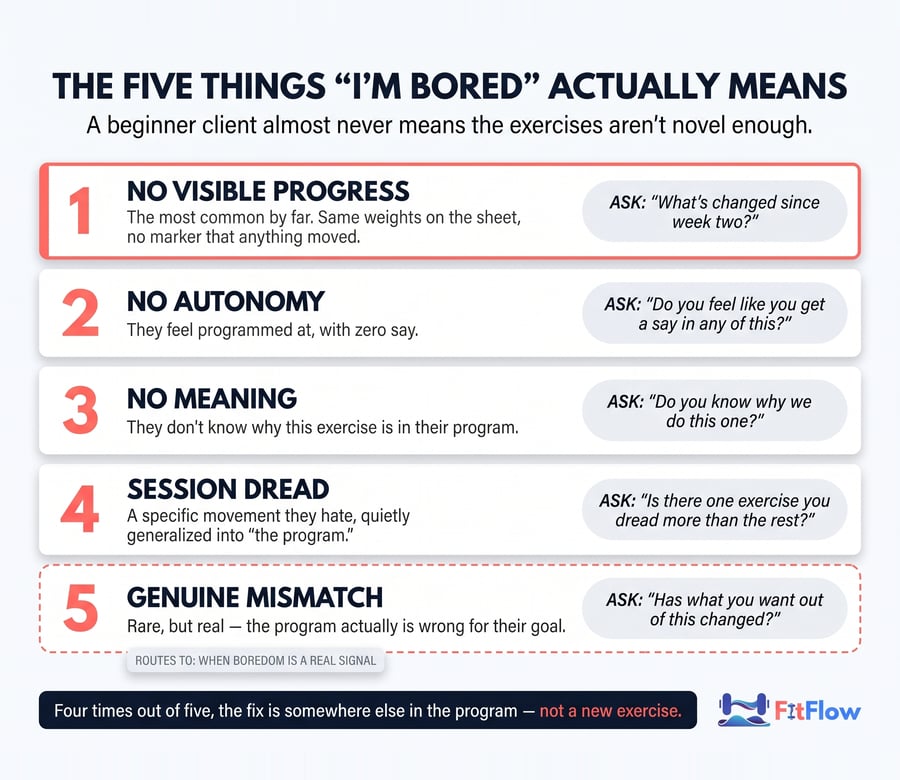
A client bored with a workout program is reporting a feeling accurately and diagnosing it badly. That is not their job. It is yours.
Take the word as raw data rather than as a request, and it resolves into five distinct causes. Each one has a different tell, and each one gets fixed in a different layer of the program.
1. No visible progress. This is the most common by a wide margin. The sheet says 3x8 at 40kg in week two and 3x8 at 40kg in week five, because you have been adding half-reps and cleaner bracing that nobody wrote down. The client has no evidence anything moved. The tell: they cannot tell you a single number that has changed since they started.
2. No autonomy. They are being programmed at. Every variable in the session was decided by someone else, including the ones where their opinion would cost you nothing. The tell: they ask permission for small things, or they quietly substitute exercises when you are not looking.
3. No meaning. They do not know why the split squat is in there. An exercise with no stated job is just a chore with a rep count attached, and chores get boring faster than hard things do. The tell: ask what a given exercise is for and you get a shrug or "legs?"
4. Session dread. There is one movement they hate. Walking lunges, maybe, or anything that makes them breathe hard in front of other people. Rather than name it, they generalise the feeling across the whole program. This one shows up on the calendar: the complaint always lands on the same day of the week.
5. Genuine mismatch. The program really is wrong for what they want now. This one is rare, it is real, and it deserves its own treatment further down.
Only the last of those five is fixed by changing exercises, and even then not for the reason the client thinks. The first four get solved elsewhere: in what you measure, what you let them choose, what you explain, which accessory sits in slot four. Swapping the squat pattern addresses none of them. It resets your baseline and buys about three weeks of novelty before the same conversation returns.
Which is why a design-time answer beats a reactive one. Decide in advance where variety lives and you never have to improvise it under pressure with a client watching your face.
What Repetition Is Actually Doing for a Novice
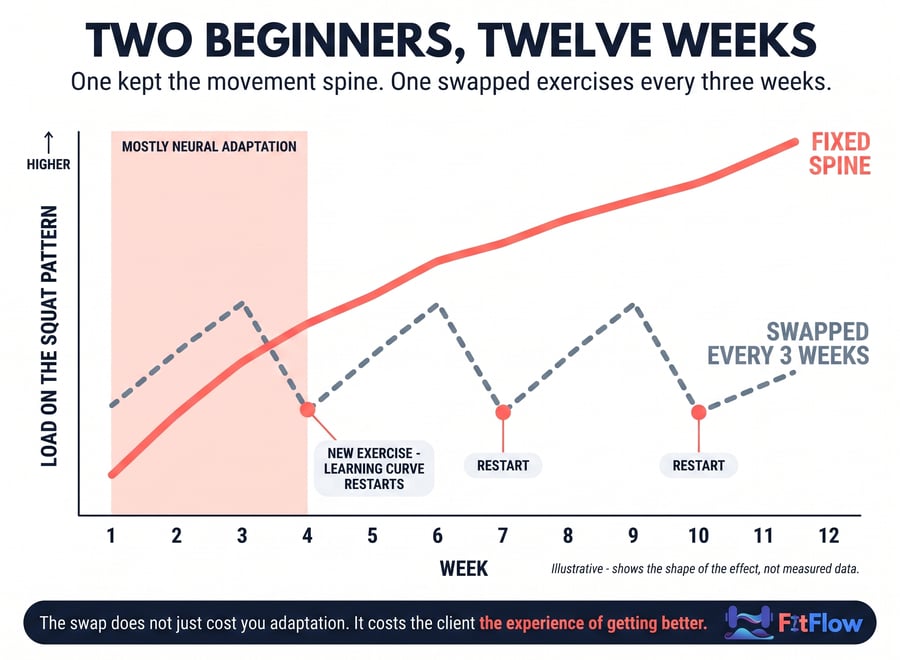
Early strength gains are not mostly a tissue story. They are a wiring story.
A review of neural adaptations to resistance training puts the first two to four weeks of force improvement as primarily neural in origin. It makes the connection explicit: resistance training behaves as a form of motor learning (Škarabot et al., 2020, European Journal of Applied Physiology). Recruitment thresholds drop. Firing rates climb. Coordination between agonist and antagonist sharpens. Your client gets stronger by getting better at the movement, well before they build much of anything new.
That has a practical consequence most programming for beginner clients ignores. Every exercise swap in the first block does not just interrupt adaptation, it restarts the learning curve at the bottom, and the client's own sense of competence goes with it. Week one on a new movement feels like week one, because it is.
It also erases your read on them. You cannot tell the difference between "getting stronger" and "getting familiar" on a movement they have done four times. That measurement argument is made in full over in why swapping exercises breaks your ability to see progress, and I am not going to relitigate it here. Same for the mechanism underneath it, which lives in what progressive overload actually requires.
What matters for this post is the second-order effect. A moving exercise list does not only cost you data. It costs the client the experience of visible improvement, which is the thing keeping them in the room. You take away the one lever that addresses boredom at its source, in the name of addressing boredom.
What the Research Actually Says About Variation
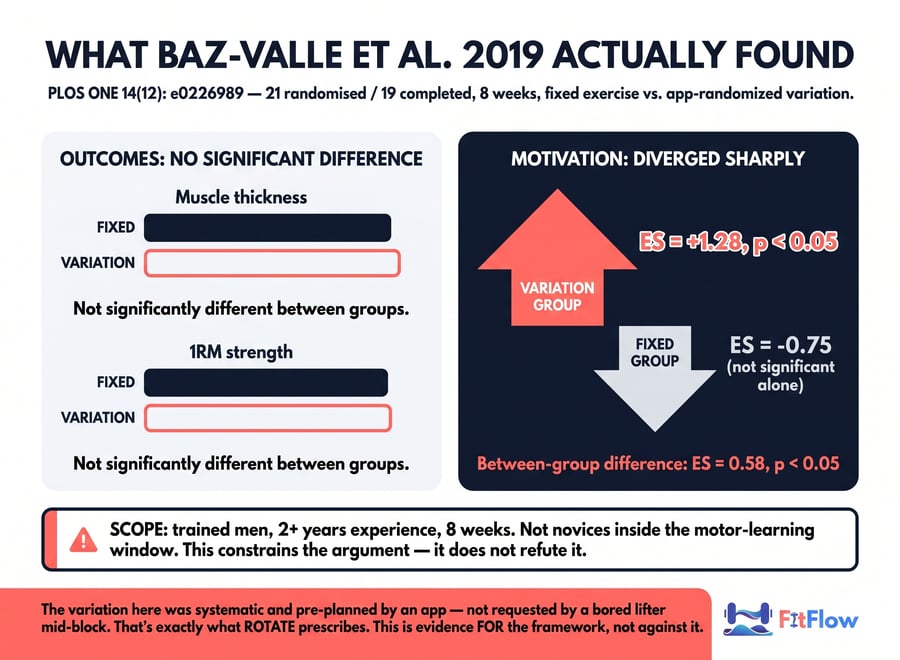
Here is where a lot of coaching content gets dishonest, so let me put the strongest evidence against a hold-everything-constant position on the table at full weight.
Baz-Valle and colleagues randomised 21 resistance-trained men (19 finished) into two groups for eight weeks, training four times a week. One group ran the same six upper-body and six lower-body exercises throughout. The other pulled its exercises at random from an 80-movement pool via an app. Muscle thickness and 1RM strength rose in both groups, and every between-group comparison came back trivial and non-significant. Intrinsic motivation is where they parted ways. It rose in the varied group (ES = 1.28, p < 0.05) and drifted down in the fixed group (ES = −0.75, not significant on its own), producing a moderate, significant between-group difference (ES = 0.58, p < 0.05) (PLOS ONE, 2019).
Read that plainly. Eight weeks of a completely fixed program cost those lifters motivation and bought them nothing in return. Anyone telling you variation harms results is not describing this study.
Two caveats, both load-bearing. The population was resistance-trained men with roughly two years of experience, not novices inside the motor-learning window, which constrains the argument rather than settling it. And the comparison group was fully fixed, all twelve exercises, for two months. No thoughtful coach writes that program.
Fonseca and colleagues point the same direction from a different angle. Their twelve-week trial crossed varied against constant exercise selection with varied against constant loading. The groups that varied their exercises showed hypertrophy across all four quadriceps heads where the constant-exercise groups did not, and the strongest strength gains came from varying the exercise rather than the load (Journal of Strength and Conditioning Research, 2014). Directionally, variation earned its place.
A 2025 randomised pilot in 47 low-active students points the same way. Over eight weeks, accelerometer-measured activity never separated the groups. What separated them was how the training felt: satisfaction of the need for autonomy was higher under built-in variety at four weeks (p = .013), and exercise self-efficacy was higher at eight (p = .025) (PLOS ONE, 2025). The authors call it a pilot and mean it, so hold it loosely. It points where everything above points: variety moves how training feels before it moves what training produces.
Now the part almost nobody states. In every one of those studies the variation was systematic and pre-planned. Baz-Valle's came out of an algorithm before the block started. Fonseca's was a fixed experimental condition. Dregney's was a menu of fourteen workouts written before anyone enrolled. None of them resembles a coach changing a movement on a Tuesday because a client seemed flat, which is the intervention actually under discussion when trainers argue about this.
That distinction is the entire ballgame. Scheduled variation and reactive variation share a name and nothing else. One is a program. The other is a program being edited by whoever is least equipped to edit it. So the rule is not "never vary," and it never was. It is: vary the accessory, never the anchor.
The ANCHOR → ROTATE → SURFACE → SHARE Framework
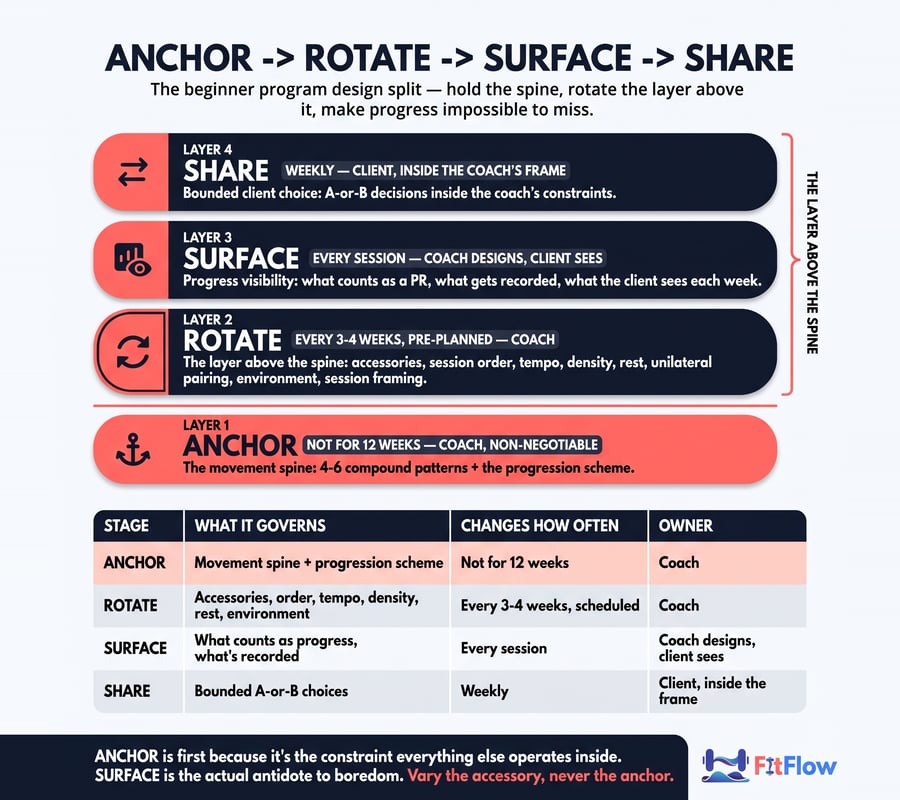
Four decisions, made once, at design time. Their order is not decorative: each stage only works inside the constraint set by the one before it.
Stage | What it governs | Changes how often | Owner |
|---|---|---|---|
ANCHOR | The movement spine: 4–6 compound patterns plus the progression scheme | Not for 12 weeks | Coach, non-negotiable |
ROTATE | Everything above the spine: accessories, session order, tempo, density, rest, unilateral pairing, environment, framing | On a pre-planned schedule, typically every 3–4 weeks | Coach, scheduled in advance |
SURFACE | Progress visibility: what counts as a PR, what gets recorded, what the client sees | Every session | Coach designs, client sees |
SHARE | Bounded choice: A-or-B decisions inside your constraints | Weekly | Client, inside your frame |
ANCHOR
Pick four to six patterns and commit to them for the full twelve weeks: a squat, a hinge, a horizontal push, a horizontal pull, and one or two of vertical push, vertical pull, or loaded carry. Write the progression scheme next to them before the client's first session, in the form "when X happens, load goes up by Y." Weekly double progression works fine. What matters is that the rule exists on paper, because a rule you invent mid-block is a preference wearing a rule's clothes. Those are the same six patterns our program design guide is built around, narrowed to what a novice can actually learn in twelve weeks.
ROTATE
Open a calendar. Decide now what changes in week four, week seven and week ten, and write it down where the client can see it. Accessories swap. Session order flips so the pull leads. Tempo goes to a three-second eccentric on the hinge for a block. Density work replaces straight sets. A session moves outdoors. None of that touches the anchor, and all of it feels like a new program from the inside. Pre-planning is what makes this legitimate instead of reactive.
SURFACE
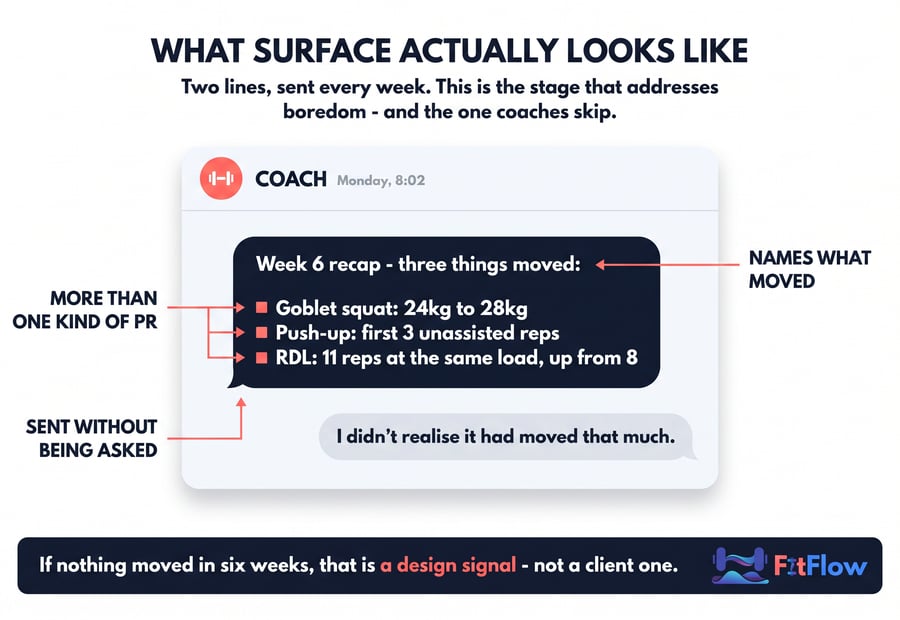
This is the stage that actually addresses boredom, and it is the one coaches skip. Define what counts as a PR in week one, and define more than one kind: heaviest set, most total reps at a given load, first unassisted rep, first session at bodyweight on the dip, cleanest set of five. Record them somewhere the client can see without asking you. Then send a weekly summary naming exactly what moved. Two lines is plenty. The client who can see progress does not experience week six the way the client who cannot does, and the five metrics worth putting on a client dashboard are a reasonable starting set.
SHARE
Give real choices inside your boundaries. "Split squat or reverse lunge today?" "Do you want the conditioning finisher or the carry?" "Sled or bike?" The autonomy is genuine and the anchor never moves, which is the point.
This stage has the best research support of the four. A meta-analysis of 73 self-determination-theory interventions found that supporting autonomy produces small-to-medium gains in self-determined motivation and in health behaviour itself, running partly through that motivation and partly through support from the people around the client (Health Psychology Review, 2021). Modest effects, heterogeneous across studies, worth saying out loud. Also the exact mechanism you use every time you hand a client a real decision.
The fitness-specific picture matches. Set against general gym floors, 1:1 coaching contexts scored higher on perceived autonomy support (p = .050) and on satisfaction of the need for relatedness (p = .001), and clients stayed with training longer on average, 26.3 months against 18.6 (p = .001) (Journal of Human Kinetics, 2015). Competence satisfaction did not differ between the two contexts, which is worth knowing before you overclaim the case. Cross-sectional throughout, so read it as a reason to build choice in on purpose, not a promise about any one client.
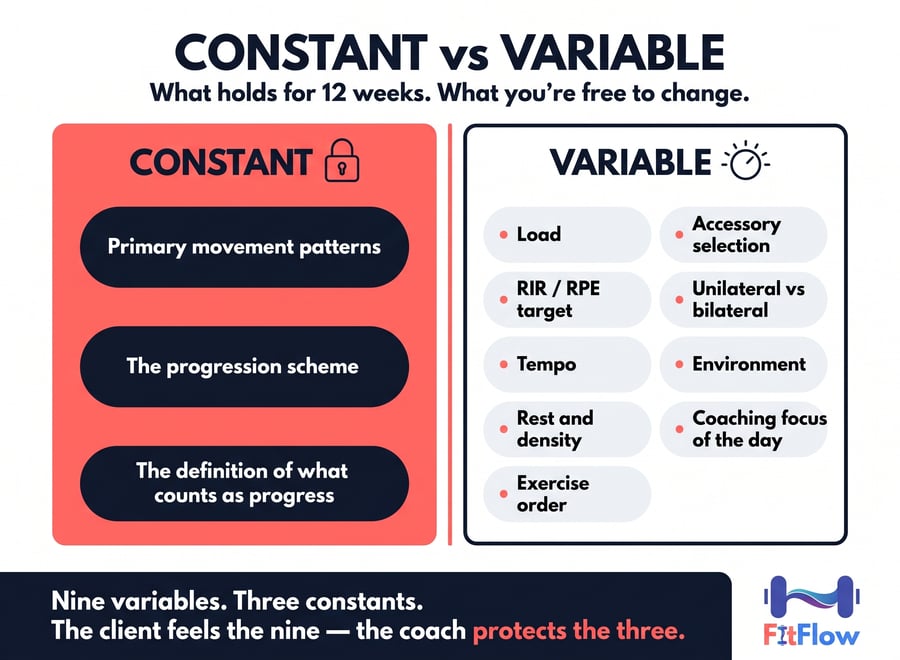
The constant/variable split, on one screen
Constant for 12 weeks | Free to vary |
|---|---|
Primary movement patterns | Load |
The progression scheme | RIR / RPE target |
The definition of what counts as progress | Tempo |
Rest and density | |
Exercise order | |
Accessory selection | |
Unilateral vs bilateral | |
Environment | |
The coaching focus of the day |
Three things stay still. Nine things move. A client experiencing nine moving variables does not describe their program as repetitive, and you keep every number you need.
You Just Read the Framework. This Kit Is the Version You Fill In. Download Free Template Kit.
The Diagnostic Script: Find Out What They Mean First

A client says the program is getting boring. Before you change a variable, you need to know which of the five causes is live, and you will not get there by asking "what would you like to do instead?"
Four questions, in this order. They take about ninety seconds.
Question 1, to separate the whole from the part: "When you say boring, is it the whole session or is it one thing in it?" A specific answer points at session dread. Vague and total points at progress or meaning.
Question 2, to test progress visibility: "If I showed you that your squat has gone up fourteen kilos since week one, would that change how the program feels right now?" A yes is your answer. They are not bored, they are flying blind. If the honest answer is that the number has not moved in six weeks, that is on the design, not the client.
Question 3, to test meaning: "What do you think the Romanian deadlift is doing for you?" If they cannot answer, the problem is that nobody told them, and thirty seconds fixes it.
Question 4, to test autonomy: "In a normal session, what do you actually get to decide?" If the honest answer is nothing, you have found it.
Then you change one layer, and you say so out loud. Something close to: "That is useful, thank you. The squat and the deadlift stay, because we are eight weeks from knowing what they are worth. What I am changing is what you can see. From Monday you get a weekly note with the three numbers that moved, and you pick the accessory each session."
The output of this conversation is always a change. It just lands in ROTATE, SURFACE or SHARE rather than in the anchor. When the honest answer is that nothing should move yet and the client needs the case for holding the line, that is a different conversation, written up in the companion piece on not swapping exercises.
When Boredom Is a Real Signal
Sometimes the client is right and the framework is not the answer. Four cases, and none of them is rare enough to wave off.
The goal moved and the program did not. They signed up to lose weight and by week five they care about their deadlift. The anchor was built for the old goal. Rebuild it deliberately, at a block boundary, and tell them that is what you are doing.
Something hurts. "Bored" is a much easier word to say than "my shoulder has been clicking for three weeks and I did not want to make a thing of it." If the complaint attaches to one movement and arrives with a shrug, ask directly about pain before you ask about anything else. Pain that persists across sessions is a referral to a healthcare professional, not a programming variable, and assessing it sits outside your scope of practice.
The plateau is real. You ran the progression honestly, the load has not moved in six weeks, and the client noticed before you did. That is not an attention-span problem, it is a programming one, and the diagnostic path runs through why clients stop progressing.
Their adherence genuinely depends on novelty. Some people are like this, and pretending a framework overrides personality is how you lose them politely. Build an anchor they will actually tolerate, three patterns instead of six, with a wider and faster rotation on top. Slower motor learning is the price of them still training in March.
One more, said plainly. If you have run SURFACE properly for six weeks and the client still cannot see progress, the problem is your program. Not their attention span.
The 12-Week Arc: Beginner Program Design, Block by Block
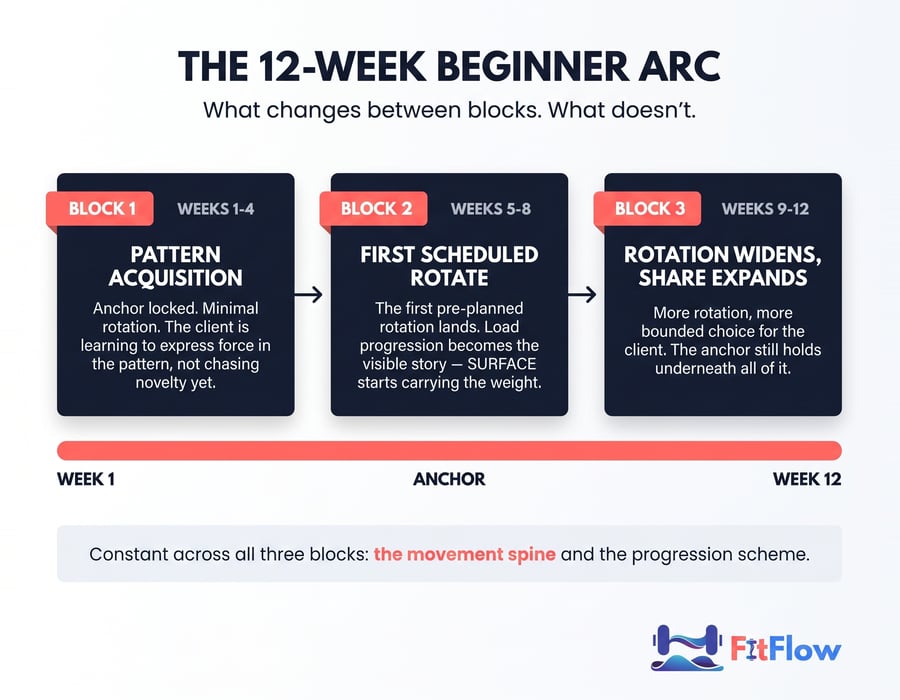
Twelve weeks, three blocks, one anchor.
Block 1, weeks 1–4. Pattern acquisition. The anchor is locked and rotation is near zero. Everything goes into technique and into establishing baselines, because SURFACE cannot work later without numbers recorded now. Enthusiasm usually carries this block on its own.
Block 2, weeks 5–8. The first scheduled rotation. Week five is where drift starts, which is exactly why the rotation was scheduled for it before the client ever felt anything. Accessories change, order flips, tempo work appears. Load progression on the anchor becomes the visible story, and the weekly summary starts doing real work. Bounded choice widens from one decision to two.
Block 3, weeks 9–12. Widen the rotation, hold the spine. More variation on top, a broader choice menu, maybe a new environment. The compound patterns are the same ones from week one, and by now the client has twelve weeks of load history proving it was worth it. That history is the argument, and you will not have to make it out loud.
What comes after twelve weeks is a different problem with a different mechanism, and it shows up right about the point most coaches think they are safe. That one is covered in what happens to consistency around month three.
Beginner Program Design Starts in Week Zero
The coaches who never have the boredom conversation are not more charismatic than you. They worked out how to keep beginner clients engaged before the client's first session, by deciding where variety was allowed to live and then making progress so visible that the question mostly stopped arriving.
That is the shift worth making. Engagement is not a thing you rescue in week six with a new exercise. It is a layer you build in week zero, sitting on top of a spine you refuse to move, and the reason it works is that it goes at the actual cause. Your beginner is not bored with the movement. They are waiting for proof it is doing something, and proof is your job to produce.
Vary the accessory, never the anchor.
Vary the Accessory, Never the Anchor. Here's the Kit That Makes That Runnable Monday. Download Free Template Kit.
Frequently Asked Questions
Comments