
Most Training Variables Don't Matter. Here's the 20% That Does.

You have 32 clients on your books. Each program takes you 40 minutes to write. You debate tempo prescriptions. You rotate exercises every four weeks to avoid "staleness." You periodize because your certification said so. You stagger rest intervals to hit a specific work-to-rest ratio. And you still lose clients at week 10 because results plateau.
Most of what you are doing does not drive results. That is not a criticism — it is now the official position of the American College of Sports Medicine. In March 2026, the ACSM published its first major resistance-training Position Stand in 17 years, synthesizing 137 systematic reviews covering more than 30,000 participants [Lees et al., 2026 — PMC12965823]. Its core message: consistency beats complexity, training to muscular failure is not required for strength or hypertrophy gains, and periodization models do not consistently outperform one another. The 80% of programming decisions you agonize over are programming theater.
Five variables drive most of your clients' results. The rest is margin. This post ranks the five in order of evidence-weighted impact, names explicitly what you can stop obsessing over, and gives you a six-step audit you can run at every check-in.

We built that audit as a free download — The 80/20 Training Audit: 20 questions that reveal which of the 5 leverage variables is actually capping a specific client's results, in under 10 minutes per audit. Download it free →
This is not a simplicity post. How to structure a program at the day/split/slot level is layout, and layout is not variable-priority. This post sits one layer above it: within any layout, what do you obsess about, and what do you ignore? Progressive overload appears at rank 2 below — but the 6-dimensional mechanics of how overload works are covered in the overload deep-dive and will not be re-explained here.
The 80/20 Programming Paradox
The Evidence Says Consistency Beats Complexity
The ACSM 2026 Position Stand names the primary driver unambiguously: "The most meaningful gains come from a simple shift — moving from no resistance training to any form of resistance training" [Lees et al., 2026 — PMC12965823]. Three additional findings collapse substantial portions of the standard programming curriculum:
Training to momentary muscular failure does not enhance strength, hypertrophy, or power gains compared with stopping 2-3 reps short [Lees et al., 2026].
Periodization models — undulating, block, conjugate, linear — do not consistently outperform one another for the average adult [Lees et al., 2026].
Hypertrophy occurs across a broad loading range (30-80% 1RM) when effort is adequate [Lees et al., 2026].
Translate each finding to practice. If failure is not required, carefully programmed AMRAP sets are optional. If periodization models do not consistently outperform each other, the undulating-vs-block debate is cosmetic. If loading range is broad, rep-range orthodoxy is narrower than the underlying physiology.
Field-scale data tightens the conclusion. James Steele's 15,000-participant, 7-year cohort — as reported in NPR's January 2026 "minimum dose" series — produced 30-50% strength gains on roughly 20 minutes per week of consistent training [NPR, January 5, 2026]. That is the mean across a large longitudinal sample — not an outlier. The implication is not "train less"; it is that most of the work you add above the minimum does very little.
The Diminishing Returns Curve Has Been Quantified
Earlier dose-response work first mapped this relationship [Schoenfeld et al., 2017 — PubMed 28498672]; a February 2026 dose-response meta-regression in Sports Medicine (67 studies, 2,058 participants) put a precise number on the curve: hypertrophy plateaus at approximately 12.25 sets per muscle per week, after which each additional set adds just 0.24% growth [Pelland et al., 2026 — PubMed 41343037]. That is a regression coefficient, not a generalization — tight enough to use as a planning heuristic.
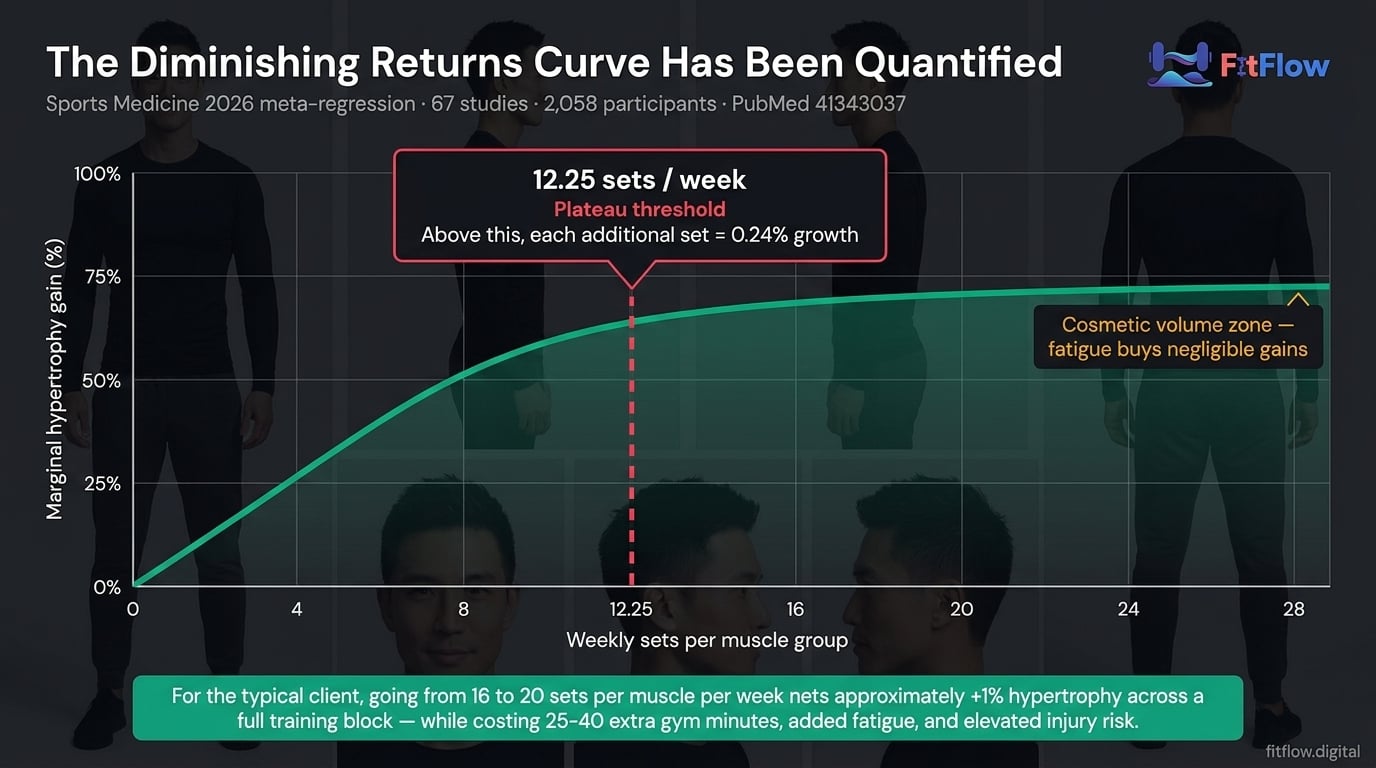
At 16 sets per muscle per week, pushing to 20 sets nets roughly 1 percentage point of additional hypertrophy across a block. The cost: 25-40 extra minutes of gym time per week, elevated fatigue, and higher injury risk. This isn't the minimum effective dose — it's the productive ceiling. Everything above it is cosmetic volume. For the physiology of why novice-phase programs stall at this exact threshold around week 6-8, see Why Hypertrophy Programs Fail After 6 Weeks.
The 80/20 Leverage Matrix: 5 Variables That Drive 80% of Results
Five variables carry the overwhelming majority of training outcomes. They are ranked below by evidence-weighted impact. A client who nails the first three is in the top 10% of outcomes. A client who adds the fourth and fifth is optimizing at the margin. Everything outside these five is programming that may feel like work but does not change results at the population level.
Rank | Variable | Evidence Weight | Primary Citations | When to Audit |
|---|---|---|---|---|
1 | Adherence (show-up rate) | HIGH | ACSM 2026; Steele 15k-person 7-yr cohort | Always. If 4-wk completion < 75%, stop everything else. |
2 | Progressive overload (any mechanism) | HIGH | ACSM 2026; Plotkin 2022; Nunes 2024 | After adherence is established. 3+ stalled sessions. |
3 | Protein at threshold (≥1.6 g/kg/day) | HIGH | Morton 2018 meta-analysis | Ranks 1-2 met but adaptation lags. |
4 | Sleep ≥ 7 hours (7-day avg) | MEDIUM-HIGH | Dattilo 2011; Chennaoui 2015 reviews | Ranks 1-3 met but RPE drifting, performance declining. |
5 | Exercise consistency (8-12+ wk) | MEDIUM | Kassiano 2023; Schmidt & Lee 2019 | Program rotates every 2-4 wk; bar weight not moving. |
Evidence weights: HIGH = multiple RCTs + meta-analyses + official guideline position. MEDIUM-HIGH = strong observational + mechanistic studies + guideline acknowledgment. MEDIUM = RCT support + field consensus but less definitive than ranks 1-3.
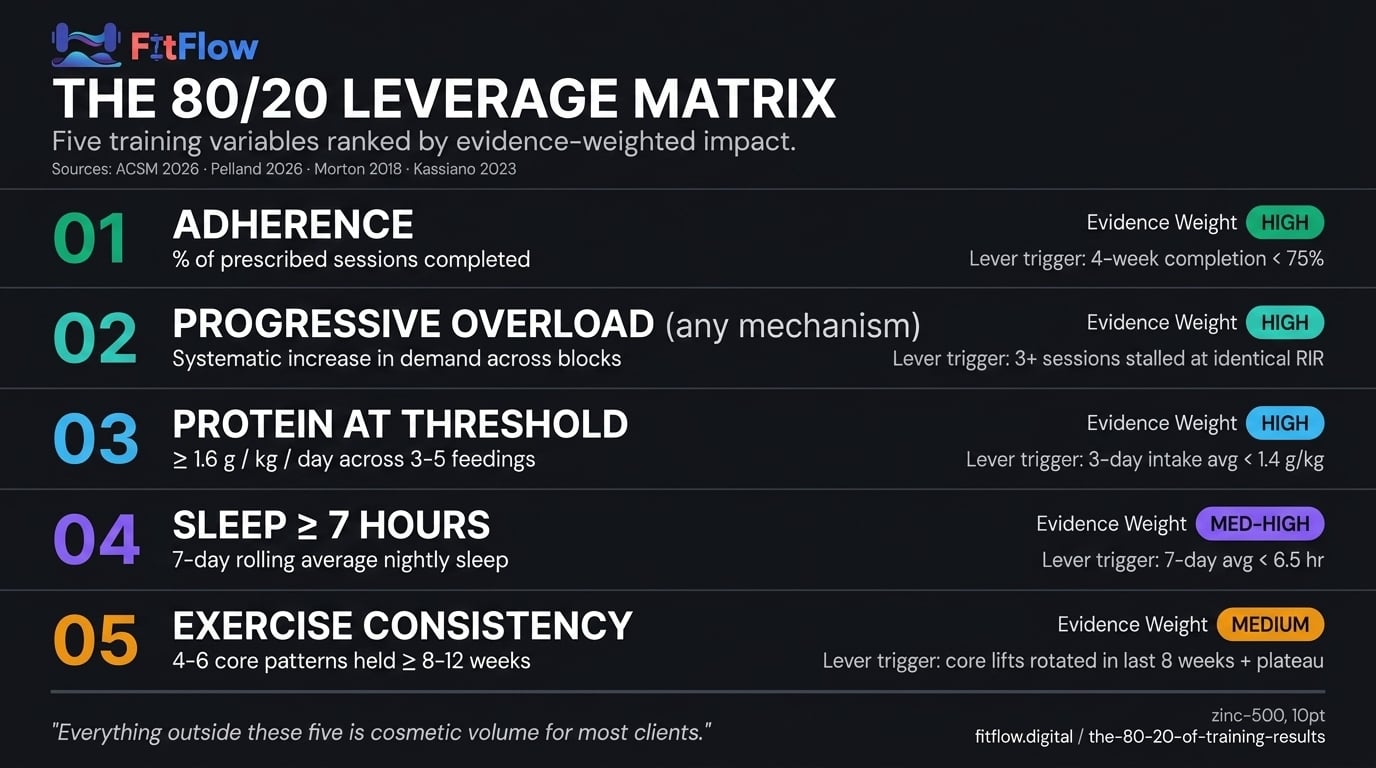
1. Adherence (Show-Up Rate) — Evidence Weight: HIGH
Adherence is the percentage of prescribed sessions actually completed across a 12-week block. Not "does the client like the program." Not "does the client feel motivated." The raw completion rate.
This is the single most important training variable because it multiplies every other variable by either 1 or 0. A perfectly programmed client who trains twice in 8 weeks gets zero results. A moderately programmed client who trains 3x/week for 8 weeks gets most of the available adaptation. The ACSM 2026 Position Stand names adherence the first-order variable and uses "consistency over complexity" as its framing for practitioners [Lees et al., 2026]. The Steele 15,000-person, 7-year cohort reinforces the pattern: minimum-dose protocols succeed because they are sustainable, and adherence rates in low-volume programs dramatically outperform high-volume prescriptions [NPR, January 5, 2026; NPR, January 26, 2026].
Adherence is always the lever. It is the substrate every other variable sits on.
Practical signal: if the client's 4-week completion rate is below 75%, do not change program variables. Investigate session length, scheduling, perceived difficulty, and client engagement. This is why we argue elsewhere that systems, not programs, are the primary lever — adherence is a system output.
2. Progressive Overload (Any Mechanism) — Evidence Weight: HIGH
Progressive overload is systematically increasing demand across training blocks through any of six mechanisms — load, volume, density, range of motion, tempo, or intent (RIR). Not load alone.
The ACSM 2026 Position Stand confirms overload as the continuation mechanism past the initial response phase [Lees et al., 2026], without mandating that it be achieved through load specifically. A 2022 direct comparison in PeerJ showed load progression and repetition progression produce equivalent hypertrophic outcomes when effort is equated [Plotkin et al., 2022 — PMC9528903]. A 2024 meta-analysis of overload progression protocols reached the same conclusion across a broader sample [Nunes et al., 2024 — PubMed 38286426]. The stimulus drives adaptation, not the specific variable used to generate it.
Overload is the bottleneck once adherence is established. If a client has produced the same weight, reps, and sets for 3+ consecutive sessions at identical RIR, overload has stalled. Pull one of the six mechanisms — which one depends on training age, plateau signal, and current volume status. For the 6-dimension decision matrix, see Progressive Overload Misunderstood. Here's the Reality.
3. Protein Intake at Threshold — Evidence Weight: HIGH
The threshold is approximately 1.6 g of protein per kg of body weight per day, distributed across 3-5 feedings. Morton et al.'s 2018 meta-analysis of 49 studies and 1,863 participants established this dose-response ceiling [Morton et al., 2018 — PMID 28698222]. Above it, additional protein produces minimal marginal gains. Below it, adaptation is meaningfully impaired regardless of training quality.
Protein is a training variable even though it is delivered as a nutrition prescription. A client training 4x/week on 0.8 g/kg/day is training into a deficit they cannot program their way out of. That is why protein ranks 3 — its absence degrades the impact of ranks 1, 2, 4, and 5.
Protein is the lever when adherence is solid and overload is progressing but hypertrophy or strength gains are lagging. Ask the client to estimate 24-hour protein intake for three non-consecutive days. Below 1.4 g/kg average, protein becomes the priority lever; below 1.2 g/kg, no programming change will outrun the deficit. Coaching the target is a five-minute conversation that outperforms every programming modification you could make at this stage.
4. Sleep ≥ 7 Hours — Evidence Weight: MEDIUM-HIGH
The target is ≥ 7 hours per night, averaged across a 7-day rolling window; investigate when the rolling average drops below 6.5 hours. Sleep supports the hormonal, neurological, and tissue-repair substrate on which training adapts.
Sleep restriction below 6 hours for 3+ consecutive nights reduces strength expression, degrades RPE accuracy, impairs the protein-synthesis response to resistance training, and elevates perceived exertion at sub-maximal loads [Dattilo et al., 2011 — PMID 21550729; Chennaoui et al., 2015 — PMID 25127157]. Chronic shortfalls degrade adaptation more than they degrade acute performance — which is what makes sleep a training variable, not a wellness variable.
Sleep ranks 4 because it is both critical and partially outside the trainer's direct control. But it is measurable, has a known threshold, and identifying it as a training variable changes how you coach it.
Practical signal: when ranks 1-3 are met but the client reports declining performance, elevated RPE at prior loads, or mood and energy shifts, ask for 7-day average sleep duration. Below 6.5 hours, the adaptation ceiling is capped regardless of design quality. Coach sleep hygiene before adding volume.
5. Exercise Consistency (8-12+ Weeks) — Evidence Weight: MEDIUM
Exercise consistency is keeping 4-6 core movement patterns in the program for 8-12+ weeks rather than rotating every 2-4 weeks.
A 2023 systematic review in the Journal of Strength and Conditioning Research found that exercise variation does not produce superior hypertrophic or strength outcomes compared with exercise consistency when volume and intensity are equated [Kassiano et al., 2023 — PMID 36662126]. Motor learning research shows that skill acquisition for complex compound lifts requires 8-20+ exposures to stabilize [Schmidt & Lee, 2019]. Rotate every 4 weeks and your client stays in the learning phase — which caps load progression and prevents overload from taking hold.
Exercise consistency ranks 5 because it magnifies ranks 1-4 rather than driving adaptation on its own. It is the lever when adherence is high, overload has stalled, and the program rotates movements frequently. Recognizable client report: "I feel strong but the bar is not moving."
Practical signal: pick 4-6 movement patterns per client. Keep them for at least 8 weeks. Progress the variables inside them. For the behavioral case against rotation, see Stop Changing Exercises — Fix This Instead.

Diagnose Which Leverage Variable Is Capping a Specific Client — in 10 Minutes
You just read the five variables. The 80/20 Training Audit turns that framework into a 20-question diagnostic you can run at every client check-in — with pass/borderline/fail thresholds tied to peer-reviewed evidence (ACSM 2026, Pelland 2026, Morton 2018) and a 2-week intervention template for the lowest-scoring variable.
Free download. No credit card. No trial.
Download the Free 80/20 Audit.
What You Can Safely Stop Obsessing Over
If five variables carry most of the weight, five categories carry almost none. These are the programming choices that feel productive and track nicely in a spreadsheet but do not meaningfully change outcomes for the typical client. Let them go.
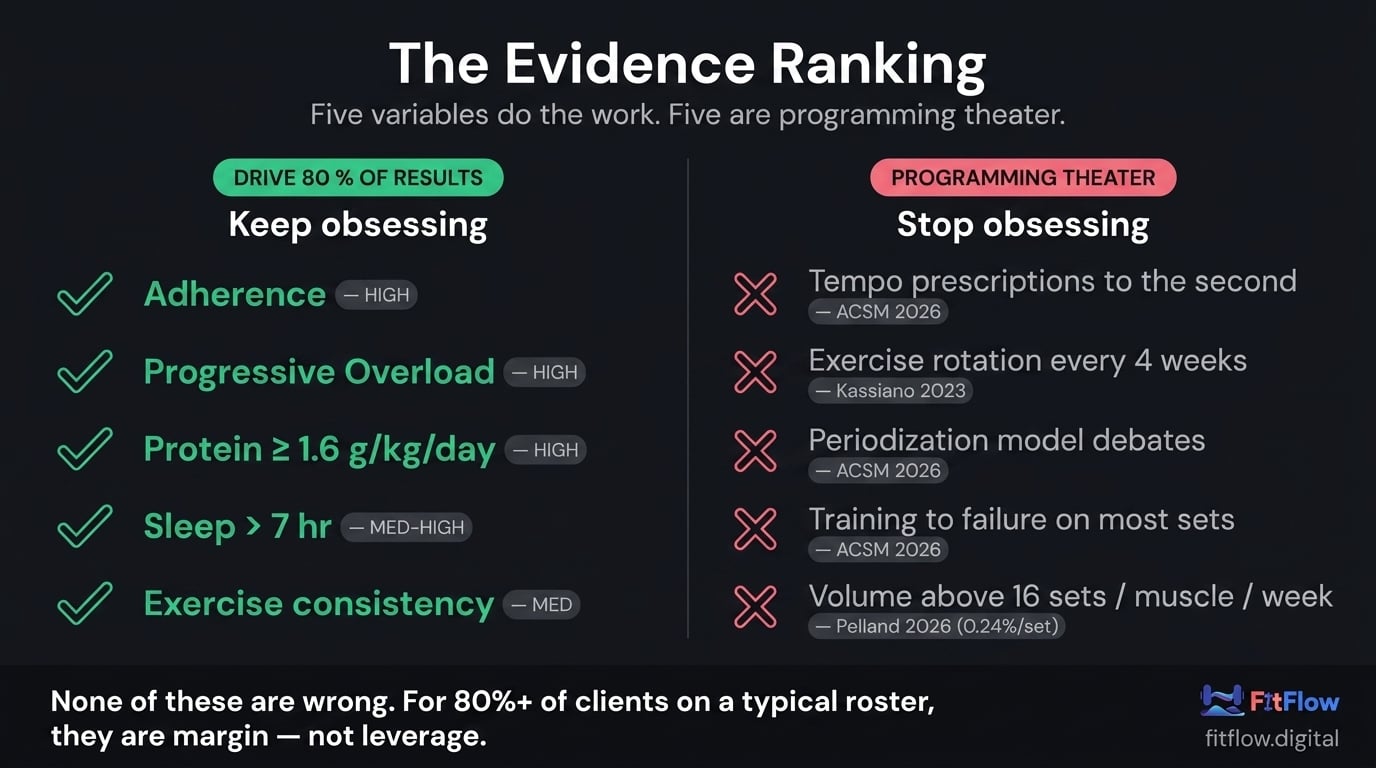
Tempo prescriptions to the second. A 3-1-2-0 tempo produces no hypertrophic advantage over "controlled eccentric, controlled concentric" at matched effort. The ACSM 2026 Position Stand lists eccentric emphasis as a legitimate overload variable but does not support second-by-second tempo notation as a superior prescription [Lees et al., 2026]. Coach controlled movement. Drop the stopwatch.
Exercise rotation every 4 weeks. Exercise variation does not improve hypertrophy when volume is equated [Kassiano et al., 2023]. It does slow skill acquisition and cap progressive overload. Rotate every 12 weeks, or when client preference or equipment constraints demand it — not on a calendar.
Periodization model debates. Undulating vs. block vs. conjugate vs. linear — the ACSM 2026 Position Stand explicitly concluded that periodization models do not consistently outperform one another for the average adult [Lees et al., 2026]. Pick one. Use it for 12 weeks. Move on.
Training to failure on most sets. The ACSM 2026 Position Stand stated directly that training to momentary muscular failure does not enhance strength, hypertrophy, or power gains compared with stopping 2-3 reps short [Lees et al., 2026]. Target 2-3 RIR on working sets. Recovery quality and subsequent session performance improve as a result. The RIR scale itself is validated to r=0.88-0.91 reliability in trained lifters [Zourdos et al., 2016 — PMID 26049792], which means it is a trainable variable, not a subjective feel.
Volume above 16 sets per muscle per week for most clients. The February 2026 Sports Medicine meta-regression quantified that above 12.25 sets per muscle per week, each additional set adds 0.24% hypertrophy [Pelland et al., 2026 — PubMed 41343037]. For the typical client, 10-16 sets per muscle per week is the productive range. Above that, you are buying fatigue with marginal gains.
None of these are wrong under every condition. Elite clients, specific sport demands, advanced bodybuilders near their genetic ceiling — at those margins, these variables matter. But for 80%+ of the clients on a typical trainer's roster, obsessing over them steals attention from the five variables that actually drive results.
How to Run the 80/20 Training Audit
This is a 6-step procedure to diagnose which of the 5 leverage variables is capping a specific client's results. Run it at every 4-week check-in. Run it on every new client. Run it on every plateaued client. Once you have the data in front of you, it takes under 10 minutes per client.
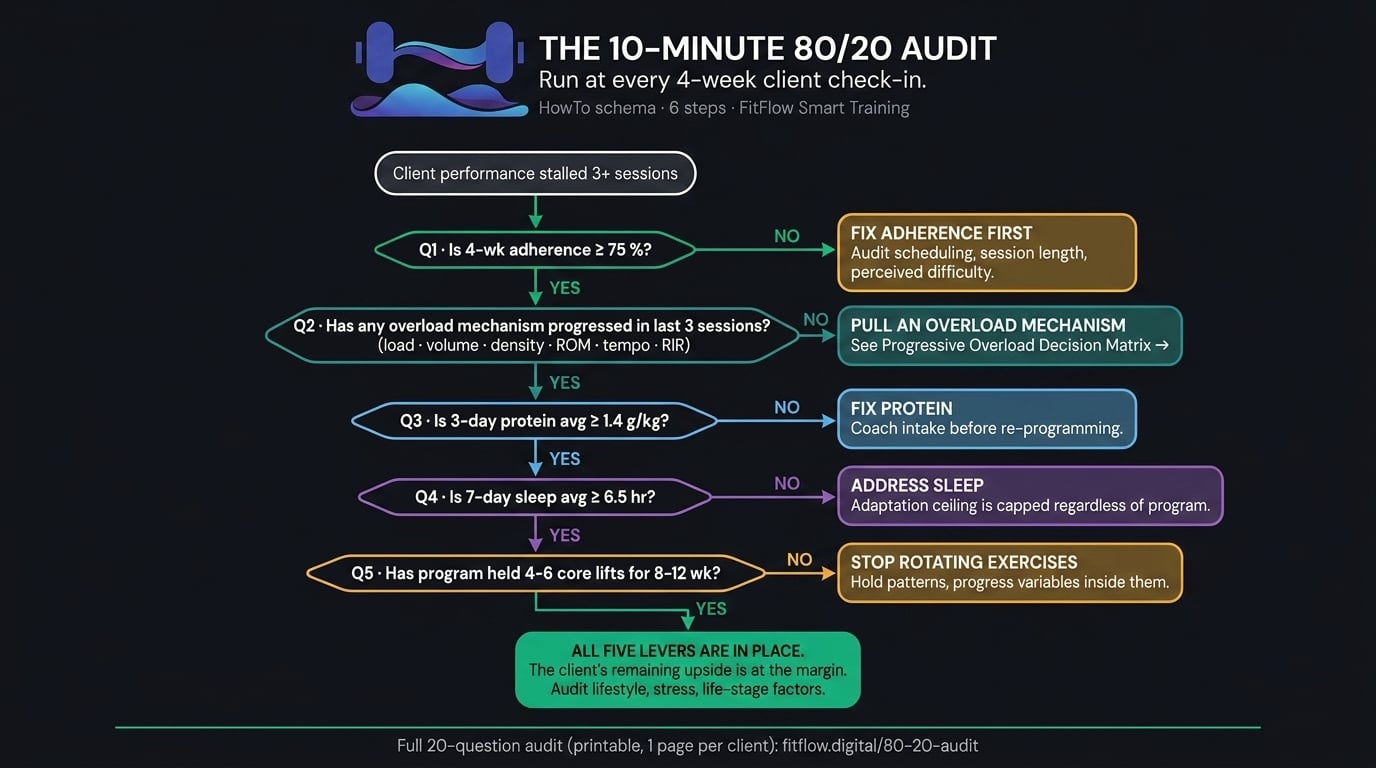
Pull the 4-week adherence rate. Count completed vs. prescribed sessions over the last 28 days. If below 75%, adherence is the lever — stop here and investigate scheduling, session length, perceived difficulty, and client engagement. Do not modify the program.
Check progressive overload status. For the client's top 3 movements, has the load, volume, density, ROM, tempo, or RIR progressed in the last 3 sessions? If no, overload has stalled — identify which of the 6 mechanisms to pull per the overload decision matrix.
Screen protein intake. Ask the client to report 24-hour protein intake for three recent days. If the average is below 1.4 g/kg/day, protein is the lever. Below 1.2 g/kg/day, it is the only lever that matters.
Screen sleep duration. Ask for 7-day average sleep duration. Below 6.5 hours, sleep is capping adaptation. Below 6 hours, no program change will produce progress until sleep moves.
Audit exercise rotation frequency. Has the client's program rotated core movements in the last 8 weeks? If yes and results are plateaued, exercise consistency is the lever — revert to the prior movement pattern and hold for 8-12 weeks.
Rank-order the findings. List which of the 5 variables flagged above needs intervention. Work them in rank order: adherence first, then overload, then protein, then sleep, then exercise consistency. Change one variable at a time, in that order. The lead magnet below walks through 20 specific diagnostic questions across these 6 steps in a printable format.
Conclusion
Most of what fills a training program does not change outcomes. Five variables do. The ACSM 2026 Position Stand, the February 2026 Sports Medicine meta-regression, and the 15,000-person Steele cohort converge on the same hierarchy — adherence, progressive overload, protein at threshold, sleep ≥ 7 hours, exercise consistency. Treat everything else as margin.
When you audit your book of business this quarter, run the 80/20 on every client. The work you thought justified your fee is not the work that was driving results — the leverage is elsewhere. That knowledge frees up hours per week you can spend on acquisition, retention, or rest.
If you are optimizing your own training, the same rule applies: before you debate a tempo prescription or research the optimal split, check your adherence rate, your protein intake, and your sleep. If any of those three is not dialed in, no programming change will fix what your lifestyle is capping.
For the full evidence base on periodization, volume landmarks, and exercise selection, see our evidence-based program design pillar guide. For the recovery side of the equation, see Recovery as a Growth Lever. FitFlow's client tracking system makes the 5 leverage variables visible across your entire book of business, so the 80/20 audit becomes an automated dashboard instead of a manual pass.

Download the 80/20 Training Audit
You have read the ranked framework. Now turn it into a tool you actually use.
The 80/20 Training Audit walks through 20 diagnostic questions across the 5 leverage variables, scores each one pass/borderline/fail against peer-reviewed thresholds, and produces a ranked intervention plan you can run in the next 2 weeks. Print one per client. Run it at every check-in.
What you get (free, no credit card):
5-driver leverage matrix (one-page reference)
- 20 evidence-anchored questions with deterministic scoring
- Triage interpretation guide + 4 client archetypes
- 2-week intervention template per driver
- Single-page printable quick-reference card
Frequently Asked Questions
Comments