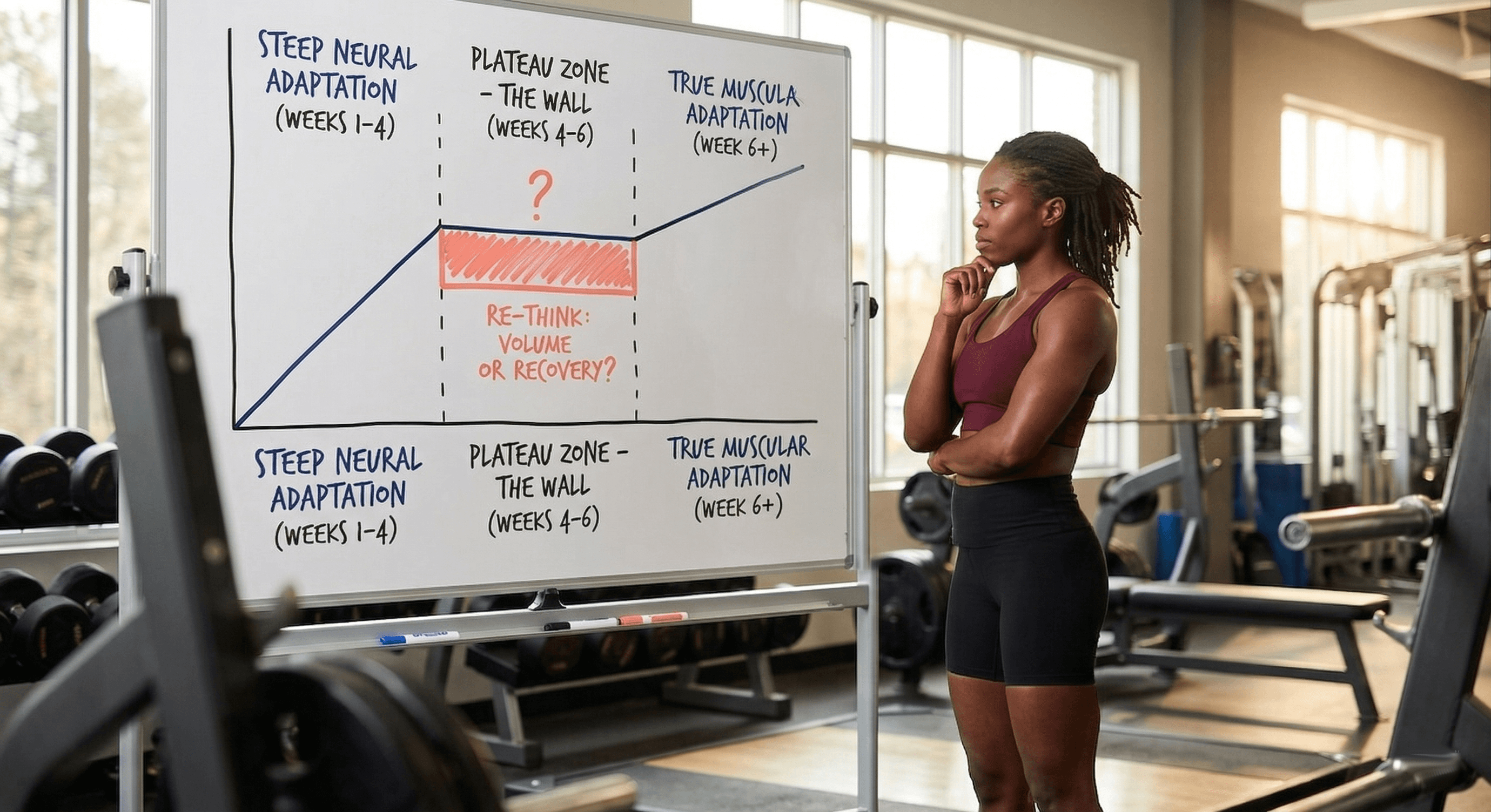
Stop Changing Exercises. Fix This Instead.

Your client is not bored with the exercise. They are bored because they are not getting stronger at it. And every time you swap it out, you restart the adaptation clock to zero.
This is the conversation every trainer managing more than a handful of clients has had — probably this week. A client six weeks into a well-designed program says the program feels stale. They want something new. The temptation is to give it to them. The evidence says that is exactly the wrong move.
In March 2026, the American College of Sports Medicine published its first resistance training guideline update in 17 years — a synthesis of 137 systematic reviews covering more than 30,000 participants. The message relevant here: "repeated exposure" to a training stimulus is the mechanism of adaptation. Consistency over complexity. Muscle confusion is not mentioned in the document, because it is not a physiological principle.
Why you should not change exercises often comes down to a simple cost: every swap resets the neural adaptation window and eliminates the progressive overload baseline your client was building. If you manage 25 clients and swap exercises every 3-4 weeks when clients ask, you spend more time explaining new movements than accumulating progressive overload on the ones that were working. The client feels entertained. The results data tells a different story. If you have ever been told that you need to "confuse" your muscles, or that doing the same exercises makes you plateau, this post is the evidence-based counterargument.
This post makes the case for exercise consistency — and gives you the specific framework for deciding when a change is actually warranted versus when it is a novelty request disguised as a programming decision.
12 Questions. 3 Gates. One Decision Before Any Exercise Change. Get the Free Audit.
Why Clients Keep Asking to Change Exercises
The request to change exercises is predictable, recurring, and biologically driven. It is not a sign that something is wrong with the program. It is a sign that the client's nervous system has shifted from the novelty feedback phase to the adaptation feedback phase — and the second phase feels worse before it feels better.
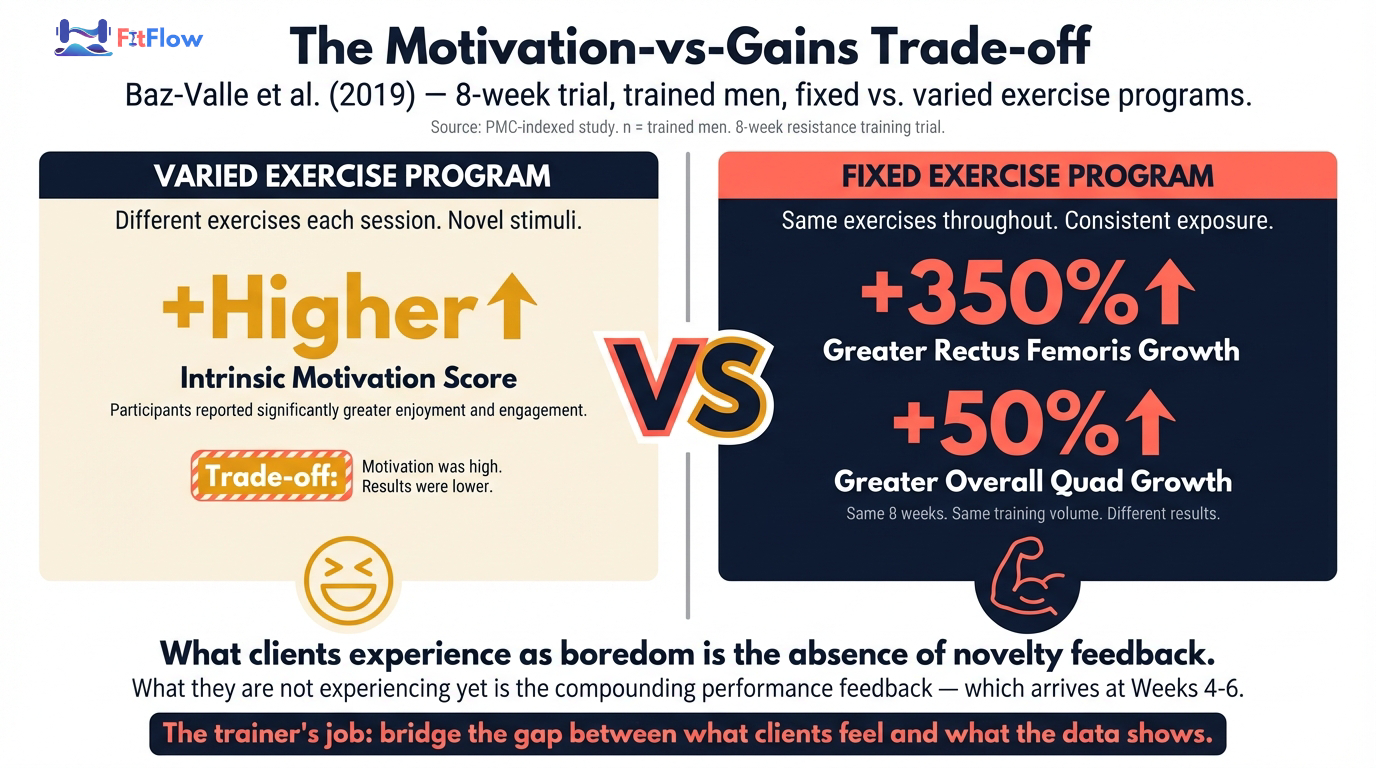
A 2019 study by Baz-Valle and colleagues compared trained men on fixed versus varied exercise programs for 8 weeks. The varied group reported significantly higher intrinsic motivation. The fixed group had 350% greater rectus femoris growth and 50% greater overall quad growth. The clients who were more motivated to train got worse results.
That is the central tension. What clients experience as boredom is often the absence of novelty feedback — the dopamine hit of learning a new movement. What they are not yet experiencing is the compounding performance feedback of getting measurably stronger at a movement they have been doing for 8 weeks. The first kind of feedback peaks early. The second kind does not arrive until week 4-6, after the initial neural adaptation plateau resolves and actual strength gains begin to compound.
The timing matters right now. If you are reading this in Q2 2026, your New Year cohort is 12-16 weeks in. This is historically the highest-risk window for program hopping — motivation is declining from its January peak, initial novelty gains have plateaued, and clients are attributing the slowdown to the exercises rather than to the timeline. This is not a coincidence. It is a predictable biological pattern.
Every trainer who has managed clients for three or more years has seen this pattern. A client says "I'm bored with squats" in week 6 of a program. The trainer changes to leg press. The client feels fresh novelty for two weeks. Then asks to switch again. The boredom was never about squats. It was about the gap between expected progress and actual adaptation timelines — a gap that resets every time you change the movement.
The Adaptation Clock: What Actually Happens When You Switch Exercises
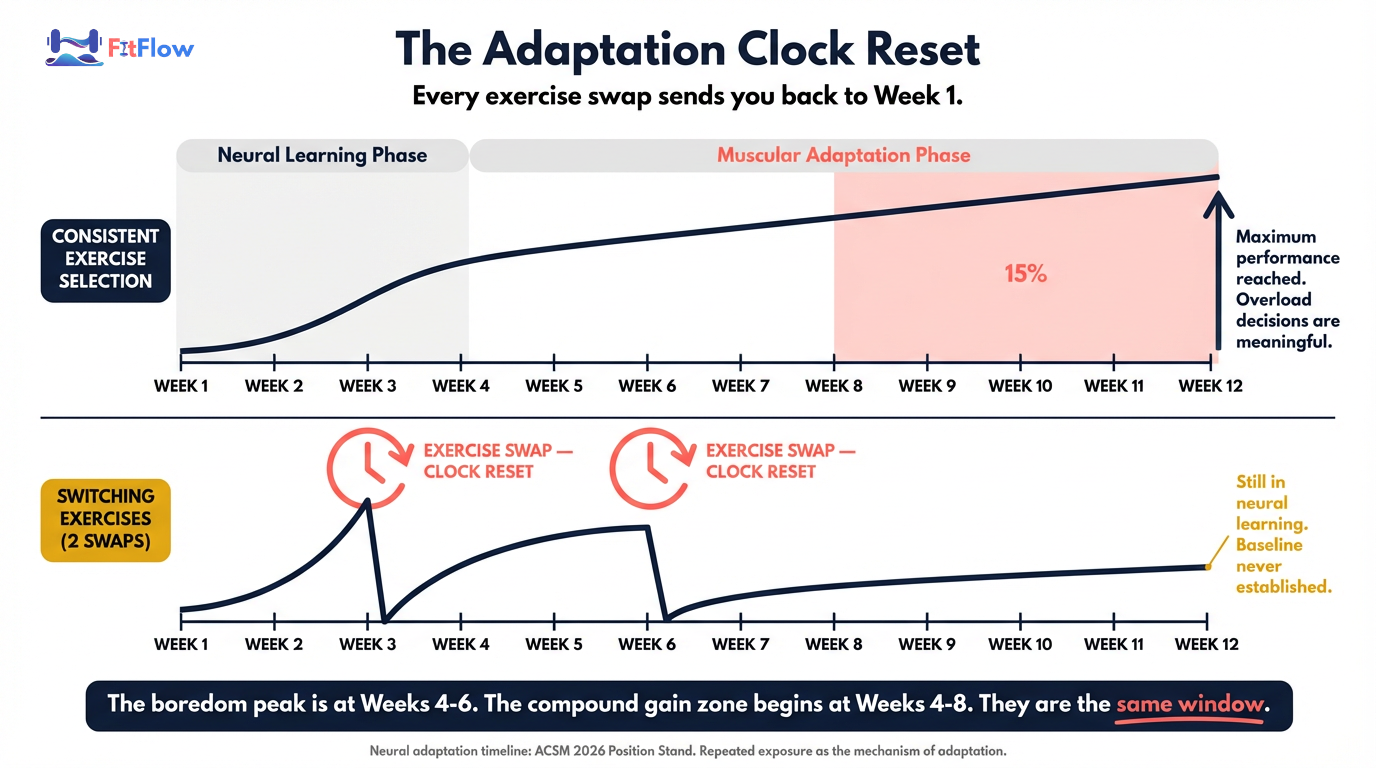
When you start a new exercise, the first 2-4 weeks of performance improvement is almost entirely neural — your nervous system is learning to recruit the motor units required for that specific movement pattern efficiently. This is why beginners make rapid strength gains even with trivial loads: they are not building muscle yet. They are learning to use the muscle they already have.
Change the exercise in week 3, and you restart this neural learning process from zero. You did not give the movement enough time to produce the adaptation that would feel like progress. You replaced a movement pattern that was beginning to compound with a movement pattern that will require another 3-4 weeks of neural learning before it even competes.
Progressive overload — adding load, reps, or sets in a structured way — requires a stable movement baseline. You cannot meaningfully overload an exercise you changed three weeks ago. The performance data from weeks 1-3 on a new movement is unreliable as a baseline because it reflects neural learning, not muscular capacity. The performance data from weeks 4-6 is where actual overload decisions can be made. For the full science of how progressive overload drives adaptation across training blocks, see Evidence-Based Program Design.
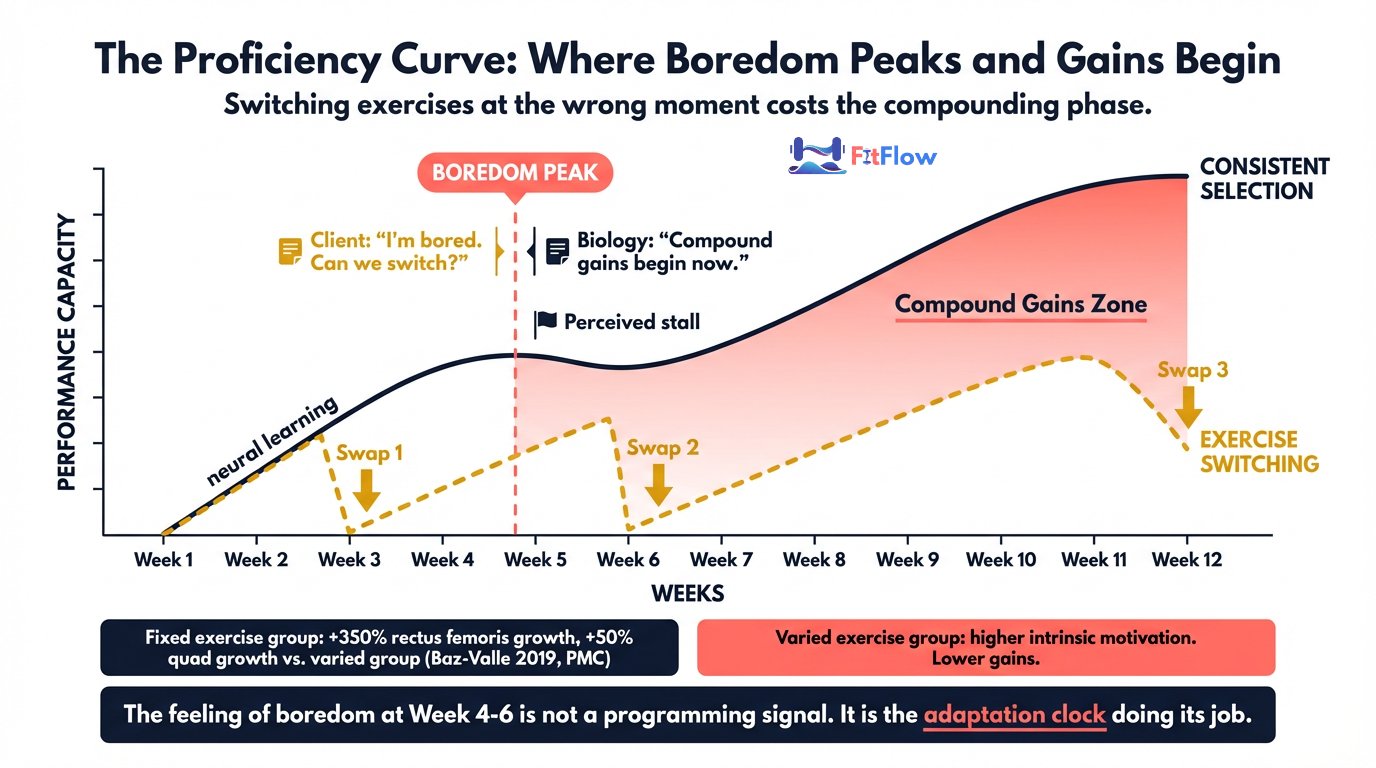
This is why the ACSM 2026 guidelines frame adaptation as resulting from "repeated exposure." Not periodic variation. Not muscle confusion. Repeated exposure to the same tension across multiple training blocks. The NFPT trainer analysis of the guidelines put it directly: complex periodization did not consistently improve outcomes for the average healthy adult compared to simpler, consistent programming.
When a trainer changes exercises frequently, the performance tracking chart shows a consistent pattern: weights and reps reset every 4-6 weeks, never compounding. The client never breaks through to the heavier loads that drive meaningful hypertrophy or strength. They are perpetually in the neural learning phase — always starting, never progressing. If you want to understand how this reset pattern intersects with the periodization failures that cause hypertrophy programs to stall at 6 weeks, see Why Most Hypertrophy Programs Fail After 6 Weeks.
The Muscle Confusion Myth — One Paragraph, Done
Muscle confusion was popularized by P90X's marketing in the mid-2000s as a rationale for constant exercise variety. It is not a peer-reviewed concept. It is a product positioning strategy that became gym culture orthodoxy.
Muscles do not get confused. They adapt, plateau if the stimulus does not progress, and respond to increased tension and volume — not to novelty. The confusion you feel when doing an unfamiliar exercise is your nervous system learning a new pattern. That is a cost, not a benefit. Kassiano and colleagues (2022) — a systematic review of 8 studies with 241 participants — found that "excessive, random variation may compromise muscular gains." The evidence base for muscle confusion as a training strategy does not exist. The evidence base for exercise consistency as a training strategy does.
Now for the legitimate question: when is it actually time to change an exercise?
When It IS Time to Change an Exercise
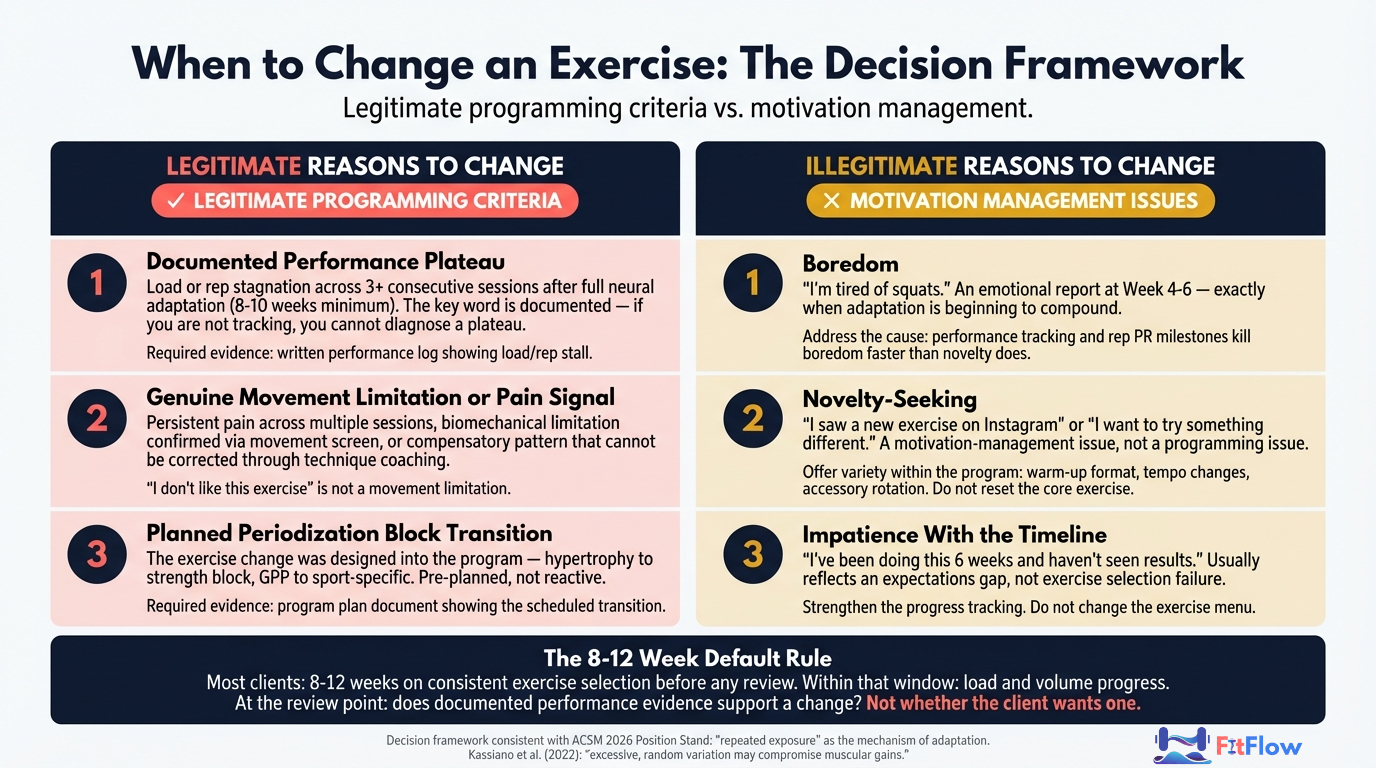
Exercise consistency is the default. But it is not an absolute. There are clear, specific conditions under which an exercise change is the correct programming decision — and equally clear conditions under which it is not. The distinction is whether the decision is driven by data or by preference.
The Three Decision Gates (and Three Ways to Fail Them)
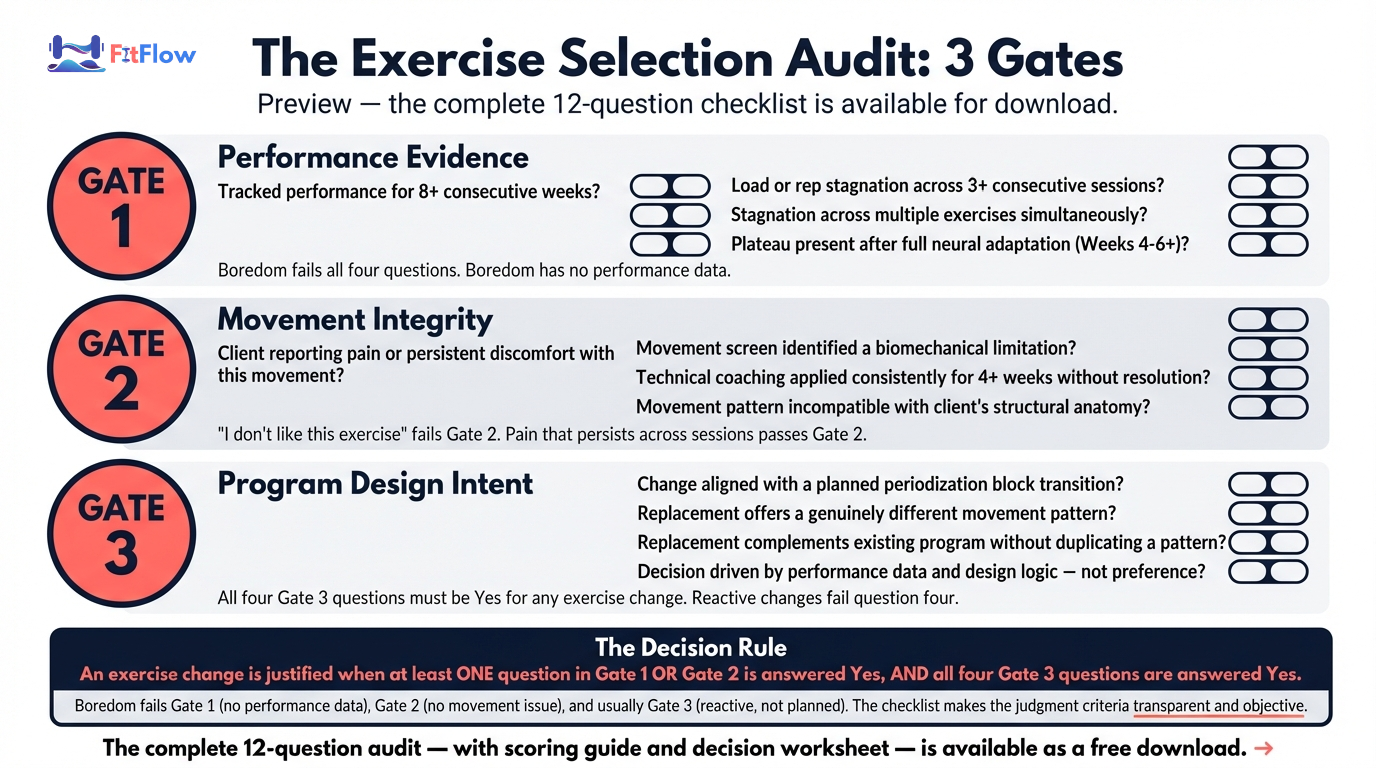
Every exercise change must pass through three gates — performance evidence, movement integrity, and program design intent. If none of these gates open, the answer is not a new exercise. It is better tracking and clearer communication.
The three gates — legitimate reasons to change an exercise:
Gate 1: Performance evidence. Documented load or rep stagnation across 3+ consecutive sessions after full adaptation — 8-10 weeks minimum. The key word is "documented." If you are not tracking, you cannot diagnose a plateau. You are guessing.
Gate 2: Movement integrity. A biomechanical issue, pain that persists across sessions, or a compensatory pattern identified via movement screen. "I don't like this exercise" is not a movement limitation. "My shoulder clicks when I press" requires assessment.
Gate 3: Program design intent. The program is designed to move from a hypertrophy block to a strength block, or from a general preparation phase to a sport-specific phase. The exercise change is pre-planned, not reactive. It is built into the program architecture before the client ever asks.
Three ways to fail all three gates:
Boredom. "I'm tired of squats" is an emotional report, not a programming signal. Boredom peaks at 4-6 weeks — exactly when adaptation is beginning to compound. Changing the exercise at this point is removing the movement at the moment it starts producing returns. No performance data (fails Gate 1), no movement issue (fails Gate 2), not pre-planned (fails Gate 3).
Novelty-seeking. "I saw a new exercise on Instagram" or "I want to try something different" is a motivation-management issue, not a programming issue. Address the motivation. Do not change the program.
Impatience with the timeline. "I've been doing this for 6 weeks and haven't seen results" often reflects unrealistic expectations about adaptation timelines, not exercise selection failure. The solution is better tracking and clearer expectation-setting — not a new exercise menu.
The 8-12 Week Default
The default for most clients is 8-12 weeks on a consistent exercise selection before any review. Not 4 weeks. Not 6. Eight to twelve. Within that window, load and volume progress. At the review point, the question is whether documented performance evidence supports an exercise change — not whether the client wants one. If you need the program structure that supports this timeline, see The Simplest Way to Structure a Client Program That Actually Works.
You Just Read the Three Reasons to Change and Three Reasons Not To. The Audit Makes It a Decision Tool. Download the Audit.
What to Say When a Client Asks to Change Exercises
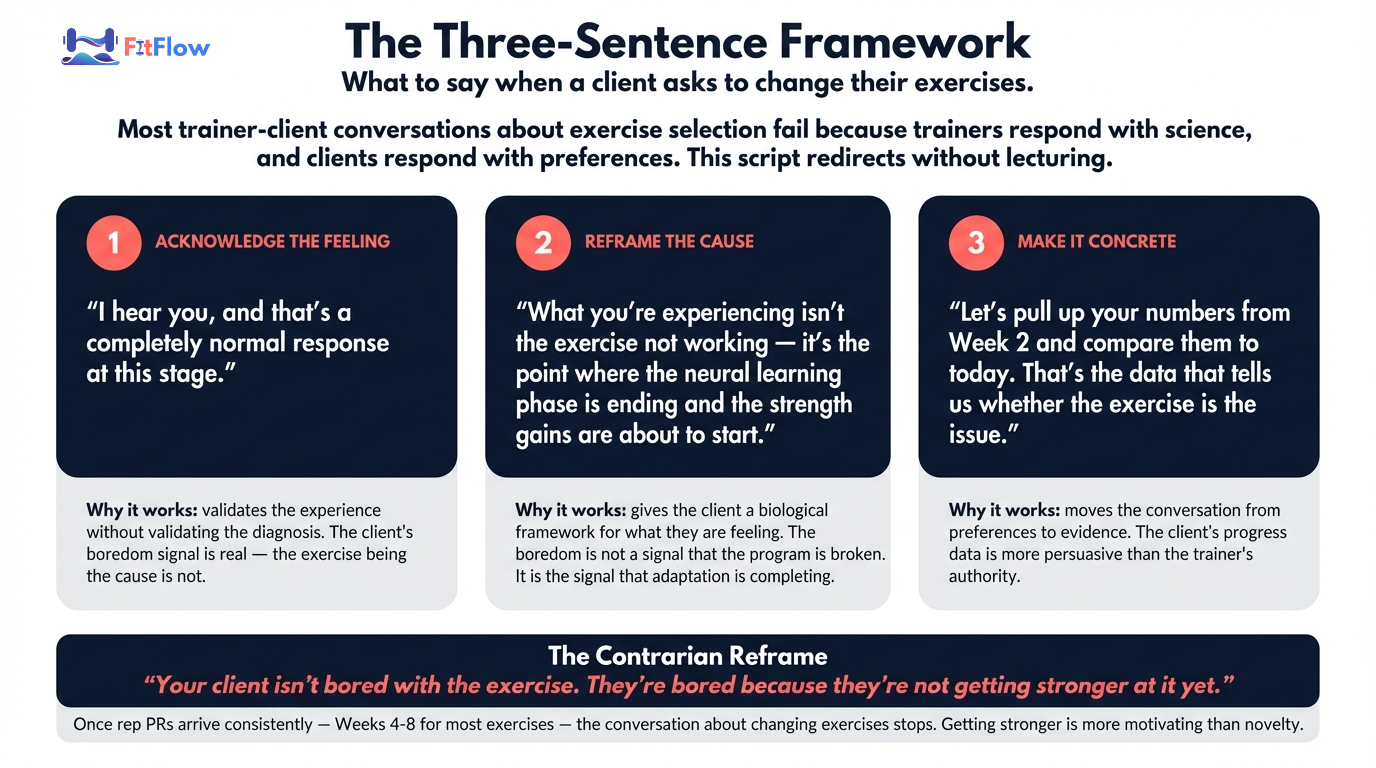
Most trainer-client conversations about exercise selection fail because trainers respond with science, and clients respond with preferences. The science is correct. The communication strategy is wrong. Here is a framework that redirects the conversation without lecturing.
The Three-Sentence Framework
When a client says "I'm bored with this exercise" or "Can we try something different?":
Sentence 1 — Acknowledge the feeling: "I hear you, and that's a completely normal response at this stage of the program."
Sentence 2 — Reframe the cause: "What you're experiencing isn't the exercise not working — it's the point where the initial learning phase is ending and the measurable strength gains are about to start."
Sentence 3 — Make it concrete: "Let's pull up your numbers from week 2 and compare them to this week. That data tells us whether the exercise is actually the issue."
This works because it does three things simultaneously: it validates the client's experience (they do not feel dismissed), it provides a credible alternative explanation (the boredom has a biological cause they can understand), and it redirects the conversation from subjective preference to objective performance data.
The Boredom Reframe
Your client is not bored with the exercise. They are bored because they are not getting stronger at it yet. Once they start hitting rep PRs consistently — which happens between weeks 4-8 for most exercises — the conversation about changing exercises stops. Getting stronger is more motivating than novelty. The exercise was never the problem. The visible progress data was.
This is the single most useful reframe a trainer can internalize. The client who wants to change exercises is not experiencing a programming problem. They are experiencing a feedback problem. Fix the feedback — show them the data, celebrate the incremental wins, make the progress visible — and the variety request resolves itself.
The Variety Offer
Acknowledging the legitimate role of variety in client motivation does not require capitulating on core exercise selection. Offering variation within the program structure — different warm-up formats, tempo changes, accessory exercise rotation, session environment changes — manages the boredom signal without disrupting the adaptation pattern. You can give clients the feeling of novelty without resetting their adaptation clock.
The distinction is between core movements and accessory movements. Core movements (the compound lifts driving the program's primary adaptation targets) stay fixed. Accessory movements (isolation work, warm-up variations, finishers) can rotate more freely because they are not the primary progressive overload vehicles.
The Efficiency Case for Consistent Programming
A stable exercise selection across your client roster means faster session planning, cleaner progress tracking, and easier progress conversations. When every client is on the same squat variation for 10 weeks, you know exactly what a plateau looks like. When you swap exercises every 4 weeks across 30 clients, you have no baseline for anything. The administrative cost of constant variation is invisible but real — and it compounds as your roster grows.
If the client's boredom is actually a symptom of inadequate recovery — chronic fatigue, poor sleep, or nutrition gaps that make every session feel harder than it should — the conversation about exercise selection is the wrong conversation entirely. What looks like "I'm bored" may actually be "I'm exhausted and I don't know how to say that." See Why Your Clients Are Not Recovering for the diagnostic framework. And if the deeper problem is not the client's behavior but your delivery system — inconsistent tracking, no progress visibility, unclear expectations — see Your Training Program Is Not the Problem. Your System Is.
The Adaptation Clock Does Not Care About Preferences
The adaptation clock resets every time you swap an exercise. Your clients are not bored with their program. They are impatient with a process that is working. The job is not to keep them entertained. The job is to keep them getting stronger.
Three things to take from this post:
Default to 8-12 weeks on core exercise selection before any review. Let the adaptation window close before evaluating whether the exercise is the problem.
Use the three-sentence framework when the conversation comes up. Acknowledge the feeling, reframe the cause, make it concrete with data.
Apply the three-gate test before any exercise change. Is there documented performance evidence? Is there a genuine movement limitation? Is the change pre-planned? If none of these gates are satisfied, the answer is not a new exercise — it is better tracking and clearer communication.
If you have not built the program this post is defending, start with The Simplest Way to Structure a Client Program That Actually Works. If you are not sure why the program is underperforming despite sound exercise selection and consistent structure, see Your Training Program Is Not the Problem. Your System Is.
Three Gates. Twelve Questions. One Decision Rule. The Exercise Selection Audit Is Free. Get the Free Audit.