
Progressive Overload Is Misunderstood. Here's the Reality.
One of your clients hit a wall. They have been training consistently for four months. You ran the program exactly as written. The sets went up, the reps went up, the weight went up -- until it didn't. Now you are three weeks past the last weight increase, they are asking questions you do not have a clean answer for, and you are running the same variable that already stalled.
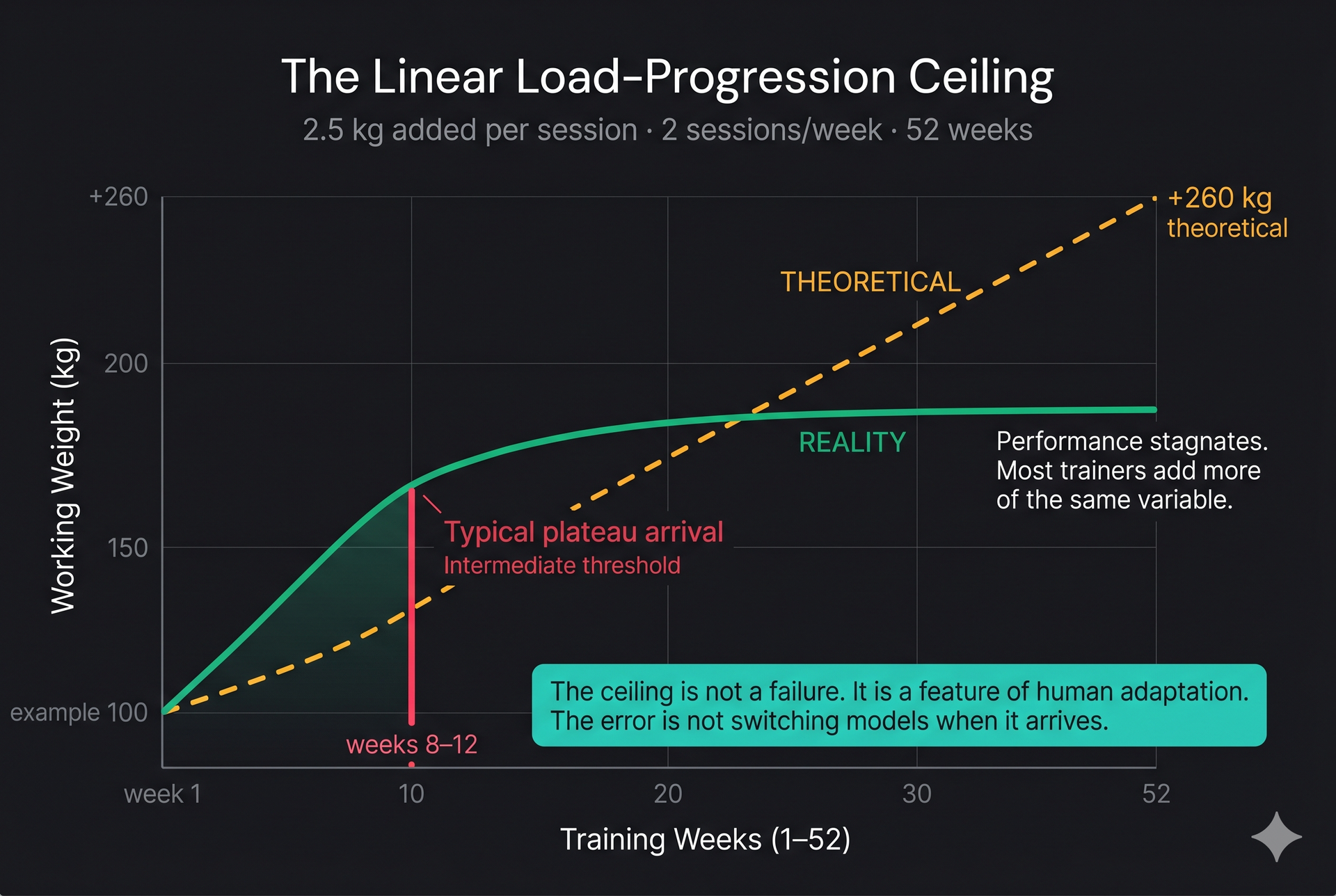
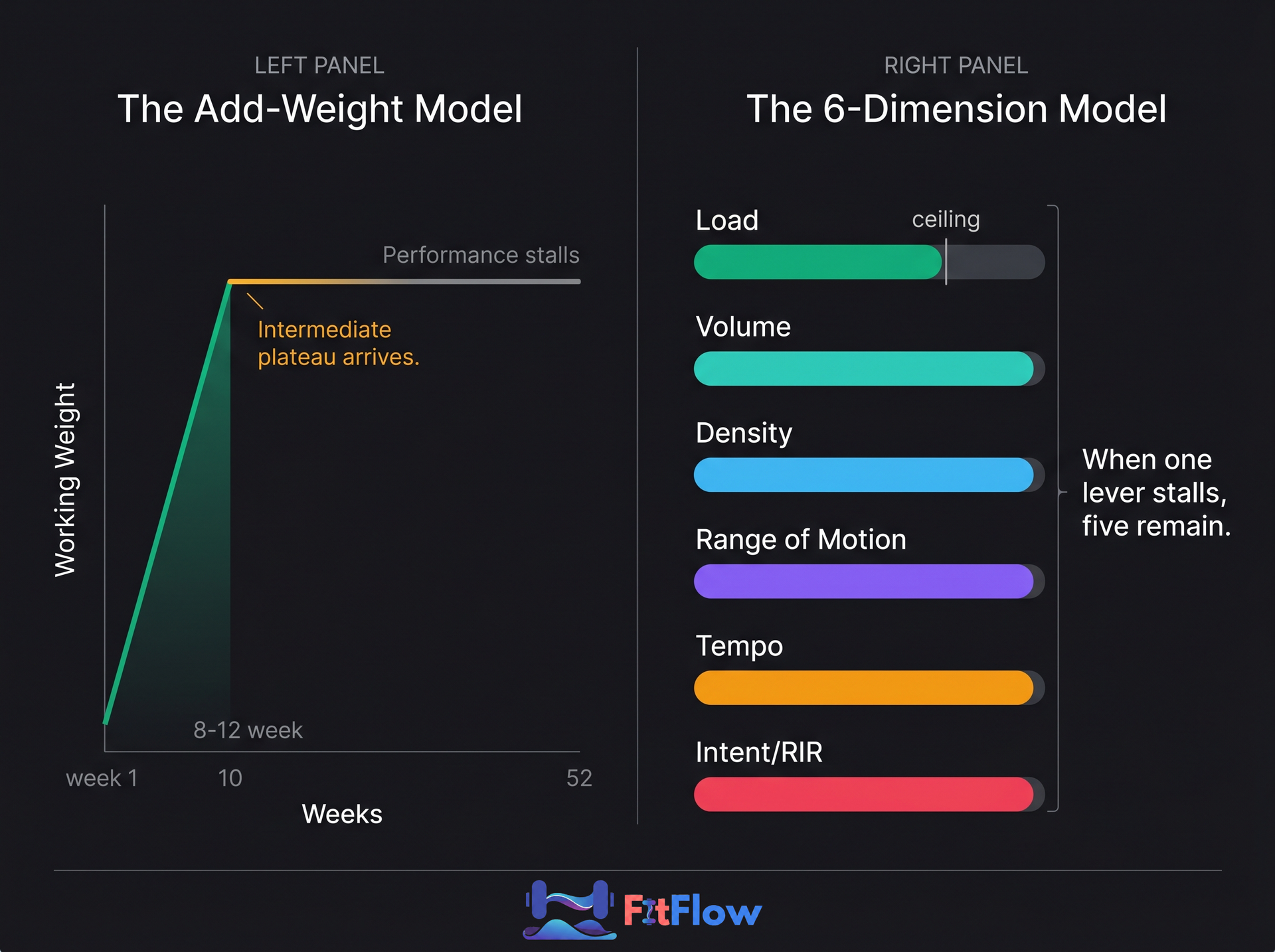
That is not a client failure and it is not a program failure. It is a model failure. The "add weight every session" model of progressive overload has a ceiling -- and for most clients, that ceiling arrives within 8-12 weeks of consistent training. What comes after that ceiling is the part nobody taught you.
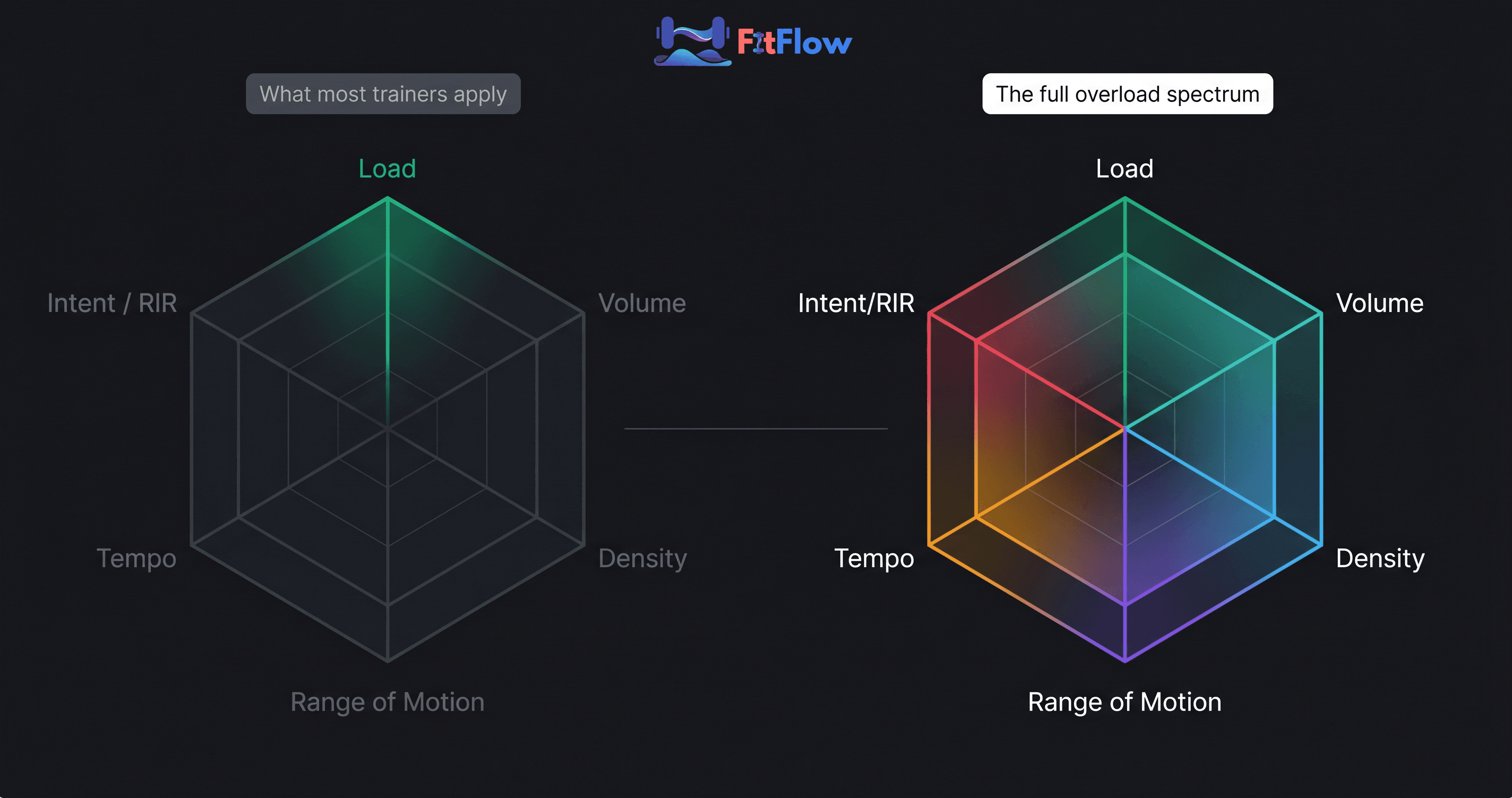
Progressive overload is not one thing. It is six. Load is the most intuitive and the most limited. Volume, density, range of motion, tempo, and effort management (RIR) are the other five. Trainers who operate with the full spectrum solve plateaus that trainers with a single dimension cannot.
We built the Progressive Overload Decision Matrix -- a 6-dimension guide to which variable to progress, when, and for which client. Download it free at the bottom of this article.
Download the Progressive Overload Decision Matrix Kit.
The reason this misunderstanding persists is not because trainers are careless. The "add weight" model was the right teaching for novice lifters because load IS the most effective single variable early in the adaptation process. Novice neural adaptation responds disproportionately to load increases, which is why every beginner who adds 2.5 kg per session sees rapid results. The problem starts when the model graduates from a useful starting point to a permanent framework. Certification curricula, fitness apps, and gym culture all reinforce the load-centric model because it works -- until it doesn't. And when it stops working, most trainers have no systematic alternative.
The ACSM 2026 Resistance Training Position Stand -- the most comprehensive review of resistance training science in 17 years, synthesizing 137 systematic reviews covering over 30,000 participants -- confirmed what the research has been showing for a decade: progressive overload is accomplished through load, volume, proximity to failure (RIR), and tempo, not through load alone Lees et al., 2026. That is not a nuance. That is a framework correction.
The Progressive Overload Myth
Progressive overload means placing greater demand on your body than it currently handles -- causing it to adapt to a higher baseline. Load addition is one way to create that demand; volume, density, range of motion, tempo, and effort management are five others.
What Trainers Think Progressive Overload Means
Most trainers learned progressive overload as a single instruction: add 2.5-5 kg (5-10 lb) per week to the working weight. This is the Starting Strength model. For absolute beginners with a 3-month training age, it is an appropriate prescription. For intermediate clients -- which is where most of your roster lives after 6-12 months -- it is a fiction maintained by well-intentioned coaching culture.
Brad Schoenfeld, the world's most-cited resistance training researcher according to ExpertScape rankings, has stated this directly: "People often think that 'progressive overload' means adding load to the bar over time. However, this is just one of many strategies to achieve overload. The key is to challenge your muscles beyond their present capacity, which can be accomplished in myriad ways" Schoenfeld, 2023.
NASM, ACE, and ISSA all define progressive overload as a broader principle in their certification materials. The 10-point definition in the certification manual covers multiple overload strategies. But the practical application of that 10-point definition collapses into "add weight" in practice -- because load is the most concrete, most easily tracked, and most intuitive single variable. If you learned progressive overload as "add 2.5 kg per week," you learned a useful starting point that nobody told you had an expiration date.
Where the "Add Weight Every Session" Model Breaks
The linear load-progression model has a mathematically predictable ceiling. A trainer who adds 2.5 kg per session, two sessions per week for a squat, demands a 260 kg annual increase in working weight. That is physiologically impossible for approximately 99% of the training population. The ceiling is not a failing; it is a feature of human adaptation. The error is not in the linear model itself but in the failure to switch models when the ceiling arrives.
Training age determines when that ceiling appears. Novice trainees (0-12 months of consistent training) can sustain session-to-session or weekly load increases. This window closes within 6-12 months for most clients NSCA, Time Course of Physiological Adaptations. Early intermediate trainees (1-2 years) can add load every 1-2 weeks. Intermediate trainees (2-5 years) may add load monthly or within structured mesocycle blocks. Advanced trainees (5+ years) measure meaningful load progress in 4-12 week blocks -- if at all within a single training cycle. At each stage, the remaining five overload variables must carry an increasing share of the progressive stimulus.
Training Age | Load Progression Rate | Primary Overload Variables |
|---|---|---|
Novice (0-12 months) | Session-to-session / weekly | Load (primary) |
Early Intermediate (1-2 years) | Every 1-2 weeks | Load + Volume (co-primary) |
Intermediate (2-5 years) | Monthly / within blocks | Volume, Density, ROM, Tempo |
Advanced (5+ years) | 4-12 week blocks | All six in active rotation |
A direct comparison published in PeerJ found that load progression and repetition progression produce equivalent hypertrophic outcomes when effort is equated. The mechanism driving adaptation is the overload stimulus itself -- not the specific variable used to generate it Plotkin et al., 2022. A separate 2024 meta-analysis of resistance training overload progression protocols reached the same conclusion: multiple progression strategies produce comparable strength and muscle mass outcomes Nunes et al., 2024.
Research published in the Journal of Physiology in 2026 stated it with maximum clarity: resistance training load does not determine resistance training-induced hypertrophy, as long as effort is adequate Lees et al., 2026. That single finding collapses the entire load-first paradigm for hypertrophy-focused training.
When your clients stop responding to load increases, they have not run out of overload options. They have reached the ceiling of one variable. The other five are waiting.
The 6 Dimensions of Progressive Overload
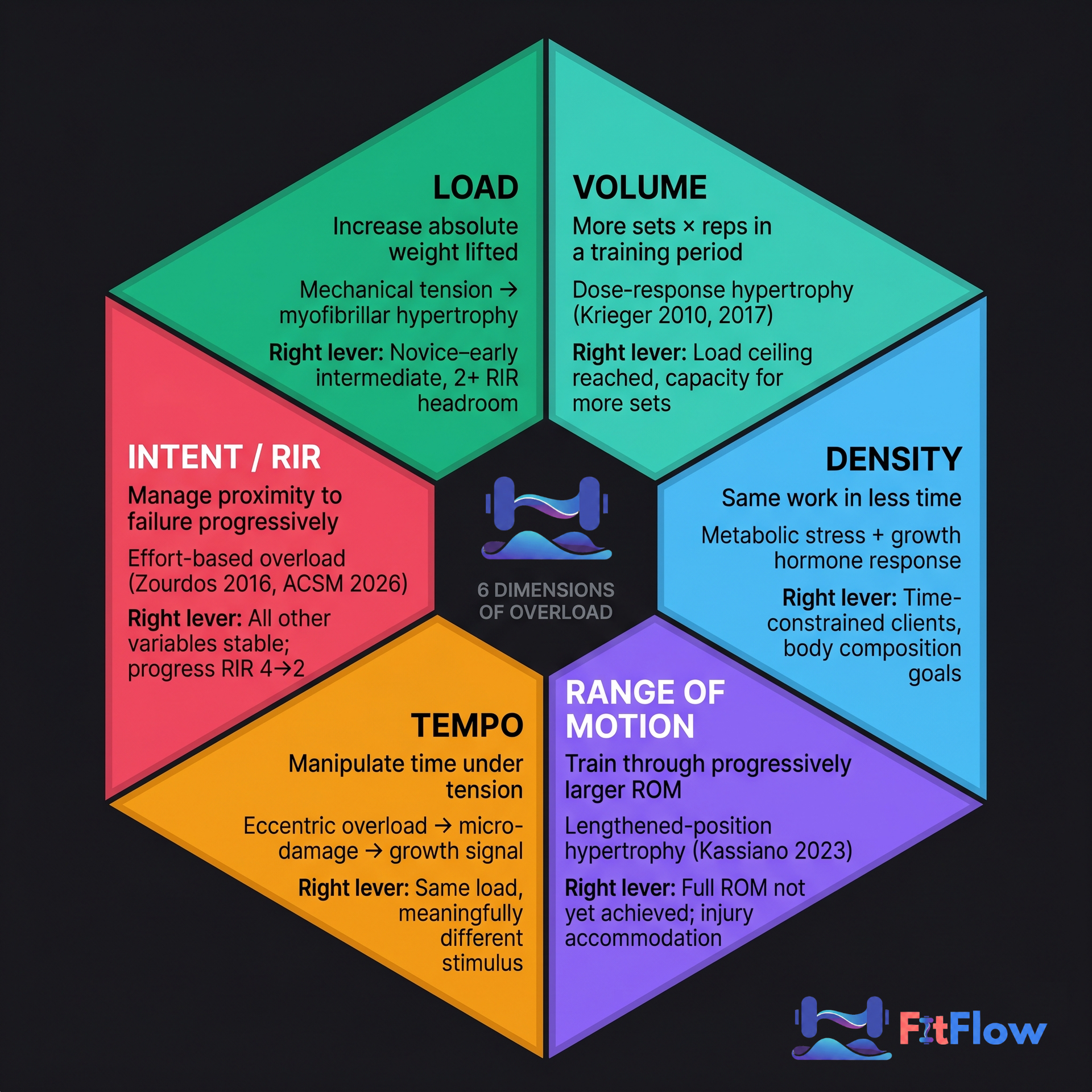
Progressive overload operates across six distinct dimensions. Load is the first and most intuitive. But when load progression stalls -- and it always does eventually -- the remaining five are not fallbacks. They are equally legitimate overload mechanisms with distinct physiological targets, timing windows, and training-age applications. Understanding all six is what separates a trainer who loses clients at the plateau from a trainer who navigates through it.
1. Load
Load overload means increasing the absolute weight lifted across equivalent reps and sets. It works because mechanical tension is the primary driver of myofibrillar hypertrophy and maximum strength development. Under progressive load, muscle fibers recruit at higher thresholds, motor unit synchronization improves, and the structural demand on connective tissue increases in proportion to the external force.
Load is the right lever for novice and early intermediate clients on compound movements during strength-focused mesocycles. Specifically, it is appropriate when the client can complete the target reps with 2-3 RIR (reps in reserve) and has done so consistently for 2 or more sessions.
Load stalls when the client's maximum recoverable volume has been reached, when form deteriorates under load increase, or when movement quality caps the safe loading range. Recognizing the stall is the skill. Continuing to chase load past it is where most programming errors originate.
2. Volume
Volume overload means increasing the total number of hard sets per muscle group within a given training period. The distinction matters: volume is measured in working sets at adequate effort, not total reps multiplied by total weight. A junk set at 6 RIR does not count.
The dose-response relationship between volume and hypertrophy is well-established. Krieger's systematic reviews demonstrated that multiple sets produce significantly greater hypertrophy than single sets, with a progressive dose-response curve that continues to climb until recovery capacity is exceeded Krieger, 2010. A subsequent meta-analysis confirmed the relationship: higher weekly set volumes produce greater muscle growth across a broad population, with diminishing returns at the upper end of individual recovery capacity Schoenfeld et al., 2017.
The ACSM 2026 Position Stand codified the minimum threshold: 10 or more sets per muscle group per week to maximize hypertrophic outcomes Lees et al., 2026. But the threshold is a floor, not a prescription. The RP Strength volume landmark system -- Maintenance Volume (MV) through Minimum Effective Volume (MEV), Maximum Adaptive Volume (MAV), and Maximum Recoverable Volume (MRV) -- provides the individualized framework for knowing how much volume a specific client can productively handle Israetel et al., RP Strength. For the complete volume landmark framework and how to apply it across mesocycles, see our evidence-based program design guide.
Volume is the right lever when the client is already operating at the upper end of their safe loading range but can handle additional working sets -- meaning energy system capacity exceeds structural loading capacity. An intermediate client who cannot add 2.5 kg to the bench press but finishes sessions with energy to spare is a volume candidate.
3. Density
Think of density as volume per unit time -- the same work in less time, or more work in the same time window. Density overload is achieved by shortening rest intervals, programming supersets, or compressing the same session into a tighter window without reducing total working sets.
The physiological mechanism differs from load-driven overload. Shorter rest intervals increase metabolic stress and elevate growth hormone release, which are secondary but meaningful drivers of sarcoplasmic hypertrophy and muscle endurance adaptation. The stimulus profile is distinct from the mechanical tension produced by heavier loads: density overload targets metabolic conditioning and work capacity, making it particularly effective for body composition goals and general fitness clients who respond well to session intensity.
Density is the right lever for general fitness clients who are not movement-limited, clients training on time-constrained schedules, and clients where the primary goal is body composition rather than maximal strength. It is NOT the right lever when training for maximal strength or power, where longer rest intervals (3-5 minutes) are required for full neuromuscular recovery between working sets.
Here is what density overload looks like in practice. A client who completed 4x8 squats with 3-minute rest periods last week and completes the same 4x8 with 2:15 rest periods this week has progressed -- even though the weight on the bar did not change.
4. Range of Motion
Range of motion overload means training through a progressively larger movement range on a given exercise. Recent evidence has strengthened the case for ROM as a deliberate overload variable: a systematic review by Kassiano and colleagues found that training at longer muscle lengths -- the stretched position -- produces greater hypertrophy than partial-range training, particularly for muscles that cross a single joint Kassiano et al., 2023.
Practical applications include progressing from parallel squat to below-parallel squat depth, deepening hip hinge range of motion in Romanian deadlifts, increasing shoulder ROM in overhead pressing, and using deficit deadlifts or deep-range lunges to extend the stretch at the bottom position.
ROM overload is the right lever when load cannot safely increase and the client has not yet achieved full technical range on the target movement. It applies when the goal is hypertrophy of a specific muscle in its lengthened position, and when the client is working around a load-limiting injury where moving through more range is feasible but adding weight is not. In GLP-1 populations and other special-population clients, ROM and technique overload often take priority over load and volume as the primary progressive variables.
ROM overload has a tissue adaptation ceiling of its own. Do not use ROM to chase range that the client's current mobility or connective tissue health cannot safely support. ROM progression in a loaded movement assumes baseline mobility already exists. If it does not, mobility work comes first.
5. Tempo
Tempo overload means manipulating the time under tension of a given set -- typically by slowing the eccentric (lowering) phase, adding an isometric pause at the bottom position, or controlling the concentric (lifting) phase. The four-digit tempo notation (e.g., 3-1-2-0: 3-second eccentric, 1-second pause, 2-second concentric, 0-second lockout) is the practitioner tracking tool.
Extended time under tension increases metabolic stress and micro-damage within the muscle fiber, particularly in the lengthened position. Slowed eccentrics specifically amplify mechanical damage to the sarcomere at long muscle lengths, which is a potent hypertrophy signal. The ACSM 2026 Position Stand explicitly identifies eccentric overload as a hypertrophy-enhancing variable, noting that eccentric-focused training produces equal or greater hypertrophic outcomes compared to concentric-only protocols Lees et al., 2026.
Tempo is the right lever when load cannot increase, when the client is a technique-focused novice who benefits from controlled movement speed, and when the goal is hypertrophy in a muscle group that has not responded to load-focused training. It is also the variable most clients underestimate -- and the one that produces the most immediate felt difference in training stimulus.
A 3-second eccentric at the same load produces a meaningfully different stimulus than a 1-second eccentric. The weight on the bar is identical. The overload is not.
6. Intent / Effort (RIR)
Intent overload means managing proximity to failure as a deliberate training variable -- specifically, progressing from sets performed at 4-5 RIR (reps in reserve) toward sets performed at 2-3 RIR as training advances within a mesocycle block. This is the overload dimension most explicitly validated by the ACSM 2026 guidelines, and the one most trainers do not track.
Zourdos and colleagues validated the RIR scale as a reliable, trainable measure of effort in trained lifters, with self-reported RIR correlating to actual repetitions remaining at r=0.88-0.91 Zourdos et al., 2016. Effort-based overload is not subjective -- it is a measured, progressive variable that can be calibrated through deliberate practice. Helms and colleagues demonstrated that autoregulated training using RPE and RIR-based prescription produces equivalent or superior outcomes compared to fixed-load prescription models Helms et al., 2018. A 2025 network meta-analysis of autoregulated resistance training confirmed these findings across a broader population, establishing autoregulation as a validated alternative to percentage-based programming Schwartz et al., 2025.
The ACSM 2026 recommendation is specific: "Training to momentary muscular failure does not enhance strength, hypertrophy, or power gains compared to stopping 2-3 repetitions short" Lees et al., 2026. Intent overload is not "train harder." It is "manage your proximity to failure as a deliberate training variable that progresses within a structured block."
Intent is the right lever early in a mesocycle when load and volume are being established. The protocol: start working sets at 4-5 RIR in week 1, progress to 2-3 RIR by weeks 4-6, deload, repeat. It applies when a client is recovering from injury and load cannot increase, and when all other variables have been temporarily maximized for the current block.
The same 4x8 at the same weight feels different at week 1 (5 RIR) than at week 5 (2 RIR). No variable changed on paper. The overload increased by design.
You just learned the 6 dimensions. The kit puts them to work. Download the Kit — Free.
When to Pull Which Lever
Understanding all six progressive overload variables is the prerequisite. Knowing which one to use for which client, at which training stage, and in response to which plateau signal is the skill. The decision is not intuitive -- it is systematic. Here is the framework.
The Overload Progression Matrix
The Overload Progression Matrix operates on two axes: the client's training age (which determines which variables are most productive) and the type of plateau presenting (which determines the direction of the variable shift). This is not a sequential process. It is a decision tool -- you consult it when a specific problem presents, not in a fixed order.
By Training Age:
Novice (0-12 months consistent training): Load is the primary lever. Session-to-session or weekly progression is both achievable and appropriate. The neural adaptation window is open and load increases produce the most visible results. Volume and intent are supporting variables; density, ROM, and tempo are rarely needed at this stage.
Early Intermediate (1-2 years): Load and volume are co-primary. Load progresses every 1-2 weeks rather than every session. Volume (measured in weekly sets per muscle group) increases monthly. Intent management begins: the client should be learning to gauge RIR as a skill, even if it is not yet the primary overload lever.
Intermediate (2-5 years): Volume and density become co-primary levers. Load progresses monthly or within mesocycle blocks. Tempo and ROM become meaningful differentiators -- the tools that separate productive intermediate training from repetitive intermediate training. This is where the single-variable trainer runs out of answers and the multi-variable trainer begins to separate.
Advanced (5+ years): All six variables are in active rotation. Load progress is measured in 4-12 week blocks. Intent (RIR) management within a mesocycle is as important as load management between mesocycles. At this level, the ability to track and manipulate all six dimensions simultaneously is the training skill, not the byproduct of experience.
By Plateau Type:
Plateau Signal | First Variable to Pull | Second Option | Avoid |
|---|---|---|---|
Load stalled, form intact | Volume (add 1 working set) or Intent (tighten from 4+ RIR to 2-3 RIR) | Density (shorten rest by 15-30s) | Forcing load increases with degraded form |
Load stalled, form degraded | Reduce load 5-10%, apply Tempo overload (3s eccentric) | ROM extension on primary movements | Adding volume on top of form breakdown |
Volume stalled (approaching MRV) | Deload, then re-enter with load progression at lower volume | Density overload if schedule permits | Adding more sets past recovery ceiling |
General plateau (nothing moving) | Assess recovery first (sleep, nutrition, stress). If recovery is adequate: ROM extension or Intent management | Tempo as a novel stimulus | Any variable increase before ruling out recovery deficit |
Tracking which variable you are currently progressing -- and which ones are being held constant -- requires a structured client data system. Without it, multi-variable overload becomes guesswork rather than programming.
Reading the Plateau Signal
Not every stall is a true plateau. Trainers who conflate recovery deficits with overload plateaus waste variable shifts on problems that need rest, not reprogramming. The distinction matters because the interventions are opposite: a genuine plateau calls for a new stimulus; a recovery deficit calls for less stimulus.
A genuine overload plateau: The client is fully recovered. Sessions are consistent. Nutrition is adequate -- protein intake is at or above 1.6 g/kg/day. Sleep is 7+ hours. But performance (weight, reps, speed) has not improved across 2-3 consecutive sessions. This is the signal to shift variables.
A recovery deficit: Performance is declining or erratic despite consistent attendance. Sleep is disrupted, life stress is elevated, or nutrition has slipped. Changing the overload variable will not fix this. Managing recovery and potentially implementing a deload is the correct first intervention.
The ACSM 2026 guidelines address this directly: "Progressive overload is important but should not supersede the priority of building consistent routine habits" Lees et al., 2026. Recovery and consistency are the substrate on which overload operates. Without them, even a correctly applied multi-dimensional overload strategy produces nothing.
Three-question plateau diagnosis for every client check-in:
Has the client completed all scheduled sessions in the past 3 weeks? (Consistency signal)
Are sleep and nutrition within acceptable parameters? (Recovery quality signal)
Has performance genuinely not changed across 3 or more consistent sessions? (True plateau signal)
If the answers to questions 1 and 2 are yes, the plateau is real and a variable shift is warranted. If either is no, address recovery first. This is the same diagnostic separation -- system failures versus mechanism failures -- that applies at the system level of training delivery. The principle holds at the variable level too: fix the substrate before changing the stimulus.
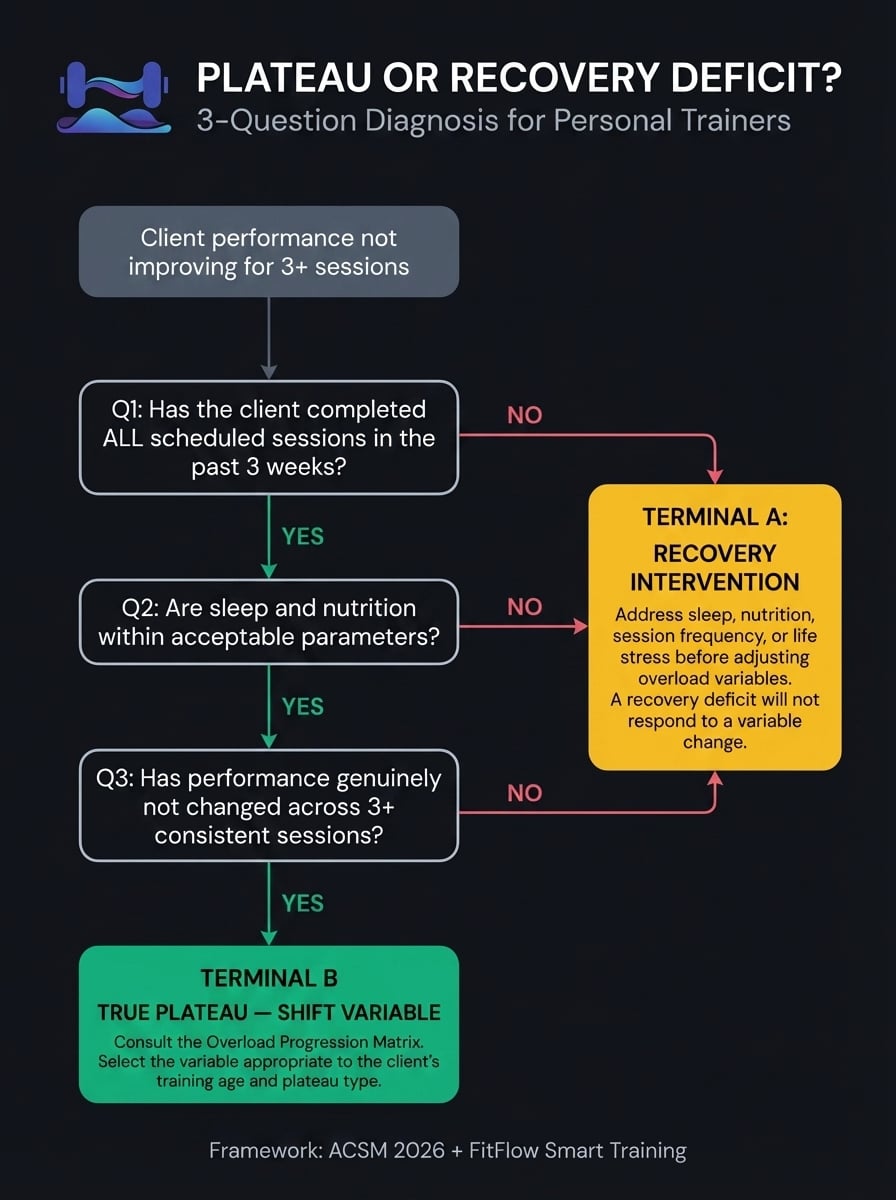
With that diagnostic framework in place, the next question is practical: what does it look like when trainers get this wrong?
Common Progressive Overload Mistakes
The mistakes below are not isolated tips. They are systemic errors that emerge from the single-variable model -- and from misapplying the 6-dimension framework itself. Each one traces to a specific root cause, and each has a specific correction.
Mistake 1: Linear Loading Past the Novice Phase
The mistake: continuing to add load to the bar every session or every week after the novice adaptation window has closed. For most untrained individuals, that window spans 12-16 weeks of consistent training. After that, session-to-session load increases become unsustainable -- and forcing them creates three failure patterns.
First, forced reps with degraded form. The client hits the target number but the movement quality has collapsed. Partial reps, excessive momentum, compensatory movement patterns. The set was completed on paper. The training stimulus was compromised in practice.
Second, accumulated fatigue without adequate recovery. Each forced load increase adds systemic stress that exceeds the client's recovery capacity. Performance does not just stall -- it declines. The client is not undertrained; they are under-recovered.
Third, psychological pressure. The client begins to define progress as "a heavier number on the bar." When the number stops moving, motivation collapses. The client does not see the other five dimensions as progress because nobody framed them that way.
The correction is not "stop progressing." It is "switch the primary variable." An intermediate client who cannot add load to the squat this week can add a working set, tighten from 4 RIR to 2 RIR, or extend the eccentric to 3 seconds. All three produce a progressive overload stimulus. None require a higher number on the bar. When load is the only overload variable a trainer applies, the 6-week wall becomes inevitable.
As Bret Contreras has written: "For veteran lifters, progressive overload requires serious strategy and specialization... you have to be clever about your programming" Contreras, Ten Rules of Progressive Overload. The cleverness Contreras references is not a personality trait. It is a technical skill: knowing which of six variables to apply, to which client, at which point in their training.
Mistake 2: Adding Volume Without Managing Recovery
Volume overload is the correct variable to pull when load stalls -- but only within the Maximum Recoverable Volume ceiling. The mistake is treating volume as an unlimited dial: adding sets week after week without tracking whether the client is recovering from them.
The recovery ceiling is individual and dynamic. Factors include training age, sleep quality, protein intake (minimum 1.6 g/kg/day for hypertrophy-focused clients), total life stress, and training frequency. A client managing a new job, a new baby, and three training sessions per week has a materially different MRV than the same client training at the same frequency under normal life conditions. MRV is not a fixed number. It fluctuates weekly.
The practical intervention: track both performance AND perceived recovery. If a client's rep quality, bar speed, or session energy declines as volume increases, they have hit or exceeded MRV. The correct move is a deload to Minimum Effective Volume -- not another volume increase. The RP Strength mesocycle model codifies this: the accumulation phase (volume ramping toward MRV) must always be followed by a deload (reset to MEV) to allow the next productive accumulation phase to begin Israetel et al., RP Strength.
The meta-analytic evidence supports this ceiling: a 2021 meta-analysis of load and volume autoregulation found that autoregulated volume prescription produces outcomes at least equivalent to fixed-volume prescription, with the advantage of built-in recovery management. Autoregulated volume does not just perform comparably -- it prevents the overreaching that fixed-volume escalation produces.
Mistake 3: Ignoring Intent (Treating 4x8 as 4x8)
A set of 8 reps performed at 5 RIR and a set of 8 reps performed at 1 RIR are not the same training stimulus. The weight is identical. The reps are identical. The sets are identical. The overload is profoundly different.
The mistake is treating "completed the prescribed sets and reps" as sufficient progressive intent without tracking where those sets fall on the effort continuum. A client who has been performing 4x8 at 5 RIR for four weeks and reports no progress has not plateaued. They have been under-stimulating the target musculature while creating the appearance of training correctly. The prescription was completed. The intent was not.
The correction: make RIR a tracked variable in every client's training log, on every working set. Zourdos and colleagues demonstrated that trained lifters can estimate their proximity to failure with high reliability -- correlations of r=0.88 to r=0.91 between self-reported and actual RIR Zourdos et al., 2016. This is not a subjective feeling. It is a trainable skill that improves with practice. The reason most clients do not use it is that most trainers do not teach it -- because most trainers were never taught to treat intent as a progressive variable themselves.
The ACSM 2026 recommendation is unambiguous: target 2-3 RIR across working sets for hypertrophy Lees et al., 2026. If the client is consistently operating above 3 RIR, intent progression is available immediately -- at no additional cost to load, volume, or any other variable. It is the only form of progressive overload that requires no external change to the program whatsoever. The same sets, the same reps, the same weight -- performed closer to failure.
Conclusion
Progressive overload is not a single variable. It is an architecture of six -- and the trainer who understands all six has a systematic answer for every plateau their clients will face. Load, volume, density, range of motion, tempo, and intent are not a hierarchy where load sits on top and everything else is a consolation prize. They are a spectrum, and the skill is knowing which dimension to apply, to which client, at which stage.
When one of your 30 clients hits a wall, you now have five options you did not have before. That is the difference between a client who stays and one who program-hops to someone who gives them the same single-variable answer you were giving.
The next time your bench stops moving, check your RIR. Add a set. Slow your eccentric. You have not run out of progress -- you ran out of one dimension. Five more are waiting.
For the complete evidence base on periodization, volume science, and exercise selection, see our evidence-based program design guide. For a practical template that builds multi-variable overload into a structured client program, see our program structure guide.
The framework is in the article. The tools are in the kit.
Six printable resources in one download:
- Decision Matrix — which variable to pull for every training age and plateau type
- Plateau Diagnosis Checklist — recovery deficit or real plateau, in 90 seconds
- Variable Quick-Reference Card — one page, all 6 dimensions, print and keep
- RPE/RIR Reference — scale, teaching protocol, mesocycle progression examples
- Client Communication Scripts — what to say when you shift a variable
- Quick-Start Guide — run the full workflow at your next check in
Frequently Asked Questions
Comments