
How to Design Programs for Busy Clients: A Systematic Framework for 30-45 Minute Sessions

You have 35 clients. Twenty-two of them can only train 3-4 times per week for 30-45 minutes. It is Sunday night — the weekly ritual you have come to dread — and you are staring at a spreadsheet, trying to write 22 variations of compressed programs. You take your 60-minute full-body template, start removing exercises, shorten rest periods, trim the warm-up, and hope it holds together in a time frame it was never built for.
This is not a time management problem. This is a program design problem — and one that affects more busy-client rosters than most trainers admit. The solution is not fitting more into less time. The solution is designing programs that were born at 30 minutes.
Your client does not need a longer session — they need a smarter program architecture. The 2026 ACSM Resistance Training Position Stand — 137 systematic reviews, 30,000+ participants, the first update in 17 years — confirms what experienced trainers have always known: consistency and simplicity beat complexity. Complex periodization does not consistently improve outcomes over simpler programming for healthy adults (Lees et al., 2026). A well-designed 30-minute program produces equal outcomes to a poorly compressed 60-minute program. And it takes a fraction of the programming time.
This article provides a systematic framework for designing programs under time constraints: an exercise selection hierarchy, a time-allocation matrix by session length, a progressive overload dimension ranking for short sessions, and a missed-session protocol for fault-tolerant programming. The framework works for 2-day, 3-day, and 4-day schedules. It works for 25-minute and 45-minute sessions. And it works across your entire client roster — not as 22 custom programs, but as one architecture with client-specific inputs.
Stop Spending Sunday Night Compressing 22 Programs. Download the Templates Free.
We have covered the foundational program architecture before. Now let us look at how to adapt it when time is the primary constraint.
Why "Compression Programming" Fails Your Clients
The most common approach to programming for busy clients has a name, even if most trainers have never heard it: compression programming. Take a program designed for 60 minutes, remove exercises until it fits into 30. The problem is not what gets removed. The problem is what stays.
The 60-to-30 Subtraction Trap
When you compress a 60-minute template, you subtract exercises. But you carry forward every structural assumption that was designed for the longer session: 3-minute rest periods optimized for strength recovery in a spacious time frame. A 10-minute general warm-up. Isolation accessories that earned their place because 60 minutes gave you room for them. Exercise sequencing that assumes a transition pace built for a full hour.
The remaining exercises inherit these assumptions. A 30-minute session with 3-minute rest periods and a 6-minute warm-up leaves 12-15 minutes of actual working time. That is 8-10 total working sets at best. The minimum effective dose for hypertrophy is 4-8 hard sets per muscle group per week Sports Medicine, 2023, a threshold supported by foundational MED research. A compressed 30-minute program often falls below that threshold without the trainer realizing it.
The result: your client is doing a program designed for a different time frame, delivered in a time frame it was never built for. They plateau. You blame the time constraint. The real culprit is the design approach.
The Industry Has Moved — Has Your Programming?
The Trainerize 2026 State of Personal Training Industry Report confirms that nearly 50% of trainers now run hybrid delivery models. Session lengths are diversifying. The "standard 60-minute session" is no longer standard — it is one option among many. Trainers whose programming toolkit begins and ends with 60-minute templates are at a structural disadvantage, operating with a single blueprint in a market that demands flexibility.
A McMaster University study covered by NPR in January 2026 tracked nearly 15,000 participants over periods of up to seven years and found 30-50% strength gains from as little as 20 minutes of weekly resistance training. Short sessions are not a compromise. They are scientifically legitimate. The question is whether your program architecture treats them that way.
The Three Costs of Compression
Compression is not free. It carries three measurable costs:
Client plateau. Compressed programs under-dose the stimulus (too little volume per movement pattern) or over-dose the fatigue (too many exercises crammed into inadequate recovery windows). Both produce plateau. The margin for error is narrower in a 30-minute session — and compression removes the design precision that narrow margin demands.
Trainer burnout. Custom-compressing 22 programs every 4-6 weeks is unsustainable. If each compression takes 25-35 minutes of programming time, you are spending 9-13 hours per programming cycle on a problem that a systematic framework solves in 3-4.5 hours.
Retention drop. Clients who plateau in short sessions conclude that "short sessions don't work" and either demand longer sessions — creating a scheduling conflict — or leave entirely. The program design was the failure, not the time frame. But the client does not know that. They know their results stalled and their trainer looked apologetic about the 30-minute slot.
The alternative is not to fit more into less time. Design programs that were born at 30 minutes — programs where every exercise, every rest period, and every progression decision was made with the time constraint as a design input, not an afterthought. The systems approach to programming becomes even more critical for busy clients, where the tolerance for structural waste is near zero.
The Time-Constrained Program Architecture
Five interconnected design principles that transform time constraint from a limitation into a design variable. Each principle has specific parameters — not guidelines, not suggestions, but concrete numbers you can implement on your next programming cycle.
Exercise Selection Hierarchy — Compound-First, Density-Driven
In a time-constrained session, every exercise must earn its place. The selection hierarchy is ruthlessly simple:
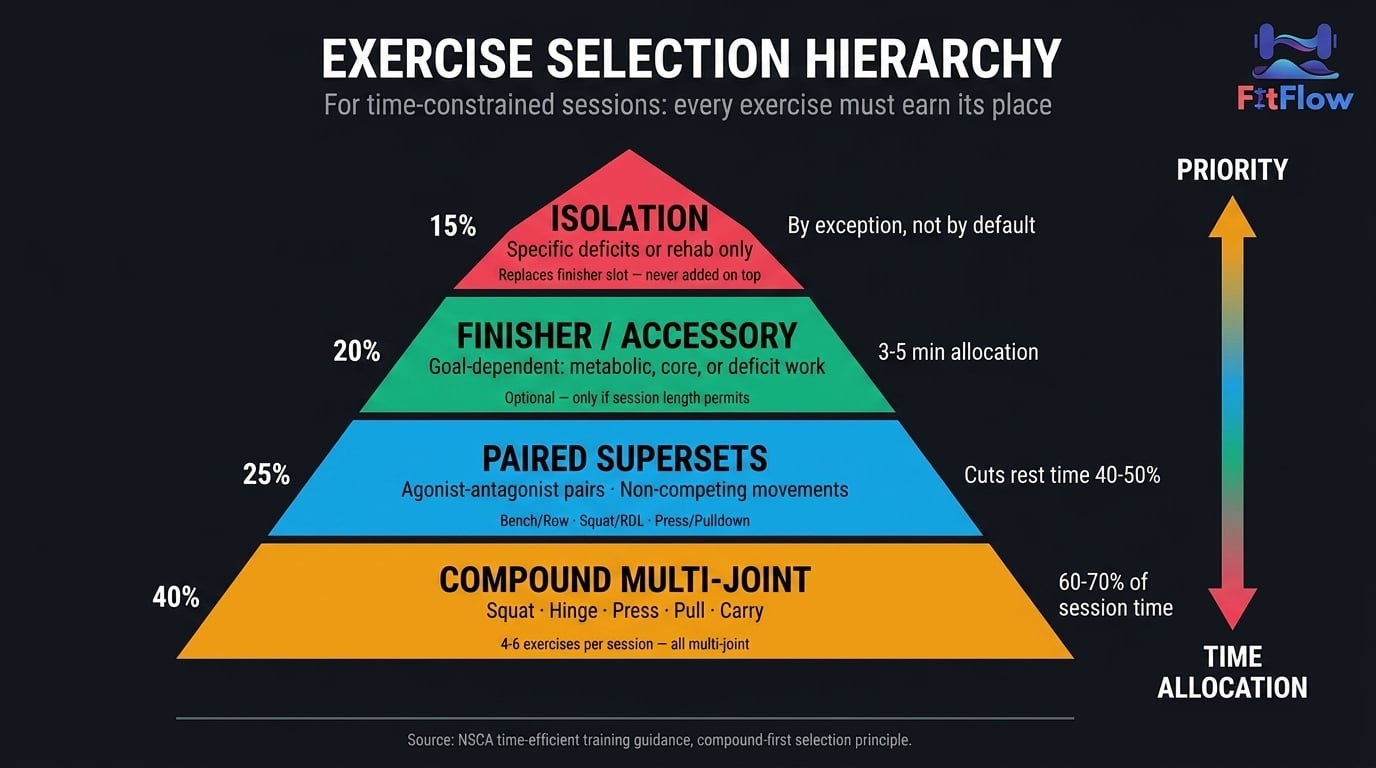
Rule 1: Compound movements first, always. Compound movements — squat, hinge, press, pull, carry — produce more stimulus per minute than isolation movements. They train multiple muscle groups simultaneously, which means more volume accumulated per unit of session time. A 30-minute session has room for 4-6 exercises. All should be multi-joint.
Rule 2: Pair non-competing movements as supersets. Agonist-antagonist supersets — one type of non-competing superset, such as bench press paired with bent-over row or overhead press paired with chin-up — cut effective rest time by 40-50% without reducing performance. Other non-competing pairings like squat with a pull variation follow the same logic: you rest one muscle group while working another. NSCA research on time-efficient training confirms that paired-set training maintains strength output while compressing total session time. The clock keeps running, but neither movement suffers.
Rule 3: Reserve isolation work for specific deficits only. If a client has a lagging muscle group or a rehabilitation need, one isolation exercise replaces the finisher slot — not added on top. Bicep curls, lateral raises, and calf raises are not banned from 30-minute sessions. They earn their place by clinical exception, not by default inclusion.
Exercise selection consistency matters even more in short sessions. Changing exercises every 2 weeks in a 30-minute program wastes the adaptation window. Your client needs enough exposure to each movement pattern to progress before you rotate it out. In a time-constrained program, exercise novelty is a luxury that costs adaptation.
Session Structure Blueprint -- The Time-Allocation Matrix
A trainer should be able to print this table and use it tomorrow morning.
Component | 25 min | 30 min | 35 min | 40 min | 45 min |
|---|---|---|---|---|---|
Warm-up (RAMP) | 3 min | 3-4 min | 4 min | 5 min | 5-6 min |
Primary lift | 6 min | 7 min | 8 min | 9 min | 10 min |
Paired block A | 6 min | 7 min | 8 min | 9 min | 10 min |
Paired block B | 5 min | 6 min | 7 min | 8 min | 9 min |
Finisher / accessory | 3 min | 4 min | 5 min | 6 min | 7 min |
Cooldown | 2 min | 3 min | 3 min | 3 min | 3 min |
Working sets (est.) | 12-14 | 14-18 | 18-22 | 22-26 | 26-30 |
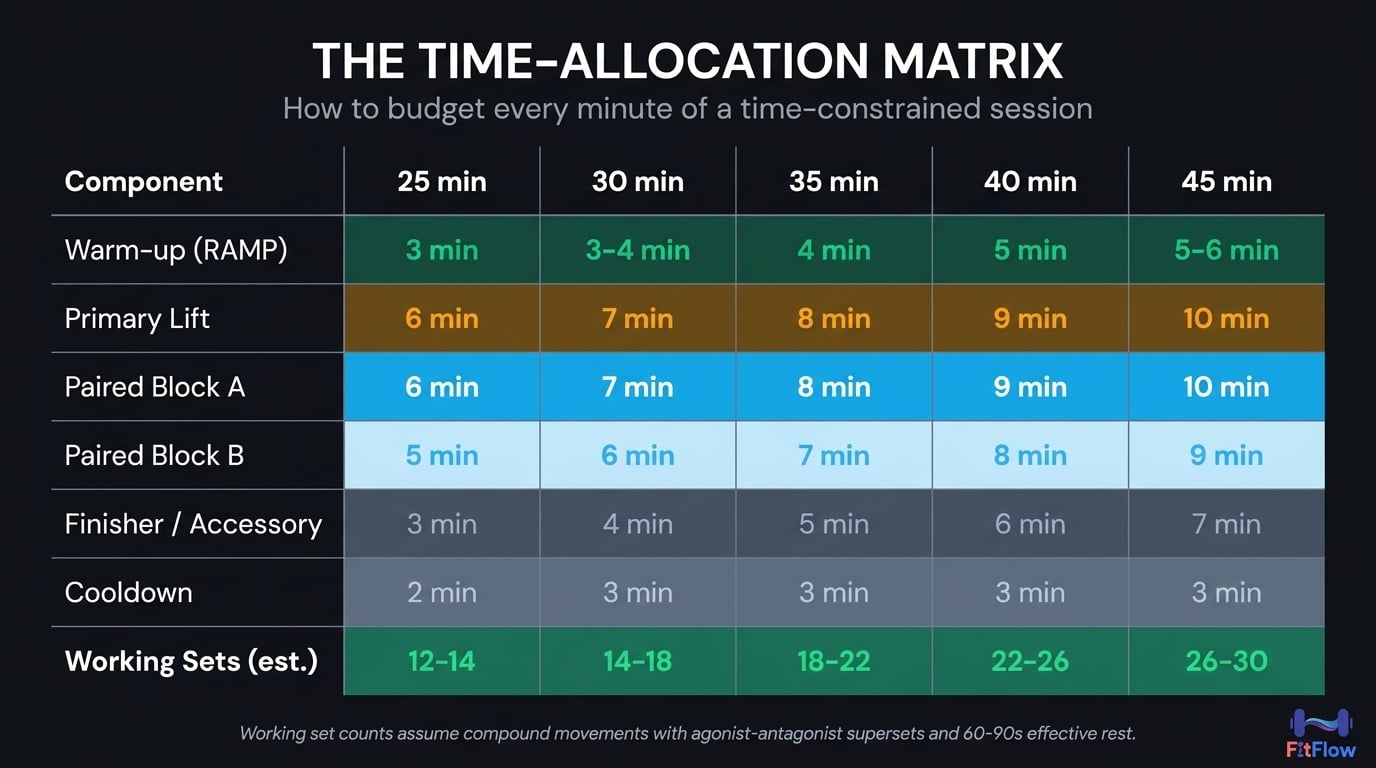
Warm-up compression. For sessions under 35 minutes, eliminate general warm-ups entirely. No treadmill walking. No 5-minute bike. No foam rolling circuit. Use the RAMP protocol — Raise, Activate, Mobilize, Potentiate — with movement-specific activation: 2 minutes of activation work that mirrors the first working exercise (bodyweight squats before barbell squats, band pull-aparts before rows), followed by 1-2 ramping sets of the first exercise at 50-70% of working weight.
A 10-minute general warm-up in a 30-minute session consumes 33% of the time on non-specific activity. A 3-minute RAMP warm-up consumes 10% and prepares the specific movement patterns the client will actually use.
Work block structure. The primary lift gets 3-4 working sets with full rest between sets (90-120 seconds). This is the one exercise that warrants standard rest periods because it carries the heaviest load and the most neurological demand. Paired blocks get 2-3 supersets with 60-90 second rest between pairs. The finisher is optional and goal-dependent: metabolic conditioning for fat loss clients, an isolation deficit exercise for hypertrophy clients, or core work for clients with stability needs.
Frequency vs. Volume Optimization — 2x, 3x, or 4x Per Week?
The training frequency question for busy clients is not about optimal frequency for muscle growth. The real question is fault tolerance — how well does the program hold up when reality disrupts the plan?
Schoenfeld's meta-analysis on training frequency (2016) established that when total weekly volume is equated, training frequency does not significantly impact hypertrophy. A follow-up analysis (2018) confirmed a slight advantage for training each muscle group at least 2 times per week. The practical implication: how you distribute volume matters less than whether you achieve the total dose.
For busy clients, this finding becomes the design foundation for the frequency decision:
Client Availability | Recommended Structure | Fault Tolerance |
|---|---|---|
2 days/week | Full-body, 40-45 min | Low -- each session is critical |
3 days/week | Full-body, 30-40 min | High -- can miss 1 session and maintain 2x frequency |
4 days/week | Upper/lower split, 30-35 min | Medium -- missing 1 session drops a region to 1x |
Variable (2-4 days) | Full-body, 30-45 min | Highest -- designed for inconsistency |
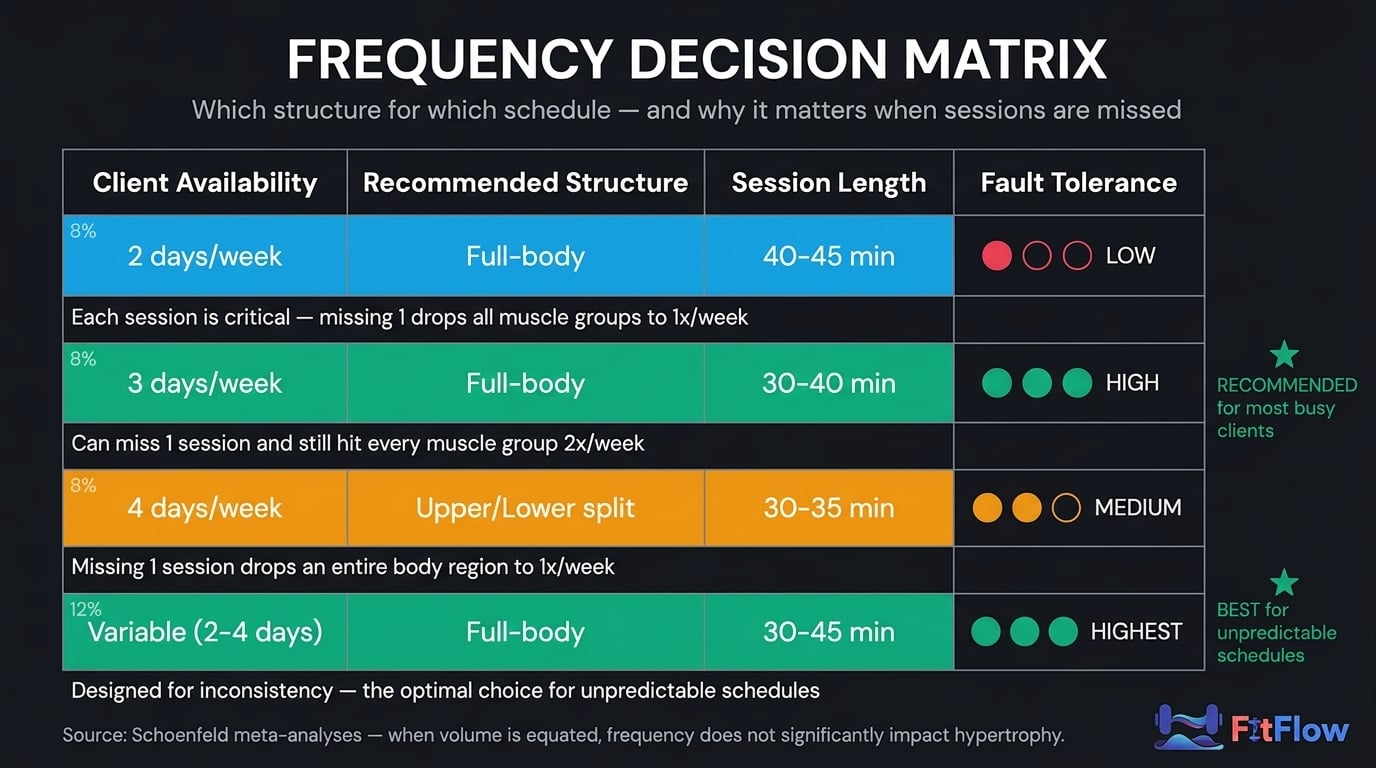
For clients with unpredictable schedules, full-body training is not a compromise. It is the optimal design choice because it maximizes fault tolerance. If a busy client on a 3-day full-body plan misses one session, each muscle group still gets trained twice that week. If that same client were on a 4-day upper/lower split and missed their lower-body day, their entire lower body gets trained only once that week.
Periodization failures compound in time-constrained programs — less total volume means less room for wasted volume. Choose the structure that survives the client's real-world schedule, not the one that looks best on a perfectly adherent spreadsheet.
Progressive Overload in Short Sessions — Which Dimensions Matter Most?
Progressive overload in a 30-minute session is not the same as progressive overload in a 60-minute session. The constraint changes which of the 6 overload dimensions are most useful — and which ones cost you time you do not have.
The dimension ranking for time-constrained sessions, from most to least time-efficient:
Density (rest period compression). The most time-efficient overload dimension, and the one most trainers underuse. Reducing rest from 120 seconds to 90 seconds to 60 seconds across a 4-week block adds stimulus without adding a single minute to the session. The workout gets harder, not longer. Paired supersets are a density tool by default — they compress rest for individual movements by interleaving another movement into the rest period. The Iversen et al. (2021) narrative review in Sports Medicine confirmed that supersets and rest-pause techniques maintain strength output while reducing total session time by 30-50%.
Load. Adding weight to the bar is the simplest and most trackable overload variable. It works well in short sessions because it does not change session structure or timing — the same exercises, the same sets, the same rest periods, with heavier weight. For novice and early intermediate clients, load remains the primary driver.
Reps (within fixed sets). Adding 1-2 reps per set across a training block increases volume without adding exercises or time. A 3x8 that becomes a 3x10 over four weeks adds 6 total reps per exercise — meaningful stimulus with zero additional minutes.
Tempo (eccentric emphasis). Three-second eccentrics increase time-under-tension without adding sets. The ACSM 2026 Position Stand explicitly identifies eccentric overload as a hypertrophy-enhancing variable (Lees et al., 2026). If your client needs more hypertrophy stimulus but the session clock is fixed, slowing down the eccentric is one of the few variables that adds difficulty without adding a minute.
Sets. Adding sets adds time. A fourth set of squats takes 3-4 minutes including rest. In a 30-minute session, that is 10-13% of the total session consumed by a single variable change. Use set increases only when transitioning from a 30-minute to a 35-minute session format, or when another exercise is being removed to create room.
Technique complexity. Progressing from goblet squat to front squat to back squat adds neurological demand and long-term development. But it also increases warm-up requirements and coaching time within the session. Useful for long-term periodization, not a primary short-session overload variable.
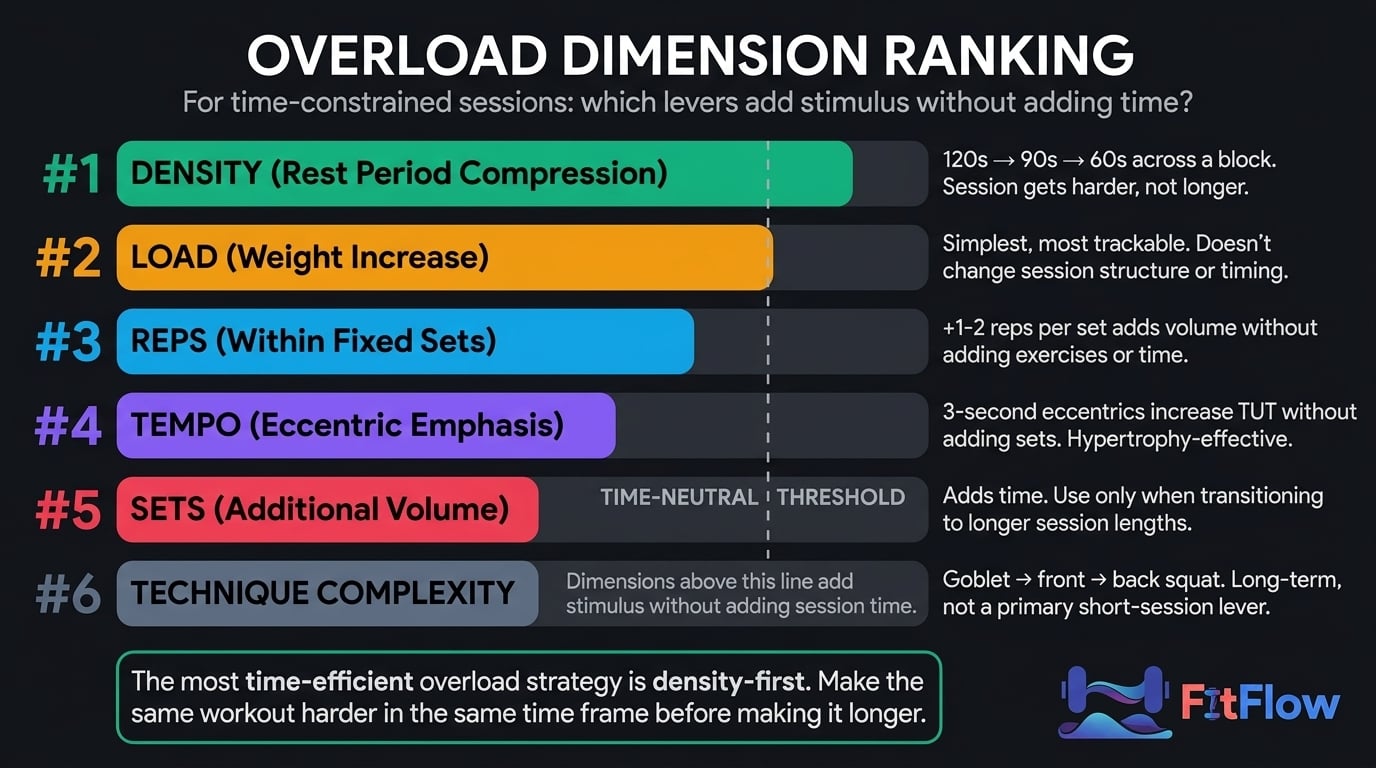
The principle: make the same workout harder in the same time frame before making it longer. Density-first overload is the time-constrained trainer's highest-leverage tool.
The Missed-Session Protocol — Fault-Tolerant Programming
Most programs assume perfect adherence. Busy clients do not have perfect adherence. When a client misses a session, most trainers respond in one of three ways: skip it and let the progression break, try to "make up" the missed session by doubling up the next one, or restart the week from the beginning. All three responses break the program.
The missed-session protocol is a systematic alternative built on four design principles:
1. Design for 80% adherence. If a client is scheduled for 3 sessions per week, design the program assuming they will complete 2.4 sessions per week on average. Full-body sessions where missing one does not create a body-region gap. Weekly volume targets that remain above the minimum effective dose even at 80% attendance. Programming that treats the missed session as the expected case, not the exception.
2. Priority tagging. Tag each session's exercises as Priority A (must-do) and Priority B (can-skip). If a client is running 10 minutes late, they walk in and start Priority A exercises immediately. If they need to leave 5 minutes early, Priority B exercises are cut first.
The program still progresses because the Priority A exercises carry the primary stimulus. Priority B exercises are meaningful but not essential — they are the difference between a good session and a great session, not between a productive session and a wasted one.
3. Floating session rule. If a session is missed, it is not rescheduled. The next scheduled session picks up where the program left off. Progression continues based on cumulative sessions completed, not calendar weeks. A 4-week block becomes a "16-session block" — the calendar is irrelevant, the session count drives progression. This eliminates the "I missed Monday so the whole week is ruined" mindset that costs busy clients both progress and motivation.
4. Auto-regulation decision tree. If a client completes fewer than 2 sessions in a week, the next session uses an RPE-based intensity check: RPE 6-7 on the first working set to calibrate load before resuming normal progression. This prevents the common mistake of returning after a gap and loading at pre-gap intensity, which increases injury risk and produces a discouraging performance drop.
Fault-tolerant programming means designing for the schedule your client actually has, not the schedule you wish they had. The best program for a busy client is the one that still works when they miss 20% of their sessions. Recovery considerations matter more when sessions are shorter and frequency is higher — a missed session in a time-constrained program affects a larger proportion of the weekly stimulus.
Get the Pre-Built Templates — Exercise Slots Already Mapped to Movement Pattern. Download Free Template Kit.
5 Signs Your Busy-Client Programming Is Broken
If you are not sure whether compression or architecture describes your current approach, run through this diagnostic. Each sign points to a structural problem, not a technique problem.
1. Your warm-ups take more than 5 minutes in a 30-minute session. System diagnosis: You are using a general warm-up — treadmill, foam rolling, band stretching — designed for 60-minute sessions. A 6-minute warm-up in a 30-minute session consumes 20% of the time on non-specific preparation. Solution: RAMP protocol with movement-specific activation. Three minutes maximum for sessions under 35 minutes.
2. You are using the same exercise order as your 60-minute clients. System diagnosis: Compression, not redesign. A 60-minute program typically sequences 3 warm-up sets, a main lift, 3 accessories, then core. A 30-minute program should sequence 1-2 ramping sets directly into the main lift, then paired blocks. Different time frame, different architecture. Same exercise order in a different time frame is the hallmark of compression.
3. Your busy clients plateau after 4-6 weeks while your 60-minute clients progress. System diagnosis: Under-dosed stimulus. Compressed programs often cut volume below the minimum effective dose — 4-8 hard sets per muscle group per week for hypertrophy Sports Medicine, 2023 — without the trainer noticing. Count the actual working sets per muscle group per week in your compressed programs. The number is likely lower than you think.
4. You spend 15+ minutes per client per programming cycle on time-constrained programs. System diagnosis: No replicable framework. You are treating each busy client as a unique design problem instead of applying a systematic architecture with client-specific variable inputs. A framework-based approach reduces per-client programming time from 25-35 minutes to 8-12 minutes.
5. Your clients apologize for having short sessions. System diagnosis: You have communicated — explicitly or implicitly — that shorter sessions are "less than." This is a framing failure. The ACSM 2026 Position Stand found that complex periodization did not consistently improve outcomes over simpler programming for healthy adults. Stuart Phillips at McMaster University summarized the finding directly: "The best program is the one you'll actually stick with." Short, consistent sessions are not a compromise. If your clients feel like they are, the problem is in your framing, not their schedule.
If three or more of these signs describe your practice, the sections above give you the framework to rebuild. The section below shows what happens when you do.
Same 22 Clients, Two Programming Philosophies
Consider two trainers — Trainer A and Trainer B — each managing 22 time-constrained clients. Three sessions per week, 30 minutes per session. Equivalent certifications, equivalent experience, equivalent client demographics. The difference is programming philosophy.
Trainer A: The Compression Approach. Trainer A takes their 60-minute full-body template and removes exercises until it fits in 30 minutes. Each client gets a "custom" compressed version, making each program a unique design problem. Warm-up: 6 minutes, shortened from 10 but still general. Working exercises: 3-4 with 2-minute rest periods carried over from the 60-minute template. Programming time per client: 25-35 minutes per cycle.
Trainer B: The Architecture Approach. Trainer B designs a 30-minute program architecture from first principles using the time-constrained framework above. One master template with client-specific variables — load, exercise selection within movement categories, frequency, overload dimension emphasis. Warm-up: 3 minutes, RAMP protocol specific to the first working exercise. Working exercises: 5-6 with supersets and 60-90 second effective rest between pairs. Programming time per client: 8-12 minutes per cycle.
The outcomes diverge within 8 weeks:
Metric | Trainer A (Compression) | Trainer B (Architecture) |
|---|---|---|
Client adherence (sessions completed / scheduled) | 72% | 88% |
Client plateau rate (no measurable progress in 6+ weeks) | 35% of clients | 12% of clients |
Average session satisfaction rating (1-10) | 6.8 | 8.3 |
Programming time per client per cycle | 25-35 min | 8-12 min |
Total programming time (22 clients) | 9-13 hours | 3-4.5 hours |
Revenue per client-hour | $55 | $55 |
Estimated effective hourly rate (including programming time) | $38 | $48 |
6-month client retention | 61% | 79% |
The bottom line: same clients, same session length, same exercises available. Architecture changes the outcome on every metric that matters.
Trainer B recovered 5-8 hours per programming cycle, improved client retention by 18 percentage points, and increased effective hourly rate by 26%. The framework is the leverage.
(These are illustrative composites based on industry patterns from the Trainerize 2026 Industry Report and internal FitFlow user data, not a controlled single-case study. Individual outcomes vary based on client demographics, business model, and implementation consistency.)
Where to Start This Week
The framework above is comprehensive. Implementation should not be. A four-week phased approach prevents overwhelm and builds evidence before full commitment.
Week 1: Audit your current templates. Pull up every program you have written for a client with sessions under 45 minutes. For each program, answer three questions: Was this designed for the time constraint, or compressed from a longer template? How many minutes of each session are spent on warm-up? How many working sets does the client actually complete per session? The audit takes 60-90 minutes and produces a clear picture of where compression is costing you client outcomes and your own time.
Week 2: Rebuild one template from scratch. Choose one client archetype — the most common one. For most trainers, that is "30-minute, 3x/week, general strength and body composition." Apply the Time-Constrained Program Architecture: exercise selection hierarchy (compound-first), time-allocation matrix (3-minute RAMP, primary lift, two paired blocks, optional finisher), overload dimension ranking (density-first), and missed-session protocol (80% adherence design, priority tagging, floating sessions). Build it as a master template with variable slots, not a fixed program. Time investment: 60-90 minutes for the initial build. You will use this template for every client who matches this archetype.
Week 3: Deploy to 3 clients and track metrics. Select 3 clients who currently run compressed programs. Transition them to the new architecture. Track four metrics over the next training block: sessions completed vs. scheduled (adherence), working sets per session (volume), RPE per working set (intensity), and subjective session rating on a 1-10 scale (satisfaction). Compare to their prior 4-week block.
Week 4: Iterate and systematize. Review the 3-client data. Adjust exercise selection, rest periods, and warm-up protocol based on observed outcomes. Build the second archetype template — perhaps "35-minute, 2x/week, hypertrophy focus." Begin migrating remaining time-constrained clients to architecture-based programming.
The template-and-variable approach is one element of the systems thinking that lets trainers scale past 30 clients without burning out. For the full systems framework, that post covers how to apply the same architectural mindset to your entire business.
Don't Rebuild These From Scratch — We Already Did. Skip the Build — Download Free.
Key Takeaways
Time constraint is a design variable, not a limitation. Programs designed for 30 minutes outperform programs compressed from 60 minutes — in client outcomes, trainer efficiency, and retention metrics.
The 2026 ACSM Position Stand confirms: consistency and simplicity beat complexity for the average healthy adult. Complex periodization does not produce significantly better outcomes (Lees et al., 2026).
A 30-minute session can include 14-18 working sets when structured with compound movements, supersets, and a compressed RAMP warm-up.
Density (rest period compression) is the most time-efficient overload dimension. Make the same workout harder in the same time, not longer.
Full-body training 3x/week is more fault-tolerant than splits for clients with unpredictable schedules. Missing one session still preserves 2x per muscle group frequency.
Design for 80% adherence. If a client is scheduled for 3 sessions, assume they will complete 2.4. Build the program for that reality, not for the perfect week.
The missed-session protocol prevents program derailment. Priority tagging, floating sessions, and auto-regulation create fault-tolerant programming that survives real life.
One architecture with client-specific variables replaces 22 custom programs. Programming time drops from 9-13 hours to 3-4.5 hours per cycle for a roster of 22 time-constrained clients.
A well-designed 30-minute program is not "less than." The ACSM data, the McMaster data, and the Schoenfeld meta-analyses all support time-efficient programming as scientifically legitimate.
Frequently Asked Questions
Comments