Guide to Fitness Technology for Professionals 2026
Why This Guide Is Different
Most fitness technology guides are written by marketers who understand features but not architecture, or by trainers who know coaching but not software. This guide offers something rare: the intersection of software engineering expertise and fitness industry understanding.
We explain not just what platforms do, but how they're built, why certain architectures enable specific capabilities, and what technical trade-offs affect your daily workflow.
Executive Summary
The fitness technology landscape in 2026 represents both unprecedented opportunity and competitive necessity. According to Straits Research (2025), the global fitness software market has reached $10.59 billion and is projected to triple by 2033.
1. Introduction: The Technology Transformation of Fitness
The Evolution (2015-2026)
The fitness industry has undergone a remarkable digital transformation. What began with simple scheduling tools has evolved into sophisticated ecosystems leveraging AI, machine learning, and real-time data analytics.
Pre-2020: Most trainers relied on spreadsheets, paper-based tracking, and fragmented tools.
2020-2022 (COVID Catalyst): The pandemic compressed ten years of digital adoption into eighteen months.
2023-2026 (Maturation Phase): Technology adoption shifted from survival necessity to competitive advantage.
Why Technology Separates Winners from Strugglers
A distinct dichotomy has emerged between "analog-first operators" capped at 20-30 clients and "tech-forward practices" managing 50-100+ clients with better retention and work-life balance.
Consider the economics:
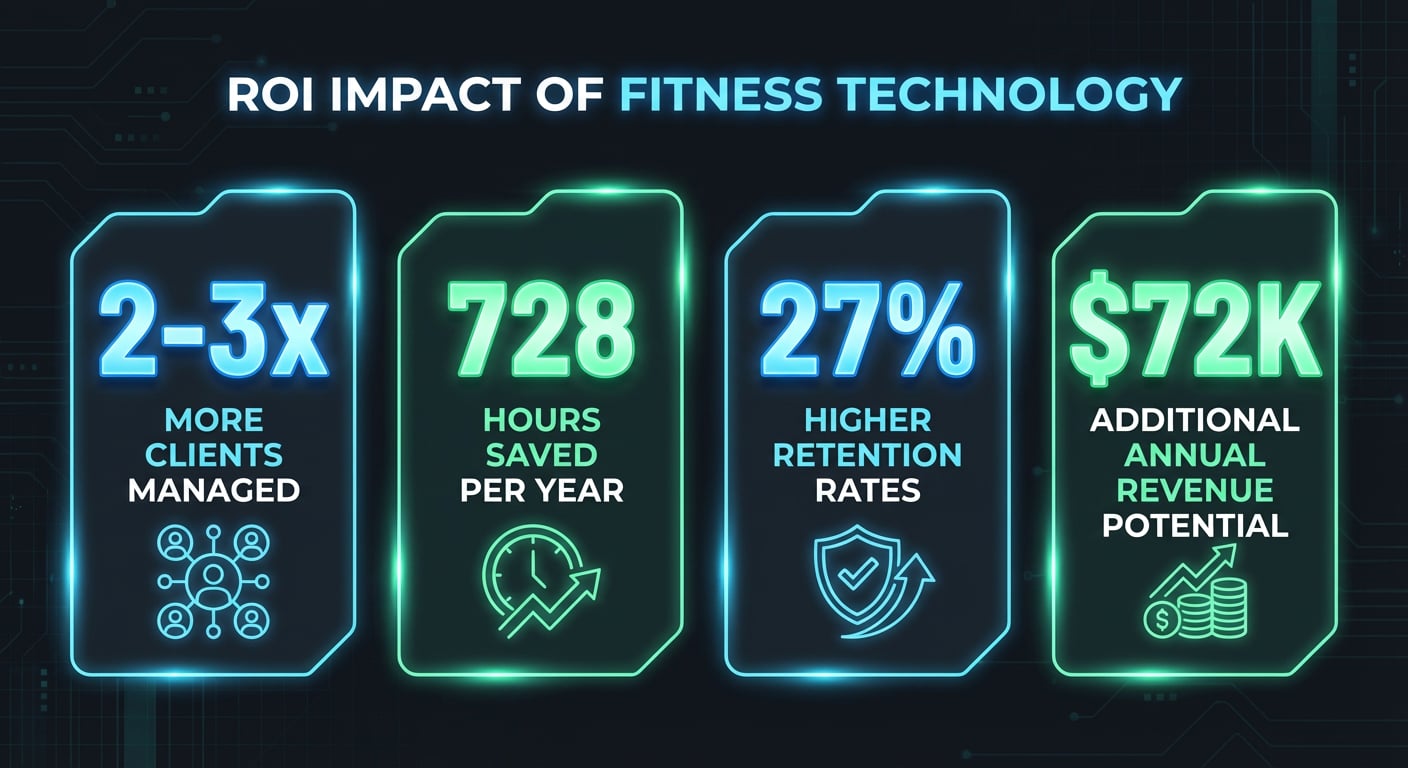
Manual Operations: Maximum ~25 clients, 30-45 min admin per session, ~$60,000 annual
Technology-Enabled: 50-60 clients manageable, 5-10 min admin per session, ~$132,000 annual
The $72,000 annual difference dwarfs the typical $1,200-3,000 annual software investment.
2. Fitness Software Landscape
Software Categories Fitness Professionals Need
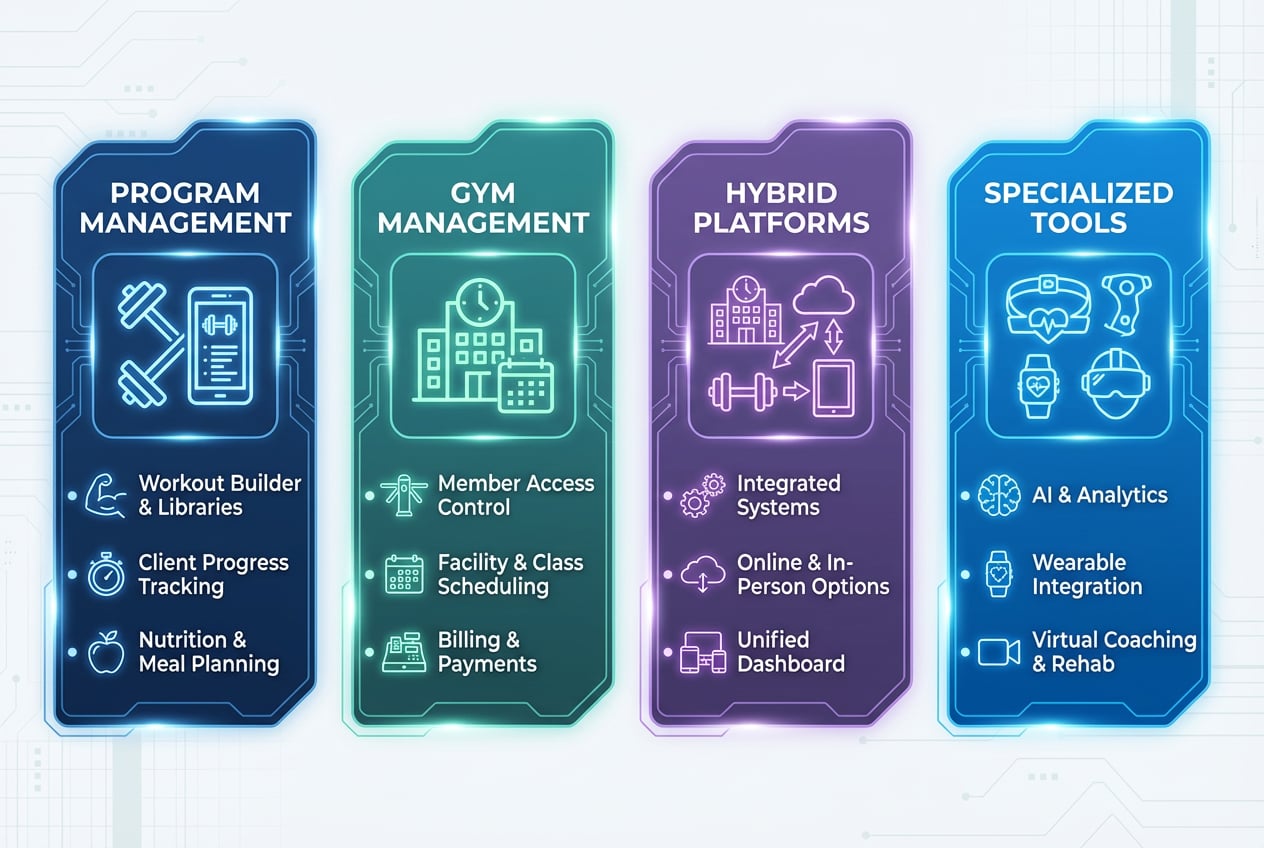
Modern fitness businesses require technology across multiple functional areas:
Program Management: Workout design, delivery, tracking (FitFlow, Trainerize, TrainHeroic, TrueCoach)
CRM: Lead tracking, client communication (Club OS, Mindbody, WellnessLiving)
Scheduling & Booking: Appointment management (Acuity, Calendly, integrated solutions)
Payment Processing: Billing, subscriptions (Stripe, Square, platform-integrated)
Analytics & Reporting: Business intelligence (Platform-native dashboards)
Integrated vs. Best-of-Breed: A Technical Decision Framework
Integrated Platform Architecture:
Native data flow—no sync delays, no integration maintenance
Single authentication, unified user experience
Consideration: Vendor lock-in
Best-of-Breed Architecture:
Best-in-class functionality per category
Swap components without full migration
Consideration: Integration complexity
3. Program Management Platforms: Deep Comparison
What Defines Effective Program Management Software
Must-Have Features:
Exercise Library: 1,000+ videos minimum with custom upload
Program Builder: Intuitive interface with periodization support
Client App Experience: Mobile-first with offline capabilities
Progress Tracking: Automated logging with visual displays
Communication: In-app messaging with notifications
Analytics: Individual and aggregate data
Platform Analysis
FitFlow
Positioning: Data-first architecture prioritizing programming effectiveness analytics and retention modeling.
Strengths: Aggregate Analytics Engine, Retention Modeling, Direct API wearable connections, API-First Design
Ideal Use Case: Evidence-based coaches who want data-driven program optimization, hybrid trainers scaling past 50 clients.
PT Distinction
Pricing: $19.90-89.90/month (3-50 clients), plus $1.60/additional client
Strengths: AI-powered program generation (~20 seconds), Custom-branded iOS and Android apps, Complete nutrition coaching
ABC Trainerize
Pricing: $0-350/month, plus $99 branded app setup fee
Strengths: 360° member experience combining fitness, nutrition, and habits. Used by major brands (Gold's Gym, Life Time, YMCA)
TrainHeroic
Pricing: $45-150/month
Best For: Teams, groups, and structured strength programming (S&C focus)
4. Client Tracking & Progress Monitoring
What to Track (Metrics Hierarchy)
Tier 1 - Essential: Workout completion rates, Weight/resistance progression, Bodyweight trends
Tier 2 - Important: Volume load, Personal records, Progress photos
Tier 3 - Advanced: HRV and recovery metrics, Energy levels, Nutrition adherence
The ROI of Systematic Tracking
Time investment vs. return for a 50-client practice:
Workout logging: 5 hrs/week manual → 30 min with platform = $17,550 annual value
Progress photos: 2 hrs/week → 20 min = $6,630 annual value
Check-in management: 3 hrs/week → 30 min = $9,750 annual value
Total annual value at $75/hr: $40,950
5. Data Analytics & Business Intelligence
Why Data Matters: The Competitive Advantage
Most trainers operate on intuition—"this program feels like it's working." Data-driven trainers operate on evidence—"this program produces 23% better strength gains based on 40 client outcomes."
Key Metrics to Track
Client-Level Analytics:
Adherence Rate: (Completed / Assigned workouts) × 100. Good: >80%
Progress Velocity: Performance change / Weeks elapsed
Engagement Score: Weighted average of logins, completions, responses
Risk Indicators: 3+ signals = intervention needed
Business-Level Analytics:
Monthly Recurring Revenue (MRR): Target >5% growth/month
Client Churn Rate: Good: <3%/month
Lifetime Value (LTV): Average revenue × Average retention months
LTV:CAC ratio should be >3:1
6. Wearable Technology Integration
The Wearable Landscape
Client wearable adoption has exploded, creating both opportunity and complexity.
Apple Watch: Comprehensive health ecosystem - best for Apple users
Fitbit: User-friendly sleep/activity tracking - large user base
WHOOP: Serious athlete focus - Recovery Score, Strain, HRV
Garmin: Endurance athlete preference - GPS, HR zones
Oura Ring: Sleep and recovery specialist - excellent insights
Practical Application: Using Wearable Data
HRV Application: If HRV drops >20% below baseline for 2+ days, advise reducing training intensity.
Sleep Application: Client reports low motivation? Check Deep Sleep - averaging 30 min vs target 60-90 min explains the issue.
7. Automation for Business Efficiency
The Economics of Automation
Trainers have 168 hours per week. Every hour on administration is an hour not training clients.
Pre-automation (40 clients): 15 hours/week admin = 780 hours annually
Post-automation target: 3-5 hours/week = 156-260 hours annually
Time recovered: 520-624 hours = $39,000-46,800 value at $75/hr
What to Automate (Priority Order)
Payment processing + failed payment retry (104 hrs/year saved)
Session scheduling + reminders (208 hrs/year saved)
Check-in reminders (104 hrs/year saved)
Program delivery sequences (78 hrs/year saved)
Progress reports (78 hrs/year saved)
8. AI & Machine Learning in Fitness

Current AI Applications (Practical, Not Hype)
Program Generation: PT Distinction creates workouts in ~20 seconds. FitnessAI trained on 5.9 million workouts.
Form Analysis: Computer vision monitors movement patterns (Coach's Eye, Tempo). Effective for simple movements, less reliable for complex lifts.
Predictive Analytics: Churn risk scoring, plateau prediction. Requires 1,000+ client outcomes for robust models.
Can AI Replace Trainers? (No—Here's Why)
AI Enhances: Routine adjustments, pattern identification, first-draft programs
AI Cannot Replace: Complex goal-setting, motivation during difficult periods, adapting to stress/grief/injury, building genuine accountability
Think autopilot in planes: handles straight-and-level flight, but pilots needed for judgment and unexpected situations.
9. Technology Adoption Strategies
Evaluation Framework
Needs Assessment: What are your 3 biggest time drains? What's your realistic budget?
Total Cost Analysis: Calculate true cost at 20, 50, 100, 200 clients
Trial and Testing: Use free trials (14-30 days), test with real clients
Integration Requirements: Native integration or Zapier required?
Common Mistakes to Avoid
Over-automating (feels impersonal)
"Set and forget" syndrome (audit monthly)
Not customizing templates
Surprise transitions without client communication
Ignoring TCO at scale
10. Building Your Technology Stack
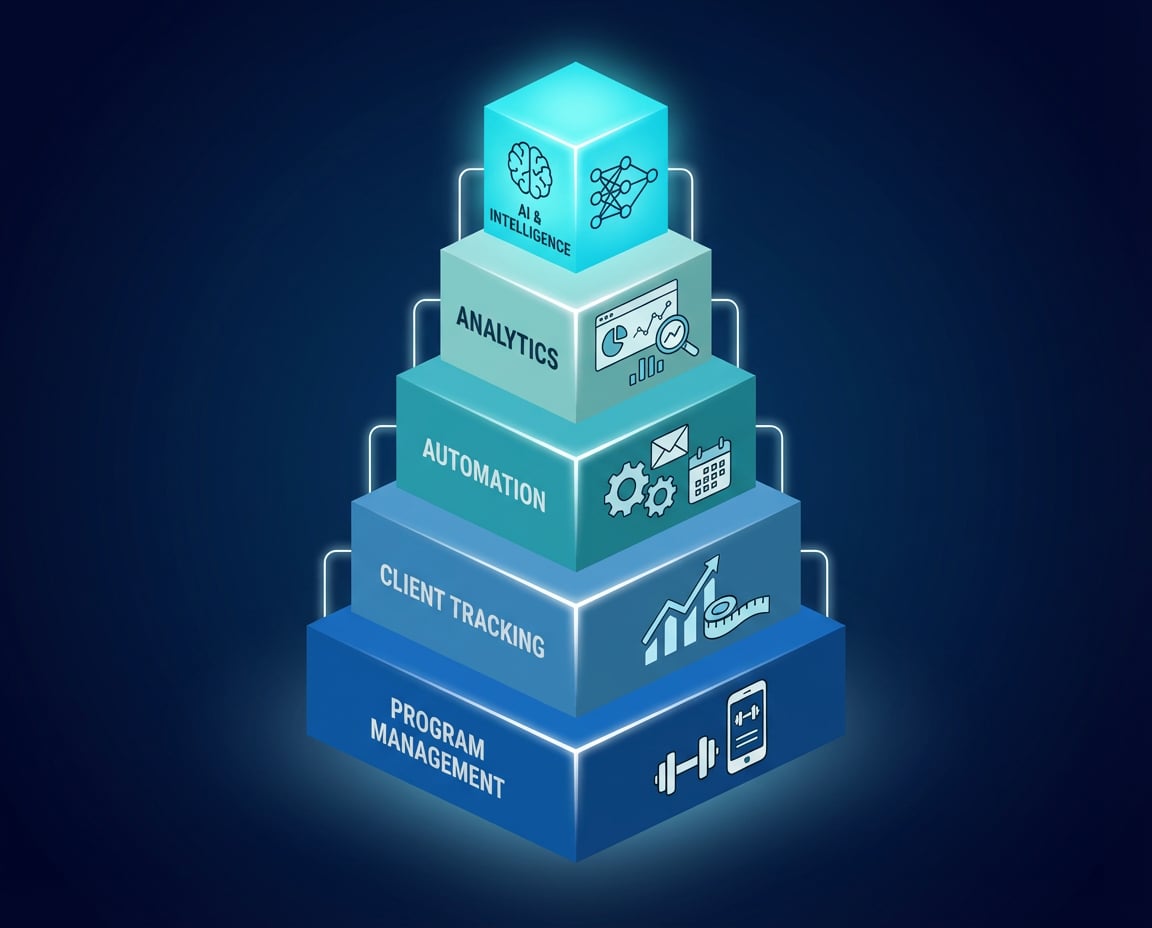
Recommended Stack by Business Stage
Solo Trainer (1-20 clients) — $50-100/month: TrueCoach, FitFlow, or PT Distinction Basic. Priority: Simplicity
Growing Practice (20-60 clients) — $150-300/month: FitFlow, PT Distinction Pro, automated billing. Priority: Automation
Established Practice (60-150 clients) — $300-700/month: Advanced analytics, ActiveCampaign. Priority: Data insights
Gym/Studio (150+ members) — $700-2,000+/month: Mindbody, ABC Glofox, WellnessLiving. Priority: Enterprise features
11. Virtual & Hybrid Training Technology
The Post-COVID Reality
62% of trainers plan to offer hybrid training. The economics favor hybrid:
Client capacity: 20-30 (in-person only) → 50-80+ (hybrid)
Geographic reach: Local only → Global
Membership renewal: +27% with hybrid model
Hybrid Model Financial Example
Before (in-person only): $4,500/month, 94 hours
After (hybrid tiers): In-person $800/mo × 15 + Hybrid $400/mo × 20 + App-only $150/mo × 40 = $26,000/month
Revenue per hour: $226/hr (vs. $48/hr previously)
12. Future of Fitness Technology (2026-2030)
Emerging Trends Worth Watching
AI Maturation: Sophisticated personalization, voice-based coaching ("Hey FitFlow, should I train heavy today?")
Wearable Evolution: Continuous glucose monitoring, blood pressure in smartwatches, real-time workout guidance
AR/VR Fitness: Apple Vision Pro gamifying cardio, virtual training environments (likely 2027+ for mainstream)
Platform Consolidation: Fewer, more comprehensive platforms as market matures
Preparing for the Future (2026 Actions)
Master your current platform completely before adding new tools
Establish data collection practices now for future AI benefits
Build hybrid delivery capabilities regardless of current model
Stay informed on AI developments without chasing every trend
13. Implementation Framework
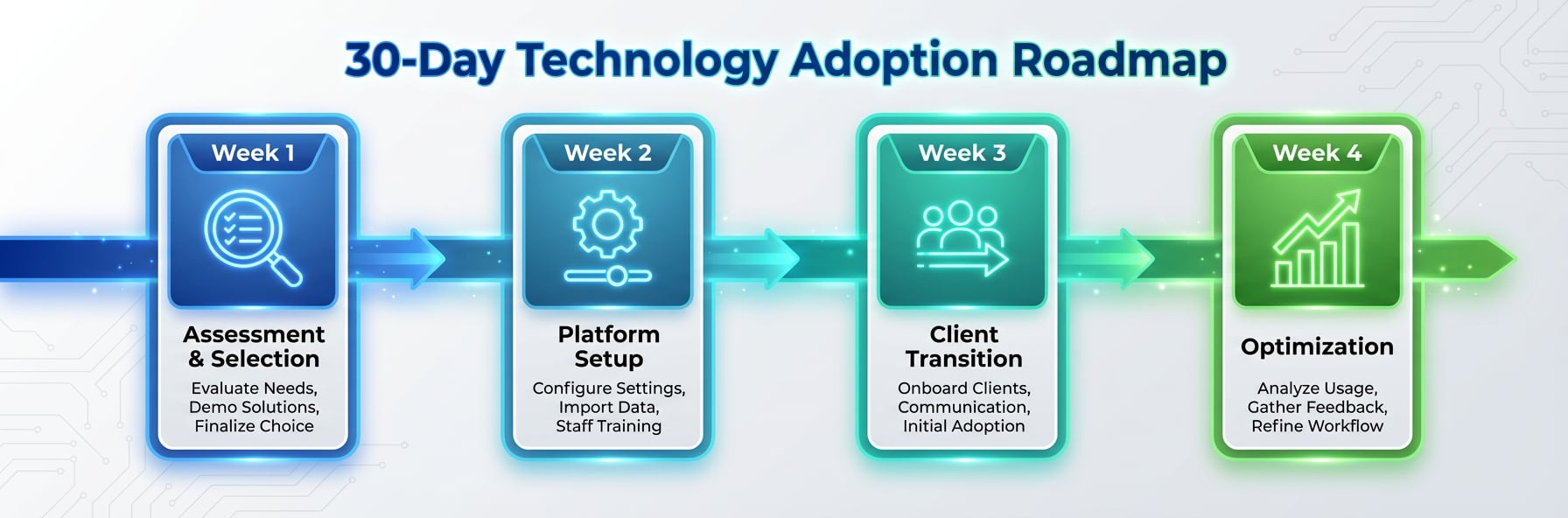
30-Day Technology Adoption Roadmap
Week 1: Assessment & Selection
Day 1-2: Audit current tools and pain points
Day 3-4: Define must-have features and budget
Day 5-7: Research 3-5 platforms, start free trials
Week 2: Platform Setup
Day 8-10: Complete account configuration
Day 11-12: Import existing client data
Day 13-14: Set up payment processing, create templates
Week 3: Client Transition
Day 15-17: Onboard 5 pilot clients (most tech-comfortable)
Day 18-19: Gather feedback and adjust
Day 20-21: Refine client-facing materials
Week 4: Optimization
Day 22-24: Implement first automation (start with payments)
Day 25-27: Onboard remaining clients in batches
Day 28-30: Monitor metrics, plan next feature adoption
14. Conclusion: Technology as Competitive Infrastructure
The fitness technology transformation is not coming—it's here. Trainers and gym owners who embrace integrated platforms, leverage data analytics, and implement intelligent automation are building fundamentally different businesses.
The evidence supports technology investment:
Systematic tracking improves retention measurably
Automation recovers 10-15 hours/week for capacity building
Data-driven program optimization produces better client outcomes
Hybrid models unlock significantly higher revenue per hour
Your implementation path:
This Week: Audit your current technology gaps using Section 9's framework
This Month: Trial 2-3 platforms matching your needs and budget
This Quarter: Commit to one platform and achieve competency
This Year: Layer in automation and analytics progressively, tracking ROI
The trainers who will thrive in 2026 and beyond are those who view technology not as an expense, but as the infrastructure that enables scale, quality, and sustainable business growth.
Research Citations
Straits Research. (2024). Personal Training Software Market Size, Share & Growth Graph by 2033.
GlobeNewswire. (2025). Fitness & Wellness Software Market Outlook & Forecast 2025-2030.
Technavio. (2025). Gym Management Software Market to Grow by USD 201.5 Million (2025-2029).
LLC Buddy. (2024). Personal Training Software Statistics 2025.
GITNUX. (2024). Personal Training Industry Statistics.
IDEA Health & Fitness. (2024). Online Training and the Post-Pandemic Fitness Landscape.
G2. (2025). Best Personal Training Software Reviews.
Capterra. (2025). Best Personal Trainer Software.
FitBudd. (2024). Hybrid Personal Training: The Future of Fitness.
Mindbody. (2025). Clients At Risk Feature Launch Announcement.
Club Industry. (2024). Member Retention Benchmarks Study.
This guide establishes FitFlow as a resource for fitness technology decisions—written from a software company perspective with genuine technical depth. Updated December 2025.