
Caffeine Timing: A Coach''s Framework for Performance vs. Sleep

A client DMs an hour before a 7pm session: "can I still take my pre-workout tonight, or is that going to wreck my sleep?" The honest answer most coaches give is a shrug dressed up as "try to keep it earlier in the day" — because they've never actually worked out whether a 6pm dose is fine, and don't have a fast way to reason through caffeine timing that doesn't sound like a guess.
Here's the number that makes it feel urgent. Young adults who use pre-workout supplements are more than twice as likely to report sleeping five hours or less a night than non-users — a finding from a 912-person cross-sectional study of 16-to-30-year-olds (Ganson et al., Sleep Epidemiology, 2025). It made health-press rounds for months. It reads like a verdict: pre-workout wrecks sleep, stop taking it.
State the caveat in the same breath it deserves. This is a cross-sectional snapshot — it cannot tell you whether pre-workout use causes short sleep, or whether people who are already short sleepers reach for a stimulant to train at all. The study's design can't separate those two stories, and neither can the headline.
Here's the number that actually settles the mechanism. A 2025 randomized, placebo-controlled crossover trial dosed the same 23 people with 100mg and 400mg of caffeine at three different distances from bedtime and measured their sleep with in-home polysomnography (Gardiner et al., SLEEP, 2025). The 100mg dose — one modest cup of coffee — produced no significant sleep disruption even four hours before bed. The 400mg dose — a single large pre-workout serving — delayed sleep onset when taken twelve hours before bed and fragmented sleep when taken eight hours before it. Same "pre-workout," same person, wildly different sleep cost. The only thing that moved was the dose.
Which reframes the coaching question entirely. It was never "how many hours before bed." It's "how many hours before bed, for this dose." A coach who gives every client the same cutoff hour is applying a 400mg rule to a 100mg client, or a 100mg rule to a 400mg client, with no way of knowing which mistake they're making.
Every caffeine dose you approve is also a sleep-debt decision you just made for your client. Price it like one.
Turn This Framework Into a 2-Minute Answer for Your Next Client. Download the free Caffeine Timing Cutoff Calculator — the fillable dose-buffer grid from this article, ready to run against your next roster conversation before you finish reading. Get the Free Calculator.
Caffeine works. That's what makes the timing question hard.
Two camps own this topic, and each is right about half of it.
The performance camp isn't wrong. Caffeine is one of the most consistently effective, cheapest, and safest ergogenic aids available. The International Society of Sports Nutrition puts the effective dose at 3–6 mg/kg body mass, typically 60 minutes pre-exercise, with benefits spanning muscular endurance, strength, sprinting, jumping, and — most consistently — aerobic endurance (Guest et al., Journal of the International Society of Sports Nutrition, 2021). That's a position stand built on a large evidence base, not a marketing claim. This camp's mistake isn't the dosing; it's treating "it works" as the end of the analysis. A dose that works at 4pm and a dose that works at 8pm are not the same decision, and this camp has no language for the difference.
The sleep-hygiene camp isn't wrong either. Sleep is the highest-leverage recovery variable a coach can influence, and caffeine is a well-documented threat to it. Where this camp goes wrong is treating that threat as grounds for a blanket cutoff rule, because the actual research shows the relationship is dose-dependent in a way a single cutoff hour cannot capture — a 100mg dose cleared four hours before bed with no measurable disruption in the same trial where a 400mg dose still delayed sleep onset twelve hours out (Gardiner et al., 2025). "No caffeine after 2pm" is simultaneously too strict for a client having a small coffee and too lenient for a client stacking a 400mg pre-workout at 6pm before an 11pm bedtime.
Neither camp is the villain here. A 2025 review names the structural conflict directly: "studies that investigated the performance-enhancing effects of caffeine recommend the ingestion of caffeine 60 min before the specific task, while studies that investigated potential issues in sleep advised against caffeine ingestion close to bedtime" (Silva, Del Coso & Pickering, Sports Medicine, 2025). Nobody has reconciled those two literatures for a working coach. That's this framework's job — see FitFlow's supplement evidence tiers for where caffeine sits in the broader picture; this post is the deep dive that tier list doesn't have room for.
The cutoff-time rule is a category error
Every competing page on this topic hands you a single number: a cutoff hour — 2pm, 3pm, "8 to 10 hours before bed." That number is a category error. It collapses two variables — how much caffeine, and how far from bedtime — into one, and it's wrong for almost every client it's applied to, because it was never calibrated to any specific person's actual dose.
This isn't a niche objection. A 2025 systematic review of nine randomized controlled trials on caffeine and athlete sleep confirmed exactly this: effects on sleep quality, quantity, efficiency, latency, and awakenings varied considerably by timing relative to bedtime, timing relative to exercise, habitual-use status, and dose (Bodur et al., Clinical Nutrition ESPEN, 2025). There's no single universal cutoff in the data — dose, timing, and the individual are jointly determinative, three variables, and a flat rule discards two of them.
If you coach clients whose primary concern is general sleep hygiene rather than a training-performance decision, FitFlow's 4-pillar sleep-stacks protocol is the right starting point — it covers light, timing, temperature, and routine for sedentary and executive clients, with a flat "roughly two half-lives before bedtime" rule for caffeine as one bullet inside a broader system. That framing holds up for a general-hygiene audience; it doesn't for a training client whose coach is actively prescribing a performance-oriented dose, because it was never built to answer "how much, and at what buffer." This post supersedes that flat rule for exactly that use case, and it's the more current citation for caffeine timing than the flat "no caffeine after 2pm" line still sitting in FitFlow's nutrition and recovery pillar guide.
The reframe that fixes the category error: the cutoff time only exists once the dose is fixed. Ask "when" before "how much" and you've already made the error the rest of this post is trying to correct.
The dose-buffer decision grid
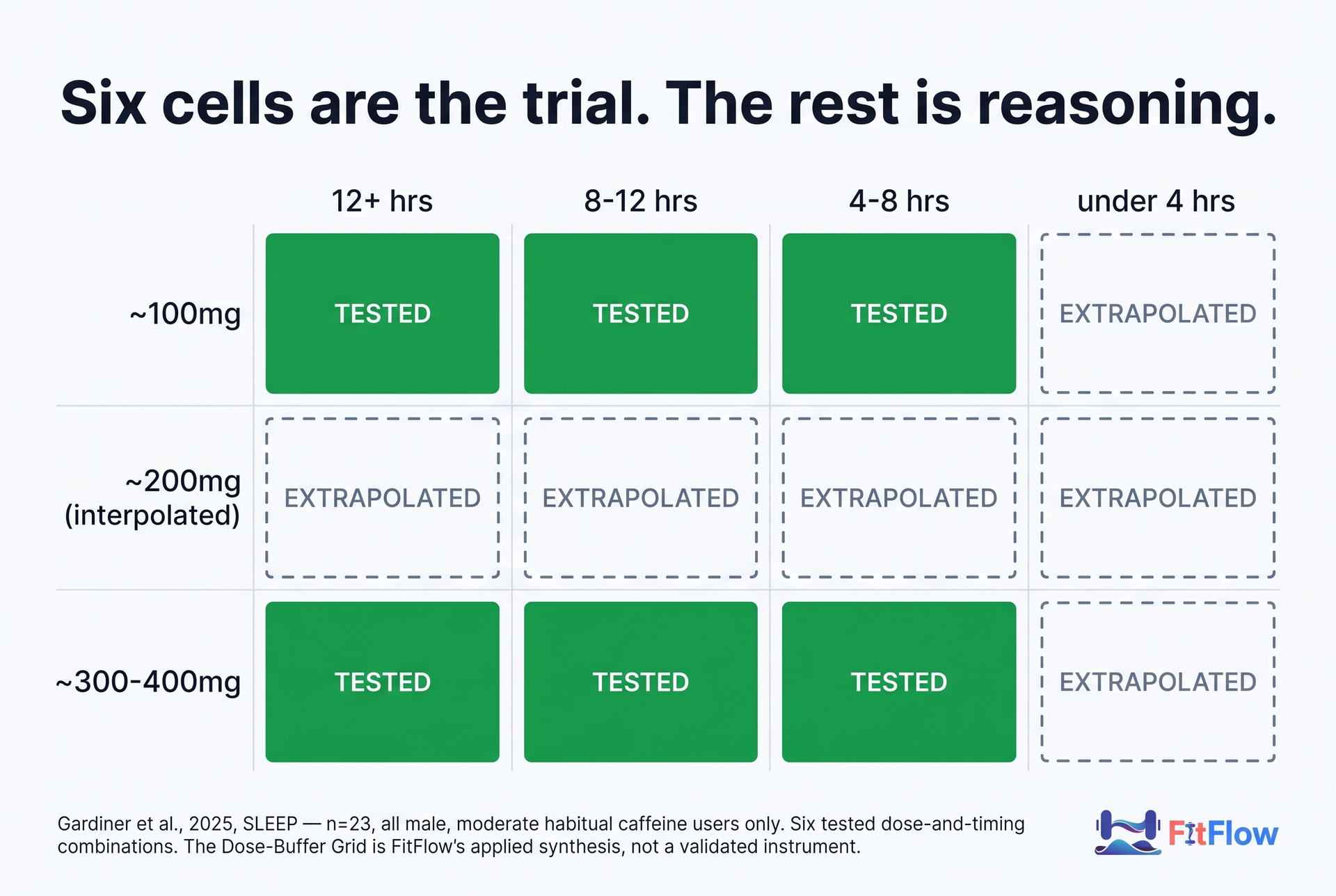
Dose and buffer aren't sequential questions — they're one joint decision. Below is FitFlow's applied synthesis of that decision, built from the six dose-and-timing combinations tested in the Gardiner et al. (2025) trial and extended with conservative extrapolation to the cells that trial didn't test.
Axis 1 — Dose. Anchor to research doses, not guesswork. A Low dose (~100mg, roughly one 8oz coffee) behaves differently than a High dose (~300–400mg, the range of a full pre-workout serving or 3–6 mg/kg body mass at the ISSN's effective ergogenic range) (Guest et al., 2021).
Axis 2 — Buffer. Hours between the dose and the client's actual intended bedtime — not "end of the day," the real number they're targeting tonight.
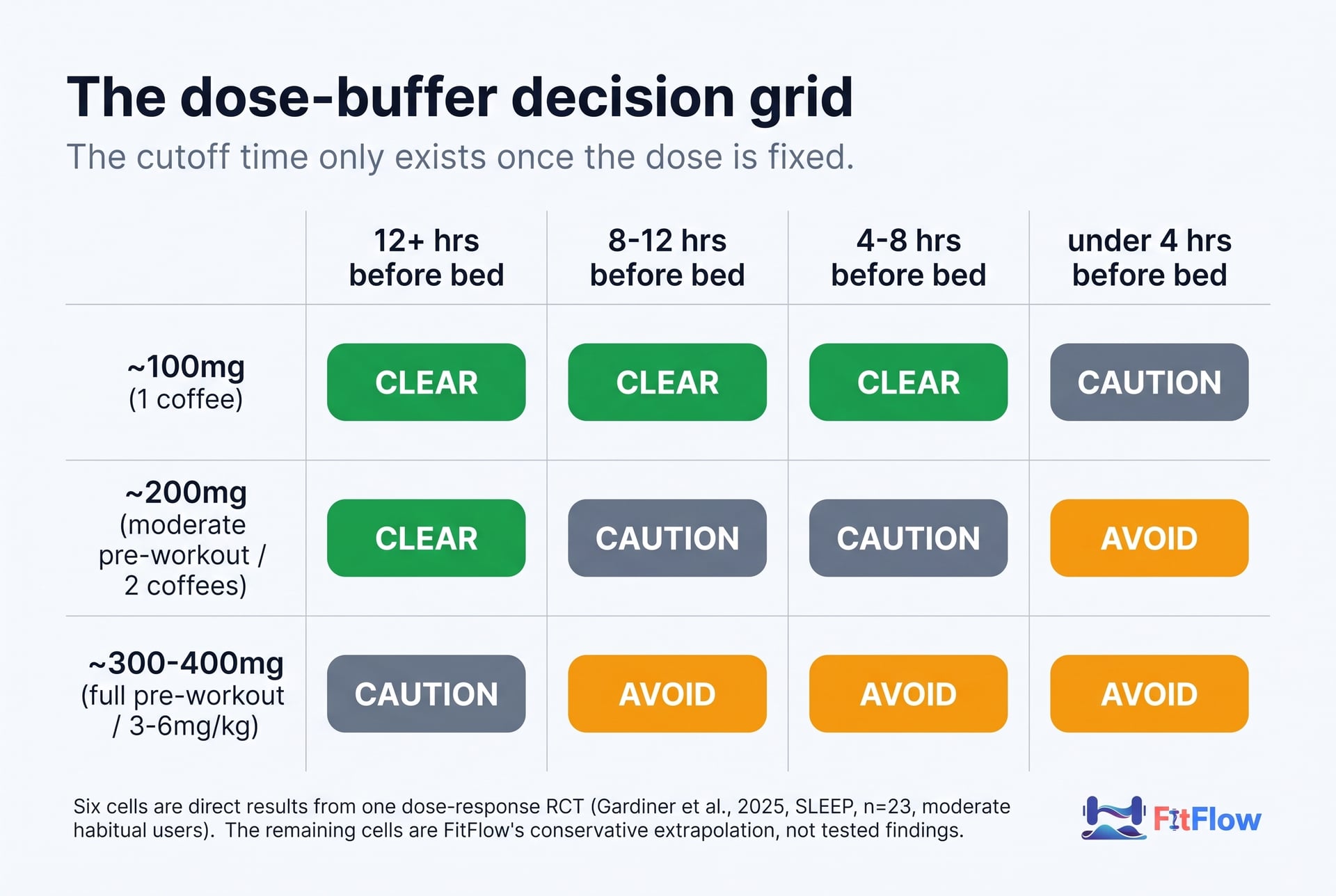
Dose | 12+ hrs before bed | 8–12 hrs before bed | 4–8 hrs before bed | Under 4 hrs before bed |
|---|---|---|---|---|
~100mg (1 coffee) | Clear | Clear | Clear — Gardiner et al. found no measurable sleep effect at 4h | Caution — untested at this range in the RCT; default to caution |
~200mg (moderate pre-workout / 2 coffees) | Clear | Caution | Caution | Avoid |
~300–400mg (full pre-workout / 3–6 mg/kg) | Caution | Avoid — sleep onset delayed at this range (Gardiner et al.) | Avoid — sleep fragmentation observed at 8h | Avoid — perceived sleep quality dropped 34% at 4h |
Say this plainly, because the grid invites more confidence than it should get on its own: this is a synthesis of a single dose-response RCT extrapolated into a decision tool. Gardiner et al. tested exactly six dose-times combinations in 23 moderate-habitual-caffeine-using men — not every cell in this table. The cells marked "Caution" that fall outside those six tested combinations are conservative extrapolations, not direct trial results. This is FitFlow's applied framework built on top of one trial's tested conditions, not a republished finding, and it should be used with that distinction in mind — the same discipline that matters when you're deciding which metric is actually worth tracking rather than the one that's merely convenient to measure.
The line to remember: the cutoff time only exists once the dose is fixed — pick the dose first.
Fast, slow, and unknown: what CYP1A2 genetics actually tells you
This is the individual-variation layer the whole framework hangs on, and it has to be reported honestly — including a genuine, unresolved disagreement in the literature.
What's well-supported. CYP1A2 is the hepatic enzyme responsible for roughly 95% of caffeine metabolism. A common polymorphism produces three genotypes: AA (fast metabolizers), AC (intermediate), and CC (slow metabolizers). A 2025 systematic review of 19 studies spanning 2012–2024 (n=732) reported that AA and AC genotypes generally show a positive ergogenic response to caffeine, while CC-genotype individuals show no effect or a negative effect from standard caffeine doses — including one included trial reporting a meaningful decrease in grip strength for CC individuals relative to placebo.
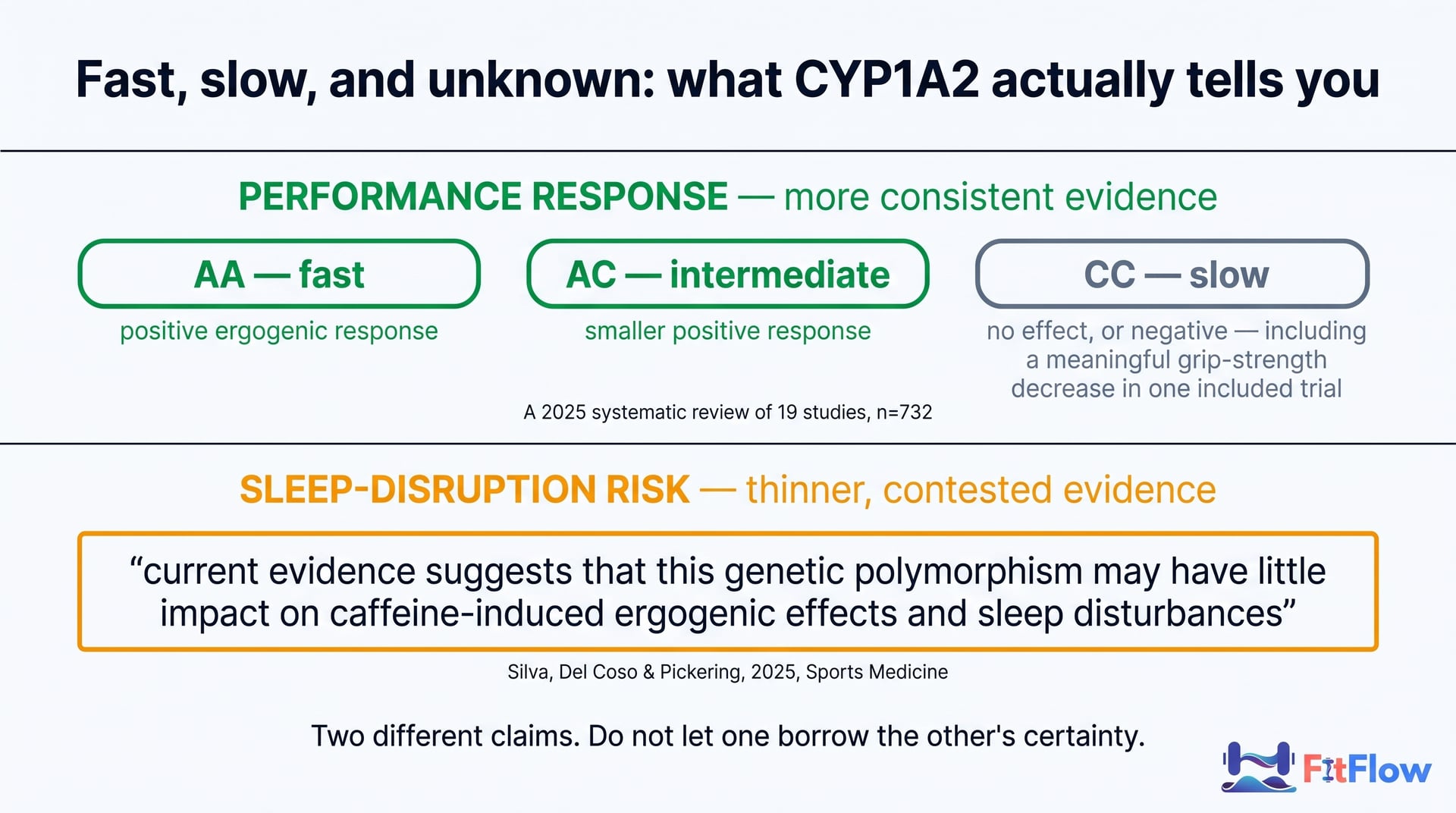
What's genuinely contested. A 2025 Sports Medicine review of the entire performance-versus-sleep conflict states plainly that "current evidence suggests that this genetic polymorphism may have little impact on caffeine-induced ergogenic effects and sleep disturbances" (Silva, Del Coso & Pickering, 2025) — in direct tension with the genotype-specific performance findings above. A 2026 study merging two randomized crossover trials (a 10km run and a 40km cycling time trial, n=38 recreational male athletes, all AA or AC carriers) lands closer to the "little impact" side of that tension: caffeine improved performance overall, but the trial found no significant gene-by-caffeine interaction between AA and AC carriers specifically (Masters et al., European Journal of Sport Science, 2026). This framework reports both positions and does not resolve the disagreement for you, because resolving it would mean picking the more citable-sounding side over the honest one.
The synthesis worth carrying into a session: genotype evidence for performance response is more consistent across studies than genotype evidence for sleep-disruption risk specifically — those are two separate claims, and the second one is thinner than headlines about "slow metabolizers" usually imply. Don't let a claim about how someone responds to caffeine's performance effect quietly borrow certainty for a claim about how it disrupts their sleep. They're not the same evidence base.
The practical translation for a coach with no genetic test available — which is nearly every coach: a client who reports getting wired, jittery, or unable to sleep off doses that other clients tolerate fine is plausibly a slow metabolizer, whether or not that's ever confirmed by a test. The coaching response is identical either way — default that client to the conservative cells in the dose-buffer grid, regardless of genotype-testing access. The framework does not require a lab test to work, and it doesn't need one to be useful for the recovery markers you're already tracking on a client who isn't bouncing back the way the program predicts.
The athlete's angle: dosing, tolerance, and cycling
Two clocks run independently here, and a coach needs to hold both at once. The ISSN's 60-minutes-pre-exercise standard (Guest et al., 2021) is a session-relative instruction — when to dose relative to training. The buffer grid above is a bedtime-relative instruction — when to dose relative to sleep. Neither clock overrides the other; you're running both calculations for the same dose, at the same time, for the same client.
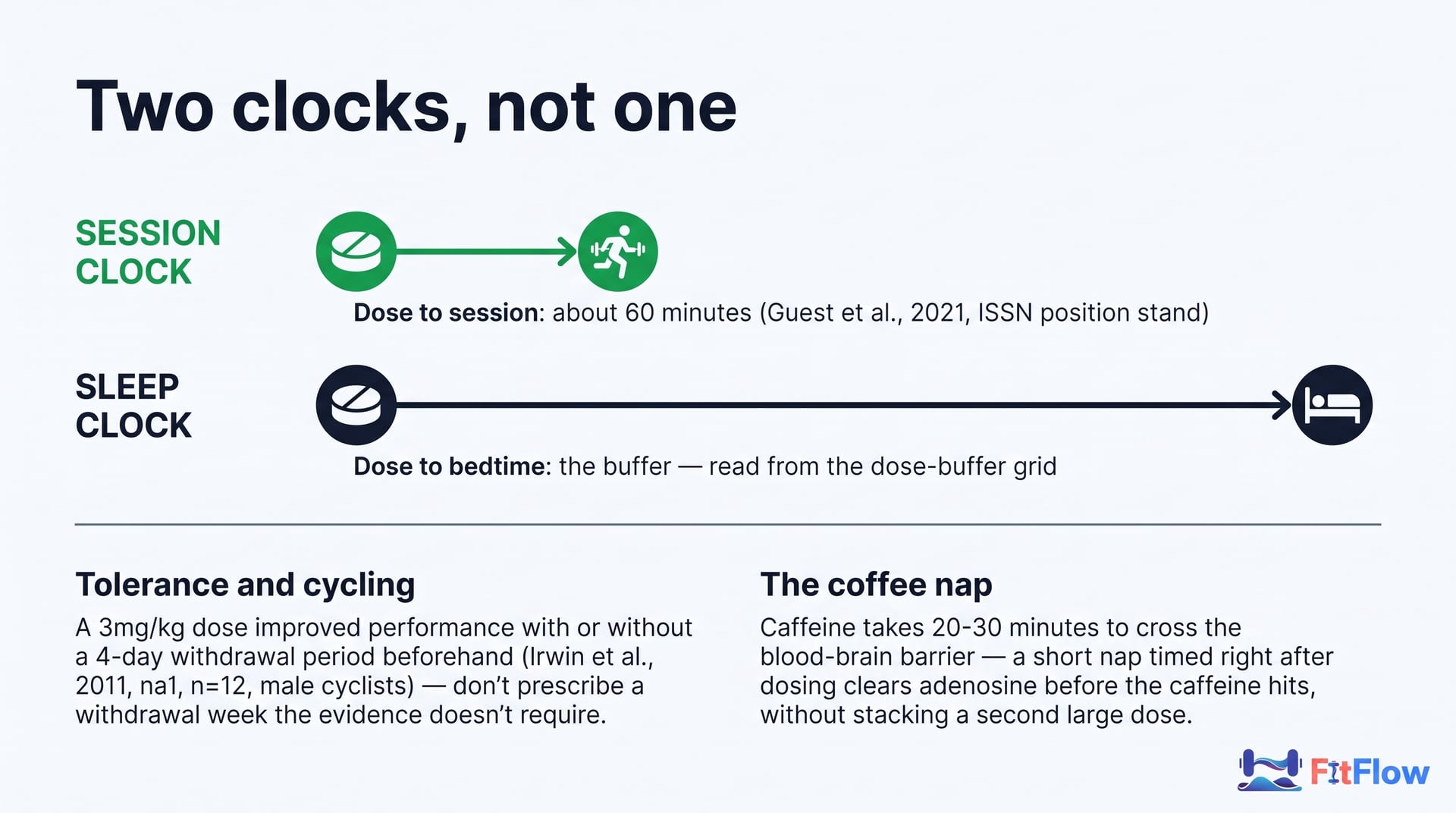
Tolerance and cycling. Regular caffeine use blunts the ergogenic response, which pushes some coaches toward pre-competition withdrawal protocols. The evidence for that specific tactic is thin. In a controlled trial of 12 well-trained male cyclists, a 3mg/kg acute dose improved performance regardless of whether a 4-day withdrawal period preceded it (Irwin et al., Journal of Sports Sciences, 2011) — withdrawal wasn't required to see the benefit, though the trial didn't test whether withdrawal makes the benefit larger. Read that as license to stop prescribing a withdrawal week you can't justify from the evidence, not as proof withdrawal never helps anyone. It's a single small trial in male cyclists; treat it as exactly that much evidence.
The coffee-nap technique. For a client managing an afternoon energy dip without stacking a large late-day dose, this is a legitimate, low-risk tactic. Caffeine takes 20–30 minutes to cross the blood-brain barrier, so a short nap timed immediately after a dose lets adenosine clear during the nap while the caffeine hits a cleared receptor field on waking — an alertness boost without a second large dose onto an already-caffeinated day. A session-timing tool, not a sleep-hygiene fix.
One myth worth clearing since it comes up in the same conversations: caffeine's mild diuretic effect does not meaningfully dehydrate a trained user at typical training doses — see the hydration and electrolytes guide for the full treatment. Adjacent to this post's scope, not part of it.
The 5-step application protocol
Run this in order every time a client's dose or session stakes change — not as a one-time assessment, but as the repeatable move.
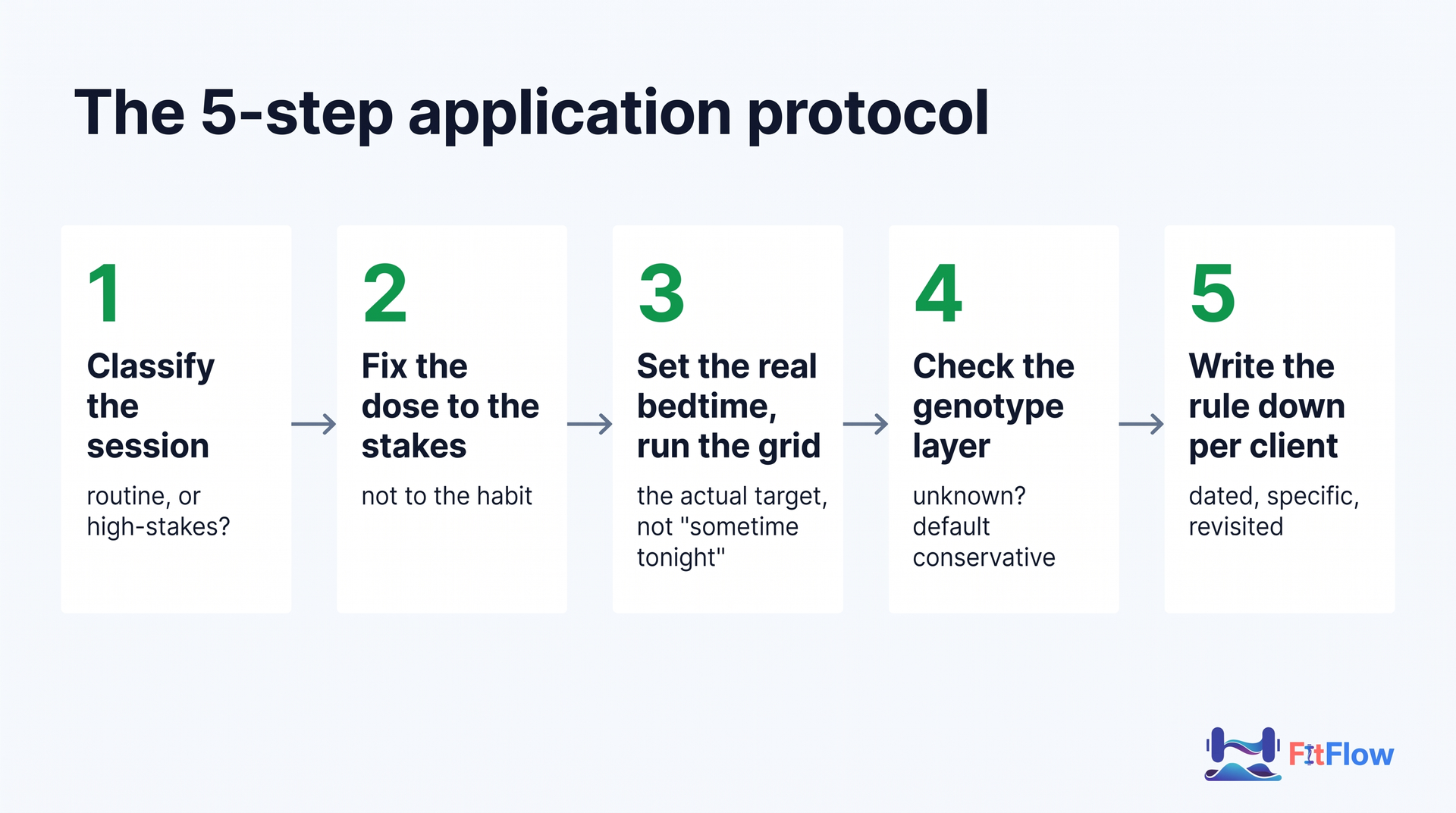
Classify the session. Is tonight's session routine — a standard training day the client could skip caffeine for with no real cost — or high-stakes: a strength test, a competition, a client's own goal event, or, for a non-athlete client, a demanding cognitive day? This determines whether the dose needs to sit at the ergogenic end of the range (3–6 mg/kg, per Guest et al., 2021) at all.
Fix the dose to the stakes, not the habit. A routine session doesn't need a 400mg dose. If the client's habitual intake already covers alertness, additional caffeine for a routine session is buying sleep risk with no performance return. Reserve the high end of the ISSN's effective range for sessions where the performance delta actually matters.
Set the real bedtime and run the grid. Not "sometime tonight" — the client's actual target bedtime. Locate the dose-by-buffer cell in the grid above.
Check the genotype and individual-response layer. If unknown — and it usually is — default to the more conservative cell, not the more permissive one.
Write the rule down per client, not per rule of thumb. The output of steps 1–4 is a specific, dated answer for this one client — "200mg is fine for you up to 6 hours before an 11pm bedtime, based on your reported sensitivity" — not a studio rule you repeat to everyone. Revisit it if the client's habitual intake, training schedule, or reported sleep changes.
This is the same discipline behind prescribing the exit alongside the tracking itself: decide the boundary at prescription time, not at the point where something's already gone wrong.
You Just Read the 5-Step Protocol. Here's the Fillable Version. Don't re-derive the grid from memory in your next session. The Caffeine Timing Cutoff Calculator gives you the same 5 steps as a worksheet with space to write the client's dose, bedtime, and the dated rule you land on. Get the Fillable Worksheet.
The conversation layer: what to actually say
Every competing page ends at "have a conversation about it" and gives you nothing to say. Here are five scripts.
Asking what they're actually taking and when, without judgment. Most clients have never been asked to say the actual dose and time out loud, and don't know it themselves until asked directly.
"Walk me through exactly what you're taking before a session — the product, how much, and roughly what time — and same for anything you drink in the evening. I'm not checking up on you, I need the real numbers to give you a real answer."
Introducing the dose-buffer framework live, in one or two sentences.
"The question was never really 'when's my cutoff' — it's 'this dose, this bedtime, does it still leave you enough runway.' Once I know your usual dose and your target bedtime, I can actually answer that instead of guessing."
Negotiating an evening high-stakes session — a client who wants a full dose before an 8pm event with an 11pm bedtime. The move is lowering the dose, not skipping it, or explicitly accepting the sleep cost as a one-time trade for a genuinely high-stakes session:
"For tonight specifically, I'd rather you take less and sleep, than take the full dose and pay for it tomorrow — unless tonight is the thing you're actually training for, in which case we accept the sleep cost on purpose, just this once, and we both know that's the deal."
The genetics conversation, without over-medicalizing it.
"Some people process this a lot slower than others, and if that's you, the same dose that's fine for someone else might not be fine for you at the same buffer. You don't need a test to know — if you're the person who's wired at midnight off an afternoon coffee, that's your answer already."
Saying the referral line, from the section below, in a way that doesn't alarm a client who isn't in that category:
"This sounds like it's become bigger than a timing question — I'd like you to talk to your doctor about your caffeine intake before we keep adjusting when you take it."
Say it plainly, without dropping your voice. A client who keeps circling back to "I can't cut this down" instead of "when should I take it" needs the adherence conversation, not the timing one.
Where the evidence runs thin
Reading this evidence honestly is the actual professional skill, and most of what's written about caffeine timing picks a side before it picks a source.
The genetics contradiction, restated as a limitation, not just a fact. Two credible, recent literatures disagree on how much CYP1A2 genotype matters. One line — the 2025 systematic review of 19 studies — finds genotype-dependent performance effects between AA/AC and CC carriers. A separate 2025 review (Silva, Del Coso & Pickering) states current evidence shows genotype "may have little impact" on either ergogenic response or sleep disturbance, and a 2026 merged-trial study (Masters et al.) lands on that side too — it found caffeine worked overall but no significant gene-by-caffeine interaction between the AA and AC carriers it tested. A coach who reads only one of those sources walks away with false confidence in either direction.
The Ganson et al. (2025) study cannot establish causation. Cross-sectional, self-reported, n=912, ages 16–30. It cannot distinguish "pre-workout use causes short sleep" from "people who already sleep short reach for a stimulant to train at all," and it doesn't isolate caffeine dose from other ingredients in a multi-ingredient blend. The "more than twice as likely" figure is real and worth knowing — it's not proof of the mechanism, and it should never be repeated without that caveat attached.
The Gardiner et al. (2025) trial — the central evidentiary pillar of the dose-buffer grid — is small and narrow. n=23, all male, moderate habitual caffeine users only. It doesn't tell you what happens in caffeine-naive users, women, heavy daily users well above 300mg/day, or adolescents. The grid extrapolates from six tested cells; most of it is reasoned extrapolation, not direct replication, and that distinction matters every time you apply it to a client who doesn't match the trial population.
The withdrawal-cycling evidence is a single small trial. Irwin et al. (2011): n=12, male competitive cyclists. It shows the ergogenic effect persists without a withdrawal period. It does not prove withdrawal never helps, and it says nothing about non-cyclists or non-competitive clients.
Where individual variation exceeds the group effect. Caffeine half-life ranges roughly 3–8 hours depending on genetics, hormonal status, age, and medication use — before any dose-buffer math even starts. Every number in this post describes a population distribution, not a guarantee for the one client in front of you — the same limitation wearable recovery data runs into, where a single HRV reading can swing 30–50% from caffeine, hydration, and stress alone, and interpreting that data responsibly means holding the same population-versus-person distinction.
What the dose-buffer grid actually is. An applied synthesis of one RCT's tested conditions plus conservative extrapolation to untested cells — a reasoning tool, not a validated clinical instrument. Say that to yourself before you say it to a client with full confidence.
When it's not a timing problem — your referral line
Some clients whose caffeine use looks like a timing problem are describing something the dose-buffer grid cannot fix: compulsive use, an inability to function or train without an escalating dose, anxiety that tracks with intake, or physical withdrawal symptoms — headache, irritability, fatigue — on days without it.
Caffeine Use Disorder is listed in DSM-5-TR Section III as a condition for further study — not yet a formal clinical diagnosis, but a recognized, researched pattern with validated screening instruments, including the Caffeine Use Disorder Questionnaire.
A trainer's job here is recognition and referral, not screening or diagnosis. If a client describes anxiety that scales with intake, an inability to train or function without an escalating dose, physical withdrawal symptoms, or a "timing" conversation that keeps circling back to "I can't cut this down" rather than "when should I take it" — that's no longer a dose-buffer question. Give the client the actual sentence, not a vague redirect:
"This sounds like it's become bigger than a timing question — I'd like you to talk to your doctor about your caffeine intake before we keep adjusting when you take it."
Don't name a diagnosis. Don't administer a screening questionnaire and call it an assessment. This is the same scope pattern that governs programming decisions for female clients: recognize the pattern, route to the person qualified to work on it, and stay in the room for the training itself. Refer out for the dependency question; keep coaching the performance question.
One adjacent note, brief on purpose: for clients on GLP-1 medications, appetite suppression can mask stimulant sensitivity changes and interact with reduced food intake around training sessions. That's its own topic with its own considerations — see the GLP-1 coaching guide for the full treatment; it's out of scope here.
Price the trade, don't memorize the cutoff
The client from the opening — the one asking about pre-workout before a 7pm session — didn't need a cutoff hour. They needed their coach to run three numbers: the dose, the buffer to their actual bedtime, and how much tonight's session actually mattered.
In short:
Both camps are right about half of it. Caffeine works, and late caffeine costs sleep. Neither fact cancels the other; the mistake is picking one and ignoring the other.
The cutoff time only exists once the dose is fixed. A single "stop by 2pm" rule is wrong for almost every client it's applied to, because it was calibrated to nobody's actual dose.
Genotype evidence is genuinely contested — don't resolve it for your client. Report both positions on CYP1A2, and default to the conservative cell when in doubt.
Fix the dose to the stakes, not the habit. A routine session doesn't need a performance-tier dose; save it for sessions where the delta actually matters.
The dose-buffer grid is a reasoning tool, not a validated instrument. Most of it is extrapolation from one RCT's six tested cells — use it that way, and say so.
Know the referral line and say it plainly. A timing conversation that keeps circling back to "I can't cut this down" isn't a timing conversation anymore.
None of this requires you to stop prescribing caffeine, and you shouldn't. It requires pricing caffeine timing like any other trade-off with a real cost on both sides: this dose, this client, this bedtime, this session — worth it or not. That's a calculation you can run in a DM in under a minute once you've done it enough times. Not a rule you memorize once — a decision you make well, repeatedly, per client.
Price the Trade, Don't Memorize the Cutoff — Get the Full Toolkit. The Caffeine Timing Cutoff Calculator: the fillable Dose-Buffer Grid, the 5-step protocol worksheet, the genetics self-report prompt, verbatim scripts, and the referral line — all five sections free. Download the Full Calculator.
Frequently Asked Questions
Comments