The Protein Distribution Myth: Timing Matters

The client who set a phone alarm
Your 11 AM client walks in slightly stressed, pulls out her phone, and shows you the screen. Three alarms: 7 AM, 10 AM, 1 PM. "Protein reminders," she says. "I read I lose muscle if I don't eat at least 30 grams every three hours."
She isn't lifting heavier than she did six weeks ago. She's sleeping worse. She skipped her sister's birthday lunch last weekend because the timing was off. Now she wants to know if her schedule is right, or if she should add a fourth alarm.
Most of us recognize some version of this client. The protein timing dogma (eat within 30 minutes of training, hit 30 grams every three hours, never miss a "window") has lodged itself deeply enough in general fitness culture that smart, capable clients are running their lives by alarm clocks.
Here is the uncomfortable part. The dogma has real science behind it. Timing does matter. The mistake is that the precision and urgency of the popular advice doesn't match what the current evidence shows. Timing matters, just not in the way most fitness culture believes. The gap between what the research says and what your clients have been told is exactly where the coaching opportunity lives.
Stop guessing which clients need a protein distribution strategy. Get the Free Checklist.
The 30-minute anabolic window: where the myth came from
The 30-minute "anabolic window" wasn't invented out of nothing. Acute muscle protein synthesis (MPS) studies from the late 1990s and early 2000s did show that resistance exercise elevates muscle sensitivity to amino acids, and that feeding protein post-training produced a measurable synthesis spike. That's a real, replicable observation.
What happened next is what usually happens. The supplement industry compressed an acute laboratory finding into a marketing claim. "Your muscles are most receptive in the first 30 minutes" became "drink this immediately or you lose your gains." A qualitative observation became a stopwatch.
The same compression happened with distribution. The leucine threshold work that emerged in the 2010s, most notably the dose-response studies from the Stuart Phillips lab at McMaster (see Witard et al. 2014, AJCN), identified a per-meal protein dose that maximally stimulates MPS, with a refractory period before another meal triggers another pulse. That work is solid. It got oversimplified into "30 grams every three hours, four times per day, or you're leaving muscle on the table." The 2022–2024 podcast ecosystem amplified the rigid version; the walk-back started in 2024 and continued through 2025–2026.
The single most consequential study in the whole conversation is the 2013 Schoenfeld and Aragon meta-analysis published in JISSN. After controlling for total daily protein, the timing effect on muscle gains essentially disappeared. Total protein intake was the significant predictor of effect size (estimate = 0.39 ± 0.15; CI: 0.08, 0.69; P = 0.01). The flaw in most older "timing matters" studies was that the timing group was also eating more total protein. The benefit attributed to timing was largely a benefit of intake.
That is the foundation. Total intake is the primary lever. Timing exists on top of it.
What the 2025–2026 evidence actually shows
The science has moved. The headline findings of the last two years aren't dramatic reversals. They're refinements that change how coaches think about per-meal recommendations.
The anabolic window is real, just much longer than you were told
The current synthesis puts the post-exercise anabolic sensitivity window at roughly 4 to 6 hours, not 30 minutes, when a pre-workout meal was consumed 2 to 3 hours prior (see 2025 MDPI Nutrients systematic review). That's a fundamentally different practical picture.
There is one meaningful exception. If your client trains fully fasted (common for early-morning sessions or intermittent fasting practitioners), the window tightens to roughly 1 to 2 hours post-session. In that case, a faster post-workout protein source genuinely matters more.
For everyone else, the "rush home and chug a shake" choreography is doing nothing your client's lunch wouldn't do anyway. If a client trains at 5 PM and has dinner at 7 PM with a real protein source, the timing question is solved.
Per-meal protein: the leucine threshold, explained without oversimplification
Leucine is the branched-chain amino acid that triggers MPS via the mTOR pathway. Below a certain leucine dose, the synthesis response is muted. Above it, you get a meaningful pulse. The thresholds:
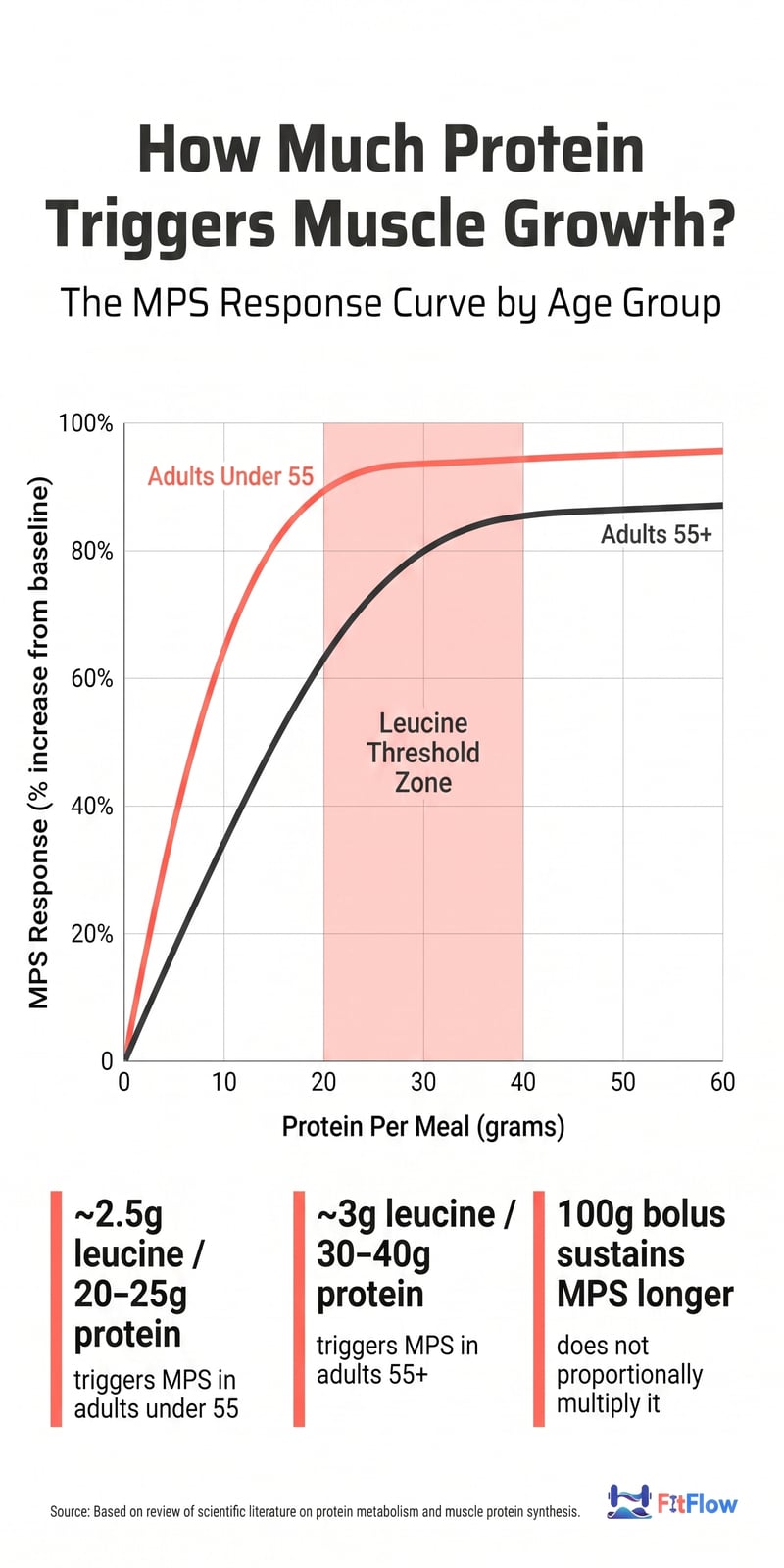
Younger adults (~18–45): approximately 2.5 grams of leucine per meal, or roughly 20–25 grams of high-quality protein (whey, eggs, lean meat, dairy). The Witard 2014 dose-response data found that 20 g of whey maximally stimulated MPS in ~80 kg trained young men.
Older adults (~55+): approximately 3 grams of leucine per meal, or roughly 30–40 grams of high-quality protein. This reflects anabolic resistance, covered below.
After a meal triggers MPS, there's a refractory period of roughly 2 to 3 hours before another protein pulse can elicit another response. This is the basis for "spread protein across the day." It's biology, not arbitrary. The Areta et al. 2013 distribution study (Journal of Physiology) demonstrated this directly: across 12 hours post-exercise, four 20 g doses every 3 hours produced superior MPS compared with eight 10 g doses every 1.5 hours or two 40 g doses every 6 hours.
One caveat worth flagging, because this is where coaches get pulled into bad client conversations. The popular framing, that "your body can only absorb 30 grams of protein at a time," is factually wrong. Absorption is not the limiting factor; your gut absorbs essentially all the protein you eat. The limit is the anabolic signaling response, which is a different thing.
This matters because Trommelen and colleagues published 2023 data in Cell Reports Medicine showing a 100 g protein bolus produced an elevated and prolonged (>12-hour) MPS response compared with a 25 g dose. The body has more adaptive capacity than the simple "MPS ceiling" interpretation allows. When total daily protein is matched, practical between-protocol differences are smaller than the popular discourse implies.
The nuanced truth: distributing across 3–4 meals produces more total daily MPS pulses than 1–2 large meals, and over months this likely supports better outcomes. But the marginal difference between 28 grams at lunch and 35 grams at lunch is not the lever your client needs to obsess over.
Where distribution actually matters: the populations that change the equation
For most general-population clients, the distribution question is overemphasized. For four specific populations, the per-meal math genuinely shifts, and coaching needs to change with it.
Older adult clients (55+): anabolic resistance changes the math
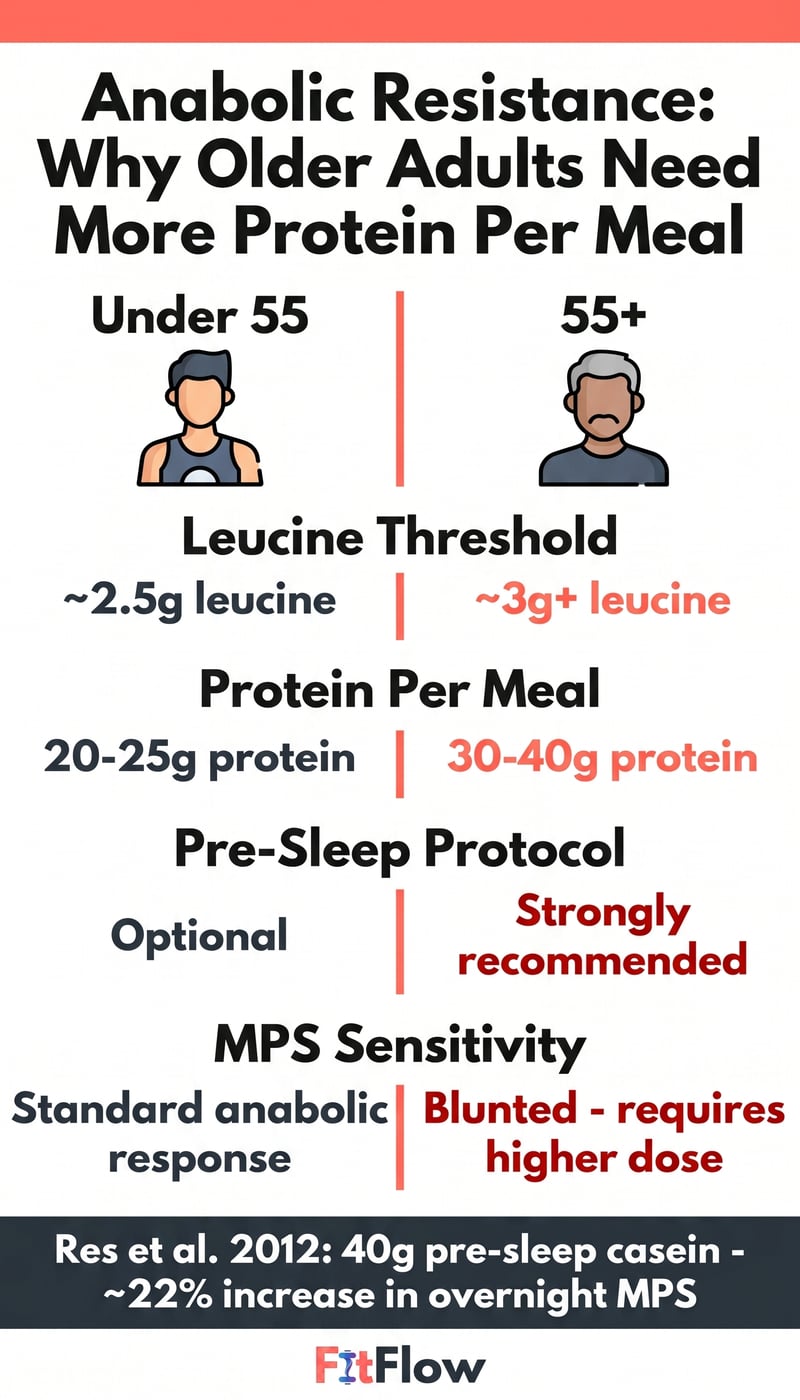
Anabolic resistance is the phenomenon where the MPS signaling response to a given protein dose blunts with age. The 20–25 grams that maximally stimulate synthesis in a 30-year-old undershoot the response in a 65-year-old. To get equivalent stimulation, older adults need roughly 30–40 grams per meal, with a leucine target closer to 3 grams (see the 2023 leucine systematic review). This isn't a marginal adjustment. It's a structural reframing. The "30 g per meal" rule that's loose advice for younger clients becomes a real physiological floor for older ones.
The original Res et al. 2012 study in Medicine and Science in Sports and Exercise established the canonical finding: 40 g of casein consumed 30 minutes before sleep increased overnight MPS by roughly 22%. Subsequent work has replicated and extended this effect in older populations, supporting the broader claim that adequate per-meal doses become a coaching priority, not just an optimization, for 55+ clients. (Note: individual results may vary by training status, total intake, and protein source quality.)
The GLP-1 connection matters here too. Clients on semaglutide or tirzepatide eat dramatically less food, which means fewer leucine-threshold crossings per day. A 60-year-old client on a GLP-1 medication can easily land at three meals of 12–15 grams each. That's not enough leucine in any single meal to meaningfully trigger MPS, and it compounds with age-related blunting. The lean mass preservation risk is real, and per-meal distribution becomes a coaching priority rather than an optimization layer. This is one of the hidden recovery barriers we cover in the broader nutrition framework.
The pre-sleep casein protocol: the one timing rule that survived
If I had to pick the single most defensible timing-specific recommendation in the literature, it would be pre-sleep casein. This is the rule that survived the broader timing-dogma walk-back.
The mechanism is clean. An overnight fast represents roughly 8 hours without exogenous amino acid availability. Muscle protein breakdown continues through that window. Slow-digesting casein consumed before bed provides a sustained amino acid trickle through the night, partially compensating for breakdown that would otherwise go unopposed.
The Res et al. 2012 work demonstrated that 40 grams of casein consumed before sleep was effectively digested and absorbed overnight, and stimulated MPS during sleep by ~22%. Subsequent work has replicated the acute effect in younger and older populations, with effective doses in the 20–40 gram range, roughly 30 minutes before sleep.
To be honest about the limitation: the acute MPS evidence is well-established. Whether this translates to meaningful chronic differences in muscle mass and strength over months and years has not been definitively resolved in the systematic review literature (see Snijders et al. 2019 Frontiers in Nutrition update). It's plausible, the mechanism makes sense, the intervention is low-cost. Not bulletproof.
Practical framing: if a client is already consistently hitting their daily protein target and wants one optimization to add, pre-sleep casein is the most defensible candidate. For clients 45 and older, push it higher in priority. For a 24-year-old who isn't yet consistently hitting 1.6 g/kg daily, it's a distraction from the primary intervention. This nests into the broader recovery periodization model.
Women clients: the research gap you need to acknowledge
The MPS and protein distribution literature has been built predominantly on young, healthy, resistance-trained males. Recent scientometric work on hypertrophy nutrition research confirms substantial underrepresentation of women in the foundational studies.
Current guidelines for female athletes, from the ISSN position stand on protein and exercise and the more recent ISSN position stand on nutritional concerns of the female athlete (2023), recommend 1.4–2.2 g/kg/day distributed across meals, with female-specific guidance noting that ingestion during the luteal phase should target the upper end of the range due to greater amino acid need. Those numbers are extrapolated in part from male MPS data. Recent work has been more direct that some MPS distribution findings may not translate cleanly to trained females.
For coaching: apply the same general framework, but explicitly acknowledge to women clients that per-gram per-meal precision isn't established for them the way it is for men. Don't present extrapolated male data as settled science. Trainers who get this right build more trust with sophisticated clients than trainers who dress up uncertainty as confidence. The menstrual cycle phase question is an emerging area without strong evidence supporting drastic distribution alteration beyond the upper-range guidance above.
Plant-based clients: the distribution math genuinely changes
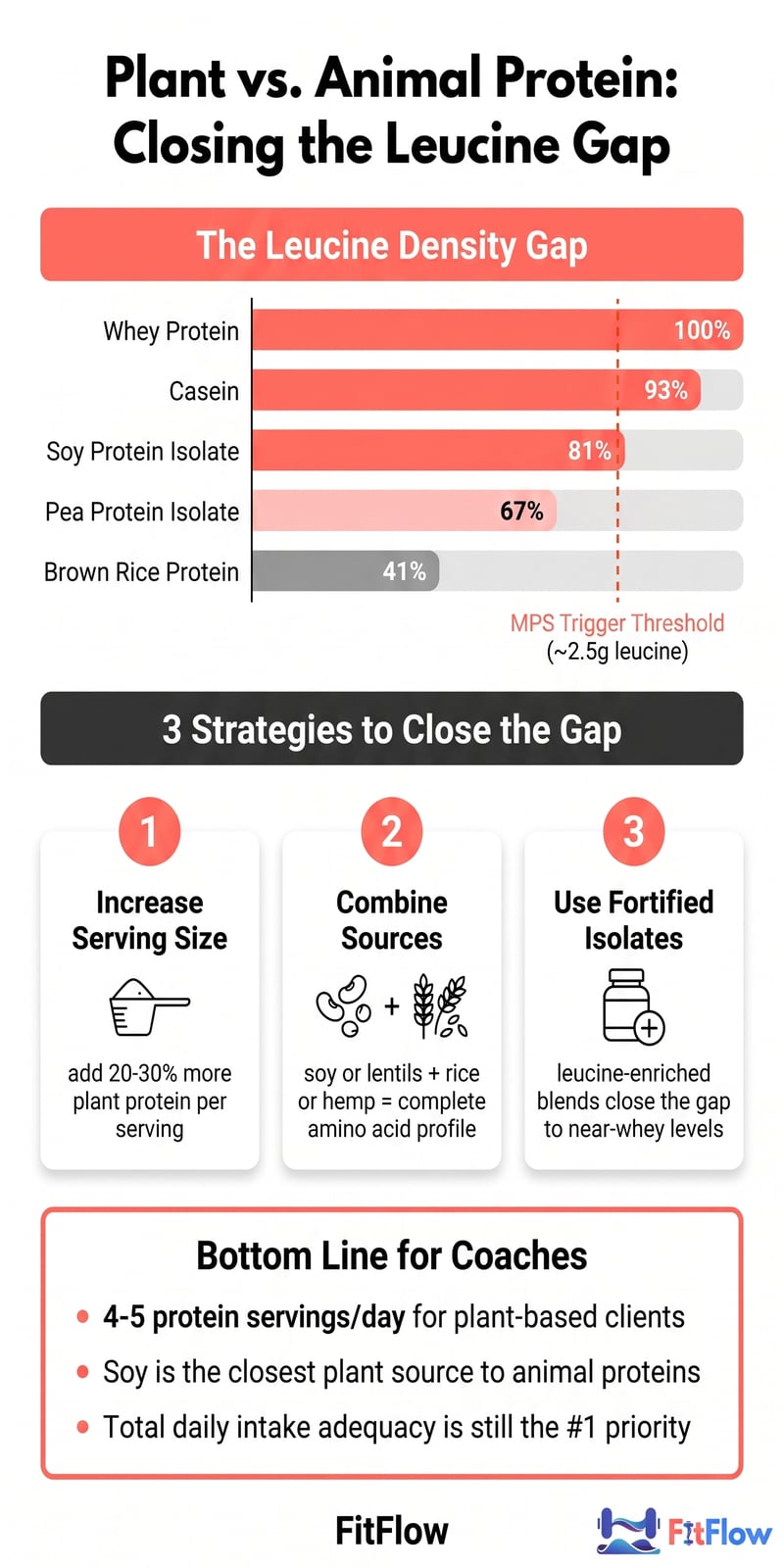
Plant proteins, on average, have lower leucine density per gram than animal proteins. The serving size required to clear the leucine threshold is larger.
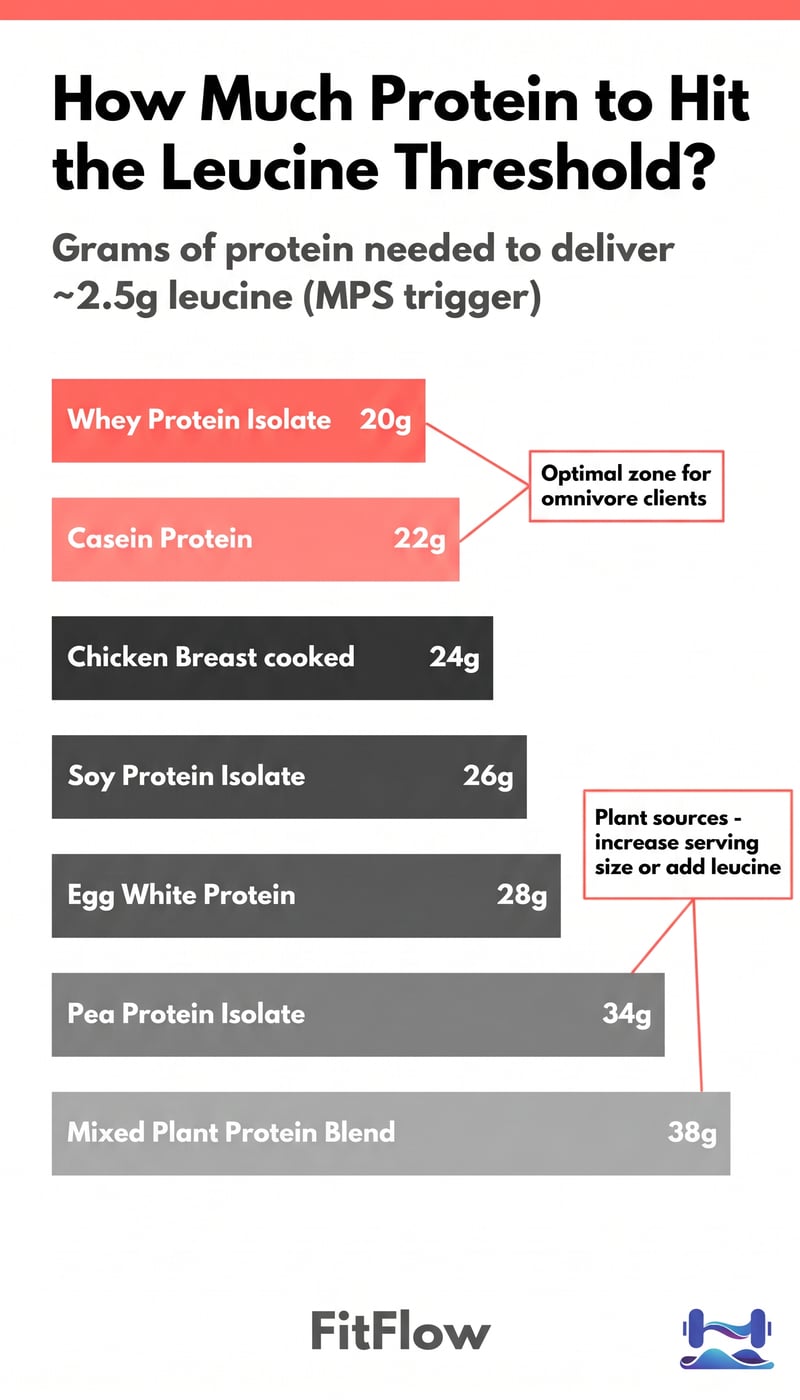
Rough numbers. To get 2.5 grams of leucine from pea protein, you need roughly 30–35 grams of total protein. From whey, you get there at ~20–22 grams. Soy is the plant-world exception, with leucine content closer to animal sources, and potato and corn protein also score well on leucine percentage.
Compensation strategies:
Increase per-meal serving size by ~20–30% over the typical animal-protein recommendation
Combine sources within meals (lysine-rich soy or lentils + methionine-rich rice or hemp)
Where feasible, use fortified plant protein isolates or blends; some are explicitly leucine-fortified
Increase serving count to 4–5 protein occasions per day rather than 3–4
The Van Loon group has shown that soy and wheat protein produce a lower post-prandial MPS response than whey or casein, and that doubling the soy dose (40 g vs 20 g) does not fully compensate for the gap (see the GSSI SSE #220 review by Van Loon and colleagues). Recent whole-meal data found an omnivorous meal produced ~47% higher post-prandial MPS than an isocaloric, isonitrogenous vegan meal in healthy older adults (Journal of Nutrition 2023). Trommelen's plant protein supplementation work has shown that added leucine can substantially close that gap.
Plant-based clients can absolutely build muscle. The distribution math is just different enough that coaches need to address it explicitly rather than copy-pasting the omnivore framework.
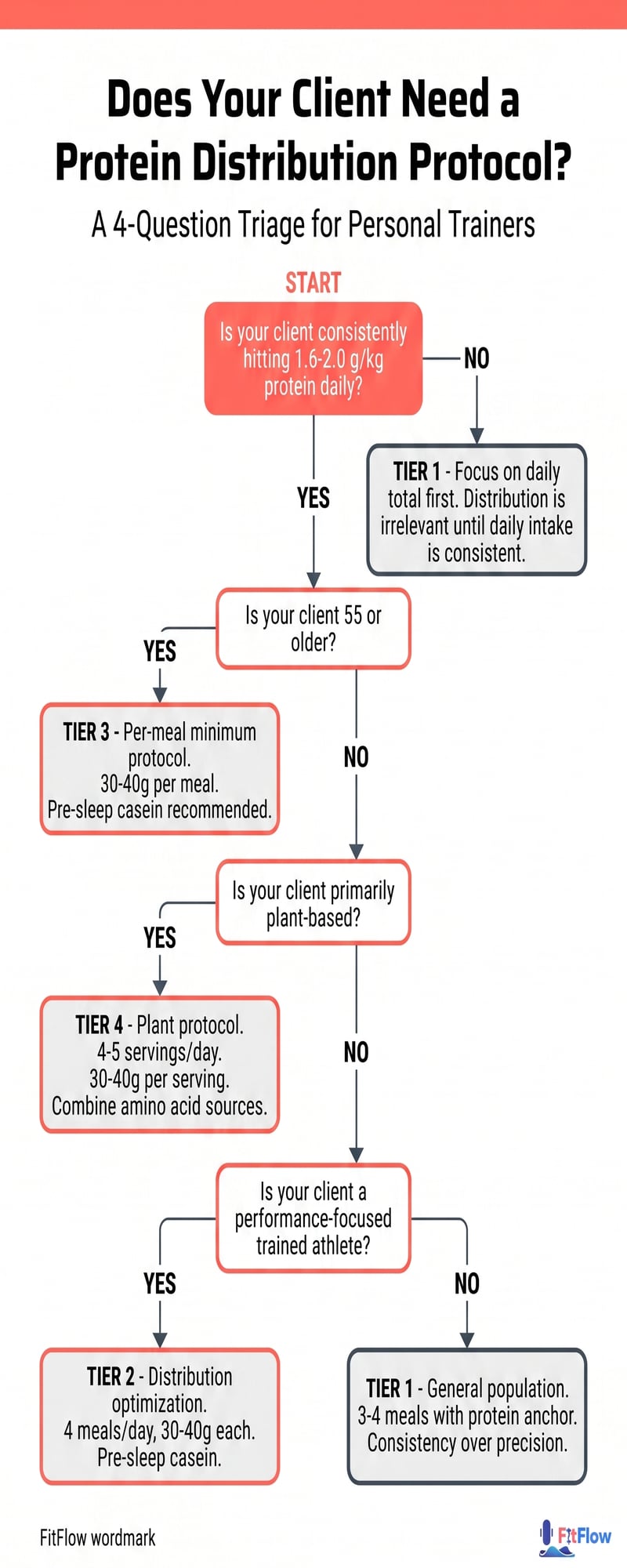
Which of your specific clients lands in Tier 3 or Tier 4?. Triage a Client in 2 Minutes.
Adherence vs. optimization: the coach's actual decision
This section is what I think separates competent technical coaches from competent practicing coaches.
The technically optimal distribution protocol is irrelevant if the client cannot and will not follow it. In practice, I see trainers prescribe a 4-meal protein distribution to a client who eats breakfast on Tuesday, skips it Wednesday, has lunch at the desk Thursday, and forgets dinner exists on Friday because their kid had a soccer game. The protocol is technically defensible. The client will not run it. The trainer feels sophisticated. The client feels overwhelmed and quietly drops the whole nutrition conversation.
There's a hierarchy. Consistency of adequate intake is the primary lever for the general population. Distribution optimization is a secondary lever that only pays off once the primary is consistently engaged.
I think of it as a 90/10 principle. About 90% of the muscle-building outcome for a general-population client comes from hitting daily protein adequacy (1.6–2.2 g/kg) with reasonable distribution (2 to 4 protein-containing meals). The last 10% (per-meal precision, pre-sleep casein, leucine fine-tuning) is real, but it's not where you start.
Who benefits from distribution optimization:
Trained athletes with hypertrophy goals who have already mastered total intake
Clients 55+ with measurable anabolic resistance
Plant-based clients who need higher serving counts to clear leucine thresholds
Clients in a caloric deficit (distribution gets more important when intake is constrained)
Who does not need distribution optimization yet:
Beginners: hitting total intake consistently is transformative on its own
Clients with irregular schedules or fragile adherence
Clients brand-new to tracking protein at all
The coaching principle: never prescribe a distribution protocol more precise than what the client can maintain for 30 consecutive days. Optimization is a later-stage conversation, not a Day 1 program element. This sits at the heart of the behavioral gap that kills good nutrition plans.
The client conversation: what to actually say
Three scenarios that cover roughly 80% of the timing questions you'll get. Language meant to be adapted, not memorized.
Scenario 1: the "30-minute window" client
Client: "I heard I need to eat protein within 30 minutes of finishing my workout or I lose my gains."
Coach: "That was the conventional wisdom for a long time, and there's real science behind it. Your muscles are more receptive to protein after training. But the more recent research shows the window is much wider than we thought, usually 4 to 6 hours. As long as you're eating a real protein source within a few hours of training, you're capturing that response. What matters more is whether you're hitting your total protein goal for the day. Let's check where you actually are on that."
The move: validate the underlying science, update the picture, redirect to the primary lever.
Scenario 2: the "every 3 hours" client
Client: "Should I be setting a timer to eat protein every 3 hours? I read that's what you need to do for muscle."
Coach: "The science behind that is real. Spreading protein across the day does support muscle building a bit better than eating it all at once. But three hours isn't a hard rule. If you're eating 3 to 4 meals or snacks per day with a solid protein source at each, you're already doing the important part. Setting a timer won't hurt you, but it's not what makes the difference. I'd rather you spent that mental energy on hitting your daily total than watching the clock."
The move: affirm the principle, soften the rigid rule, give a simpler usable target.
Scenario 3: the skeptical, evidence-literate client
Client: "I saw a well-known evidence-based creator say protein timing doesn't matter at all. Is that true?"
Coach: "They're mostly right for general-population clients. Total daily intake swamps everything else, and that's well established. But there's a layer on top: once you're consistently hitting your protein target, distributing it across meals, and maybe adding a high-protein snack or casein before bed, pays off as a marginal optimization. The mistake is optimizing timing before nailing total intake. If you're already at 1.8 g/kg consistently, distribution becomes a real next step for you specifically."
The move: acknowledge the truth in the claim, add the conditional nuance, contextualize for this client.
The pattern across all three: meet the client where their belief lives, don't disagree with the underlying science even when the popular version is overstated, then redirect to the primary lever.
A practical distribution framework for your clients
Tier-based by client population, with a deliberate adherence-priority field because what to coach depends as much on what the client can sustain as on what the science would technically optimize.
Tier 1: general population clients
Daily protein target: 1.6–2.0 g/kg body weight
Distribution: 3–4 meals/day, protein anchor at each
Per-meal protein: 20–30 g minimum
Timing flexibility: wide (4–6 hour post-workout window)
Pre-sleep protocol: optional; recommended only if total target is consistently met
Adherence priority: HIGH. Consistency of total intake is the entire game
Tier 2: performance-focused trained athletes
Daily protein target: 1.8–2.2 g/kg body weight
Distribution: 4 meals/day minimum; aim for relatively even distribution
Per-meal protein: 30–40 g at each primary meal
Timing: if training fasted, protein within 1–2 hours post-workout; otherwise 2–3 hour flexibility
Pre-sleep protocol: recommended (30–40 g casein or high-protein equivalent)
Adherence priority: MEDIUM. Structure is achievable for this population
Tier 3: older adults 55+ and anabolic resistance
Daily protein target: 1.6–2.0 g/kg body weight (higher end for active or resistance-training clients)
Distribution: 3–4 meals/day with explicit per-meal minimum enforcement
Per-meal protein: 30–40 g minimum (leucine threshold shifts upward with age)
Timing: pre-sleep casein specifically supported
Adherence priority: HIGH, with a quality check. Per-meal minimums matter more here
Tier 4: plant-based clients
Daily protein target: 1.6–2.0 g/kg body weight (same as omnivores; source quality matters more)
Distribution: 4–5 protein occasions/day to compensate for lower leucine density
Per-meal protein: 30–40 g per serving from plant sources to clear leucine threshold
Source strategy: combine lysine-rich (soy, lentils) with methionine-rich (rice, hemp); consider fortified isolates
Pre-sleep protocol: valid if using a high-leucine source (soy or fortified isolate preferred over pea alone)
Adherence priority: HIGH. Total intake is typically more challenging, so don't layer distribution complexity until total is consistent
You can run any client through these tiers in roughly 60 seconds. The decision tree is short: age 55+? plant-based? performance-focused with adherence locked? Otherwise, default to Tier 1. The tier system mirrors the broader nutrition frameworks we use with clients.
What the evidence is not telling you (honest limitations)
Trust is built faster by acknowledging what the data doesn't yet support than by overselling what it does:
Most MPS research measures acute, single-meal responses. Whether acute differences translate to long-term lean mass differences is less established than the per-meal data alone suggests.
The study population problem is real. Young, healthy, resistance-trained males remain dominant. Women, older adults, plant-based athletes, and GLP-1 users are all underrepresented.
Many older "distribution matters" studies confounded distribution with total intake. Separating the two effects cleanly is methodologically harder than the headline conclusions implied.
The Trommelen 100 g bolus finding is still being integrated. It challenges the simple MPS ceiling interpretation that was load-bearing for the original distribution argument.
Pre-sleep casein has solid acute MPS evidence and weaker chronic hypertrophy evidence. Most defensible timing recommendation we have, but not the same as bulletproof.
The framework in this article reflects the best current evidence, not settled consensus carved in stone. Treat it as a working model that will keep refining. For clinical populations (GLP-1 users, eating disorder history, kidney disease), this is educational content, not a substitute for registered dietitian or physician input. For the full evidence base, see our complete evidence-based nutrition and recovery framework.
Key takeaways
Total daily protein intake (1.6–2.2 g/kg) is the primary lever for muscle outcomes; distribution is a secondary optimization.
The post-workout "anabolic window" extends roughly 4–6 hours with a pre-workout meal, not 30 minutes. The 1–2 hour rule applies only to fully fasted training.
The leucine threshold is real: ~2.5 g leucine (20–25 g protein) for younger adults, ~3 g leucine (30–40 g protein) for older adults.
Four populations where distribution shifts the equation: older adults (55+), plant-based clients, trained athletes with hypertrophy goals, and clients in a caloric deficit.
Pre-sleep casein (20–40 g) is the single most defensible timing-specific recommendation, with strongest application in clients 45+ already consistently hitting daily totals.
Adherence-first coaching: never prescribe a distribution protocol more precise than what the client can sustain for 30 consecutive days.
Be honest with evidence-literate clients about research gaps in women, chronic outcomes, and plant-specific populations.
Turn this article into a session-ready coaching tool. Download the Checklist.
Frequently Asked Questions
Comments