
Pricing vs Positioning: Why Most Personal Trainers Are Solving the Wrong Revenue Problem

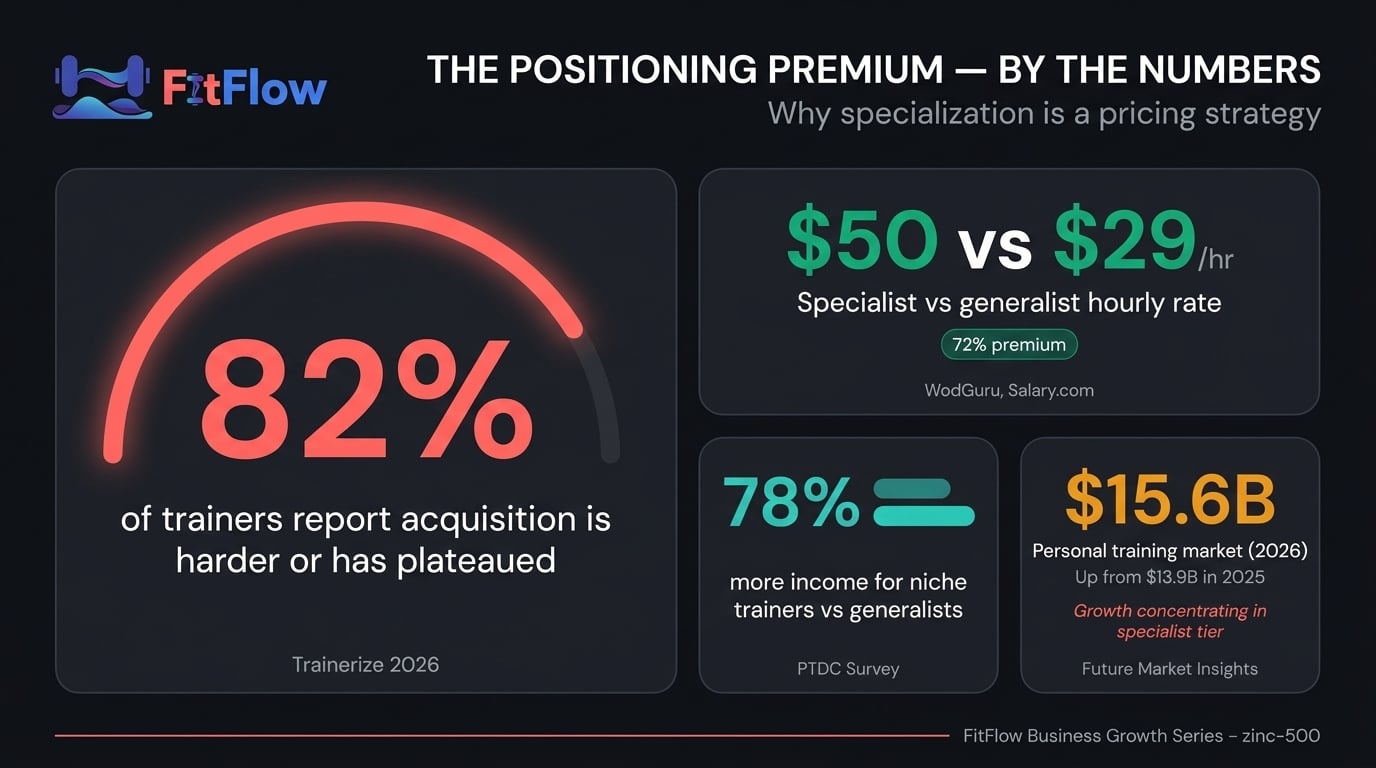
82% of personal trainers report that client acquisition is harder or has plateaued (Trainerize 2026 State of the Personal Training Industry Report). The instinctive response is predictable: lower prices, add discounts, restructure packages. The counterintuitive finding: trainers who narrowed their niche report 20–40% premium pricing and higher close rates.
Charging more can be easier than charging less. The prerequisite is positioning correctly.
This is not a coincidence. It is the difference between a pricing problem and a positioning problem. Most trainers trying to fix their revenue are adjusting the math when the strategy is broken.
This article provides a diagnostic framework -- the Positioning Diagnostic -- that helps you determine whether your revenue problem is actually a pricing problem or a positioning problem wearing a pricing mask. It includes the Specificity Ladder (five levels of differentiation with concrete pricing power at each level), a 30-day repositioning plan, and the data to support every claim.
What this article is NOT: a "charge your worth" motivational post, a pricing calculator, or a rate-setting guide.
What this article IS: a diagnostic framework backed by industry data that helps you identify which lever -- pricing or positioning -- will actually move your revenue.
Get the Free Positioning Audit Worksheet. Download Free Worksheet.
The Pricing Trap: Why Adjusting Rates Does Not Fix Revenue
The median general personal trainer earns $58,318 per year (NASM 2026 Industry Salary Data). Gym-employed trainers start at $12-$19 per hour (BLS, salary aggregators). Adjusted for inflation, the median generalist hourly rate has declined 2.3% since 2023.
These are not marginal numbers. They are structural. They help explain why an estimated 80% of personal trainers leave the profession within two years (ISSA, FitBudd). The economics of generalist personal training are compressing in real time.
The instinct when revenue stalls is to adjust the price. Raise it and risk losing clients. Lower it and devalue the work. Restructure packages and rearrange the same problem into different containers. This is the pricing trap -- the belief that the number on the invoice is the variable that matters most.
It usually is not.
When clients push back on price, trainers assume the price is too high. But price pushback is frequently a positioning signal: the client does not understand why THIS trainer at THIS price is the right choice for THEIR problem. The trainer is selling sessions. The client is buying outcomes. Without differentiation, the client defaults to comparing price. And when price is the only comparison axis, the cheapest option wins.
Here is the distinction that changes the analysis:
Pricing is a math problem. Costs plus margin plus market rate. It has a correct answer for any given cost structure.
Positioning is a strategy problem. Who you serve, what problem you solve, and why you are the obvious choice. It determines whether the market sees your price as expensive or as an investment.
Most trainers keep tightening the math while leaving the strategy untouched. If you have not read our diagnosis of the four structural failures that create the trainer income ceiling, start there. This article goes deeper on the mechanism: why trainers underprice, and what to do about the upstream cause.
What Positioning Actually Means for a Personal Trainer
Positioning is not a marketing buzzword. For a personal trainer, positioning answers three questions:
Who exactly do I serve?
What specific problem do I solve?
Why am I the obvious choice to solve it?
The operational definition: positioning is the intersection of specificity, credibility, and communication. It determines how the market perceives you BEFORE they hear your price. Two trainers can charge identical rates and have completely different close rates, retention, and referral velocity. The difference is positioning.
Here is the contrast:
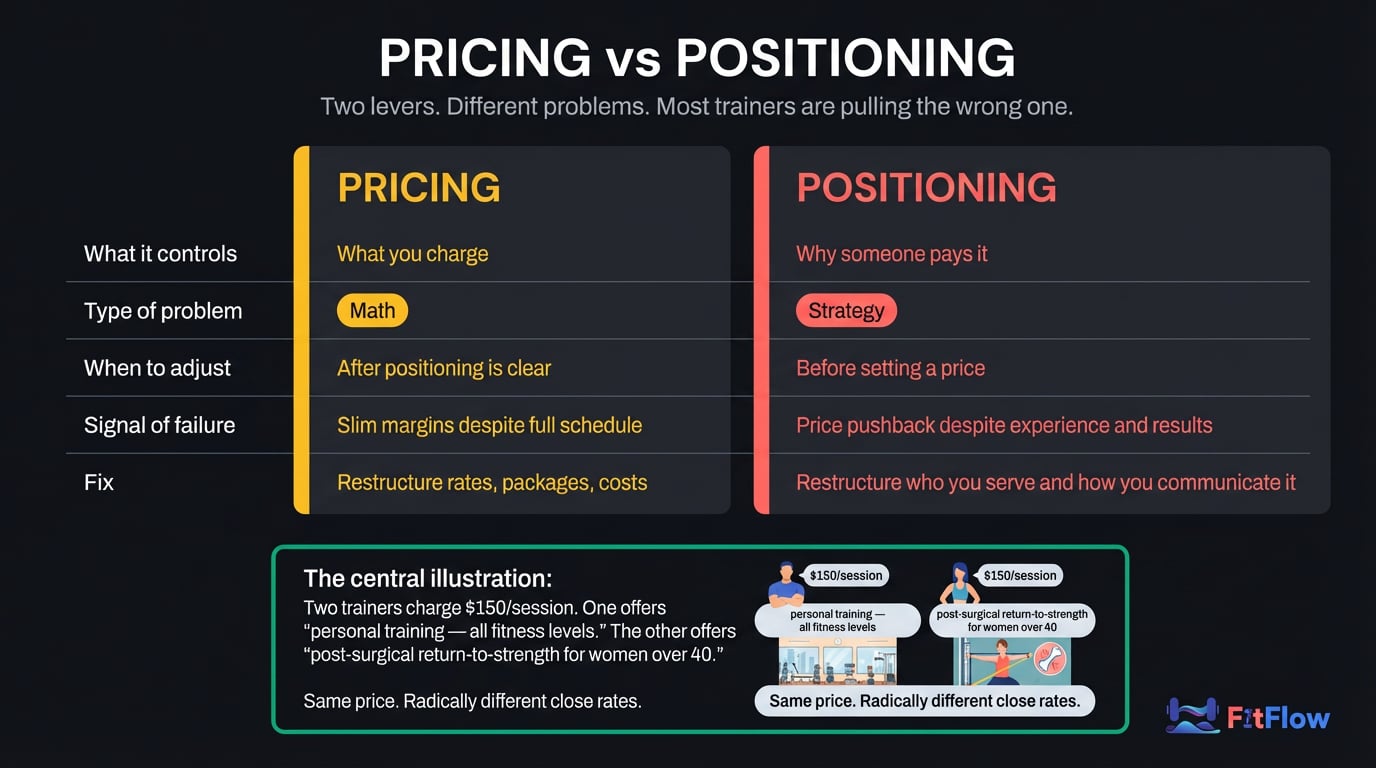
Element | Pricing | Positioning |
|---|---|---|
What it controls | What you charge | Why someone pays it |
Type of problem | Math | Strategy |
When to adjust | After positioning is clear | Before setting a price |
Signal of failure | Slim margins despite a full schedule | Price pushback despite experience and results |
Fix | Restructure rates | Restructure who you serve and how you communicate it |
Consider two trainers:
Trainer A: $150/session. "Personal training -- all fitness levels welcome."
Trainer B: $150/session. "Post-surgical return-to-strength programming for women over 40."
Same price. Radically different businesses.
Trainer B's positioning eliminates comparison shopping. A woman recovering from knee surgery does not compare Trainer B's rate to the gym's generic personal training package. She compares it to the cost of poor recovery -- months of limited mobility, missed time with her family, the prospect of a second procedure. The frame shifts from "is $150 a lot for training?" to "is $150 worth getting back to hiking with my daughter?"
That frame shift is not a pricing change. It is a positioning change. And it is the reason Trainer B closes at a higher rate, retains clients longer, and generates referrals from surgeons and physical therapists rather than from Yelp. Your ability to deliver evidence-based programming IS your positioning -- here is the framework that builds that foundation.
The Positioning Diagnostic: Is This a Price Problem or a Strategy Problem?
Before adjusting your rates, run this diagnostic. Five questions. Each one reveals whether your revenue bottleneck is pricing or positioning.
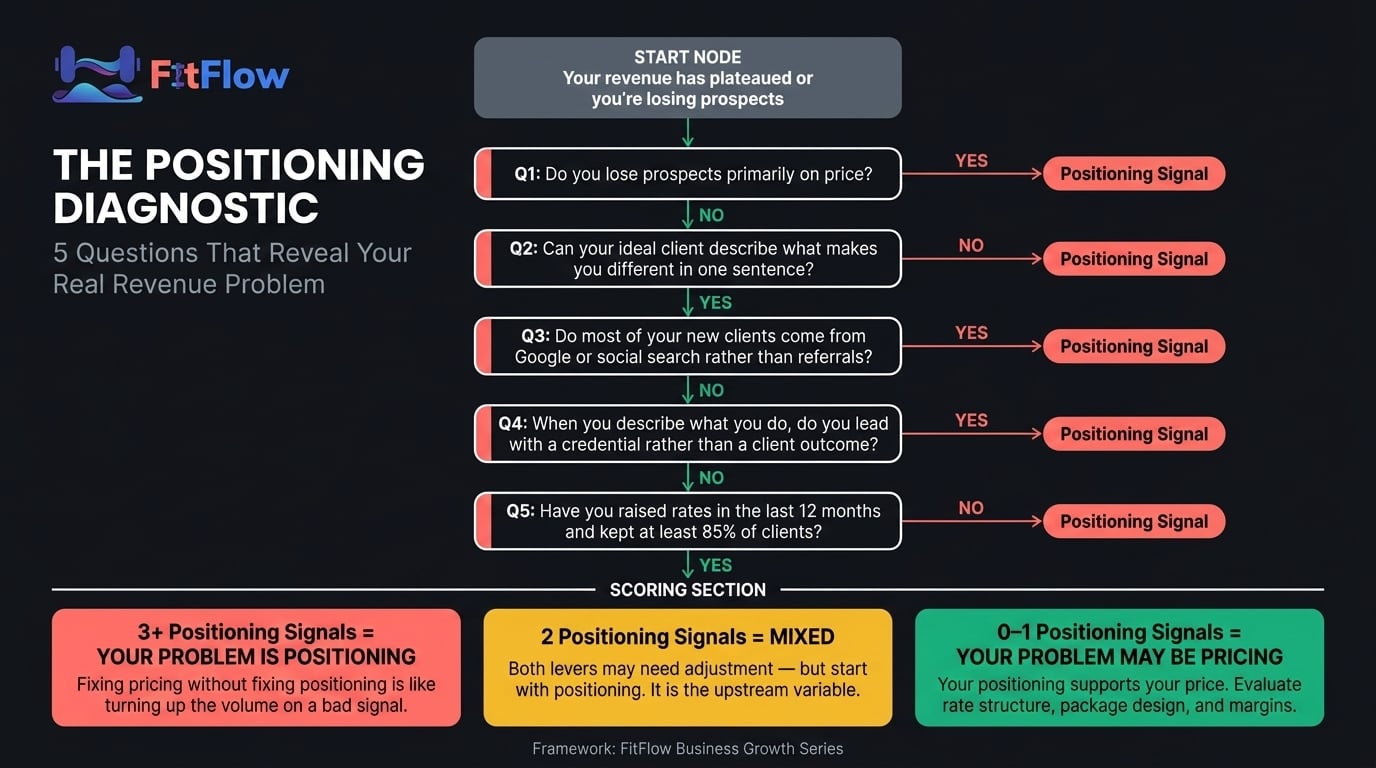
Question 1: Do you lose prospects primarily on price?
If yes -- this is likely a positioning problem. Prospects who push back on price often lack enough differentiation context to justify the rate. They are comparing you to every other trainer in the area. The issue is not what you charge. It is that they cannot see why you are different.
If no -- your pricing may be a genuine mismatch with your market. Evaluate your cost structure and local competitive rates.
Question 2: Can your ideal client describe what makes you different in one sentence?
If no -- positioning problem. If your own clients cannot articulate your differentiation, prospects certainly cannot. Your positioning is not clear enough to survive word-of-mouth.
If yes -- your positioning may be working. Evaluate whether your pricing aligns with the value that differentiation represents.
Question 3: Do most of your new clients come from Google or social search rather than referrals?
If yes — your positioning must work harder. Strangers need clearer signals than referrals do. Your website headline, social bio, and first impression must communicate specificity instantly. This is a positioning signal.
If no (referral-driven) — your positioning may be adequate but invisible to new audiences. The referral channel validates your work; the challenge is extending that clarity to people who have not met you yet.
Question 4: When you describe what you do, do you lead with a credential or a client outcome?
If credential ("I'm a NASM-certified personal trainer") -- positioning gap. Credentials are table stakes. They do not differentiate. Every trainer in your area has a certification.
If outcome ("I help women over 40 rebuild strength after surgery") -- positioned. Outcome-led descriptions attract the clients who have that problem and repel the ones who do not. Both are useful.
Question 5: Have you raised your rates in the last 12 months AND kept at least 85% of clients?
If yes -- your positioning may already support your price. Continue building specificity and monitoring retention.
If no -- positioning likely needs work before another rate increase. Raising rates without positioning is volume on a bad signal.
Scoring
3 or more "positioning problem" signals: Your revenue problem is positioning, not pricing. Fixing pricing without fixing positioning is like turning up the volume on a bad signal -- louder, but still unclear.
2 positioning signals: Mixed. Both levers may need adjustment, but start with positioning. It is the upstream variable.
0-1 positioning signals: Your positioning may be solid. Evaluate pricing structure, cost basis, and local market rates.
Once you have diagnosed a positioning problem, the implementation becomes a systems problem. Here is the systems framework that supports it.
The Specificity Ladder: From Commodity to Category-of-One
Positioning is not binary -- positioned vs. not positioned. It is a spectrum. The Specificity Ladder maps five levels of positioning, each with a measurable impact on pricing power and competitive dynamics.
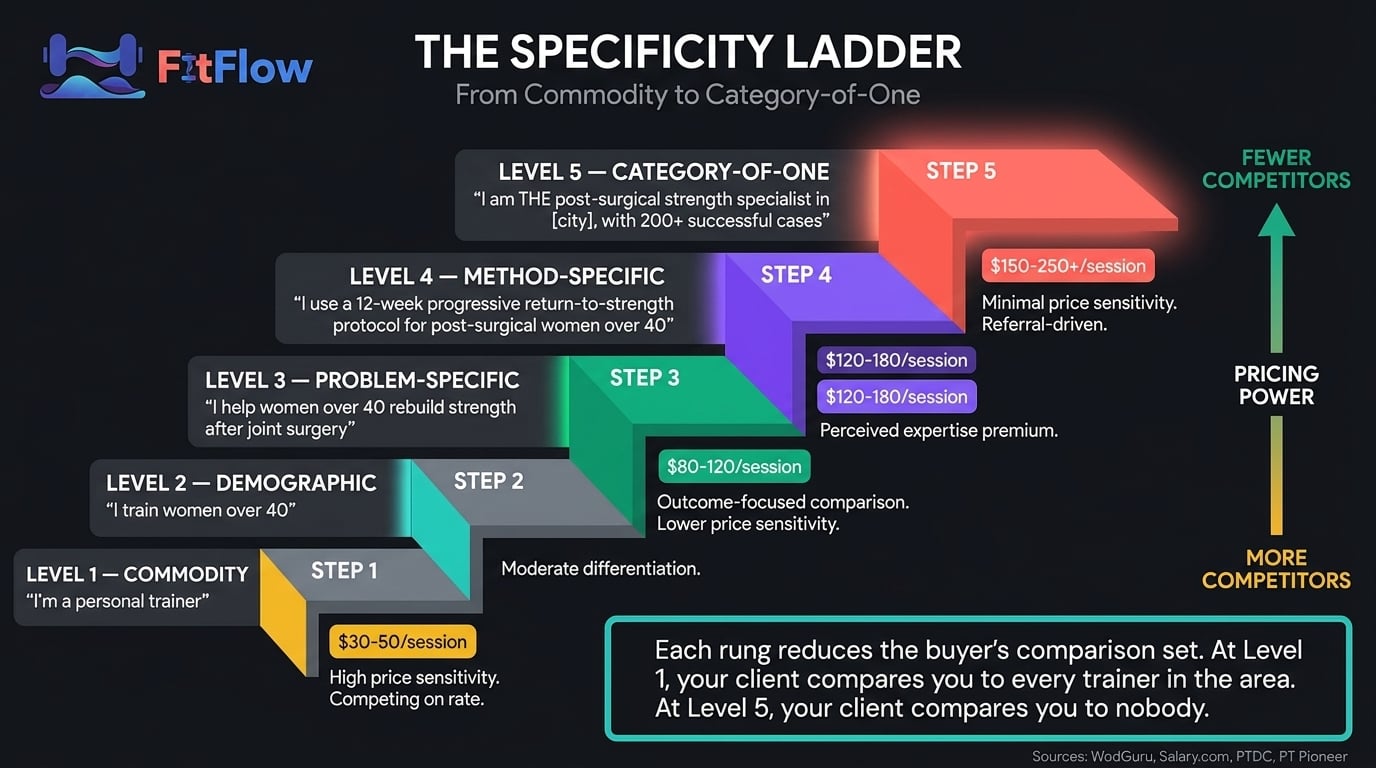
Level | Description | Example | Pricing Power | Close Rate Signal |
|---|---|---|---|---|
1. Commodity | "I'm a personal trainer" | Generic fitness, all levels, no specialization | $30-50/session | High price sensitivity; competing on rate |
2. Demographic | "I train [demographic]" | "I train women over 40" | $50-80/session | Moderate; some differentiation |
3. Problem-Specific | "I solve [specific problem] for [demographic]" | "I help women over 40 rebuild strength after joint surgery" | $80-120/session | Lower price sensitivity; outcome-focused comparison |
4. Method-Specific | "I use [proprietary method] to solve [problem] for [demographic]" | "I use a 12-week progressive return-to-strength protocol for post-surgical women over 40" | $120-180/session | Low price sensitivity; perceived expertise premium |
5. Category-of-One | "I am THE [specific authority] for [niche]" | "I am the go-to post-surgical strength specialist in [city], with 200+ successful return-to-activity cases" | $150-250+/session | Minimal price sensitivity; referral-driven |
The data supports this gradient:
Senior specialists earn $50/hr vs. $29/hr for generalists -- a 72% premium (WodGuru, Salary.com)
Niche trainers earn 78% more than generalists on average (PTDC survey)
Master-level certification commands $100/session vs. $40-50 for generalist rates (PT Pioneer)
Specialists charge 30-50% more than generalists across multiple markets (MyPTHub, multiple sources)
Each rung on the ladder reduces the buyer's comparison set. At Level 1, your prospective client compares you to every trainer in the area — dozens, possibly hundreds. At Level 5, your prospective client compares you to almost no one. You are one of very few options that match their specific need.
The personal fitness trainer market grew from $13.9 billion in 2025 to $15.6 billion in 2026 (Future Market Insights). That growth is not evenly distributed. It is concentrating in the specialist tier. Generalists face wage compression. Specialists capture the margin. Positioning determines which side of that bifurcation you land on.
Revenue concentration data reinforces this: 54.2% of personal training revenue comes from clients aged 35-54 (Trainer Academy). Trainers positioned to serve this demographic -- with age-appropriate programming, injury awareness, and outcome specificity -- capture a disproportionate share of the market's highest-spending segment.
Where Are You on the Specificity Ladder? Find Out in 5 Minutes. Download the Free Worksheet.
How Positioning Changes Your Pricing Conversation
When positioning is clear, the pricing conversation changes fundamentally. The question shifts from "how much do you charge?" (commodity frame) to "do you work with people like me?" (positioning frame). That shift is not semantic. It is economic.
Three mechanisms drive the change:
1. Comparison Set Reduction
A generalist trainer competes against every other trainer in the area. A post-surgical specialist competes against two or three local options -- if that. When the comparison set shrinks, price sensitivity drops. The client is no longer evaluating your rate against a menu of alternatives. They are evaluating whether you can solve their specific problem.
2. Value Frame Shift
Positioned trainers change what clients compare their price against. A generalist's $150 session gets weighed against the gym's $60 package. A post-surgical specialist's $150 session gets weighed against the cost of poor recovery -- additional physical therapy, lost work time, reduced quality of life. The frame shifts from "is this training expensive?" to "is this outcome worth the investment?"
Hybrid membership pricing in personal training now ranges from $250-$500/month (Trainerize 2026). Positioned trainers command the upper end of that range because clients understand the specific value they receive. Digital fitness products have seen a 34% price increase from 2024 to 2026 (CommuniPass 2026), reflecting a market-wide willingness to pay more for specificity and outcomes.
3. Referral Velocity
Positioned trainers generate specific referrals. "My orthopedic surgeon recommended this trainer for post-surgical rehab" closes at a fundamentally different rate than "my friend goes to a trainer." Specific referrals carry built-in credibility. They arrive with the problem already identified and the trust already partially established.
A Two-Brain Business case study captures the filter effect: a gym owner raised rates 40%, lost approximately 8 members, and increased total revenue (Two-Brain Business). The members who stayed valued the specificity. The ones who left were commodity buyers who would have churned at the next price increase regardless. The rate increase functioned as a positioning filter, not a revenue lever.
Once positioning drives consistent close rates, scaling becomes an operational problem -- not a demand problem. Here is the scaling framework for that next stage.
Implementation: Repositioning Without Losing Current Clients
The fear of repositioning is losing existing clients. The reality: repositioning is additive, not destructive. You do not fire clients. You change what you attract.
Here is a 30-day repositioning plan designed for trainers who cannot afford to start over.
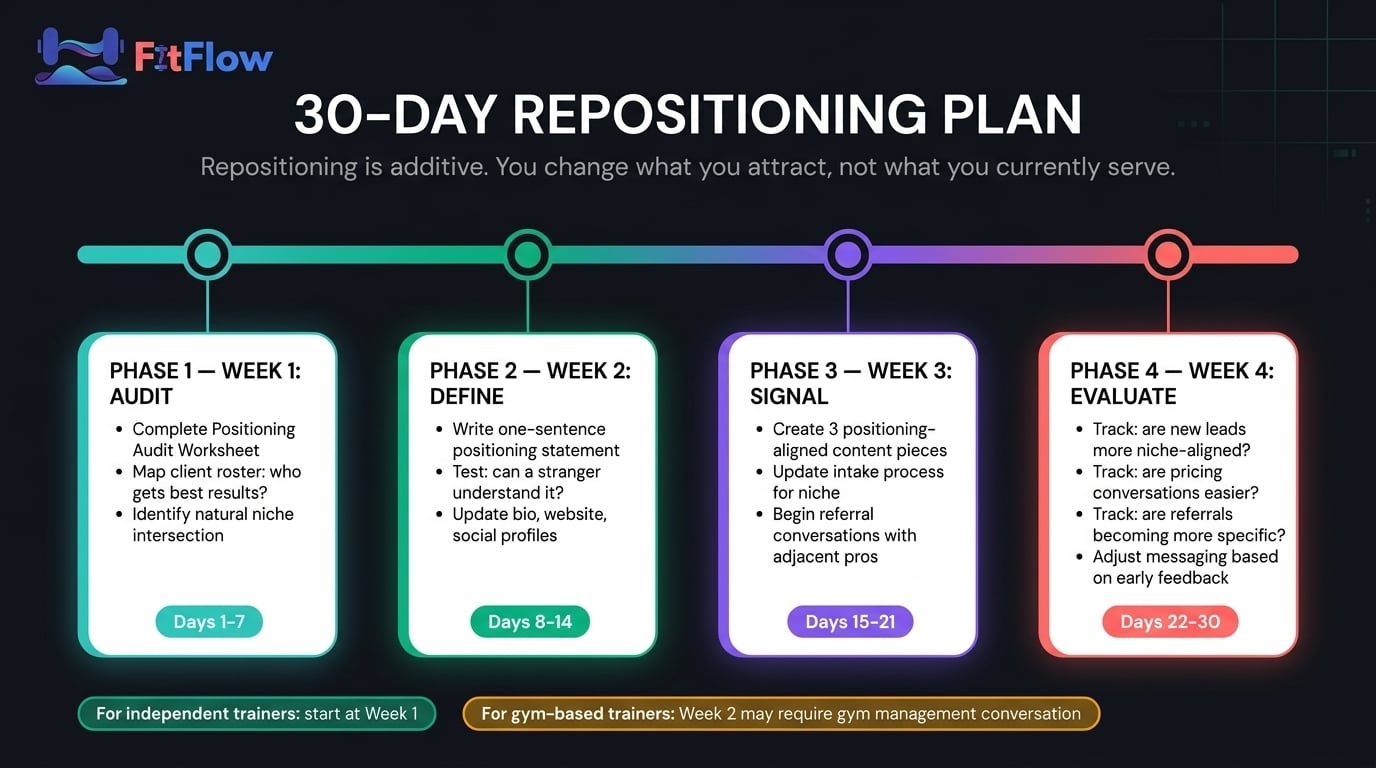
Week 1: Audit (Days 1-7)
Complete the Positioning Audit Worksheet — the 5-question diagnostic from this article, expanded into a 12-question scoring rubric with the Specificity Ladder self-assessment.
Map your current client roster: who gets the best results? What do they have in common? Age, goal type, injury history, lifestyle pattern -- look for the cluster.
Identify your natural niche: the intersection of your best results, your strongest professional interest, and demonstrable market demand.
Week 2: Define (Days 8-14)
Write a one-sentence positioning statement: "I help [specific demographic] achieve [specific outcome] through [specific method/approach]."
Test it: can someone who has never met you understand what you do and who you serve? If the answer requires a follow-up question, it is not specific enough.
Update your bio, website headline, and social profiles. These are the first three things a prospect sees. They must communicate your positioning instantly.
Week 3: Signal (Days 15-21)
Create 3 pieces of content that demonstrate your positioning: one case study (anonymized client results), one educational post (your expertise applied to your niche), one results post (before/after or milestone data).
Update your intake process to reflect your niche. Intake questions, assessment flow, and onboarding materials should signal that you serve a specific population.
Begin referral conversations with adjacent professionals: physical therapists, physicians, mental-health professionals, or adjacent coaches who serve your target demographic. These relationships are how Level 4 and Level 5 positioning becomes self-reinforcing.
Week 4: Evaluate (Days 22-30)
Track inquiry quality: are new leads more aligned with your niche?
Track price resistance: are pricing conversations easier or harder?
Track referral source: are referrals becoming more specific?
Adjust messaging based on early feedback. Repositioning is iterative, not binary.
For independent trainers: Start with Week 1. Your repositioning is entirely in your control. Every change -- from your website headline to your intake form -- is a decision you can make today.
For gym-based trainers: Start with Week 1, but Week 2 may require a conversation with gym management about specialization within their offering. Many gym owners welcome trainers who develop a niche because it expands the gym's service range and reduces internal competition among their training staff.
Once your positioning is clear, automation becomes the delivery layer. Here is the automation stack that makes the operational side scale.
Key Takeaways
Pricing is a math problem. Positioning is a strategy problem. Most trainers are solving the wrong one.
Price pushback is often a positioning signal, not a pricing signal. Clients who do not understand your differentiation default to comparing price.
The Positioning Diagnostic reveals whether your revenue bottleneck is pricing or positioning. Run the five questions before your next rate adjustment.
The Specificity Ladder shows how each level of differentiation increases pricing power. Senior specialists earn 72% more than generalists. Niche trainers earn 78% more on average.
Positioned trainers compete against fewer alternatives, shift the value frame, and generate specific referrals. All three mechanisms compound.
Repositioning is additive: you change what you attract, not what you currently serve. The 30-day plan works without disrupting existing clients.
Start with the Positioning Audit -- before your next rate increase. Diagnose first, then prescribe.
Download the Positioning Audit Worksheet — or See How FitFlow Helps You Reposition. Download Free Positioning Audit.
Frequently Asked Questions
Comments