The Acquisition Funnel Most Trainers Build Is Not a Funnel. Here Is the Architecture That Converts

Open your Instagram DMs
Open your Instagram DMs. Count the unanswered ones. Now count the ones you followed up on twice. Most trainers stop at one DM. The lead does not go cold. The stage disappears. There is no Stage 2.
If you are Amanda at 4 clients and 200 Instagram followers, posting three times a week and sending your rate when someone asks, you know this scene. So does 82% of the industry, the share reporting acquisition got harder last year (Trainerize 2026 State of the Personal Training Industry Report).
More leads are not the problem. Funnel architecture is.
The fix starts with four stages, a few benchmarks, and one 10-minute diagnostic. This post does not cover retention, pricing, or fulfillment. Those are different problems, linked below.
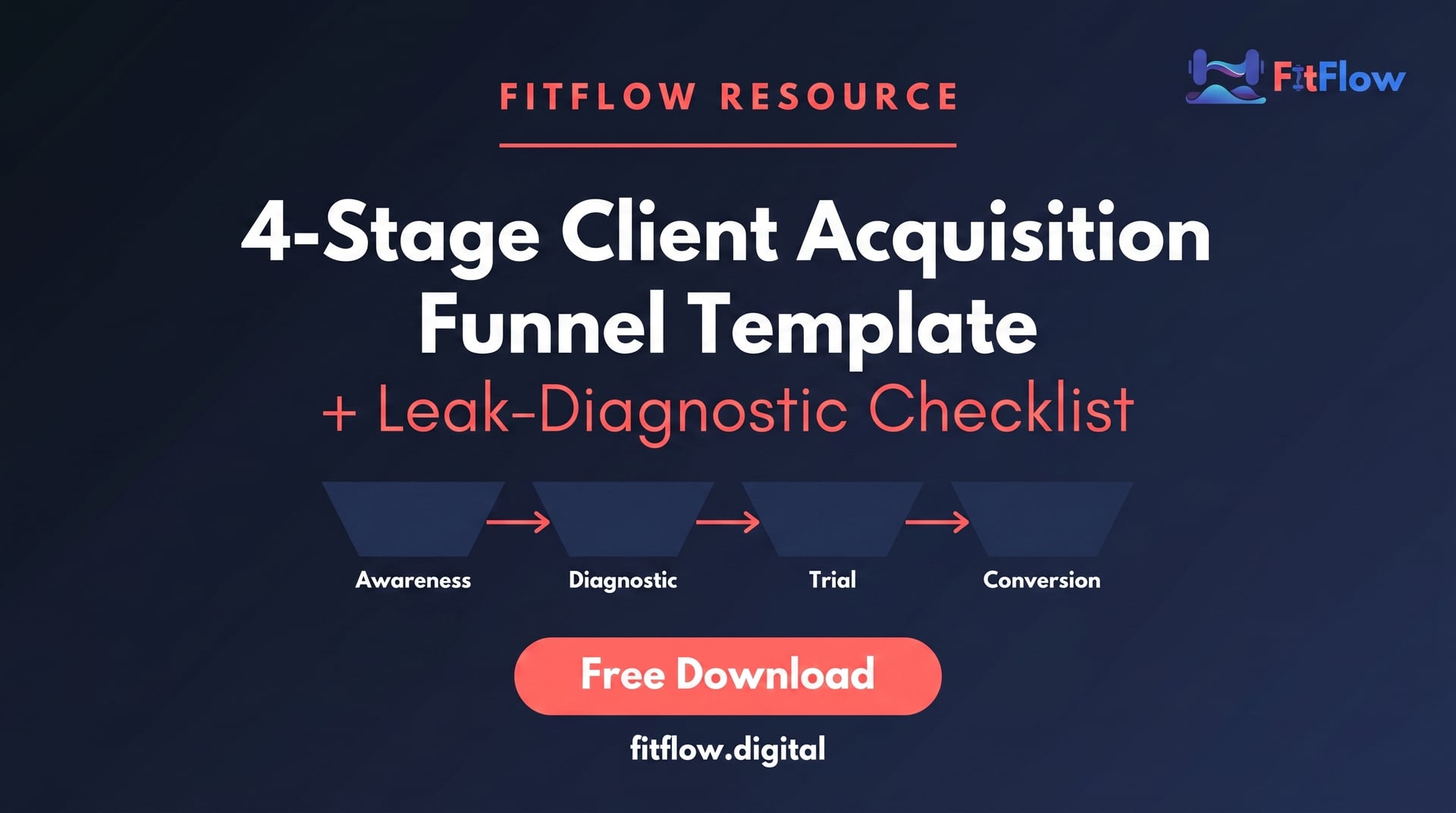
The 4-stage funnel in one page. Fill in the boxes. Find what is missing. A printable one-page diagram with four boxes: Awareness, Diagnostic, Trial, Conversion. The boxes you cannot fill in are your leaks. Includes the 14-item leak-diagnostic checklist, four fill-in-the-blank scripts, and a 30-day implementation plan. Download the template.
Two scope notes before we get into it. The $5K/month trainer ceiling diagnosis showed why most trainers stall: four structural failures. This post fixes the first one, the lack of a reliable acquisition path. The pricing-versus-positioning framework established that positioning is upstream of pricing, and positioning is your funnel's Awareness layer. The funnel is also the better-systems-not-more-clients philosophy applied to one job: stranger to signed client.
What a client acquisition funnel actually is
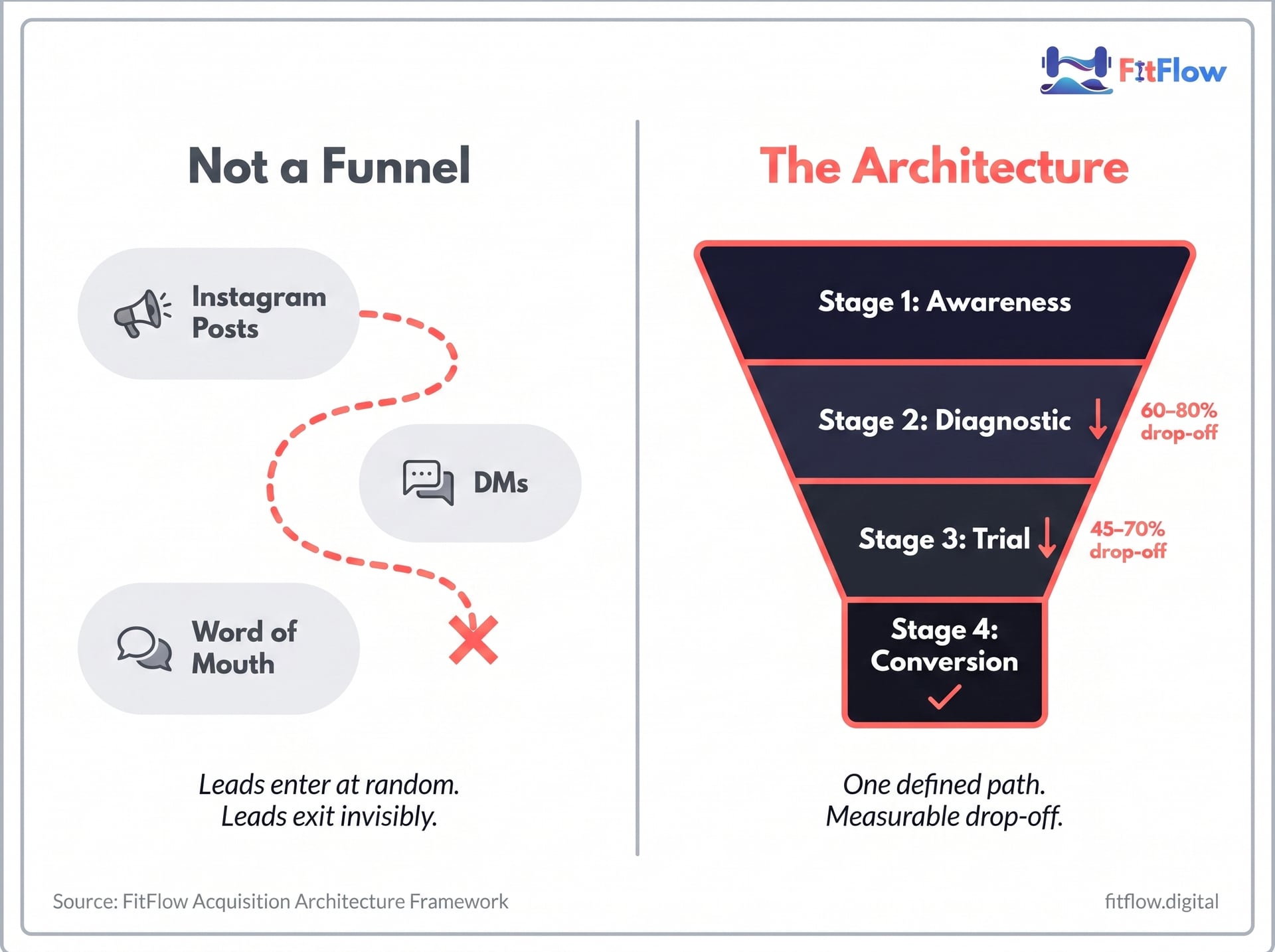
A client acquisition funnel for personal trainers is a 4-stage system: Awareness, Diagnostic, Trial, and Conversion. It moves a stranger into a paying client through defined handoffs, measurable drop-off rates, and a single conversion event. Without that structure, leads enter at random stages and exit invisibly.
Most trainers actually have a content cadence, a few referrals, and a price they will share if asked. More than half the industry cites word-of-mouth as their primary channel (50%+, trending toward 65% for referral-heavy operators, per Fitness Mentors 2026). Word-of-mouth is not a funnel stage. It is passive inbound.
Word-of-mouth is not the problem. Depending on it as your only stage is.
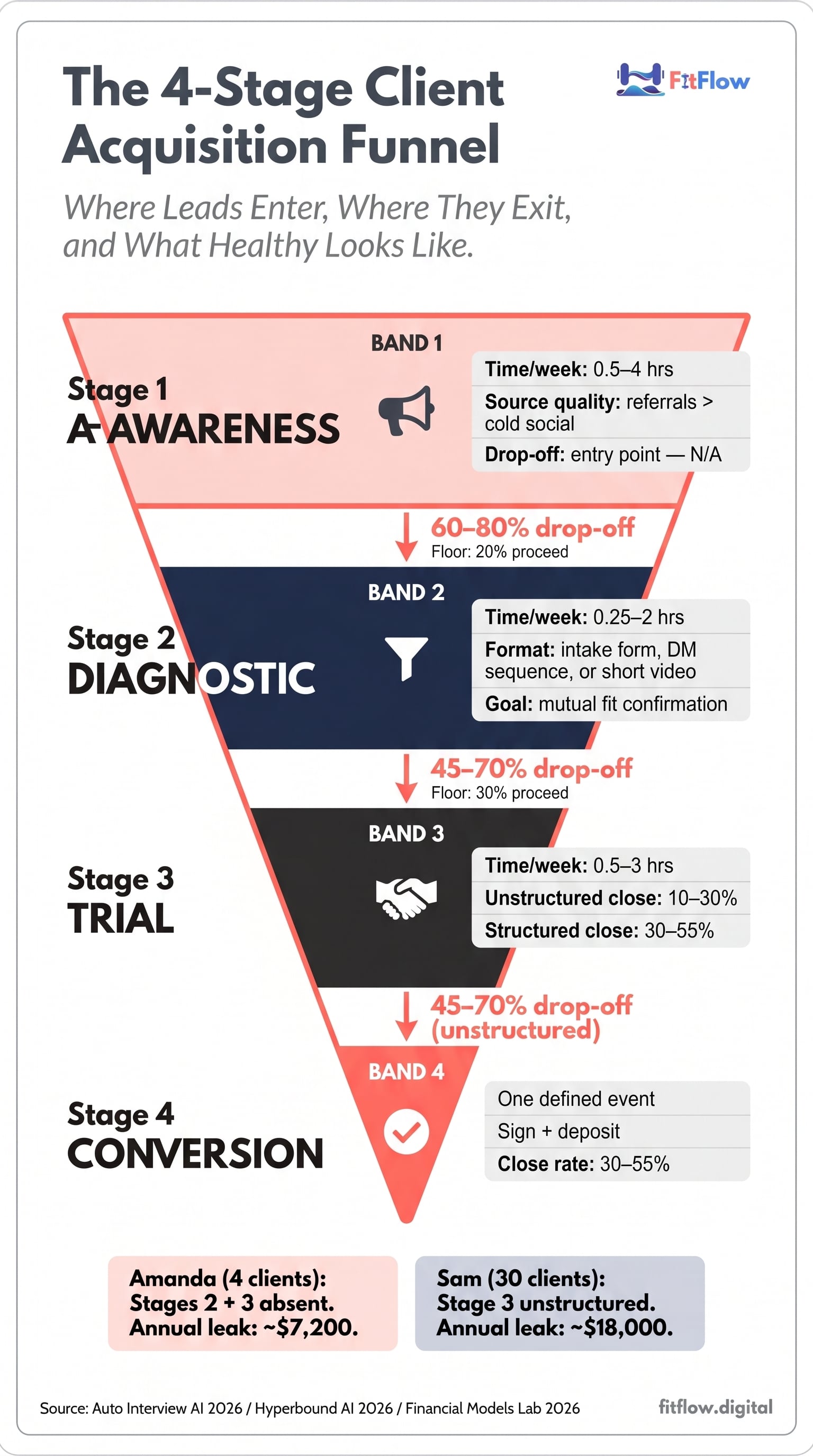
A real funnel has a defined handoff between every stage. Stage 1 produces a contact. Stage 2 qualifies it. Stage 3 lets the prospect experience your work. Stage 4 names the moment they become a client. Without those handoffs, you have disconnected posts hoping a stranger will DM.
Sam at 30 clients and 1.5 hours per week on acquisition is not a high performer. He is a trainer whose referral network is working passively. The moment referrals slow (82% report harder acquisition, Trainerize 2026), Sam has no pipeline. This matters more now that 67% of trainers offer hybrid or online coaching, up from 49% in 2023 (IHRSA 2025). The lead pool is larger, less captive, and harder to convert without architecture.
The 4-stage client acquisition funnel
Stage 1: Awareness
Awareness is how a stranger learns you exist. For Amanda at 4 clients and 200 Instagram followers, the entire awareness stage is 200 people, most of whom already know her. She is not acquiring strangers. She is recycling acquaintances.
The highest-quality Awareness source is referrals: they convert approximately 40% higher than cold traffic (Trainerize 2026). The weakest source is cold posts with no niche signal. Your positioning is your Awareness layer. The pricing-versus-positioning diagnostic makes every Stage 1 contact count more because strangers self-select based on who you say you are.
Weekly time budget: floor 0.5 hrs, median 2 hrs, ceiling 4 hrs.
Stage 2: Diagnostic
Diagnostic is a defined qualification step where the trainer and lead each learn whether there is a fit. Most trainers skip it entirely, going from "someone follows me" to "can we start Monday?" with nothing in between.
The Diagnostic does not have to be a call. A 3–5 question intake form, a DM sequence with two qualifying questions, or a short video before Trial all work. Amanda has no Stage 2: someone DMs her, she sends her price, they ghost. The problem is not the price. It is no qualification.
Your content is not the problem. The absence of a Stage 2 is.
Weekly time budget: floor 0.25 hrs, median 0.75 hrs, ceiling 2 hrs.
Stage 3: Trial
Trial is a structured low-commitment interaction: a fit call with a defined agenda, a free week, a paid challenge. Structure is what matters, not format or length.
An unstructured discovery call closes at 10–30% (practitioner benchmarks from Auto Interview AI 2026 and Hyperbound AI 2026, not peer-reviewed; Two-Brain Business 2025 names close rate as a primary funnel metric). A structured application plus fit call closes at 30–55%. The 25-point improvement comes from architecture, not personality or pricing.
Sam is likely running an unstructured Stage 3: a 15–30 minute call with no pre-qualification, no defined agenda, no conversion event. He closes 15–20% and assumes that is normal. Interactive trial formats also show 14× higher completion than passive courses (Passion.io 2025), which is why challenge-as-trial keeps showing up in online coaching.
Weekly time budget: floor 0.5 hrs, median 1.5 hrs, ceiling 3 hrs.
Stage 4: Conversion
Conversion is the single moment when a prospect becomes a client. Not "when they feel ready." Not "when I follow up enough." One named event: they sign, pay a deposit, or both. Structured onboarding from this event also lifts 90-day retention (PT Distinction 2025).
Without a defined conversion event, you cannot compute your close rate. If you cannot compute it, you cannot improve it.
For reference: 35–50% of paid-challenge completers upgrade to a recurring offer when there is a clear conversion event (CommuniPass 2026), and referred clients carry approximately 30% higher LTV than cold-acquired clients (Trainerize 2026).
Weekly time budget: floor 0.25 hrs, median 0.75 hrs, ceiling 1 hr.
Per-stage benchmarks
The table below uses three columns: floor (the funnel is leaking), median (healthy but still improvable), and ceiling (well-architected). If your rate is below the floor for any stage, that is your leak.
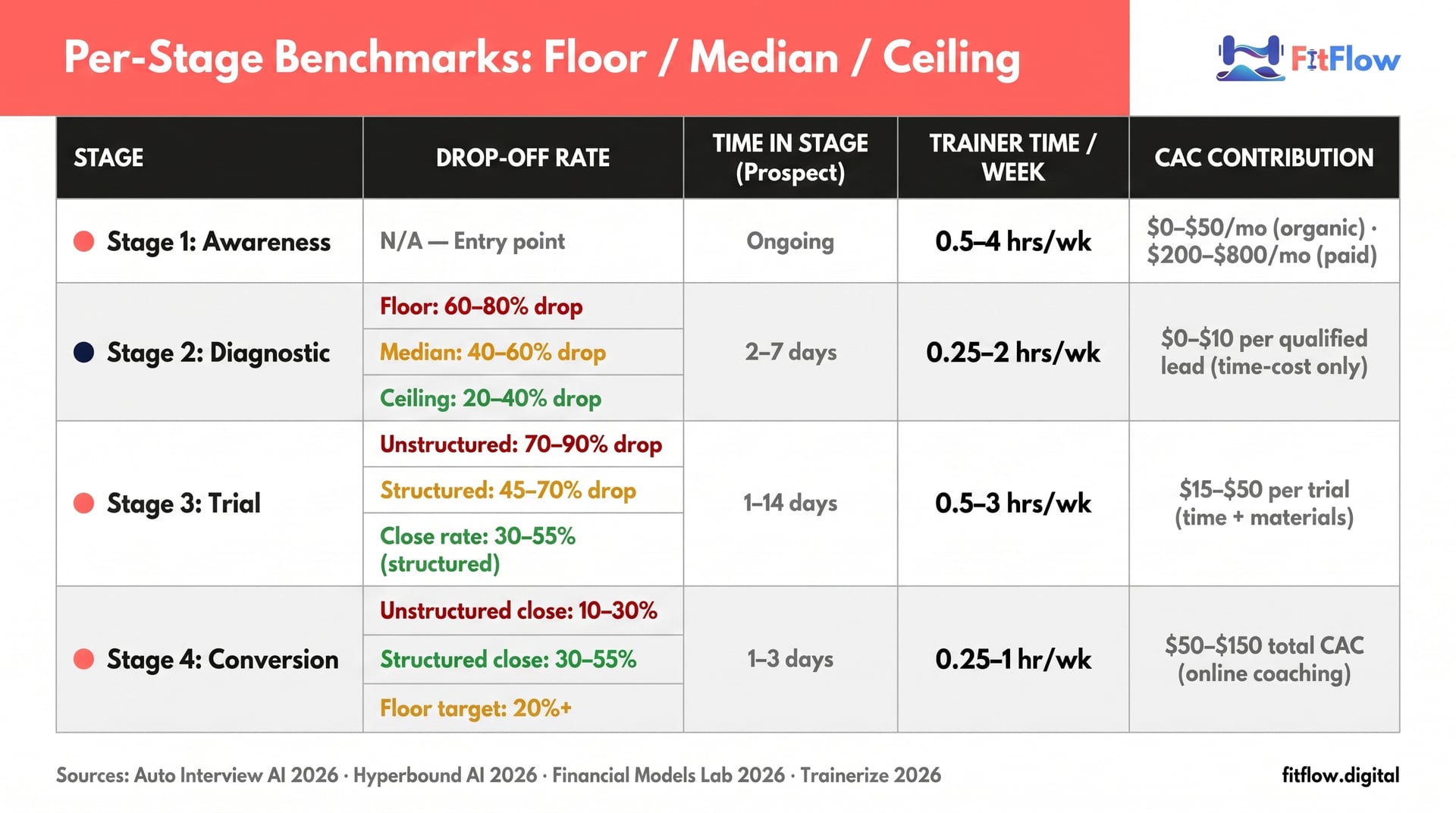
Stage | Drop-Off Rate | Time in Stage | Trainer Time/Week | CAC Contribution |
|---|---|---|---|---|
1: Awareness | N/A (entry) | Ongoing | 0.5–4 hrs | $0–$50/mo organic; $200–$800/mo paid |
2: Diagnostic | Floor 60–80% / Median 40–60% / Ceiling 20–40% | 2–7 days | 0.25–2 hrs | $0–$10 per qualified lead |
3: Trial | Unstructured 70–90% drop / Structured 45–70% drop | 1–14 days | 0.5–3 hrs | $15–$50 per trial |
4: Conversion | Unstructured close 10–30% / Structured close 30–55% | 1–3 days | 0.25–1 hr | $50–$150 total online-coaching CAC |
Sources: Trainerize 2026 (referral conversion, acquisition difficulty); Auto Interview AI 2026 + Hyperbound AI 2026 (close rates, practitioner benchmarks, not peer-reviewed); Two-Brain Business 2025 (set/show/close framework); Financial Models Lab 2026 (CAC baseline $50, healthy LTV:CAC 3:1); CommuniPass 2026 (challenge-to-recurring upgrade). Time budgets reflect EntrepreneursHQ 2026's finding that coaches lose ~1.25 hrs/day to non-billable tasks. The median is your protected time, not your available time.
The 10-minute funnel leak diagnostic
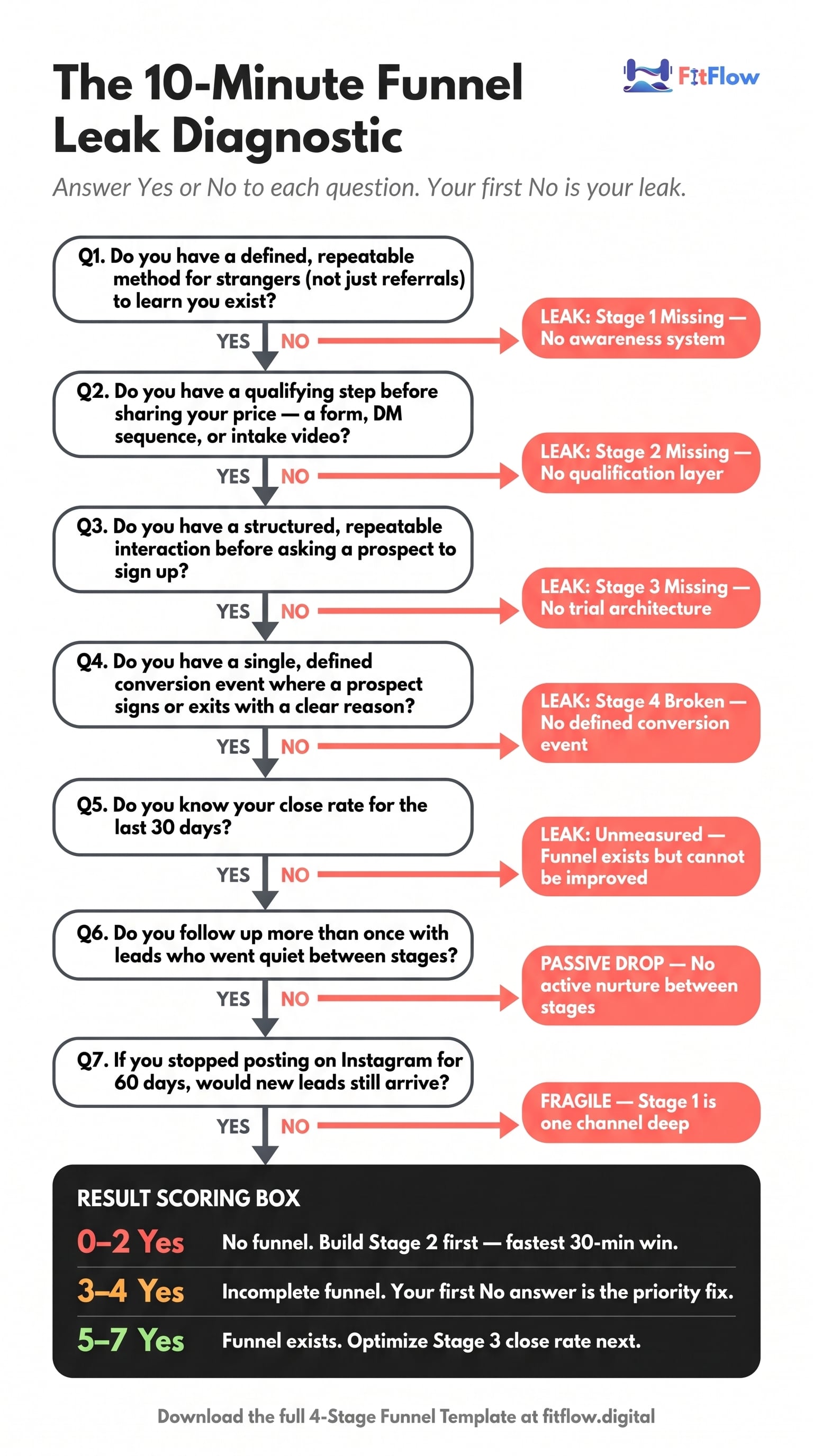
Seven yes/no questions. The first No is your leak.
Do you have a defined, repeatable method for getting strangers (not friends or referrals) to learn you exist? (No = Stage 1 missing)
Do you have a qualifying step before you tell a prospect your price, such as a form, DM sequence, or video that filters non-fits? (No = Stage 2 missing)
Do you have a structured, repeatable interaction before asking a prospect to sign? (No = Stage 3 missing)
Do you have a single defined conversion event, a moment where a prospect becomes a client or exits with a clear reason? (No = Stage 4 broken)
Do you know your close rate for the last 30 days (Stage 3 entries ÷ conversions)? (No = you cannot measure the funnel)
Do you follow up more than once with leads who went quiet between stages? (No = passive drop)
If you stopped posting on Instagram for 60 days, would new leads still come in? (No = Stage 1 is one channel deep)
Scoring: 0–2 Yes = no funnel; build Stages 2 and 4 first. 3–4 = incomplete; first No is your leak. 5–7 = funnel exists; optimize Stage 3.
Two walk-throughs:
Amanda at 4 clients and 200 Instagram followers answers No to 1, 2, 3, and 5. She has a price sheet and hope. Build Stage 2 first. A 3–5 question qualifying form is the fastest 30-minute win.
Sam at 30 clients and 1.5 hours per week on acquisition answers Yes to 1 and 4, No to 2, 3, and 5. Awareness exists, but no qualification and no structured Trial. His close rate is probably 15–20%. The Stage 3 architecture fix alone moves it to 30–40%.
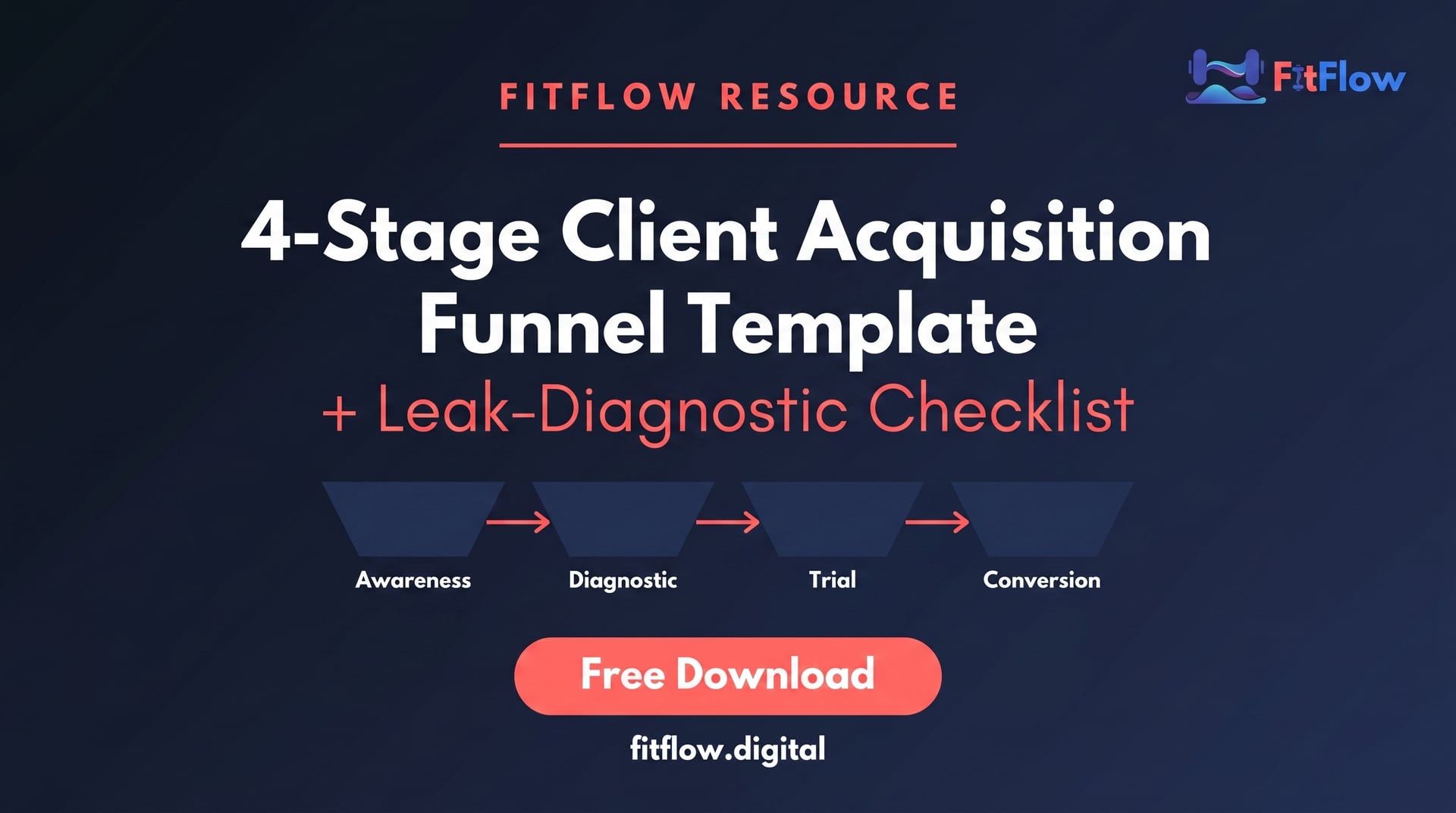
Answered No to any of those questions? Each No is a 30-minute fix. The pack tells you which one. The full 14-item diagnostic expands the 7 questions you just read: tagged by stage, with the next step for each No. Plus the four fill-in-the-blank scripts that handle each handoff. Plus the 30-day implementation plan. Download it and turn each No into a build. Get the full diagnostic.
What an unarchitected funnel costs each year
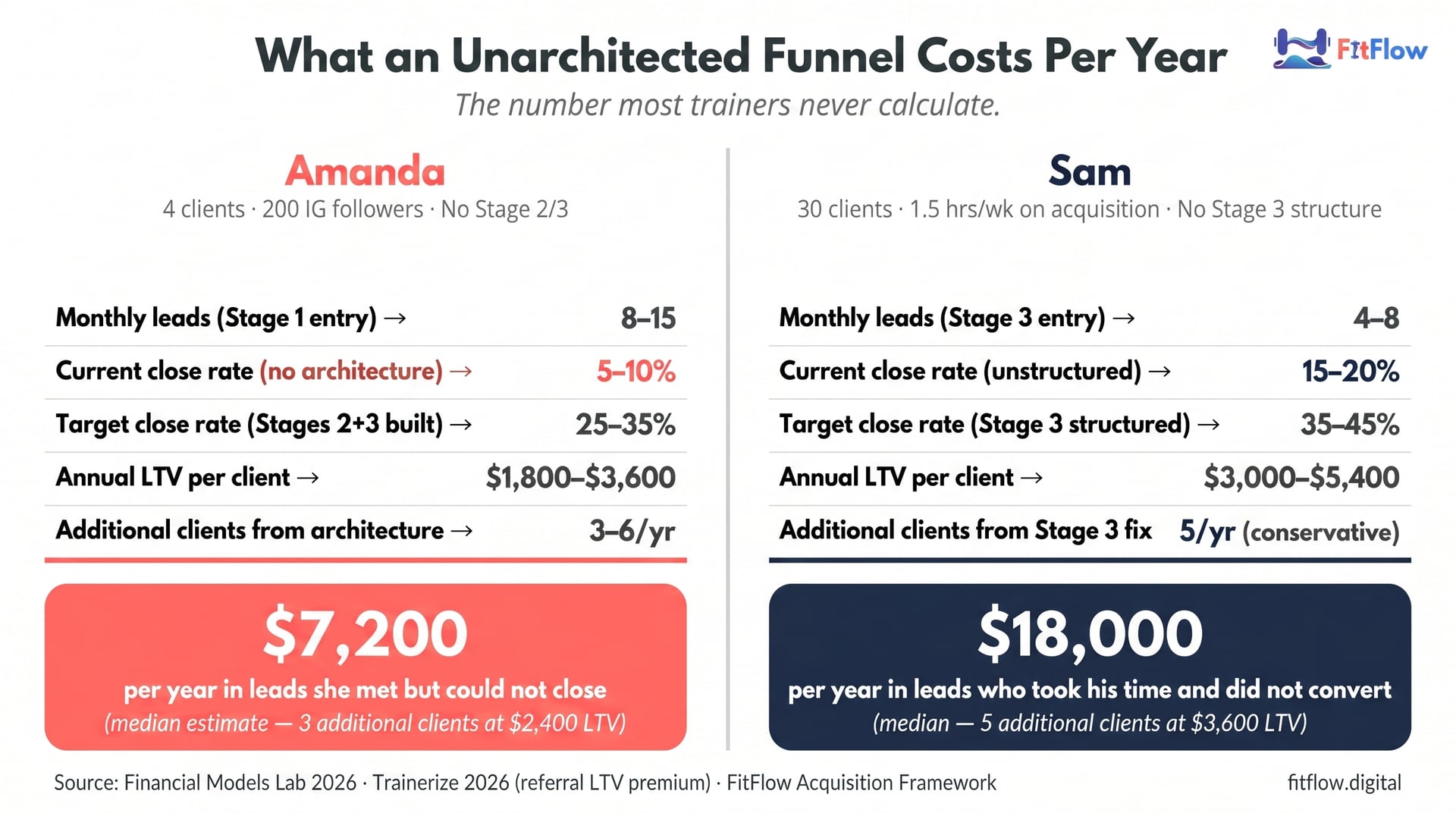
CAC × close-rate gap × annual lead volume = annual dollar cost of the missing architecture.
Amanda (4 clients, 200 followers, no Stage 2 or 3):
Monthly Stage 1 leads: floor 8, median 12, ceiling 15
Current close rate (no architecture): 5–10%
Target close rate (Stages 2+3 built): 25–35%
Annual LTV: floor $1,800, median $2,400, ceiling $3,600
Realistic additional clients/year: 3 (median) to 6 (ceiling), capped by serving capacity
Annual leakage: $7,200/yr median ($14,400/yr ceiling). Not because the leads were bad. Because she had no Stage 2 to qualify them and no Stage 3 to give them an experience.
Sam (30 clients, 1.5 hrs/week, no structured Stage 3):
Monthly Stage 3 leads: floor 4, median 6, ceiling 8
Current close rate (unstructured): 15–20%
Target close rate (structured Stage 3): 35–45%
Annual LTV: floor $3,000, median $3,600, ceiling $5,400
Realistic additional clients/year: 5 (median) to 10 (ceiling)
Annual leakage: $18,000/yr median ($36,000/yr ceiling). Not because prospects could not afford it. Because the architecture gave them nothing to trust before saying yes.
This is the acquisition side of the busy-vs-profitable margin-per-available-hour math. Unstructured discovery hours are the highest-cost, lowest-return time in Sam's business. And once he approaches 30 clients, acquisition past that threshold requires funnel-as-system rather than personal hustle (the 30-client wall operations playbook).
CAC anchor: online coaching CAC starts at approximately $50 and ranges to $150+ depending on channel mix (Financial Models Lab 2026). A healthy LTV:CAC ratio is 3:1. A $3,600/year client should cost no more than $1,200 to acquire. Trainers running unstructured funnels typically carry implicit CAC 2–3× higher because they invest time in prospects who were never qualified.
What this funnel does not solve
The 4-stage funnel solves one thing: stranger to signed client. It does not solve:
Retention. Once a client signs, keeping them is a delivery-quality problem. Read the 30-client wall operations playbook for the operations architecture that keeps clients past 30.
Fulfillment quality. Poor programming or inconsistent coaching means a well-architected funnel closes clients faster and loses them faster. Fix the product first.
Pricing power. If you are underpriced for your market, a funnel will fill your roster at low margins. Read the pricing-versus-positioning framework to fix positioning first.
A positioning problem. If you are a generalist in a crowded market, Stage 1 will be expensive and slow regardless of architecture. Positioning is upstream. Do the pricing-versus-positioning diagnostic first, then return.
Build the stage that is missing
The funnel is not complicated. Four stages. One defined conversion event. The average trainer has zero to two of the four built. That is why so much of the acquisition problem tracks back to missing architecture, not lead volume. FitFlow's synthesis of Trainerize 2026's "acquisition harder" data and Fitness Mentors 2026's word-of-mouth-primary data points to the same thing: trainers do have interest. They just do not have handoffs.
So build the missing stage first. Amanda needs qualification. Sam needs a structured Trial. Grace needs Stages 2–4 before she puts more money into paid traffic. See FitFlow pricing for the plans that support each stage, or FitFlow features to map the platform to Stages 1–4.
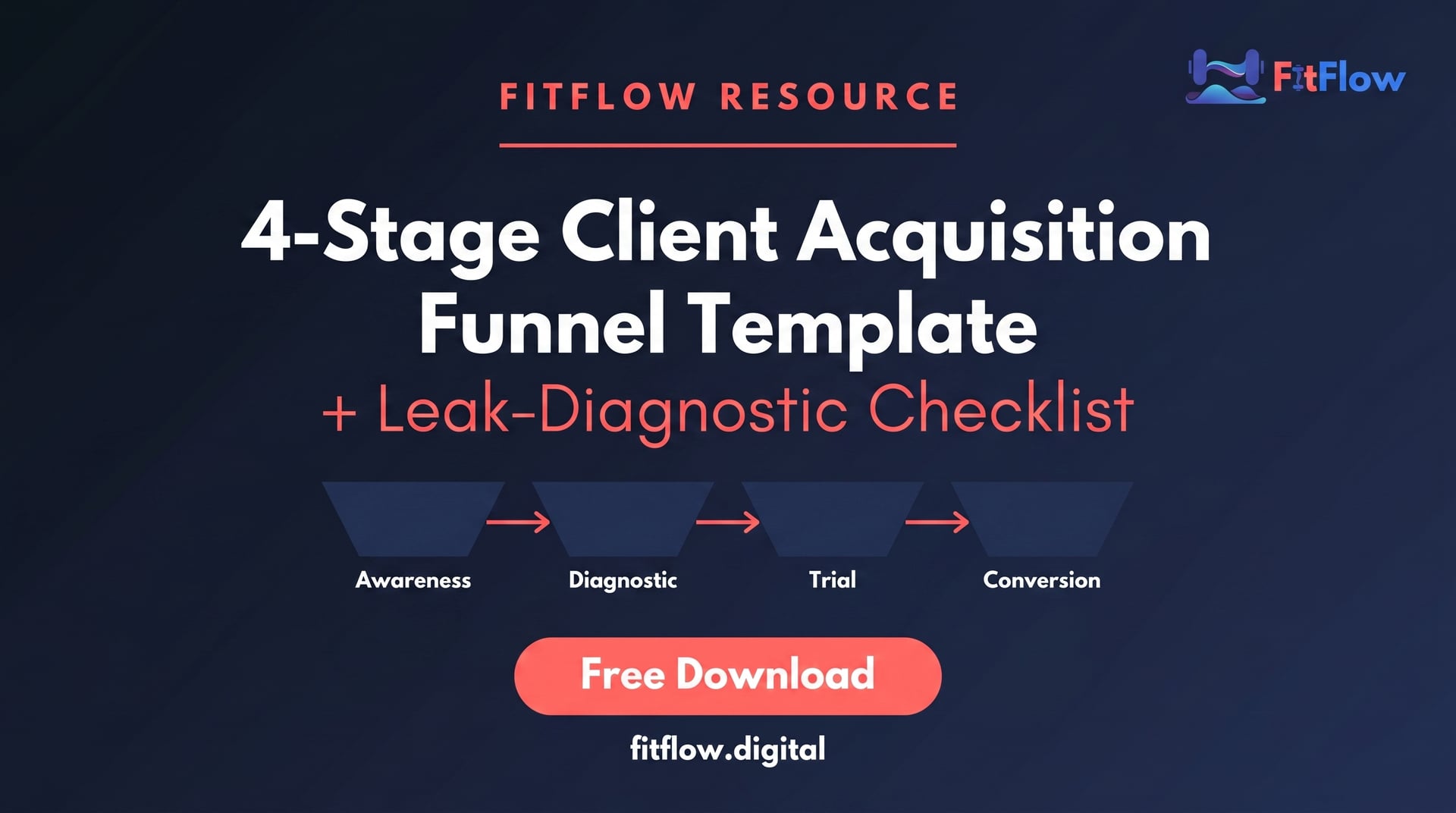
$7,200 to $18,000 per year is the cost of an unarchitected funnel. The pack is the fix. Amanda’s missing Stage 2 costs approximately $7,200/year. Sam’s unstructured Stage 3 costs approximately $18,000/year. Both numbers are median estimates with documented floor/ceiling ranges in the pack. Download the template, compute your own number, then build the stage your funnel is missing. Stop the leakage.
Frequently Asked Questions
Comments