
Why Perfect Diets Fail: The Behavioral Systems Gap Every Trainer Ignores

Your Client Does Not Need a Better Meal Plan
Your client does not need a better meal plan. They need a system that makes any reasonable plan work.
You already know how this goes. A new client wants to lose weight, clean up their diet, or get their nutrition "dialed in." You spend two or three hours building a plan. You calculate macros. You structure meal timing around their schedule. You hand them a PDF or a MyFitnessPal template and review it in person. They leave the session motivated.
By week four, they have stopped logging. By week six, the nutrition conversation has quietly disappeared from your check-ins. By month three, you are writing a new plan — or more likely, neither of you brings it up again.
This pattern is not a coaching failure. It is a systems failure. And the data on it is unambiguous.
Diet adherence drops below 50% within three to four weeks across virtually every controlled study, regardless of the dietary approach. Dansinger et al., JAMA, 2005 randomized participants to Atkins, Zone, Ornish, and Weight Watchers and found that adherence level — not diet type — was the single strongest predictor of weight loss at 12 months. The correlation between adherence and outcomes was consistent across all four diets.
The landmark DIETFITS trial reinforced this finding at scale. Gardner et al., JAMA, 2018 followed 609 overweight adults for 12 months on either low-fat or low-carb diets. The conclusion was definitive: there was no significant difference in weight loss between diet types when adherence was controlled. The diet was never the variable that mattered. Adherence was.
The diet is not failing. The delivery system is.Get the Free Audit Kit.
Turn This Article Into Action in 10 Minutes. You now understand why perfect diets fail. This 15-point checklist turns the 4-layer framework into a practical diagnostic you can run on your current nutrition coaching approach today. Includes the Baseline Assessment Template, Habit Staging Worksheet, Weekly Check-In Script, and Red Flags Reference Card.
This article presents a four-layer behavioral systems framework that addresses the actual reason nutrition coaching breaks down. It is built on published research in behavioral science, habit formation, and dietary adherence — not intuition, not influencer wisdom, and not the assumption that your clients just need more willpower.
Here is what we will cover: the data behind the adherence cliff, why more restriction accelerates failure, the five hidden failure points in most trainers' nutrition coaching, a modular four-layer framework you can implement in 30 days, and the specific decision rules for when to progress, hold, simplify, or refer out.
Diagnose Your Nutrition Coaching System in 10 Minutes. This free 15-point checklist reveals whether your nutrition coaching has the behavioral infrastructure to keep clients adherent past week four. Score yourself across 5 critical categories. Get the Free Audit Checklist.
The Adherence Cliff: What the Data Actually Shows
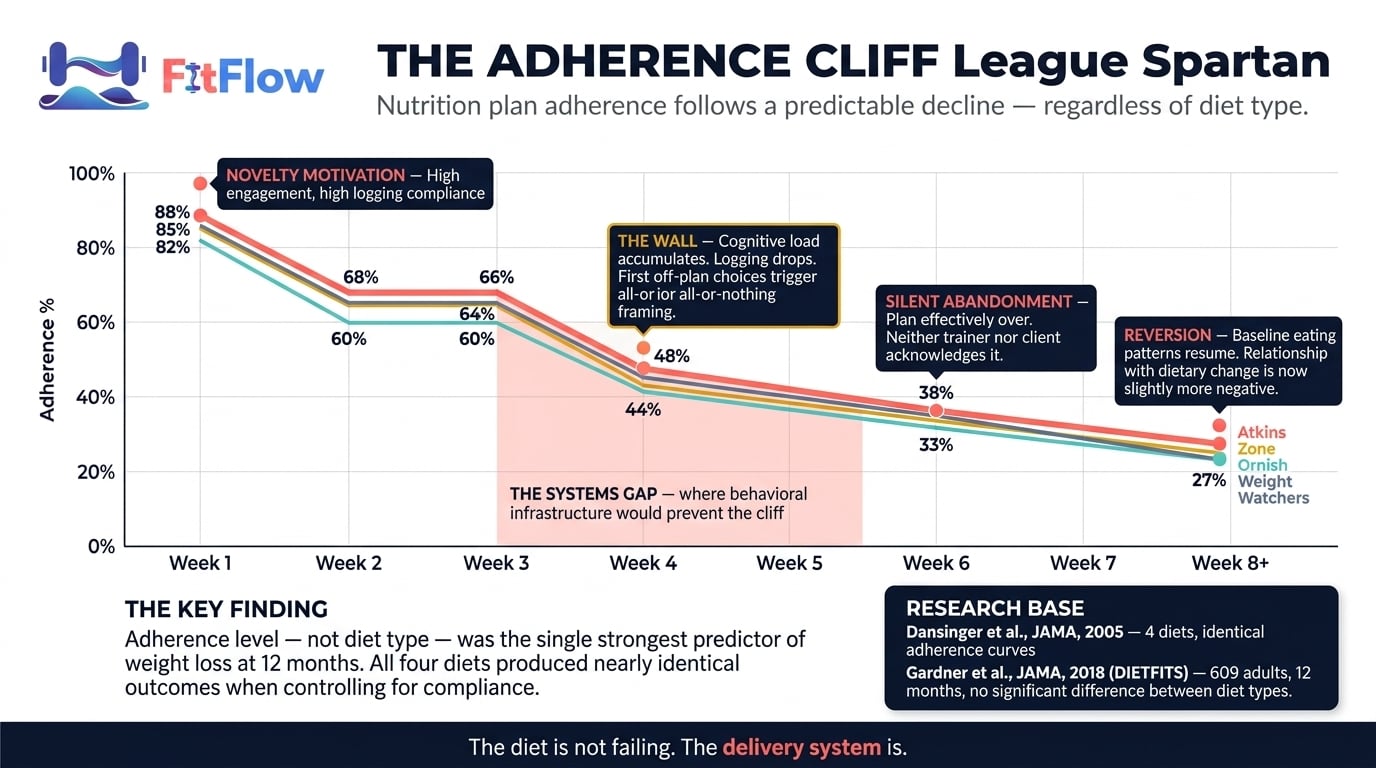
There is a predictable curve to nutrition plan adherence, and if you have coached more than a handful of clients through dietary changes, you have seen it play out firsthand.
The pattern looks roughly like this across the published literature. (Note: figures represent composites from self-reported adherence in controlled research settings, including Dansinger 2005 and Gardner 2018.)
Timeframe | Typical Adherence Rate | What Is Happening |
|---|---|---|
Week 1 | ~85% | Novelty motivation, high engagement |
Week 2-3 | ~65% | Initial friction, first schedule disruptions |
Week 4 | ~45% | Cognitive load accumulates, logging drops |
Week 6 | ~35% | Plan effectively abandoned or heavily modified |
Week 8+ | <30% | Reversion to baseline eating patterns |
This is not a table of client weakness. It is a table of predictable system failure.
Dansinger et al., JAMA, 2005 demonstrated this adherence degradation curve across all four diets studied. Participants were randomly assigned to Atkins, Zone, Ornish, or Weight Watchers. At one year, each group showed nearly identical weight loss when controlling for adherence. The dieters who stuck with their plan lost weight. The majority who did not — across every diet type — did not. The dropout pattern was remarkably similar across all four groups, suggesting the problem was not the nutritional approach but the behavioral infrastructure surrounding it.
Wing and Phelan, American Journal of Clinical Nutrition, 2005 analyzed the National Weight Control Registry data — the largest study of individuals who successfully maintained significant weight loss. The consistent finding: long-term success was associated with consistent behavioral patterns (self-monitoring, regular physical activity, consistent eating patterns), not with any specific diet composition.
Now consider the contrast between two coaching approaches.
The first trainer — the one most of us were trained to be — spends three hours building the nutritionally optimal plan. Macros calculated to the gram. Meal timing mapped to the client's work schedule. Food lists with approved and restricted items. The plan is precise, evidence-based, and nutritionally sound. It is also abandoned by week four.
The second trainer starts differently. No meal plan on day one. A baseline assessment. One habit. A feedback loop. Progressive complexity only when adherence data supports it. At month three, their client has consolidated three habits and is losing weight steadily.
Same nutritional knowledge. Different system. Different outcomes.
The best diet is the one your client actually follows. This is not a platitude — it is what the research demonstrates repeatedly. The hours you spend optimizing macronutrient ratios matter far less than the minutes you spend designing the behavioral system that determines whether your client eats according to any plan at all.
The Compliance Paradox: Why More Restriction Accelerates Failure
Here is the paradox that trips up well-trained coaches: the more nutritionally precise the plan, the faster it tends to fail.
More rules create an initial motivation spike. The client feels like they are doing something serious. The specificity feels professional. But that specificity carries a cognitive cost that compounds daily.
Every food decision a restrictive plan requires — Is this on my list? How many grams of carbs is this? Can I eat this at 3pm or should I wait until 5pm? — draws from the same cognitive budget your client needs for work, parenting, and every other decision they make that day. Baumeister and Tierney's research on decision fatigue showed that self-regulation is a finite resource. A meal plan requiring 15 to 20 conscious food decisions per day is competing with every other demand on that resource.
The trajectory is predictable. Week one: high motivation overcomes cognitive load. Week two: the novelty wears off, but momentum carries.
Week three: a work deadline, a family obligation, or a social event disrupts the routine. The client makes one "off-plan" choice and experiences it as failure. Week four: the all-or-nothing framing — which the rigid plan implicitly created — triggers abandonment. "I will get back on track Monday" becomes "I will get back on track next month" becomes silence.
If this sounds familiar, it should. It parallels what happens in training program design. Just as adaptation requires progressive overload properly sequenced, nutrition adherence requires progressive complexity properly staged. You would not program heavy singles in week one for a beginner. You should not program full macro tracking in week one for someone who currently eats fast food four times a week.
Trexler et al., Journal of the International Society of Sports Nutrition, 2014 documented how metabolic adaptation compounds this behavioral difficulty. As a client restricts calories, their body fights back — reduced metabolic rate, increased hunger hormones, decreased satiety signals. That biological resistance escalates at the same time the psychological resistance to compliance escalates. The client is fighting on two fronts simultaneously, and the plan offers no mechanism for managing either.
This is not about lowering standards. It is about sequencing complexity correctly. A client who builds three sustainable habits over 12 weeks will outperform a client who follows a perfect plan for three weeks and quits every single time. The evidence is clear: Dalle Grave et al., Obesity, 2005 found that cognitive behavioral strategies — which emphasize gradual behavior change over dietary prescription — produced significantly better long-term weight management outcomes than diet-only approaches.
The permission reframe for trainers who feel like simplicity is settling: Simplicity is not settling — it is the evidence-based choice. Starting simple and building complexity based on adherence data is not lowering the bar. It is the approach that the published literature consistently associates with sustained outcomes.
Understanding why restriction fails also clarifies what kind of nutrition coaching actually works — which raises a question about what trainers are equipped to provide.
What Trainers Can — and Cannot — Do About Nutrition
Before building any nutrition coaching system, you need to know where the legal and ethical boundaries sit. This is not a formality — it is a strategic advantage when you understand it correctly.
In most U.S. states and many countries, personal trainers without a registered dietitian credential cannot prescribe diets, provide medical nutrition therapy, or create clinical meal plans for specific medical conditions. The National Academy of Sports Medicine scope of practice guidelines are explicit: certified personal trainers can provide general nutrition information and education, recommend balanced eating patterns consistent with government guidelines, and coach behavioral habits around food. They cannot diagnose nutritional deficiencies, prescribe specific calorie levels for medical conditions, or create therapeutic diets for disease management.
The American Council on Exercise position stand mirrors this framework. And the International Society of Sports Nutrition position stand on nutrition coaching clarifies the boundary further: trainers with nutrition certifications can provide more specific guidance (macronutrient recommendations, supplement information), but medical nutrition therapy remains outside the scope of all non-RD credentials.
Here is the reframe most trainers miss: these scope limits force you toward exactly the approach the evidence supports.
You cannot hand a client a 1,800-calorie meal plan with specific food lists and call it a day. Good. That approach fails at week four anyway. What you can do — and what the research says actually works — is coach behavioral habits, recommend balanced eating patterns, educate on general nutrition principles, and build the systematic feedback loops that sustain any dietary approach.
The three trainer-appropriate nutrition frameworks from the Simple Nutrition Frameworks guide — plate method, hand-portion method, and habit-based approach — all sit comfortably within scope of practice for certified trainers. They are also, not coincidentally, the approaches with the highest long-term adherence rates in the literature.
Scope-of-practice disclaimer: Personal trainers should operate within their certified scope of practice at all times. The behavioral coaching framework in this article addresses habit formation, adherence systems, and general nutrition education — not medical nutrition therapy, clinical dietary prescriptions, or eating disorder treatment. When a client's needs exceed your scope, the professional move is to refer out. We will cover exactly when and how later in this article.
The 5 Hidden Failure Points in Nutrition Coaching
If the diet is not the problem and the client is not the problem, where exactly does nutrition coaching break down? In our work with trainers — and in the behavioral science literature — the same five systemic gaps surface repeatedly.
Think of these as a diagnostic audit. If three or more apply to your current approach, the issue is structural. No amount of nutritional knowledge will fix a broken delivery system.
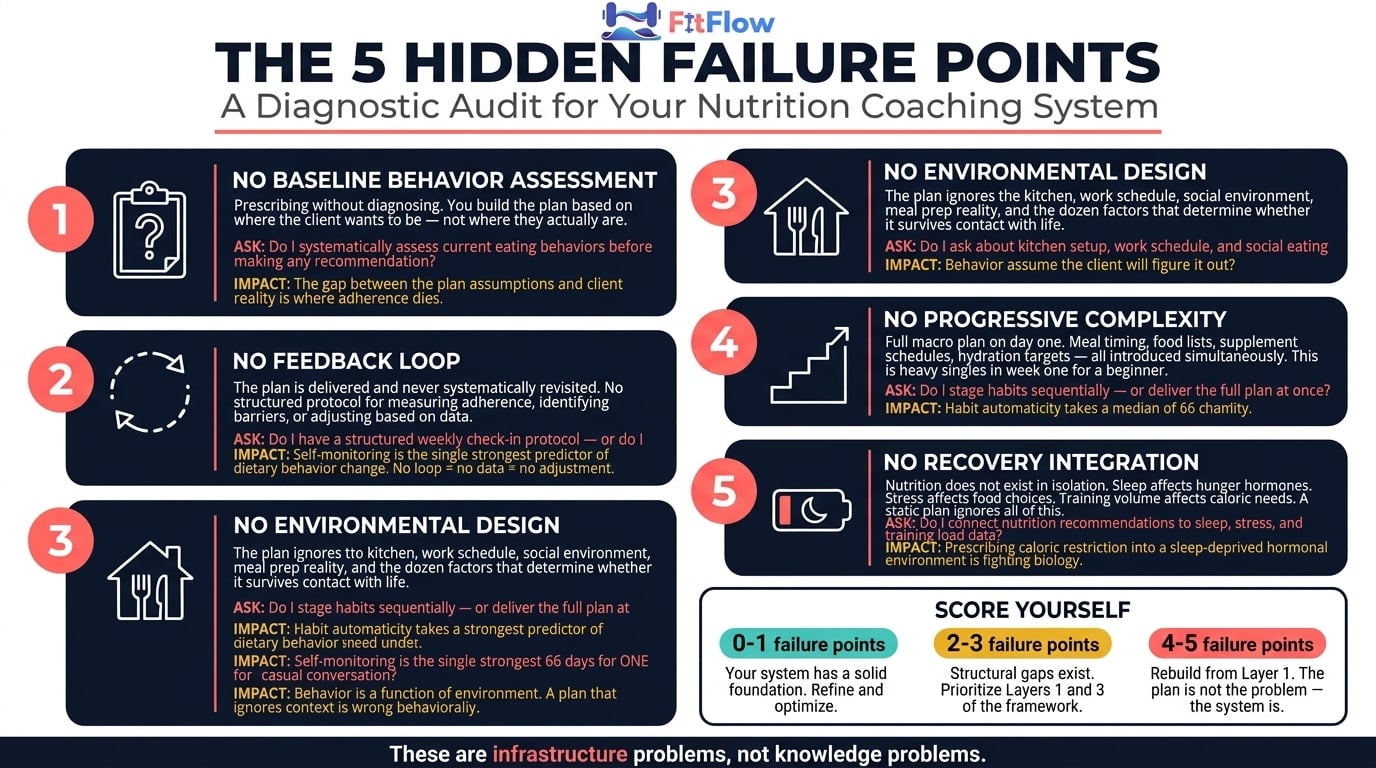
1. No Baseline Behavior Assessment
Most trainers prescribe without diagnosing. They learn the client's goals, maybe get a rough sense of current eating habits from a casual conversation, and then build a plan based on where the client wants to be — not where they actually are.
This is the nutritional equivalent of writing a training program without doing a movement assessment. You would never program back squats for a client who cannot bodyweight squat to depth. But trainers routinely prescribe full macro plans for clients who currently skip breakfast and eat fast food four times a week.
Without a systematic baseline assessment, you are guessing at the starting point. And the gap between the plan's assumptions and the client's reality is where adherence goes to die.
2. No Feedback Loop
The plan is delivered — discussed in a session, sent as a PDF, loaded into an app — and then never systematically revisited. The trainer might ask "how's the nutrition going?" in passing, but there is no structured protocol for measuring adherence, identifying barriers, or adjusting based on data.
Burke et al., Journal of the American Dietetic Association, 2011 conducted a comprehensive review and found that self-monitoring is the single strongest predictor of dietary behavior change. Not knowledge. Not motivation. Self-monitoring — the systematic tracking of what is actually happening versus what was planned.
No feedback loop means no monitoring. No monitoring means no data. No data means no adjustment. The plan drifts silently until it is abandoned entirely. Every abandoned meal plan costs you a client's trust and three months of rebuilding.
3. No Environmental Design
Behavior is a function of environment. Michie et al., Implementation Science, 2011 developed a taxonomy of 93 behavior change techniques and found that environmental restructuring — changing the physical and social context in which behaviors occur — was one of the most effective intervention categories.
Yet most nutrition coaching ignores the kitchen, the work schedule, the social environment, the meal prep reality, and the dozen other environmental factors that determine whether a plan survives contact with a client's actual life.
A client who works 60-hour weeks in finance and eats lunch at their desk is not going to meal prep five times a week. A client whose spouse keeps the pantry stocked with processed snacks faces a fundamentally different adherence challenge than a client who lives alone and controls their own food environment. The plan that ignores these realities is not wrong nutritionally — it is wrong behaviorally.
4. No Progressive Complexity
Full macro plan on day one. Meal timing, food lists, supplement schedules, and hydration targets all introduced simultaneously. This is the nutritional equivalent of programming heavy singles in week one for a beginner. It does not build capacity — it overwhelms it.
Lally et al., European Journal of Social Psychology, 2010 studied habit formation and found that the average time to automaticity — the point where a behavior becomes habitual rather than requiring conscious effort — was 66 days. The range was 18 to 254 days. And that was for single habits.
Stacking multiple new habits simultaneously does not add linearly to the timeline. It extends it exponentially, because each new habit competes for the same limited pool of self-regulatory resources. One habit at a time is not slow — it is the pace at which sustainable change actually occurs. The same principle applies to exercise selection: the urge to stop changing exercises and fix the underlying system is the training-side equivalent of what we are describing here for nutrition.
5. No Recovery Integration
Nutrition does not exist in isolation. Sleep quality affects hunger hormones. Stress load affects food choices. Training volume affects caloric needs. A nutrition plan that ignores recovery context is incomplete by definition.
If your client is sleeping five hours a night, their ghrelin is elevated and their leptin is suppressed. Prescribing caloric restriction into that hormonal environment is fighting biology. If their training volume just increased by 30%, their caloric needs shifted — and a static plan did not shift with them.
We covered the cascading effect of recovery deficits in detail in the evidence-based recovery guide. Nutrition coaching that operates independently of sleep, stress, and training load data will always underperform coaching that integrates these variables.
If three or more of these failure points describe your current approach, the system needs rebuilding — not your nutrition knowledge. The question becomes: what does a working system actually look like?
The Behavioral Systems Framework: 4 Layers That Make Any Diet Work
Here is the core framework. It is modular, sequential, and built on published behavioral science research. It works with any dietary approach — whether your client is doing a Mediterranean pattern, flexible dieting, a plant-based approach, or the simple plate method. The diet type is irrelevant. The system that supports adherence is everything.
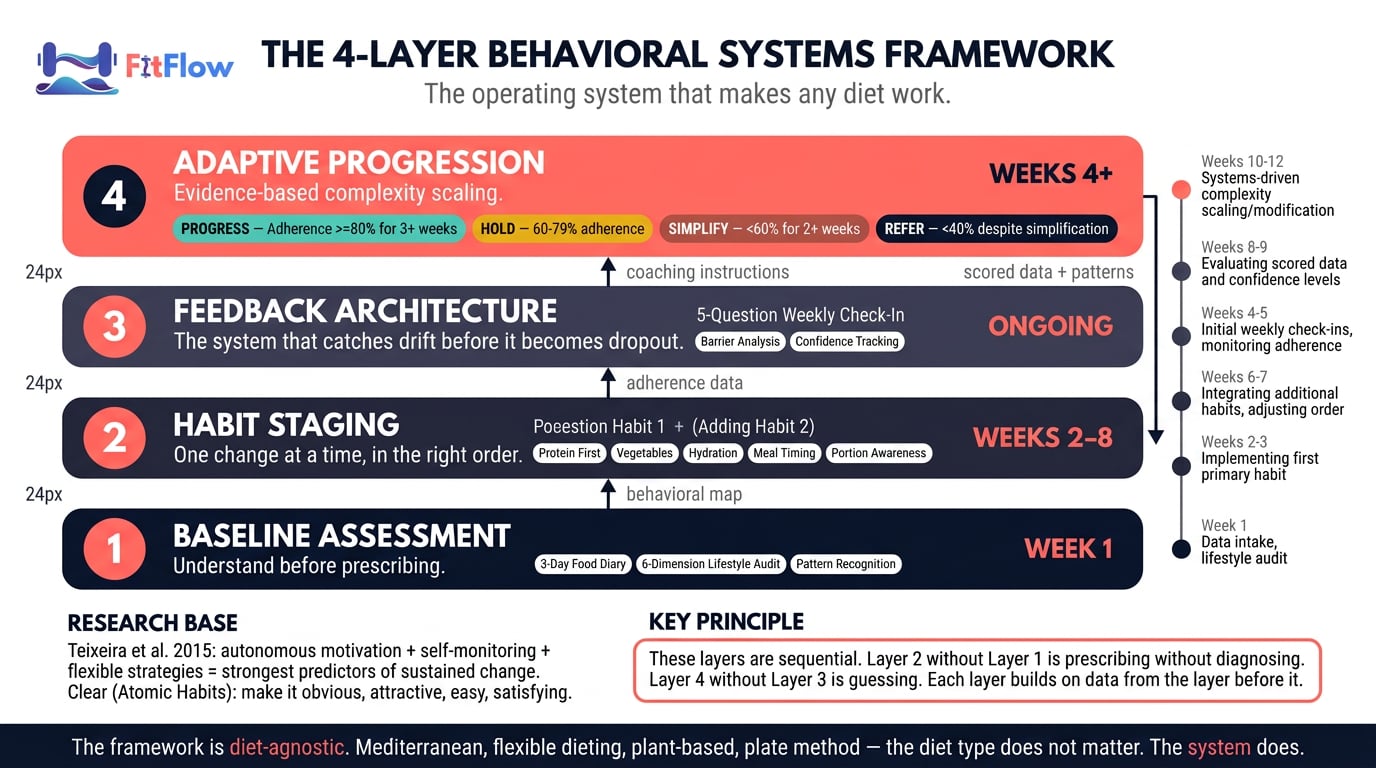
Layer | Name | Focus | Duration |
|---|---|---|---|
1 | Baseline Assessment | Understand before prescribing | Week 1 |
2 | Habit Staging | Sequential habit installation | Weeks 2-8 |
3 | Feedback Architecture | Systematic monitoring + adjustment | Ongoing |
4 | Adaptive Progression | Evidence-based complexity scaling | Weeks 4+ |
These layers are sequential. Layer 2 without Layer 1 is prescribing without diagnosing. Layer 4 without Layer 3 is guessing. Each layer builds on the data and behavioral capacity established by the layer before it.
The framework draws directly from Teixeira et al., International Journal of Behavioral Nutrition and Physical Activity, 2015, who reviewed the evidence on self-regulation and weight management and concluded that autonomous motivation, self-monitoring, and flexible (rather than rigid) behavioral strategies were the strongest predictors of sustained dietary change. The four layers operationalize these findings into a practical coaching protocol.
It also builds on James Clear's Atomic Habits framework, which synthesized the behavioral science literature into a practical model: make the behavior obvious, attractive, easy, and satisfying. Each layer maps to those principles — baseline assessment makes the starting point obvious, habit staging makes change easy, feedback architecture makes progress satisfying, and adaptive progression keeps the challenge attractive.
Let us walk through each layer.
Which of the 5 Behavioral Layers Is Your Weakest? Baseline assessment? Habit staging? Feedback architecture? Adaptive progression? Scope boundaries? This checklist scores each layer independently so you know exactly where to focus first. Score Your 5 Layers.
Layer 1: Baseline Assessment — Understand Before You Prescribe
The first layer is the one most trainers skip. It requires you to spend an entire week understanding your client's actual eating behavior before making a single recommendation. This feels slow. It is the fastest path to sustained change.
The 3-Day Food Diary Protocol
Have your client record everything they eat and drink for three days: two weekdays and one weekend day. This is not for calorie counting. It is for pattern recognition.
You are looking for:
Meal timing patterns (when do they eat, and how consistent is it?)
Protein distribution (is it clustered in one meal or spread across the day?)
Vegetable and fruit frequency
Processed food reliance
Hydration patterns
Eating context (desk? car? standing in the kitchen?)
The three-day window gives you a minimum viable data set. Two weekdays capture the work routine. One weekend day captures the unstructured environment where most adherence breaks happen.
The Lifestyle Audit Questionnaire (6 Dimensions)
These six dimensions give you the environmental and behavioral map you need to design a system that fits the client's actual life — not the idealized version that meal plans assume. Before writing a single nutrition recommendation, ask these questions:
Sleep quality and consistency: How many hours on average? How consistent is the schedule? Poor sleep directly undermines dietary adherence through hormonal disruption.
Work schedule and meal timing constraints: What does a typical workday look like? When are meals possible? What is not negotiable in their schedule?
Cooking skills and meal prep capacity: Can they cook? Do they want to? How much time per week can they realistically spend on food preparation?
Social eating frequency: How often do they eat out? How many meals per week involve other people's food choices (family dinners, work lunches, social events)?
Stress levels and emotional eating patterns: What does stress look like in their life right now? Do they notice a connection between stress and eating behavior?
Current supplement and hydration habits: What are they already taking? How much water do they drink? What is their caffeine intake?
Layer 2: Habit Staging — One Habit-Based Nutrition Change at a Time, in the Right Order
Layer 2 is where the actual behavioral change begins. The protocol is simple: one new habit per two-week cycle. Maximum three concurrent habits at any point.
The order matters. You want to start with changes that have the highest combination of impact and adherence probability. Here is the hierarchy we recommend, based on the Precision Nutrition coaching data and the behavioral science literature:
Priority | Habit | Why This Order |
|---|---|---|
1 | Protein at every meal | High nutritional impact, low cognitive load — just add, don't subtract |
2 | Vegetables at 2+ meals per day | Builds on existing meal structure, increases satiety |
3 | Consistent hydration (64+ oz daily) | Simple, measurable, immediate feedback |
4 | Meal timing consistency | Requires schedule awareness but no food restriction |
5 | Portion awareness | Higher cognitive load — only after earlier habits are consolidated |
Precision Nutrition's internal data on coaching outcomes — drawn from over 100,000 clients — found that clients who changed one habit at a time had two to three times higher adherence at 12 months compared to clients who attempted multiple simultaneous changes. This aligns with the Lally et al., 2010 finding that habit automaticity takes 18 to 254 days, with a median of 66 days.
Two weeks is the minimum assessment window for a new habit, not the completion window. At the two-week mark, you are looking for adherence data that tells you whether to continue focusing on this habit, simplify it, or progress to adding the next one. The decision rules for that assessment live in Layer 4.
Notice the sequencing logic: the first habits are additive (add protein, add vegetables, add water). They do not require the client to stop doing anything. Restriction — removing foods, reducing portions — comes later, if at all, and only after the additive habits have created a foundation of positive momentum and demonstrated adherence capacity.
This sequencing is intentional. It mirrors the evidence on self-determination theory and autonomous motivation — Teixeira et al., writing in the International Journal of Behavioral Nutrition and Physical Activity, found that dietary approaches supporting autonomy and competence produced better long-term adherence than those relying on controlled motivation (rules, restrictions, compliance pressure).
Layer 3: Feedback Architecture — The System That Catches Drift Before It Becomes Dropout
Layer 3 is the layer most trainers skip — and the one that determines whether the entire system works or collapses. Without systematic feedback, adherence degrades silently. By the time you notice, the client has already mentally disengaged.
The Weekly Check-In Protocol (5 Questions)
These five questions take less than five minutes. They can be asked in person, via text, or through a digital form. The format matters less than the consistency.
How many days this week did you [current habit]? (Produces an adherence percentage)
What made it easy? (Identifies enablers you can reinforce)
What made it hard? (Identifies barriers you can address)
On a 1-10 scale, how confident are you in continuing this habit next week? (Predictive indicator — scores below 7 are early warning signs)
Is anything in your schedule or life changing this week that might affect your eating? (Proactive disruption detection)
These questions are not casual conversation. They are a data collection protocol. Every answer feeds the decision rules in Layer 4.
The Adherence Scoring System
Adherence % | Classification | Action |
|---|---|---|
90-100% | Excellent | Progress to next habit in the next cycle |
80-89% | Strong | Hold current habit, reinforce enablers |
60-79% | Moderate | Investigate barriers, adjust environment |
40-59% | Struggling | Simplify the current habit, increase contact frequency |
<40% | System failure | Return to baseline assessment, consider referral |
This scoring system transforms nutrition coaching from a subjective "how do you feel about your eating?" conversation into an objective, data-driven decision process.
Burke et al., Journal of the American Dietetic Association, 2011 found that self-monitoring is the single strongest predictor of dietary behavior change — stronger than nutritional knowledge, stronger than motivation at baseline, stronger than social support. This check-in protocol is the monitoring system. It is not optional. It is the mechanism through which the entire framework produces results.
For a deeper look at building systematic progress tracking into your coaching practice, see the Client Progress Tracking Dashboard guide.
Layer 4: Adaptive Progression — When to Add Complexity and When to Simplify
Layer 4 is the decision engine. It takes the adherence data from Layer 3 and converts it into specific coaching actions. This is where most behavioral coaching frameworks stop at "use your judgment." This one gives you explicit decision rules.
When to Progress (Add Complexity)
All three conditions must be met:
Adherence >=80% for 3 or more consecutive weeks on the current habit
Client reports the habit feels "automatic" — it no longer requires conscious effort on most days (this maps to Lally's automaticity threshold)
No major life stressors on the horizon (job change, move, family event, illness)
When all three conditions are met, introduce the next habit in the hierarchy while maintaining the existing habits.
When to Hold
Adherence 60-79%: The habit is not yet consolidated. It still requires conscious effort and is vulnerable to disruption. Continue the current habit. Investigate barriers using the check-in data. Adjust environment if possible.
When to Simplify
Adherence <60% for 2 or more consecutive weeks: Reduce to an easier version of the same habit. For example, "protein at every meal" becomes "protein at two meals per day." "Vegetables at 2+ meals" becomes "vegetables at dinner." The habit is the same direction — just a lower threshold.
When to Refer Out
Adherence <40% despite one simplification cycle
Signs of disordered eating (discussed in the referral section below)
Medical nutrition needs beyond scope of practice
The 12-Week Progressive Complexity Timeline
Here is how the four layers map to a realistic 12-week coaching period:
Week | Layer | Activity |
|---|---|---|
1 | Layer 1 | Baseline assessment + 3-day food diary |
2-3 | Layer 2 | Habit 1: Protein at every meal |
4-5 | Layer 2 + 3 | Continue Habit 1 + first adherence scoring cycle |
6-7 | Layer 2 | Add Habit 2: Vegetables at 2+ meals (if Habit 1 >=80%) |
8-9 | Layer 3 | Full feedback cycle, assess both habits |
10-11 | Layer 4 | Progress/hold/simplify decision on each habit |
12 | Layer 4 | Add complexity or consolidate based on data |
At week 12, a client on this protocol typically has two to three consolidated habits with adherence above 80%. That does not sound dramatic. But compare it to the alternative: a client who followed a perfect plan for three weeks and then abandoned it entirely. Two consolidated habits at 80% adherence will always outperform a perfect plan at 0% adherence.
The qualification that matters: this is not about lowering standards. It is about sequencing complexity correctly. The client who has consolidated three habits at week 12 is ready for more complexity — macro awareness, portion calibration, periodized nutrition — precisely because they have built the behavioral capacity to sustain it. The client who started with full macros and failed does not have that capacity. They have a negative association with dietary change that makes the next attempt harder, not easier.
Two Clients, One Trainer, Two Systems
Theory becomes concrete when you watch it play out in practice. Here are two composite scenarios — drawn from real patterns we see across trainers using different coaching approaches — that illustrate the difference between prescriptive planning and behavioral systems.
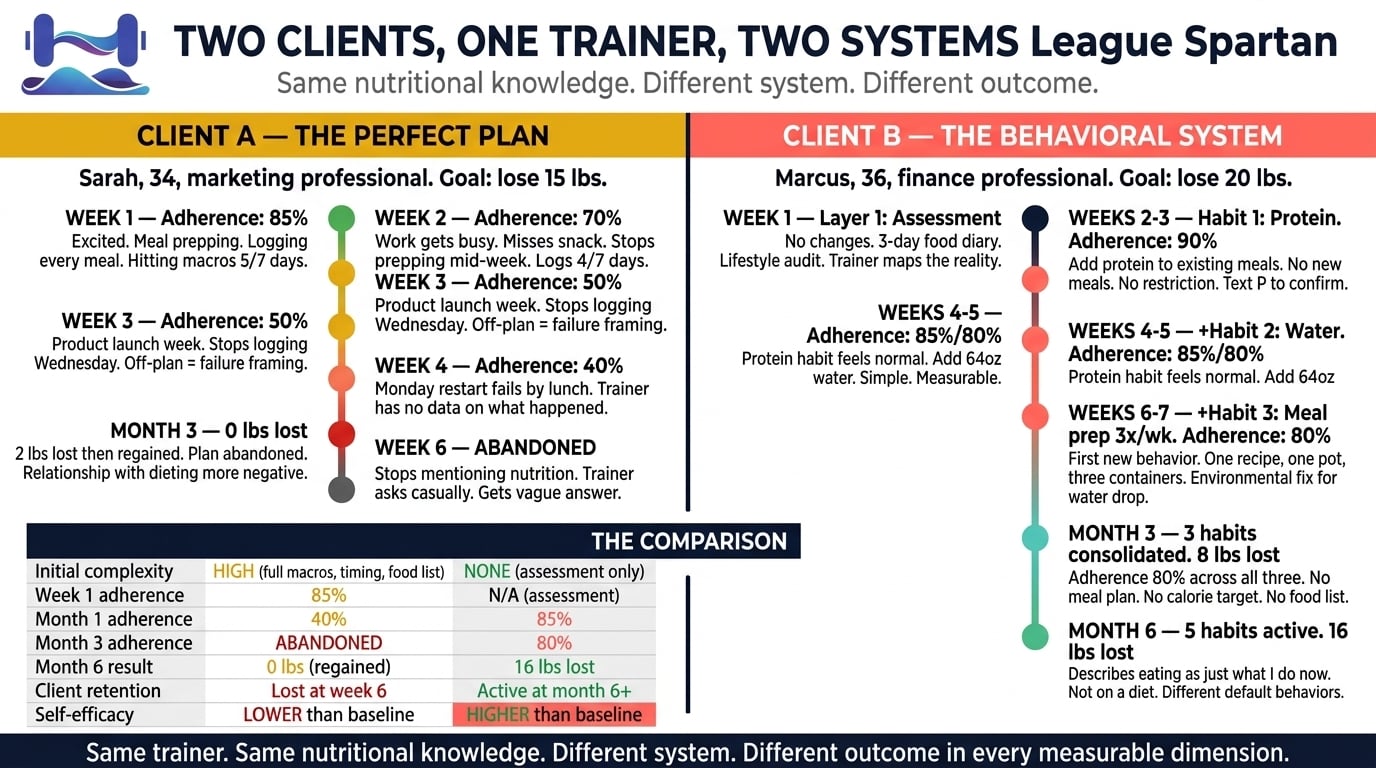
Client A: The Perfect Plan Approach
Sarah is 34, works in marketing at a mid-size agency, and wants to lose 15 pounds before a vacation in four months. She has tried calorie counting twice before and "knows what to do but can't stick with it." Her trainer is skilled and well-intentioned.
The trainer builds a detailed plan: 1,800 kcal daily, 140g protein, 180g carbohydrates, 60g fat. Meal timing structured around her work schedule: breakfast at 7am, lunch at 12pm, afternoon snack at 3pm, dinner at 6:30pm. The trainer provides a food list with approved items and portion guidance, loads everything into MyFitnessPal, and reviews the plan during a 30-minute nutrition consult.
Week 1: Sarah is excited. She spends Sunday afternoon meal prepping. She logs every meal in MyFitnessPal. She hits her macros five out of seven days. Adherence: 85%.
Week 2: Work gets busy — a product launch is approaching. She misses the 3pm snack twice because she is in back-to-back meetings. Tuesday dinner shifts to 8pm after a late meeting. She stops prepping lunches mid-week and grabs a salad from the place downstairs. She logs four out of seven days. Adherence: 70%.
Week 3: The product launch week. She stops logging on Wednesday. "I already know what I'm eating today is off." She eats lunch at her desk, grabs dinner on the way home. She does not meal prep Sunday because she is catching up on the sleep she missed all week. She tells herself she will get back on track Monday. Adherence: 50%.
Week 4: Monday comes. She logs breakfast. By lunch she is in meetings again. She does not log. She tells her trainer "this week was crazy, but I'm getting back on it." Her trainer encourages her. Neither of them has data on what actually happened. Adherence: 40%.
Week 6: Sarah stops mentioning nutrition in their sessions. Her trainer asks "how's the eating going?" and gets a vague "better this week." The plan is effectively abandoned. Neither acknowledges it directly. Sarah tells a friend she is "taking a break from dieting" and "just focusing on training for now."
Total outcome at month 3: Approximately 2 pounds lost, then regained. The plan is abandoned. Sarah's relationship with dietary change is slightly more negative than before. When she is ready to try again, she will need to overcome both the practical barriers and the psychological residue of another failed attempt.
Client B: The Behavioral Systems Approach
Marcus is 36, works in finance, and wants to lose 20 pounds. He describes his current eating as "terrible" and says he has "no discipline with food." His trainer uses the four-layer framework.
Week 1 (Layer 1): The trainer runs a baseline assessment. No nutrition changes — just data collection. The 3-day food diary reveals: Marcus skips breakfast, eats a grab-and-go lunch from a nearby deli (usually a sandwich and chips), snacks on whatever is in the office break room between 3-5pm, and orders delivery for dinner (fast food or takeout four times per week). The lifestyle audit shows: high-stress job with irregular hours, limited cooking skills, lives alone, sleeps about six hours per night.
The trainer does not judge any of this. The trainer maps it.
Weeks 2-3 (Layer 2): One habit introduced — include a source of protein at every meal Marcus already eats. Not new meals. Not different timing. Just add protein to what he is already doing. A protein shake with his morning coffee. Double meat on his deli sandwich. Protein-forward choice when ordering dinner. The trainer explains why protein matters and asks Marcus to text him a quick "P" when he hits protein at a meal. Adherence: 90%.
Weeks 4-5 (Layer 2 + 3): Continue the protein habit. Layer 3 check-in confirms adherence is holding at 85%. Marcus says the protein habit "just feels normal now." The trainer adds Habit 2: drink 64 ounces of water daily. Simple, measurable, no food restriction. Adherence: 85% protein, 80% water.
Weeks 6-7 (Layer 3): Full feedback cycle. Both habits holding. Confidence scores are 8/10 and 7/10. The trainer identifies a barrier — Marcus's water intake drops on days with lots of external meetings. Solution: Marcus starts bringing a water bottle to meetings. Problem solved with environmental design, not willpower.
The trainer adds Habit 3: prepare lunches three times per week instead of buying from the deli. This is the first habit that requires new behavior, not just modification of existing behavior. The trainer checks Marcus's cooking skills (minimal) and recommends batch-cooking a simple protein-and-rice recipe on Sunday — one recipe, one pot, three containers.
Month 3: Three habits consolidated. Marcus has lost 8 pounds. He did not follow a diet plan. He changed three specific behaviors, sequentially, with systematic monitoring and adjustment. Adherence across all three habits: 80%.
Month 6: Five habits active. 16 pounds lost. Marcus describes his eating as "just what I do now." He is not on a diet. He has a different set of default behaviors. His trainer has never given him a meal plan, a calorie target, or a food list. Marcus has not needed them.
The Comparison
Metric | Client A (Perfect Plan) | Client B (Behavioral System) |
|---|---|---|
Initial plan complexity | High (full macros, timing, food list) | None (assessment only) |
Week 1 adherence | 85% | N/A (assessment phase) |
Month 1 adherence | 40% | 85% |
Month 3 adherence | Abandoned | 80% |
Month 6 result | 0 lbs lost (regained initial loss) | 16 lbs lost |
Client retention | Lost at week 6 | Active at month 6+ |
Client self-efficacy | Lower than baseline | Higher than baseline |
Same trainer. Same nutritional knowledge. Different system. Different outcome in every measurable dimension.
Run This Audit Before Your Next Sarah Becomes Another Lost Client. The difference between Sarah and Marcus was not the trainer — it was the system. This 15-point checklist diagnoses which of the 5 behavioral layers your current approach is missing, so your next client gets the Marcus trajectory, not the Sarah one. Audit Your System Free.
How Technology Supports the Behavioral System
The four-layer framework works on paper and pencil. A notebook, a simple spreadsheet, and a weekly text exchange are sufficient for the mechanics. But the math changes as your client roster grows.
If you manage 25 clients and each requires a five-question weekly check-in, barrier analysis, adherence scoring, and progression decisions — that is 25 feedback loops to maintain manually. At 40 clients, the administrative load of Layer 3 (Feedback Architecture) becomes the bottleneck. And Layer 3 is the layer you cannot afford to drop, because it is the mechanism that prevents silent disengagement.
This is where technology earns its place — not by replacing the coaching relationship, but by handling the systematic monitoring that makes the coaching relationship productive.
Here is how FitFlow's tools map to each layer:
Layer 1 (Baseline Assessment): Client onboarding questionnaire with the six lifestyle audit dimensions built in. The 3-day food diary data feeds directly into the client profile.
Layer 2 (Habit Staging): Habit tracking module with single-habit focus. Clients log one behavior per cycle. The interface reinforces the "one thing at a time" principle by not showing future habits.
Layer 3 (Feedback Architecture): Automated weekly check-in prompts sent at a time you configure. Adherence dashboard that scores each client automatically and flags those dropping below 60%. This is the layer that technology handles at scale and that manual systems struggle with above 15 clients.
Layer 4 (Adaptive Progression): Progress algorithms that flag when a client's adherence data meets the criteria for progression, hold, simplification, or referral. The decision is still yours — the system surfaces the data.
Disclosure: FitFlow is our product. We built these features because the trainers we work with asked for exactly this workflow. The framework itself is not proprietary — it is built on published research. The technology simply makes Layer 3 sustainable at scale.
For a deeper look at how systematic tracking integrates with training and nutrition data, see the Client Progress Tracking Dashboard guide.
The key message: technology handles the feedback loop at scale. A trainer managing 40 clients cannot manually run 40 weekly adherence scoring cycles, analyze 40 sets of barrier data, and make 40 informed progression decisions — at least not consistently. A system that automates data collection and scoring while leaving coaching decisions to the trainer can. Technology does not replace judgment. It provides the data that makes judgment informed rather than intuitive.
When to Refer Out: Red Flags Every Trainer Must Recognize
Not every adherence problem is a systems problem. Some clients present with challenges that exceed a trainer's scope, and recognizing those situations is a professional responsibility — not a limitation.
The following red flags should trigger an immediate pause in your nutrition coaching and a referral conversation:
Behavior or Sign | Risk Level | Action |
|---|---|---|
Extreme caloric restriction (<1,000 kcal) without medical supervision | HIGH | Immediate referral to registered dietitian or physician |
Purging, laxative use, or compensatory exercise after eating | CRITICAL | Refer to eating disorder specialist — do not attempt to coach through this |
Obsessive food logging or weighing causing visible distress | MODERATE | Discuss with client, refer to RD or therapist if persistent |
Adherence <40% despite two or more simplification cycles | MODERATE | Refer to RD for specialized behavioral assessment |
Medical condition affecting nutrition (diabetes, kidney disease, thyroid) | HIGH | Co-manage with physician or RD — do not adjust nutrition independently |
Significant unintentional weight loss or gain | HIGH | Refer to physician first before any nutrition coaching continues |
Client expresses guilt, shame, or anxiety around specific foods | MODERATE | Screen for disordered eating patterns, refer if persistent |
The Referral Script
Here is language that frames referral as a strength, not a failure:
"I want to make sure you are getting the best possible support. I would like to connect you with a registered dietitian who can [specific reason — e.g., 'help you navigate nutrition with your thyroid condition' or 'provide more specialized support for your relationship with food']. I will continue handling your training program, and we can coordinate so everything works together."
This script accomplishes three things: it normalizes the referral, it specifies why, and it reassures the client that the training relationship continues. Most clients respond positively when the referral is framed as expanding their support team rather than admitting defeat.
For trainers working with clients on GLP-1 medications — which have specific nutritional implications that interact with the behavioral framework — the GLP-1 Coaching Guide covers the scope considerations and practical adaptations in detail.
Scope-of-practice disclaimer: Personal trainers should operate within their certified scope of practice. The behavioral coaching framework in this article addresses habit formation and adherence systems — not medical nutrition therapy, clinical dietary prescriptions, or eating disorder treatment. When in doubt, refer out. The cost of an unnecessary referral is minimal. The cost of missing a referral that was needed is significant.
Your 30-Day Implementation Roadmap
The framework is modular. You do not need to implement all four layers at once. Here is a week-by-week plan for integrating the Behavioral Systems Framework into your existing coaching practice.
Week 1: Audit Your Current Approach
Review your current nutrition coaching against the five failure points from Section 5. Be honest with yourself.
Baseline Assessment: Do you systematically assess current eating behaviors before making recommendations? Or do you go from goals to plan?
Feedback Loop: Do you have a structured weekly check-in protocol? Or do you rely on casual conversation?
Environmental Design: Do you ask about kitchen setup, work schedule, social eating? Or do you assume the client will figure out implementation?
Progressive Complexity: Do you stage habits sequentially? Or do you deliver the full plan at once?
Recovery Integration: Do you connect nutrition to sleep, stress, and training load? Or do you treat them as separate domains?
Score yourself 1-5 on each dimension. Total below 15: your system has structural gaps. Total below 10: start with Layer 1 and build from there.
Week 2: Implement Layer 1
Create or adopt a baseline assessment template that covers the 3-day food diary and the six-dimension lifestyle audit.
Run the assessment with your next three clients who ask about nutrition. Do not make any nutrition recommendations during this week — just collect data. This will feel uncomfortable. It is the right move.
Document what you learn about each client's actual eating patterns. Compare what you discover to what you would have assumed without the assessment. The gap is usually wider than expected.
Week 3: Launch Layer 2
For each assessed client, select one habit from the priority hierarchy based on their baseline data. The habit should be additive (adding something, not removing something) and achievable at 80%+ adherence based on what you know about their life.
Set a two-week commitment window. Define what adherence looks like in specific, observable terms — not "eat more protein" but "include a protein source of at least 20g at breakfast, lunch, and dinner."
Communicate the approach to your client: "We are going to start with one change. Just one. I want you to nail this before we add anything else." Most clients will push for more. Hold the line. The evidence supports your position.
Week 4: Build Layer 3
Create your weekly check-in protocol using the five questions from the Feedback Architecture section. Decide on the format: in-person during a session, via text, via a shared form, or through your coaching platform.
Schedule the first adherence check with each client on the Layer 2 protocol. Run the scoring. Make your first data-informed decision: progress, hold, or simplify.
Set up your tracking system. This can be as simple as a spreadsheet with columns for client name, current habit, week number, adherence percentage, confidence score, and next action. If you are using FitFlow or a similar platform, configure the automated check-in for each client.
From this point forward, the system is running. Layer 4 decision rules activate naturally as adherence data accumulates. Your job shifts from prescribing to monitoring, adjusting, and progressing — the same shift that separates average training programming from systematic programming.
You Have the 30-Day Plan. Now Get the Tools to Run It. The roadmap walks you through weeks 1-4. This free kit gives you the assets to execute each week: Baseline Assessment Template (Week 2), Habit Staging Worksheet (Week 3), Weekly Check-In Script + Adherence Scoring (Week 4), and the Red Flags Reference Card for scope decisions. All 6 documents, ready to use with your next client. Get the Implementation Kit.
Key Takeaways
Diet type does not predict outcomes — adherence does. The DIETFITS trial (Gardner et al., JAMA, 2018) and the Dansinger study (Dansinger et al., JAMA, 2005) both demonstrate that no dietary approach is superior when adherence is controlled. The variable that matters is whether the client actually follows the plan.
More restriction accelerates failure — the Compliance Paradox. Cognitive load from restrictive plans depletes the same self-regulatory resources clients need for daily life. The more rules, the faster the burnout.
The five failure points are systemic, not nutritional. No baseline assessment, no feedback loop, no environmental design, no progressive complexity, no recovery integration. These are infrastructure problems, not knowledge problems.
The 4-layer Behavioral Systems Framework provides the operating system for any nutrition approach. Baseline Assessment, Habit Staging, Feedback Architecture, and Adaptive Progression — sequential, modular, and built on published behavioral science.
One habit at a time, with adherence at or above 80% before adding complexity. Lally et al. found that habit automaticity takes a median of 66 days. Stacking multiple new habits simultaneously extends this timeline and reduces adherence across all of them.
Feedback architecture is the layer most trainers skip — and the layer technology can automate. Self-monitoring is the strongest predictor of dietary behavior change (Burke et al., JADA, 2011). Systematic weekly check-ins are the monitoring mechanism.
Know your scope of practice — and know when to refer out. Scope limits are a strategic advantage. They push trainers toward habit-based behavioral coaching, which is exactly the approach the evidence supports. When a client's needs exceed your scope, referring out is the professional move.
Marcus lost 16 pounds over six months without a single meal plan. Sarah abandoned a nutritionally perfect plan in four weeks. The diet is not failing. The delivery system is. Build the system.
For trainers ready to build systematic nutrition coaching into their practice: start with the simple nutrition frameworks that work within scope of practice, pair them with the behavioral systems framework from this article, and track progress using the client progress dashboard. The training program handles the stimulus. The nutrition system handles the environment. And the evidence-based recovery guide connects both to the recovery variables that determine whether your client's body actually responds to either. These are not separate domains — they are one system, and the problem was never the program. It was always the system around it.
Frequently Asked Questions
Comments