
Why Your Clients' Results Stall: The Adherence Diagnostic Guide

The problem isn't the program. The problem is you can't see the decay until it's already happened.
Tuesday afternoon. Sam is managing 32 clients. He just changed Jordan's training split for the second time this month because Jordan said the workouts "aren't working." Sam opens the app: Jordan logged 2 of 4 sessions last week, 3 of 4 the week before, and 4 of 4 during the first two weeks.
The program works. Jordan stopped doing it. The split change will reset adaptation and confirm Jordan's wrong suspicion that programming was the issue.
Run the adherence diagnostic before redesigning anything. Your client stopped doing the program, and the decay was visible weeks ago.
Four tools: the Adherence Decay Curve (how compliance actually fails), a signal hierarchy you can spot from any check-in, a 5-question diagnostic, and a decision tree to run before changing programs. This is operations, not motivation.
Before you read the rest: if you have a client whose results have stalled right now, download The Adherence Pattern Diagnostic Checklist. 12 early-warning signals, a decay-stage scorecard, and the full check-in script, free.
The number every trainer ignores
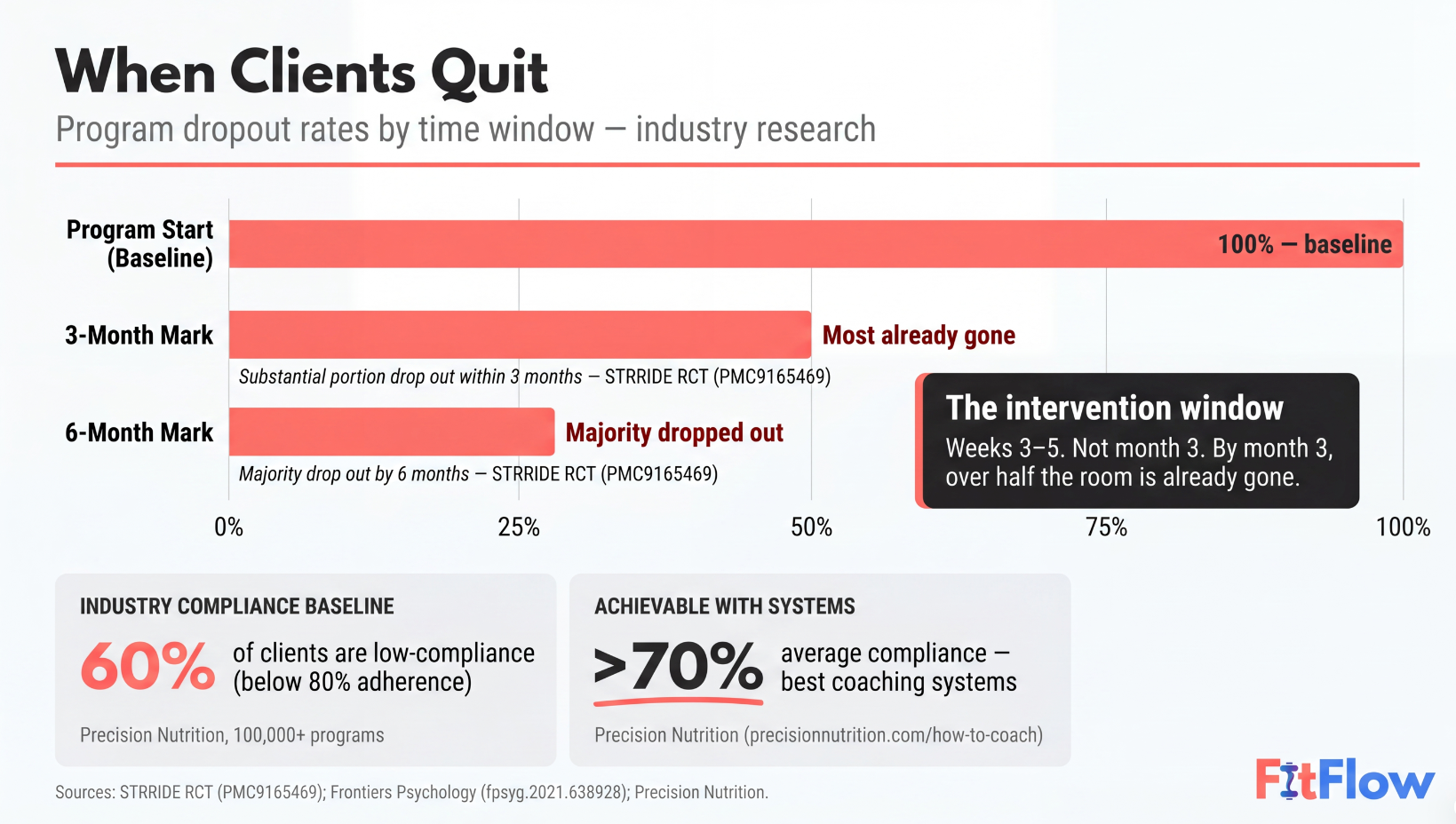
Precision Nutrition's data from 100,000+ client programs: most clients are "low compliance" — under 80% of prescribed habits and workouts executed (Precision Nutrition: How to Coach). This is normal. Any given week, a chunk of your roster isn't doing what you prescribed.
Trainer reflex: results stall, change the program. Add a deload. Shift macros. New split.
That reflex is wrong. If most clients are under 80% compliance, the stall is execution, not prescription. But most trainers can't tell the difference by week three of a plateau. This guide fixes that.
The stakes: Precision Nutrition's best systems get 70% average compliance — better than medication adherence for life-threatening conditions (55%) (Precision Nutrition: Compliance Solution). Compliance engineering is the service. Trainerize's 2025 report: inconsistent communication and "feeling no progress" drive churn more than price or programming.
Not a motivation problem. Detection problem.
Before you run the adherence diagnostic, check the upstream: the 5-domain framework for why your clients aren't progressing tells you which domain to enter first. This guide expands Domain 5 (Adherence) into a standalone system.
Adherence doesn't fail suddenly. It decays.
Adherence doesn't fail suddenly. Most trainers think it does — "client ghosted on Tuesday" — but STRRIDE trial data shows people drop out gradually: many within three months, most by six (PMC9165469). SportRxiv found training consistency in the first 28 days predicts everything. You can see it coming weeks out.
The Adherence Decay Curve maps the arc. Five stages, each with timing, psychology, signals, and a mistake to dodge.
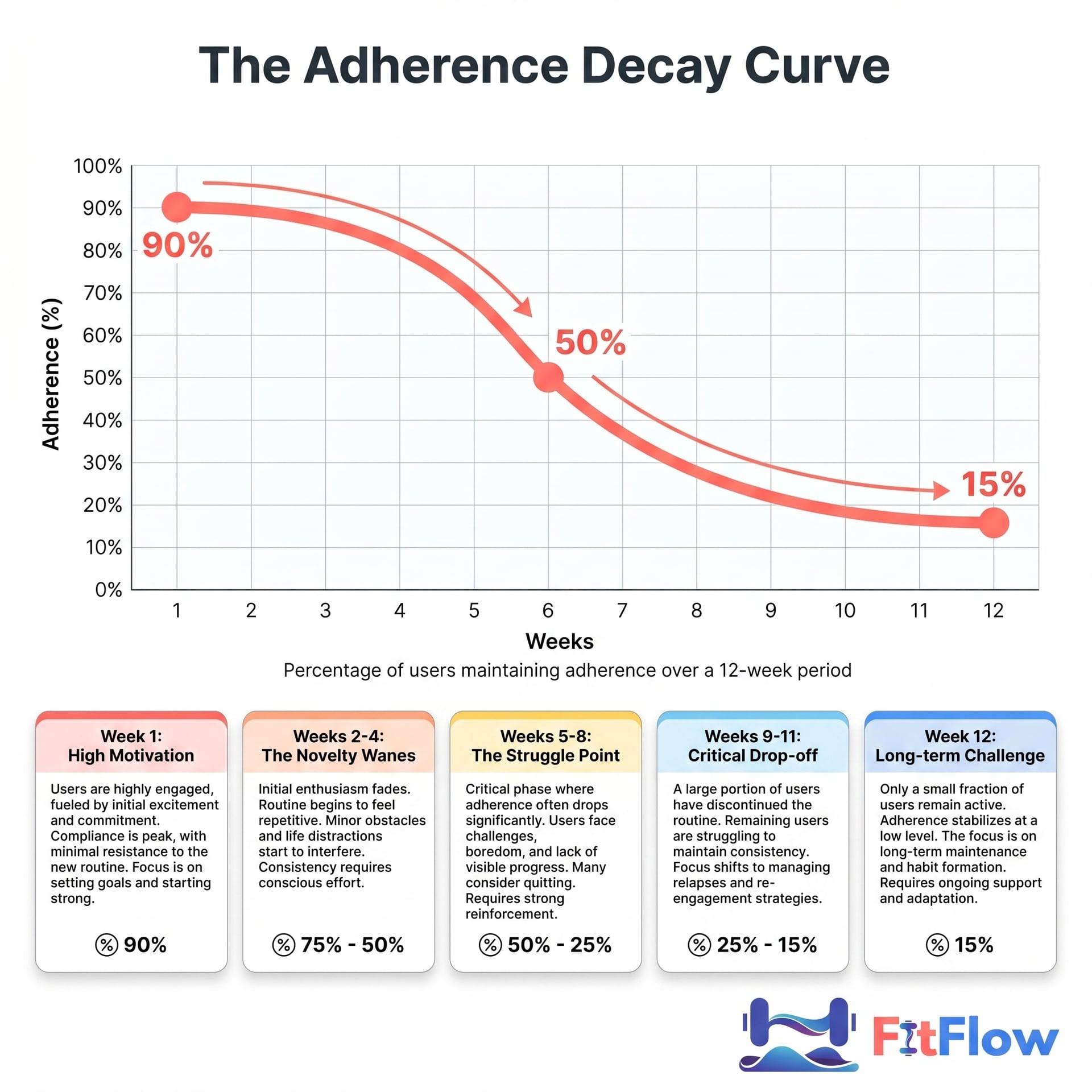
Stage 1 — Full Compliance (Weeks 1-3). Honeymoon phase. Dopamine running hot. 85-100% completion, instant responses, essay-length check-ins, logs every rep. Mistake: thinking this is normal and ramping intensity to match. Week 2 is not baseline. Signals: responds in hours, logs everything, messages you first, hits prescribed RPE or higher.
Stage 2 — First Friction (Weeks 3-5). Novelty wears off. Real life hits: deadline, sick kid, trip. Client starts "making up" missed sessions on weekends instead of admitting they missed. This is your intervention window. Most trainers miss it because surface compliance still looks OK. Signals: first 24+ hour response delay, emojis replacing sentences, "I'll catch up this weekend."
Stage 3 — Narrative Construction (Weeks 5-8). Client invents why progress stalled: "program isn't working," "need more protein," "maybe change the split." Wrong. The real cause: weeks 4-5 compliance tanked. They're not lying—just working backwards from "this feels off" to find something to blame. Biggest mistake of the whole arc: believing them and changing the program. Resets adaptation, confirms their wrong theory, removes the one stable thing. Signals: first programming complaints, says "staying on track" while logs show 60-70%, switches from talking effort to talking explanations.
Stage 4 — Disengagement (Weeks 8-12). Active withdrawal. 1-2 sessions/week. Radio silence on check-ins. "Life is crazy right now." They're not bored—they're drowning. Mistake: pumping motivation content. They don't need motivation; they're already over-pressured. More feels like more pressure. Signals: 5+ days of silence, reschedules but doesn't complete, talks about the program in past tense.
Stage 5 — Quiet Quit or Ghost. Silent non-renewal, cancellation, or vanishes. Too late for prevention—you're reacting. If you keep catching clients here, your system is broken. Decisions happened weeks ago.
Research confirms the timeline. Frontiers Psychology: beginners with behavioral support attended 55% of sessions vs 36% without. Dropout: 20% vs 55% (Frontiers Psychology 2021). The workout wasn't the difference. The system caught Stage 2 before it hit Stage 4.
The four signals that predict dropout
Knowing the curve exists doesn't mean you can read it. The Decay Signal Hierarchy ranks four signal types by how early they show up.
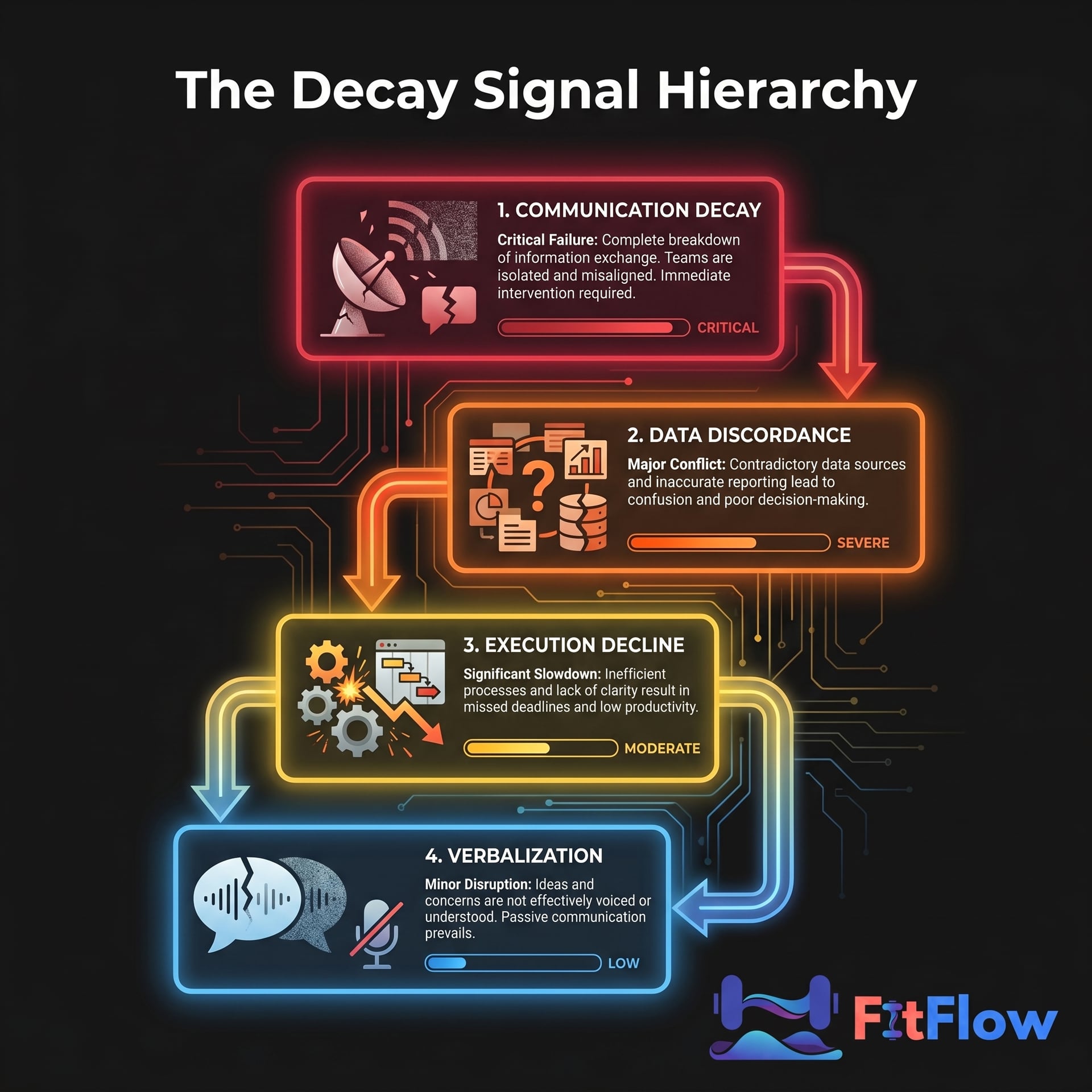
Signal 1 — Communication frequency decay (earliest, most predictive)
First thing to change: how they talk to you, not what they do in the gym. Response time goes from hours to a day, then two. Messages shrink. Emojis replace sentences.
This shows up 7-10 days before they start missing sessions. Client taking longer to respond? They're about to skip. Threshold: two late check-ins (24+ hours past normal) = Stage 2. Move now.
Signal 2 — Self-report vs. logged-data discordance
Client: "Staying on track." App: 2 of 4 workouts logged. Not lying—they're mentally averaging intentions with reality. The gap measures adherence pressure in real time.
Never frame as catching a lie. Frame as "what the data shows about the prescription." (See Truth-Surfacing Check-In.) Threshold: 20%+ gap for two weeks = Stage 3.
Signal 3 — Session execution quality decline
What happens inside the workout. Does 3 sets instead of 4. Goes lighter without reason. RPE drops, performance flat. Step count often shows it first: daily baseline drops weeks before they complain.
Threshold: two sessions with unexplained volume/intensity drop = Stage 2-3 boundary.
Signal 4 — Explicit verbalization (latest, least predictive)
"I've been so busy." "Not sure this is working." "Maybe switch things up?" When they say this out loud, you're already at Stage 3-4. If you're waiting for words, you're 4-6 weeks late.
Signal | Stage Window | Behavior | Threshold | Common Mistake |
|---|---|---|---|---|
1. Communication frequency decay | Early (Stage 2) | Slower responses, emoji replies | 2 consecutive late check-ins | Coding "they're just busy" |
2. Self-report vs. logged discordance | Mid (Stage 3) | "On track" vs <70% logged | >20% gap for 2+ weeks | Calling it out as dishonesty |
3. Session execution decline | Mid (Stage 2-3) | Volume/intensity drift | 2 sessions of unexplained drift | Adding volume or changing split |
4. Explicit doubt or busyness | Late (Stage 3-4) | "Maybe this isn't working" | Any single instance | Treating it as an early signal |
The problem isn't motivation. It's the prescription.
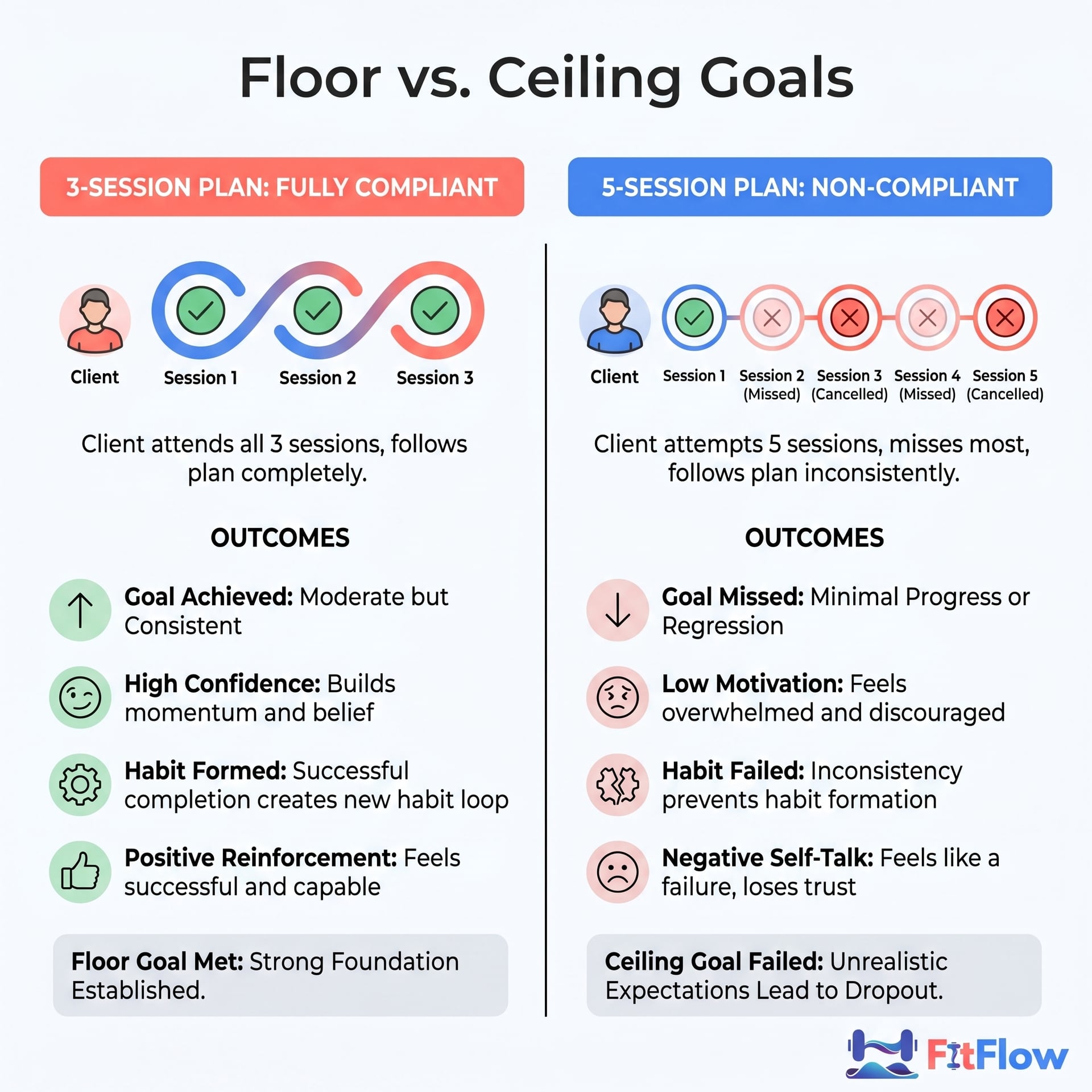
Most trainers never face this: you build adherence failure into the prescription on day one. Any client with that life would have failed. The fix: Floor vs. Ceiling Goals.
Every client has two boundaries. Ceiling: what they can do when life cooperates (vacation, no kids, easy work week). Floor: what they can hold when life hits (deadline, sick kid, travel).
Job + two kids + two years off = floor of 3 sessions, ceiling of 5. Single + remote + flexible = floor of 5, ceiling of 7.
Prescribe 5 sessions/week to the first client? You didn't ask for ceiling effort. You asked for impossible—their ceiling is 5 only on perfect weeks. Week 3 hits, life happens, boom: "non-compliant." Same client, same effort, different label. You wrote the failure in.
Fix: Floor Goal Prescription. Prescribe to their floor—the minimum that still gets results. ACSM says 2-3 sessions/week works for most people (ACSM 2026 Resistance Training Guidelines). Nutrition: 80% of days hits most goals. Not lowering standards—matching reality. Ceiling weeks become wins, not baseline.
Not "go easy on clients." Stop designing failure. Client doing 3 sessions on a 3-session plan = fully compliant. Same client doing 3 sessions on a 5-session plan = failing. Same behavior, different story. You wrote the story.
The same principle applies to nutrition. The behavioral systems that make any nutrition prescription stick cover the diet-specific version: the "perfect diet that fails" is almost always a ceiling diet given to a floor-capacity client.
Mid-read tool drop: The Floor vs. Ceiling Goal Worksheet is on page 5 of The Adherence Pattern Diagnostic Checklist. Calibrate any new client's prescription to their actual floor in under 10 minutes. Free download.
The 5-question adherence diagnostic check-in
Copy-paste these five questions into any check-in. They catch decay signals without sounding like you're calling anyone out.
Q1: "On a scale of 1-10, how well does this week's training schedule match what your life actually looked like?" Gets at schedule vs. reality gap. Two weeks of 6 or below = Stage 2.
Q2: "Of the sessions prescribed this week, how many did you complete as written — and if any were missed or modified, what got in the way?" Shows actual vs. intended, plus friction points. Below 75% with specific reason = Stage 1-2 (fixable). Below 75% with no reason = Stage 2-3. No reason is the red flag.
Q3: "When you think about next week, what's the biggest obstacle between you and executing the program?" Catches future friction. Can't name an obstacle? Either Stage 1 (actually smooth) or Stage 3 (avoiding the truth). Check against other answers.
Q4: "Is there anything about how we're currently working together that isn't feeling right?" Gets at relationship friction. Previously chatty client gives flat "no"? That's your signal. Breaks the "everything's fine" reflex.
Q5: "What's one thing you did this week that you felt genuinely good about — fitness or otherwise?" Shows emotional state. Can't name any win = Stage 3-4, no matter what logs say. Only non-fitness wins = life pressure incoming. This answer predicts the next month better than completion stats.
You've learned the 5 questions. The full Adherence Pattern Diagnostic Checklist includes these questions PLUS the 12-signal scorecard with exact thresholds, the Truth-Surfacing script for difficult conversations, and the Floor vs. Ceiling worksheet. Everything on one page for your next check-in. Download the Complete Diagnostic Kit →.
The Truth-Surfacing Check-In
Signal 2 is the hardest live conversation in coaching. A client tells you they've been "really consistent this week." Their data shows 2 of 4 workouts logged. The gap is real. The client is not consciously lying. Calling them out destroys trust. Ignoring it fails the client.
The Truth-Surfacing Check-In is the script. Structure matters more than wording.
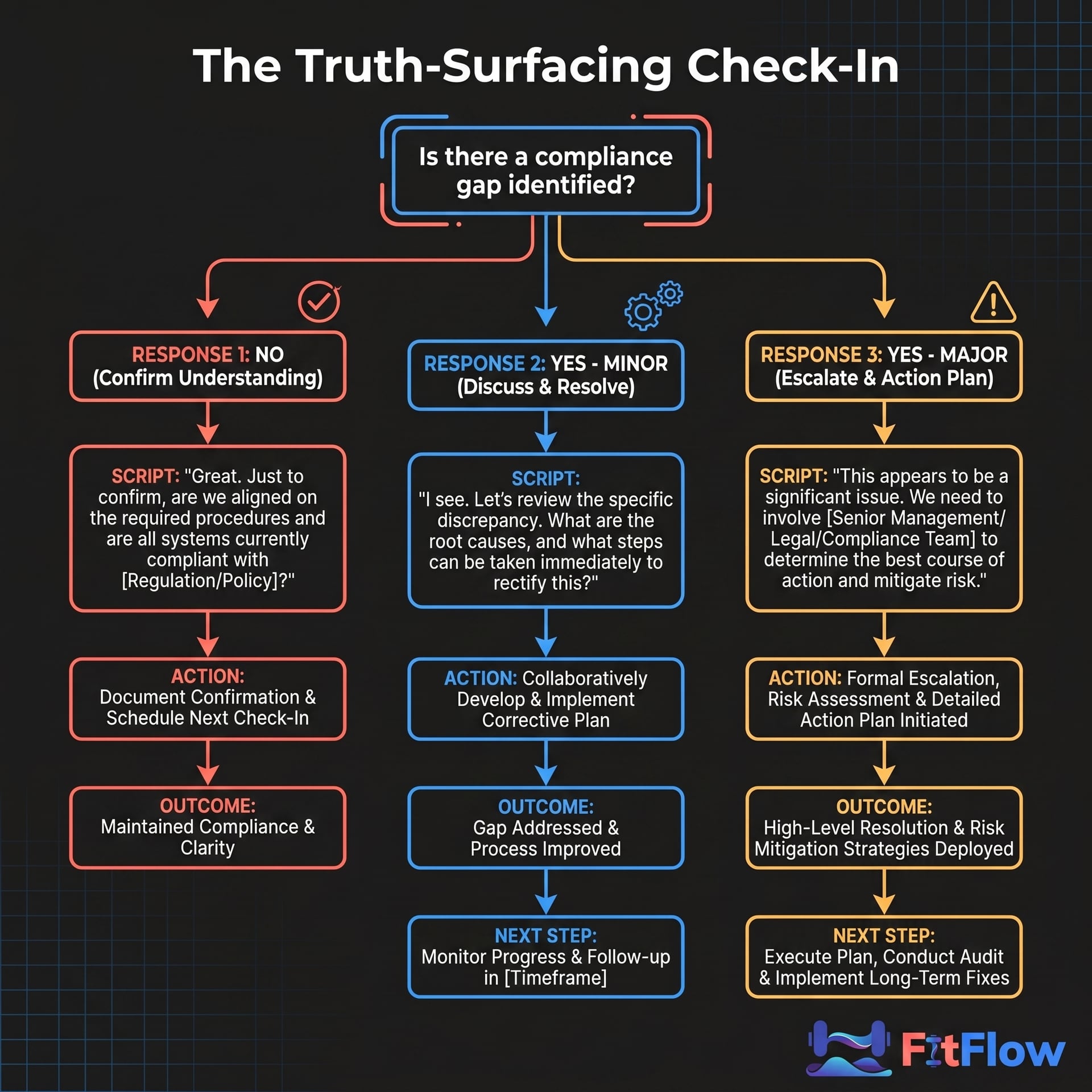
"I noticed something in your data this week that I want to understand better — not to call anything out, but because it helps me prescribe better. Your check-ins show [specific number] sessions completed, and your notes say [what they reported]. Can you help me understand what the week actually looked like? I want to make sure what I'm asking of you is realistic for your life right now."
Why this works:
"Helps me prescribe better." Frames the inquiry as the trainer's need, not the client's failure.
"What the week actually looked like." Invites narrative rather than yes/no defense.
"Realistic for your life right now." Signals that downward recalibration is acceptable, removing the shame incentive that drove the false report.
It is not accusatory. It is direct. It names the gap without calling it dishonesty.
Follow-up by response:
Client opens up about schedule pressure: recalibrate to floor goal. Document the new baseline without ceremony.
Client doubles down on "I did do it": acknowledge without argument. Add a monitoring note. Watch for Signal 2 repetition next week.
Client gets defensive: back off the data and re-anchor to the relationship. "I just want to make sure you feel supported through this" is the bridge back.
Three patterns you're confusing with training problems
Three concrete misdiagnoses this guide is designed to prevent.
Pattern 1 — The strength plateau. Looks like insufficient progressive overload. Actually is session execution decay. Client's 1RM estimates flat for 6+ weeks; default move is to add volume or change the split. Real cause: client has dropped from 4 sets to 2-3 without flagging it; skipped 1-2 sessions/week; overload cannot accumulate at 65% completion. Check: compare prescribed vs. logged sets and reps for the last 6 weeks before changing anything.
Pattern 2 — The fat loss plateau. Looks like metabolic adaptation. Actually is nutrition compliance decay. Client's weight flat for 4-6 weeks; default move is to drop calories or add cardio. Real cause: nutrition compliance has dropped from 6/7 days to 3-4/7; the client has averaged their good days into a week-level positive attribution. A deeper deficit on this foundation increases adherence pressure and accelerates Stage 4. Check: food log completeness (not content) for the last 4 weeks; tracked days vs. reported adherence. GLP-1 clients show this pattern at compressed timelines — the medication suppresses appetite and total intake drops, but the structure of eating collapses.
Once you've confirmed adherence is the bottleneck, the off-program audit routes you to the specific lifestyle variable to address first.
Pattern 3 — The motivation problem. Looks like a client mindset issue. Actually is prescription mismatch. Client seems less engaged; default move is to add accountability calls and inspirational content. Real cause: floor capacity is 3 sessions/week, prescription is 5; the "motivation problem" is the experienced friction of a systematically overloaded prescription. Motivation content here adds pressure, not support. Check: run the Floor vs. Ceiling assessment retroactively — what was this client actually executing in weeks 1-3, before they "lost motivation"?
Before you change the program, run this
The operational version of the post's thesis. A four-step decision sequence. Run it before you redesign anything.
Step 1: Pull the last 4 weeks of logged data. Session completion rate, check-in response latency, food log frequency. If completion is below 80% for 2+ weeks, this is an adherence problem. Skip to Step 2 with that mindset. If completion is at or above 80% for the full window, this may be a genuine programming plateau and Step 2 still applies.
Step 2: Run the 5-Question Adherence Diagnostic Check-In. Regardless of logged rate. Logged data shows behavior; the check-in surfaces experience. A client can have 80% completion and still be sliding into Stage 3 based on answers to Q4 and Q5. Two or more red-flag responses = address the adherence signal before touching programming.
Step 3: Identify the decay stage and route.
Stage 1-2: Floor Goal recalibration. No program change required. Most apparent stalls resolve here.
Stage 3: Truth-Surfacing Check-In. Hold the program steady. Recalibrate expectations explicitly.
Stage 4: Re-enrollment conversation. The program cannot help a withdrawn client. Re-establish the relationship before discussing any program variable.
Step 4 (only if Steps 1-3 confirm high compliance): diagnose the programming variable. At this point you've confirmed execution and the plateau is real. Proceed with the 5-domain diagnostic. Most stalls don't reach Step 4. The ones that do are the cleanest programming problems you'll ever solve, because you've eliminated the noise.
The GLP-1 context: why adherence is the only variable that matters right now
GLP-1 dropout data: 30-50% quit within 3-6 months (AJMC: GLP-1 RA Adherence Shows Drop-Off After 1 Year; Prime Therapeutics GLP-1 three-year persistence report). Meds work fine. The lifestyle part fails. You're the only one watching that part.
GLP-1 plateau = nutrition structure collapsed (Pattern 2, but faster). They eat less but randomly. Protein tanks first. Meal timing drifts. Can't lift heavy on 800 calories. NASM says it straight: your job is muscle and training adherence, not meds (NASM GLP-1 guidance).
GLP-1 training is the highest-stakes adherence game out there. "Weight loss on meds" vs "body comp with muscle" = entirely about sticking to training and protein. The diagnostic isn't optional for GLP-1 clients—it's the whole point. Meds handle hunger. You handle everything else. Recovery signals often show up first—sleep, stress, HRV tank before training does.
"GLP-1 didn't kill coaching. It showed who was actually coaching." The diagnostic is coaching.
Where this leaves you
Not philosophy. Operations. The program's rarely the problem—your ability to diagnose is. Three things for next week:
Stop changing programs without 4 weeks of data. Most "plateaus" are Stage 2-3 decay in disguise.
Watch response time before completion rates. Signal 1 gives you a week Signal 4 doesn't.
Prescribe to floor. You wrote the failure in at intake. Fix it there.
Winners the next 24 months won't have better periodization. They'll have the diagnostic baked into weekly workflow—runs itself. The check-in is the product. Program's just what's inside.
Got the system. Now make it automatic. The Adherence Pattern Diagnostic Checklist: 12-signal checklist, decay scorecard, the 5 questions, Truth-Surfacing script, Floor vs. Ceiling worksheet. Five pages. Print and use. Free.
Frequently Asked Questions
Comments